A slide showing a blue surface with waves and superposed 0s and 1s on the left, and text describing the session and details for submission:
ITS1.9/OS4.1
Machine Learning for Ocean Science
https://meetingorganizer.copernicus.org/EGU26/sessionprogramme/5869#
Session abstract:
Machine learning (ML) methods have emerged as powerful tools to tackle various challenges in ocean science, encompassing physical oceanography, biogeochemistry, and sea ice research.
This session aims to explore the application of ML methods in ocean science, with a focus on advancing our understanding and addressing key challenges in the field. Our objective is to foster discussions, share recent advancements, and explore future directions in the field of ML methods for ocean science.
A wide range of machine learning techniques can be considered including supervised learning, unsupervised learning, interpretable techniques, and physics-informed and generative models. The applications to be addressed span both observational and modeling approaches.
Observational approaches include for example:
- Identifying patterns and features in oceanic fields
- Filling observational gaps of in-situ or satellite observations
- Inferring unobserved variables or unobserved scales
- Automating quality control of data
- Modeling approaches can address (but are not restricted to):
- Designing new parameterization schemes in ocean models
- Emulating partially or completely ocean models
- Parameter tuning and model uncertainty
The session also welcomes submissions at the interface between modeling and observations, such as data assimilation, data-model fusion, or bias correction.
Researchers and practitioners working in the domain of ocean science, as well as those interested in the application of ML methods, are encouraged to attend and participate in this session.
📣 One week left!! 📣
🌊 Call for abstracts #EGU26 !!! Please consider our session:
ITS1.9/OS4.1
Machine Learning for Ocean Science
meetingorganizer.copernicus.org/EGU26/sessio...
Deadline 15 January 2026
@brajard.bsky.social @rachelfurner.bsky.social
@redouanelg.bsky.social
08.01.2026 09:23 — 👍 2 🔁 3 💬 0 📌 1
A slide showing a blue surface with waves and superposed 0s and 1s on the left, and text describing the session and details for submission:
ITS1.9/OS4.1
Machine Learning for Ocean Science
https://meetingorganizer.copernicus.org/EGU26/sessionprogramme/5869#
Session abstract:
Machine learning (ML) methods have emerged as powerful tools to tackle various challenges in ocean science, encompassing physical oceanography, biogeochemistry, and sea ice research.
This session aims to explore the application of ML methods in ocean science, with a focus on advancing our understanding and addressing key challenges in the field. Our objective is to foster discussions, share recent advancements, and explore future directions in the field of ML methods for ocean science.
A wide range of machine learning techniques can be considered including supervised learning, unsupervised learning, interpretable techniques, and physics-informed and generative models. The applications to be addressed span both observational and modeling approaches.
Observational approaches include for example:
- Identifying patterns and features in oceanic fields
- Filling observational gaps of in-situ or satellite observations
- Inferring unobserved variables or unobserved scales
- Automating quality control of data
- Modeling approaches can address (but are not restricted to):
- Designing new parameterization schemes in ocean models
- Emulating partially or completely ocean models
- Parameter tuning and model uncertainty
The session also welcomes submissions at the interface between modeling and observations, such as data assimilation, data-model fusion, or bias correction.
Researchers and practitioners working in the domain of ocean science, as well as those interested in the application of ML methods, are encouraged to attend and participate in this session.
📣 🌊 Call for abstracts #EGU26 !!! Please consider our session:
ITS1.9/OS4.1
Machine Learning for Ocean Science
meetingorganizer.copernicus.org/EGU26/abstra...
Deadline 15 January 2026 (1 December for travel grant applications) @brajard.bsky.social @rachelfurner.bsky.social @redouanelg.bsky.social
05.11.2025 09:03 — 👍 5 🔁 3 💬 0 📌 0
NB: small error in the right row of figures 8 and 9.
28.09.2025 08:38 — 👍 0 🔁 0 💬 0 📌 0
Interested in working in a world-leading and motivating research group, located in one of the most beautiful places on Earth?
12.07.2025 09:26 — 👍 0 🔁 0 💬 1 📌 0
Well done guys! But I don’t think I was part of the team 😉
16.06.2025 08:29 — 👍 0 🔁 0 💬 0 📌 0

Join our Cloud HD Video Meeting
Zoom is the leader in modern enterprise cloud communications.
The call is open to all researcher working in a French institution.
The links for the videocall:
📅 Wednesday, June 11, 2025 – 4:00 PM (Paris time)
cnrs.zoom.us/j/9818976076...
📅 Thursday, June 12, 2025 – 12:30 PM (Paris time)
univ-lille-fr.zoom.us/j/9520884409...
10.06.2025 17:31 — 👍 1 🔁 0 💬 0 📌 0
Join the PNTS committee during one of the upcoming videoconferences to ask your questions and learn more about the program:
📅 Wednesday, June 11, 2025 – 4:00 PM (Paris time)
🔗 Join via Zoom (CNRS)
📅 Thursday, June 12, 2025 – 12:30 PM (Paris time)
🔗 Join via Zoom (Lille University)
10.06.2025 17:26 — 👍 0 🔁 0 💬 1 📌 0

Appel à projets en cours - Programmes de l'INSU
L’appel à projets PNTS 2026 est ouvert sur Sigap du 1er juin 2025 au 5 septembre 2025, 17h (heure de Paris). Fichier attaché Taille Texte de l’appel à projets PNTS 2026 907 Ko Dossier scientifique PNT...
🚨 Call for Proposals – PNTS Program 🇫🇷
The PNTS (Programme National de Télédétection Spatiale) supports researchers developing algorithms and validation procedures for remote sensing data across diverse domains: ocean, atmosphere, continental surfaces, and solid Earth.
10.06.2025 17:26 — 👍 0 🔁 0 💬 1 📌 0
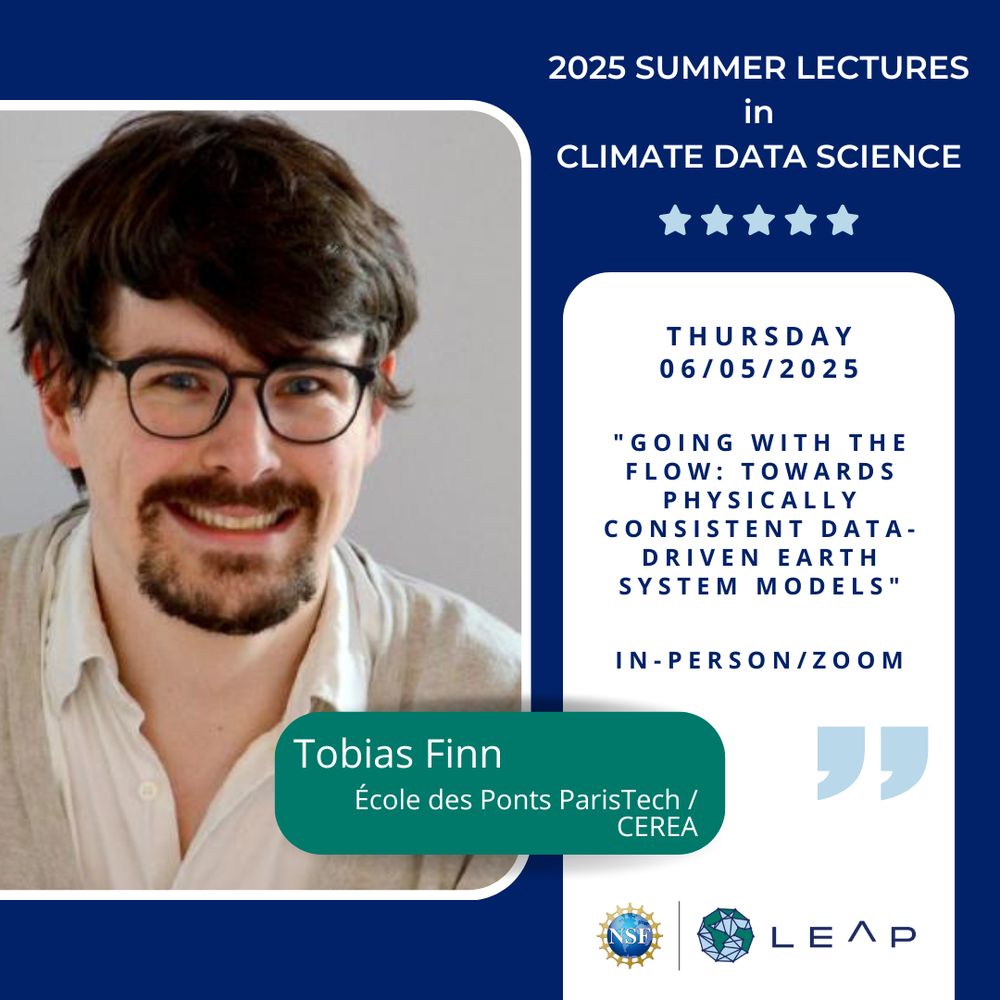
Please join us for a Summer'25 Lecture in #Climate #Data Science w/TOBIAS FINN @ecoledesponts.bsky.social!
📅 THIS THURSDAY || 6/5/25
🕛 12p EST
📍 @columbiaseas.bsky.social Innovation Hub/Zoom
💻 RSVP: www.eventbrite.com/e/1363524320...
#LEAPEducation #community #physics #climatemodel #AI #ML
03.06.2025 14:19 — 👍 4 🔁 2 💬 0 📌 0
EDS Special Collection on Connecting Data-Driven and Physical Approaches
EDS Special Collection on Connecting Data-Driven and Physical Approaches
📢 New CFP: Special Collection in EDS!
Calling for work exploring the convergence between #data-driven methodologies (#AI, #machinelearning) and physical modeling for Earth system science, building upon an upcoming workshop #EGU25 (@egu.eu).
ℹ️ How to submit: bit.ly/3Eq4WLV
📅 Deadline: 31 Oct 2025
29.04.2025 14:55 — 👍 3 🔁 1 💬 0 📌 0
And if you are looking for a venue to publish your work, please consider the following
@envdatascience.bsky.social
29.04.2025 14:55 — 👍 1 🔁 0 💬 1 📌 0
Session OS4.7
The Copernicus Marine Service and the European Digital Twin of the Ocean
Orals | Thu, 01 May, 14:00–18:00 (CEST) Room L2
Posters on site | Attendance Thu, 01 May, 10:45–12:30 (CEST)
meetingorganizer.copernicus.org/EGU25/sessio...
29.04.2025 14:55 — 👍 0 🔁 0 💬 1 📌 0
Session ITS1.2/OS4.8
Machine Learning for Ocean Science
Orals | Thu, 01 May, 08:30–12:30 (CEST), 14:00–15:45 (CEST) Room -2.41/42
Posters on site | Attendance Thu, 01 May, 16:15–18:00 (CEST)
meetingorganizer.copernicus.org/EGU25/sessio...
@rachelfurner.bsky.social @redouanelg.bsky.social @aida-alvera.bsky.social
29.04.2025 14:55 — 👍 4 🔁 1 💬 1 📌 1
If you are at EGU, you can check out those two sessions related to machine learning 🤖 and the ocean 🌊
@egu.eu #egu25
29.04.2025 14:55 — 👍 2 🔁 0 💬 1 📌 0
Ever wondered why presenting more facts can sometimes *worsen* disagreements, even among rational people? 🤔
It turns out, Bayesian reasoning has some surprising answers - no cognitive biases needed! Let's explore this fascinating paradox quickly ☺️
07.01.2025 22:25 — 👍 234 🔁 78 💬 8 📌 2

NECCTON Case Studies
NECCTON will be working in collaboration with a range of stakeholders to supporting fisheries management and biodiversity conservation through development and exploitation of NECCTON tools and product...
At the NECCTON Annual Meeting in Trieste, we unveiled co-designed case studies that are reshaping fisheries management and marine conservation. Fresh tools & ideas are setting our oceans on a new course. Learn more: neccton.eu/case-studies @copernicusmarine.bsky.social @plymouthmarine.bsky.social
06.03.2025 08:44 — 👍 5 🔁 2 💬 0 📌 0
can you please add me?
10.01.2025 09:56 — 👍 2 🔁 0 💬 1 📌 0
Climate Informatics 2025
Hosted by IBM Research Brazil at _Centro Cultural Fundação Getúlio Vargas (FGV)_ from **April 28 to 30, 2025**.
[3 days:] 📚🌍 Submit to #CI2025 and have a chance to publish in @cambridgeup.bsky.social "Environmental Data Science" #OpenAccess #Science
2025.climateinformatics.com.br
07.01.2025 12:07 — 👍 2 🔁 4 💬 0 📌 0
In this last session, we are honored to have Julie Deshayes as solicited speaker.
@rachelfurner.bsky.social @aida-alvera.bsky.social @redouanelg.bsky.social
07.01.2025 08:59 — 👍 2 🔁 3 💬 0 📌 0
Session ITS1.2/OS4.8
If you are developing or using an original machine learning algorithm for the ocean, this is where you can go: "Machine Learning for Ocean Science" meetingorganizer.copernicus.org/EGU25/sessio...
07.01.2025 08:59 — 👍 0 🔁 0 💬 1 📌 0
Session OS4.7
If you develop new products or models for the ocean, please consider the session "The Copernicus Marine Service and the European Digital Twin of the Ocean " meetingorganizer.copernicus.org/EGU25/sessio...
07.01.2025 08:59 — 👍 0 🔁 0 💬 1 📌 0
Happy New Year 2025!🌍
To start well the year, please consider submitting an abstract to EGU. #EGU25
@eurogeosciences.bsky.social
07.01.2025 08:59 — 👍 3 🔁 3 💬 1 📌 0
These diffusion models are incredibly versatile!
02.12.2024 13:23 — 👍 3 🔁 1 💬 0 📌 0
Only 3 days left to submit an abstract to the Living Planet Symposium!
29.11.2024 06:01 — 👍 3 🔁 2 💬 0 📌 0
Nice session to consider with a great team of conveners 😀
27.11.2024 15:22 — 👍 4 🔁 3 💬 0 📌 0
🌊
27.11.2024 15:19 — 👍 0 🔁 0 💬 0 📌 0

Are you interested in the links between physical modeling and machine learning? What is the potential of hybrid physics/data models?
Please consider submitting to the special issue of the "Environmental Data Science" journal
www.cambridge.org/core/journal...
@cambridgeup.bsky.social
25.11.2024 07:23 — 👍 2 🔁 0 💬 0 📌 0
Professor in Polar Oceanography at GFI, UiB & @bjerknes.bsky.social. General Arctic and Antarctic interest, and anywhere were were sea ice forms.
Environmental Data Science is an #OpenAccess journal @cambridgeup.bsky.social dedicated to the use of data science & AI to enhance our understanding of the environment.
Physicien-Climatologue, porte-parole de l'Afis, professeur au Collège de France (2024-25).
Velotaffeur et parfois alpiniste
Papa x6
Nansen Environmental and Remote Sensing Center 👉 https://nersc.no/
We conduct research on ocean, sea-ice, and atmospheric conditions in the North Atlantic and the Arctic, and study connections with global climate and environmental changes.
Mobilizing the fight for science and democracy, because Science is for everyone 🧪🌎
The hub for science activism!
Learn more ⬇️
http://linktr.ee/standupforscience
New Copernicus Capability for Trophic Ocean Networks (NECCTON). Marine research project. @HorizonEU Grant no: 101081273.
https://neccton.eu/. Sign up for E-news and updates http://bit.ly/43aHvg4
The #CopernicusMarine Service, implemented by Mercator Ocean International on behalf of the European Commission, provides data & forecasting services for marine applications and coordinates the #CopernicusCoastalHub and #CopernicusArcticHub.
PhD Student @Cambridge_Uni @BAS_News in @AI4ER_CDT studying ❄️🧊💻 supported by @MarshallScholar @Gates_Cambridge @clarehall_cam. Alum @michiganstateu.
European contribution to the Argo international programme
Political science prof. researching ⚖️law as political strategy @ Departement of Government & LawTransform, @unibergen.bsky.social
🚩Lawfare, autocratisation & resistance, human rights 🌈sexual & reproductive rights, child rights, climate, indigenous rights
Graph Nets + Physics | Visiting PhD Student at Geometric Intelligence Lab, UC Santa Barbara
🌐 https://danielholmberg.fi
Ocean/climate. Research scientist #CNRM @meteofrance working on observations from #satellites (marine heatwaves, ocean color). Cyclist enthusiastic from the Pyrénées, climate refugee in Brittany back in Toulouse
Paleoceanographer at the Department of Earth Science, University of Bergen and Bjerknes Centre for Climate Research • ocean & climate variability • past interglacials • foram enthusiast 🔬😊
Researcher at the Geophysical Institute and Bjerknes Centre for Climate Research in Bergen, Norway; Researching the Gulf Stream, overturning circulation (AMOC), and North Atlantic-Nordic Seas exchanges
Researcher at UiB and BCCR, Norway / Ocean Science / Carbon Cycle / Detection and Attribution / Tipping points
Project Leader Mountains in Motion-lab https://mountainsinmotion.w.uib.no/ 🏔️| Mountains | Biogeography | Pollen-based paleoecology | Macroecology | GIS & RS | PaleoGlaciers | Global Change Ecology | EiC at Ecography @ecography.bsky.social
A wondering and wandering scientist
Scientist, Educator, Reader, Dog-lover...
Climate scientist; ocean carbon cycle and climate solutions. Professor, University of Hawaiʻi at Mānoa; Visiting Faculty, Arizona State University. https://linktr.ee/david_ho