The region most impacted by shipping desulphurisation shows a net-flux increase more than double the global Earth's Energy Imbalance increase.
Both driven by a very strong increase in absorbed sunlight and a RELATIVE decrease in Outgoing Longwave Radiation.
19.02.2026 19:45 — 👍 62 🔁 14 💬 2 📌 0

🚨The most important graph in the world has another year of data, and it doesn't look good!🚨
NASA CERES satellites measure how much sunlight Earth absorbs and how much heat is radiated back to space.
The difference is heat accumulation, which has more than tripled!
19.02.2026 19:27 — 👍 491 🔁 322 💬 11 📌 43
#Juno will never approach Ganymede at such close distances anymore, but the @esa.int #Juice spacecraft is en route to Ganymede, and it will orbit around it. With its UV spectrograph it will acquire unprecedented views of Ganymede's auroras. So Juno's images were just an appetizer.
19.02.2026 16:51 — 👍 0 🔁 0 💬 0 📌 0

Auroral beads as seen from the International Space Station. Credit: NASA
If they are indeed the counterpart of the so-called "auroral beads" at Earth, they could be related to plasma instabilities in the magnetotail, participating to explosive reconfigurations of the magnetosphere called sub-storms.
19.02.2026 16:51 — 👍 1 🔁 0 💬 1 📌 0

Artistic views of the ultraviolet aurorae on Ganymede, based on Juno’s close-up observations from 7th July 2021. As Juno flew by Ganymede at high speed, its UV spectrograph could only acquire narrow strips, combined here to display the overall shape of the aurora (left). However, when zooming on individual strips (right), it becomes apparent that that this aurora is formed of a chain of patches rather than a uniform curtain. Similar auroral forms have been observed at Earth, as well as on other planets such as Jupiter or Saturn, suggesting that universal processes are at play. | © NASA/JPL-Caltech/SwRI/UVS/ULiège/Gusbin/Bonfond
However, when zooming on individual strips, it becomes apparent that that this aurora is formed of a chain of patches rather than a uniform curtain. Similar auroral forms have been observed at Earth, and on other planets such as Jupiter or Saturn, suggesting that universal processes are at play.
19.02.2026 16:51 — 👍 0 🔁 0 💬 1 📌 0

Artistic views of the ultraviolet auroras on Ganymede, based on Juno’s close-up observations from 7th July 2021. As Juno flew by Ganymede at high speed, its UV spectrograph could only acquire narrow strips, combined here to display the overall shape of the aurora. Credit: NASA/JPL-Caltech/SwRI/UVS/ULiège/Gusbin/Bonfond
On 7 July 2021, it was Ganymede's turn. The fly-by only lasted for ~15 minutes. Since Juno is a spinning spacecraft, its ultraviolet can only capture narrow strips across the moon, unveiling the auroras bits by bits. Combined together, they display the overall shape of the auroral ovals.
19.02.2026 16:51 — 👍 0 🔁 0 💬 1 📌 0

Artistic view of the Juno spacecraft near Jupiter. Credit: NASA
Juno is a NASA spacecraft orbiting Jupiter since 2016. Its instruments are optimized to observe Jupiter itself and reveal its inner workings, its atmosphere and its magnetosphere. However, during its extended mission, it got the opportunity to perform close-up observations of some of its moons.
19.02.2026 16:51 — 👍 0 🔁 0 💬 1 📌 0

Image of the UV auroras of Ganymede as viewed by the STIS instrument on board the Hubble Space Telescope, placed on top a visible image of Ganymede. The auroral emission are forming two ovals of UV emissions, one around each pole. The shape of these ovals, projected into the image, is materialized by dashed pink lines.
As a result from this interaction, electrons precipitate along Ganymede's magnetic field lines into the moon's thin atmosphere, forming bright auroras. Seen from the Hubble Space Telescope, these auroras form two blurry rings of light around the pole.
uni-koeln.de/sites/uni/im...
19.02.2026 16:51 — 👍 1 🔁 0 💬 1 📌 0

Artistic representation of Ganymede orbiting Jupiter and being embedded into the Jovian plasma sheet, shown in yellow. Yellow arrow represent the direction of the plasma flow. The plasma sheet is tilted relative to Ganymede's orbital plane because the plasma is constrained by the tilted magnetic field of Jupiter. Arrows going through Jupiter materialize this tilt. Credit: B. Bonfond
Ganymede is embedded into Jupiter's own magnetosphere, constantly swept by the plasma that rotates around the Giant Planet, forming a unique case of a magnetosphere inside a magnetosphere like a Russian doll.
19.02.2026 16:51 — 👍 0 🔁 0 💬 1 📌 0

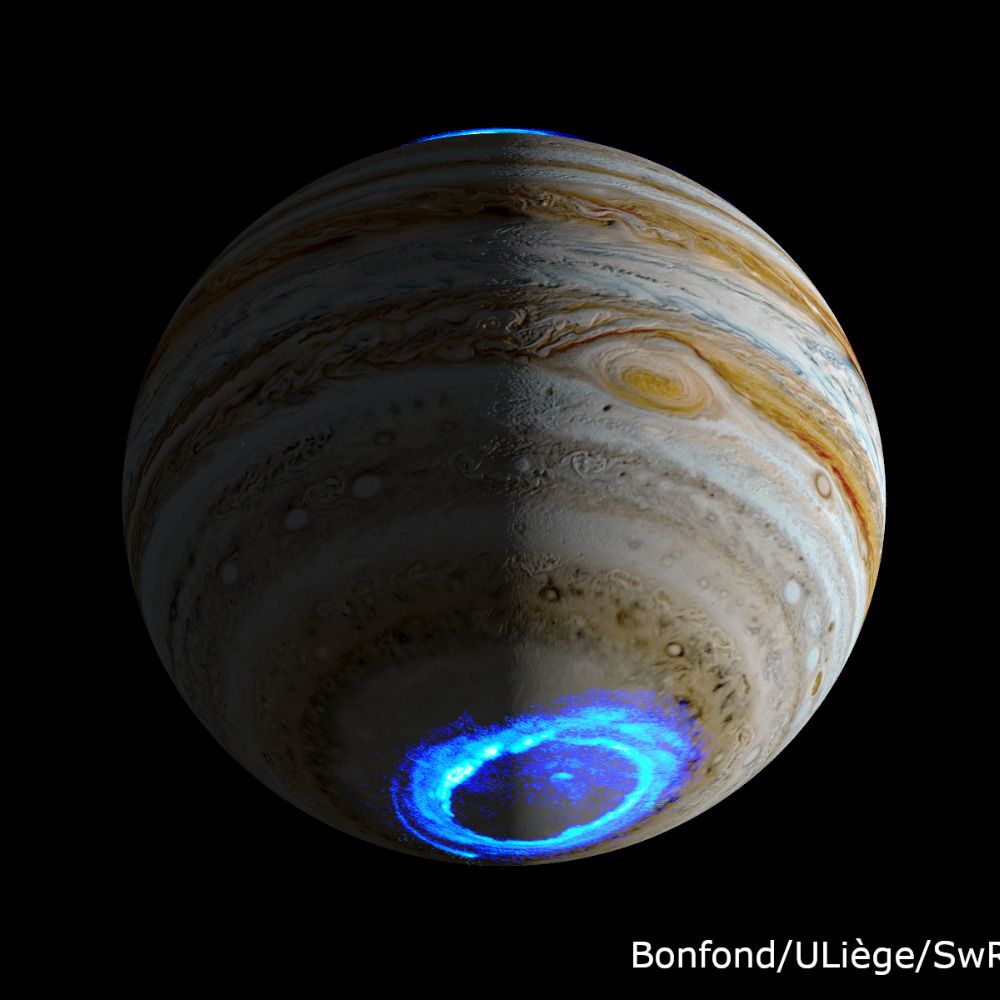
Artistic view of Jupiter, with its southern auroras shown in blue, along with its moons Io, Europa and Ganymede. The intrinsic magnetic field of Ganymede is represented by a dipolar grey shell. Credit: B. Bonfond
Ganymede is the largest moon of the Solar System (it is larger than the planet Mercury), and the only one with its intrinsic magnetic field.
19.02.2026 16:51 — 👍 0 🔁 0 💬 1 📌 0
My ancestors have been trying to solve this problem for a looooong time
18.02.2026 02:20 — 👍 65 🔁 6 💬 2 📌 0
A meteor with nice persistent ion train today at 4:27am in Crestone, Colorado USA. Full timelapse to follow.
#timelapse #astronomy #astrophotography
18.02.2026 01:24 — 👍 55 🔁 13 💬 2 📌 1

Le gouvernement Trump va donc être responsable de morts dans le monde entier…
13.02.2026 06:09 — 👍 91 🔁 53 💬 9 📌 5

🪐 Breaking News from Saturn! A new study led by Lina Hadid at Laboratory of Plasma Physics discovered that the tiny moon Enceladus has a huge impact around Saturn, trailing a wake of electromagnetic ripples over half a million kilometres 👉 Read the press release: bit.ly/tiny-enceladus
09.02.2026 14:48 — 👍 8 🔁 3 💬 1 📌 0
Watch as a massive crack forms in the ice on Lake Erie.
An impressive view captured by GOES-19 earlier on Sunday.
09.02.2026 07:07 — 👍 426 🔁 172 💬 9 📌 30

Photo du Soleil qui se lève au-dessus de l'horizon par Daniel Korona. On voit un gros groupe de taches solaires à sa surface
Somptueuse photo du Soleil et de son extraordinaire complexe de taches solaires appelé AR 4366
Ces "zones actives", comme on les appelles, sont le siège d'éruptions solaires qui, si elles sont dirigées vers la Terre, peuvent la baigner de bouffées de radiations ou d'intenses flux de particules
1/2
09.02.2026 09:53 — 👍 57 🔁 13 💬 1 📌 1
Message à Elon Musk. A regarder jusqu’au bout 😇🚀
@ericlagadec.bsky.social
06.02.2026 16:34 — 👍 619 🔁 273 💬 37 📌 19

Lunes de Jupiter : pourquoi Io est-elle si différente de sa cousine Europe ?
Io est la lune la plus volcanique du Système solaire, alors qu’Europe est un monde d’eau : comment expliquer ce contraste ? Une étude suggère qu’Io n’a jamais été aussi riche en eau que sa cousine. Né...
Io est la lune la plus volcanique du Système solaire alors qu’Europe est un monde d’eau : comment expliquer un tel contraste ? Selon une nouvelle étude, elles ne sont pas nées au même endroit. Ainsi, Io n’a jamais été aussi riche en eau que sa cousine et son destin était scellé dès sa naissance.
05.02.2026 06:44 — 👍 52 🔁 15 💬 3 📌 2
Hop on board Mars Express, for a flight over Flaugergues Crater.
Be sure to turn up the volume for the audio guide 🔊
More info, images and a map showing the route of the video 👉 www.esa.int/Science_Expl...
🔭🧪
04.02.2026 10:01 — 👍 110 🔁 28 💬 2 📌 7

Un sourcier marchant vers le photographe avec une baguette de bois en forme de Y
Les sourciers affirment détecter de l'eau souterraine au moyen de différents dispositifs (baguettes, pendule...)
Loin d'être cantonnés à des activités traditionnelles, on apprend en 2024 que certaines préfectures rendent leur passage obligatoire dans le cadre de grands travaux.
Fil à dérouler ⬇️⬇️⬇️
03.02.2026 17:32 — 👍 740 🔁 396 💬 26 📌 37

[NOUVELLE VIDÉO !!!] Pourquoi Les Revues du Monde se trompe (cas d’école des travers des sciences sociales)
https://www.youtube.com/watch?v=3dJPhT3fUTY
Points-clés :👀⬇️
#dégoût #beauté #subjectivité
03.02.2026 14:19 — 👍 43 🔁 13 💬 1 📌 4
27.01.2026 10:14 — 👍 10 🔁 2 💬 1 📌 0

A big ball that is mostly yellow is shown. The ball has many circular and irregular regions that are different colors, typically brown or olive green. Please see the explanation for more detailed information.
🔭 Io in True Color
Image Credit: NASA, JPL, Galileo Project
apod.nasa.gov/apod/ap26012...
20.01.2026 08:00 — 👍 181 🔁 41 💬 6 📌 11
Lors de sa mise en route (il n'est pas encore pleinement opérationnel) le gigantesque télescope terrestre Vera Rubin a, en quelques nuits, découvert 2 104 nouveaux astéroïdes !!!
(dont 7 géocroiseurs, 11 astéroïdes troyens de Jupiter et 9 astéroïdes transneptuniens)
noirlab.edu/public/video...
23.01.2026 09:04 — 👍 139 🔁 36 💬 11 📌 0
Climate scientists are also obsessed with Greenland, not because of the Mercator projection, but because the melting of the Greenland ice sheet is going to raise sea levels significantly, change ocean circulation, and be generally very bad for humanity.
21.01.2026 20:04 — 👍 727 🔁 203 💬 11 📌 6
Ever wondered what powers a solar flare? 💥
Solar Orbiter is finally giving us answers to this long-standing mystery.
The mission caught a 'magnetic avalanche' on the surface of the Sun just before a flare was released.
🔭🧪1/3
21.01.2026 08:16 — 👍 290 🔁 74 💬 2 📌 14

La physique cachée de Van Gogh remise en question
Une étude très médiatisée affirmait que La Nuit étoilée de Van Gogh représentait fidèlement un phénomène de turbulence. Depuis, plusieurs travaux ont remis en cause cette interprétation. Une controver...
Dans La Nuit étoilée, Van Gogh avait-il représenté fidèlement la "turbulence" ? C’est ce qu’avançait une étude médiatisée dont plusieurs travaux remettent aujourd’hui en cause les résultats. Au-delà d’un simple désaccord méthodologique, cette histoire révèle une entrave au débat scientifique.
21.01.2026 06:46 — 👍 51 🔁 19 💬 7 📌 2
Images from NASA's Juno probe, processed by citizen scientists. Credits in text, descriptions in alt. Inspired by the late Bits of Pluto Twitter account. Trans rights!
NOT affiliated with NASA/JPL/SwRI/MSSS.
Maintained by @gustavo-bc.bsky.social
▪️ GĖOPOLITIQUE >> 🌍 (focus 🇺🇦 🇷🇺 🇪🇺 🇺🇸 🇵🇸 🇮🇱 🇦🇷 🇹🇬)
▪️ ACTUS >> Vie publique 🏛️ 🇫🇷 | Numérique 💻 | Nature 🌳 | #Nantes 📍
▪️ DÉTENTE >> 🪶 📷 🎸 🚲
i write the data-driven politics newsletter Strength In Numbers: gelliottmorris.com/subscribe
wrote a book by the same name wwnorton.com/books/Strength-in-Numbers
polling averages at @fiftyplusone.news
formerly @ 538 & The Economist. email, don't DM, me
Douteur en Ronds, Sceptique bien entouré
https://linktr.ee/romeunierEBBH
Accessoirement Délégué Général de l'Afis - mais les bêtises sur ce compte n'engagent que les petits rondshommes.
Producteur du Collimateur, le podcast consacré à la Défense et aux conflits armés.
Agrégé-docteur en histoire, prof (en pause).
https://lnk.to/lecollimateur
Président autoproclamé du circuit de Spa Francorchamps. Président du parti PMR. Ancien para commando. Invalide suite au contact rapproché de mon zizi avec une barre, j'ai un faible pour les Merdeces et un tempérament bagarreur.
Peut-être parodique.
On veut des chips, tant qu'il y aura des chips.
team @graffitivre
PP par @Grillaum
@suave_morbida@piaille.fr
Canadian Artist & Experimental Poet-
#sedserio #QuantumPoetry #forensicPoetry https://sedserio.com Critical AI—Forensic Poet 🇨🇦
EU High Representative for Foreign Affairs and Security Policy
Vice-President of the European Commission
Planetary Scientist @MSU www.planetarymakerspace.org
Planetary scientist @iaacsic.bsky.social, working on @esa.int's Rosetta & @cometinterceptor.bsky.social. Prev @TU-Braunschweig.de, @LAM, @QMUL 🇬🇧🇪🇸🇪🇺
https://sites.google.com/view/nickattree
ORCID: 0000-0003-3344-6693
Associate Professor of Experimental Physics at the @unibe.ch
Co-I of ESA's Comet Interceptor, collaborator on NASA's Lucy and ESA's Rosetta missions.
www.spaceMarschall.net
(he/him)🇨🇭🇺🇸🇫🇷
#asteroids #comets #protoplanetarydisks #planetaryScience 🧪🔭🚀🛰️☄️
Assistant Prof. at @api.uva.nl in Amsterdam | Astrochemistry | Carbon Molecules & Dust | Titan | Interdisciplinary Education | #EDI | WiF board @wif.bsky.nl | #OpenScience | Working Mum | Lazy Runner | opinions my own
Matrix is an open network for secure, decentralised communication. Please support at matrix.org/support
Staff writer at The New Yorker. (Currently on leave working on a book about MAHA.)
Clare_malone@newyorker.com
Astrophysicist. Research Associate FNRS, Associate Professor ULiège. Mom of 3. Verviétoise
Planetary scientist and Professor at the Université de Liège.
Grey is just dark white
professional astronomer at ULiège • exoplanet imaging, infrared instrumentation, image processing, machine learning