Perceptions of US party ideology are not shaped by elites in Congress.
In POQ, Warner uncovers that, as voters have sorted ideologically by party, they now also see the parties as more distinct—and extreme—than they would based on policy alone.
Read now: doi.org/10.1093/poq/...
29.01.2026 19:05 — 👍 5 🔁 3 💬 1 📌 0


Support for financial restitution after police violence differs.
In POQ, Israel-Trummel & Streeter uncover that, regardless of race-gender identity, Black respondents are significantly more likely to say the detainee deserves restitution.
Read now: doi.org/10.1093/poq/...
27.01.2026 17:40 — 👍 3 🔁 3 💬 0 📌 0


Voters want a justice system that is less cruel.
In POQ, Yogev finds that progressive politicians, such as DAs, are perceived as abandoning accountability for offenses like shoplifting and drug usage, they invite a political backlash.
Read now: doi.org/10.1093/poq/...
23.01.2026 22:06 — 👍 6 🔁 3 💬 0 📌 0


What shapes public support for military withdrawals?
In POQ, Silverman & Fealing show that framing effects by pollsters can seriously distort public opinion about ending wars and "going home."
Read now: doi.org/10.1093/poq/...
21.01.2026 18:15 — 👍 12 🔁 6 💬 1 📌 0


Does expertise affect conservatives' authoritarian predisposition?
Federico et al. find a correlation between conservatives' ability to match psychological needs with political positions, i.e., expertise, and authoritarian predisposition.
Read more: doi.org/10.1093/poq/...
15.01.2026 17:21 — 👍 9 🔁 9 💬 0 📌 0


Does news about a more diverse Congress change how Americans see democracy?
In POQ, Olson et al. find that diversity boosts Democrats’ trust in Congress, has no effect on Republicans, and does not weaken support for democratic norms.
Read now: doi.org/10.1093/poq/...
13.01.2026 17:58 — 👍 10 🔁 6 💬 1 📌 0

Partisanship has positive and negative contributions to representative democracies.
In POQ, Kasper & Bakker review Bankert's book, which explores how we can amplify the positive impacts while mitigating the negative ones.
Read now: doi.org/10.1093/poq/...
17.12.2025 22:14 — 👍 3 🔁 4 💬 1 📌 0

How does the gender of an interviewer affect responses?
Jones & Mitchell test interviewer gender effects and find that men provide desirable political responses to men interviewers, and provide desirable social responses to female interviewers.
Read now: doi.org/10.1093/poq/...
12.12.2025 21:53 — 👍 6 🔁 1 💬 0 📌 0

Weren't able to attend the @aapor.bsky.social conference this year?
In POQ, Kreuter's presidential address discusses how AI will transform polls, surveys, and the measurement of public opinion.
Read now: doi.org/10.1093/poq/...
09.12.2025 22:28 — 👍 4 🔁 2 💬 0 📌 0


Chinese citizens largely internalize regime narratives.
In POQ, Han et al. offer an alternative survey method for studying public opinion, using word association to examine Chinese citizens’ attitudes toward the Chinese Communist Party (CCP).
Read now: doi.org/10.1093/poq/...
05.12.2025 17:53 — 👍 6 🔁 2 💬 1 📌 0
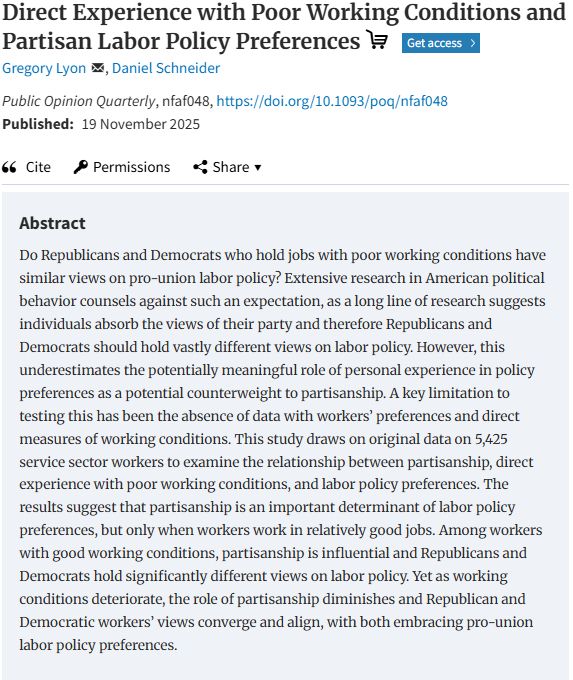

Democrats and Republicans who both toil in bad jobs see their labor policy preferences align.
In POQ, Lyon & Schneider explore how working conditions affect views on labor policy. As working conditions deteriorate, partisanship decreases.
Read now: doi.org/10.1093/poq/...
04.12.2025 19:28 — 👍 9 🔁 4 💬 0 📌 0
Got a great paper on how AI is reshaping public opinion research? Submit it to POQ's special issue on Artificial Intelligence and the Future of Survey Research!
Papers are being reviewed and accepted on a rolling basis starting now – full details here: s3-us-west-2.amazonaws.com/clarivate-sc...
03.12.2025 18:16 — 👍 3 🔁 3 💬 1 📌 0


Why do some union members vote Republican?
In POQ, Macdonald analyzes how workplace political discussion affects voting behavior among union members. More frequent workplace political discussion is associated with union members voting Democrat.
Read now: doi.org/10.1093/poq/...
21.11.2025 22:26 — 👍 11 🔁 5 💬 0 📌 1

Does Congress listen to public opinion and advocacy?
In POQ, Grossman reviews Burstein’s book on American Public Opinion, Advocacy, and Policy in Congress. Burstein’s findings show that the public and media are seldom influential in Congress.
Read more: doi.org/10.1093/poq/...
19.11.2025 21:49 — 👍 2 🔁 1 💬 1 📌 0


Autocratization is not isolated within country borders.
In POQ, Chan argues that an authoritarian's electoral success abroad can shatter democratic norms and demonstrate the viability of authoritarianism.
Read more: doi.org/10.1093/poq/...
14.11.2025 17:51 — 👍 11 🔁 4 💬 1 📌 0


Are Americans less welcoming to immigrants seeking economic opportunity?
New in POQ, Pangakis dispels the common view that Americans are more supportive of people immigrating to flee violence than economic migrants.
Read now: doi.org/10.1093/poq/...
13.11.2025 16:09 — 👍 1 🔁 1 💬 0 📌 0

Public opinion sometimes seems much larger than typical news audiences.
New in POQ, Peterson reviews Taylor Carlson's book, which puts potential opinion leaders and their ability to convey information in the spotlight.
Read now: doi.org/10.1093/poq/...
07.11.2025 20:17 — 👍 4 🔁 2 💬 0 📌 0
Got a great paper on how AI is reshaping public opinion research? Submit it to POQ's special issue on Artificial Intelligence and the Future of Survey Research!
Papers are being reviewed and accepted on a rolling basis starting now – full details here: s3-us-west-2.amazonaws.com/clarivate-sc...
05.11.2025 22:28 — 👍 6 🔁 3 💬 1 📌 0

Tonight is not New York City's first impactful three-way race.
Though it was not a mayoral election, the 1948 presidential election, between Truman, Dewey, and Wallace, saw a dramatic last-minute swing.
Read more: doi.org/10.1086/266073
04.11.2025 23:13 — 👍 3 🔁 2 💬 0 📌 0


Why does a significant minority of the Latinix community support restrictive immigration policies?
In POQ, Hickel et al. find that negative stereotypes of immigrants are a motivating force electorally among the Latinx community.
Read more: doi.org/10.1093/poq/...
28.10.2025 20:15 — 👍 5 🔁 1 💬 0 📌 0


Does health anxiety persist longer than economic anxiety?
In POQ, Henderson and Oden explore COVID-19’s impact on the duration of anxiety and how its persistence translates into political attitudes.
Read more: doi.org/10.1093/poq/...
15.10.2025 21:19 — 👍 1 🔁 1 💬 0 📌 0


How does the perception of “electability” influence Democratic primary voters' behaviors?
In POQ, Green et al. discern differences in candidate preference and perceived electability among 2020 Democratic primary voters.
Read more: doi.org/10.1093/poq/...
10.10.2025 17:14 — 👍 4 🔁 5 💬 0 📌 0

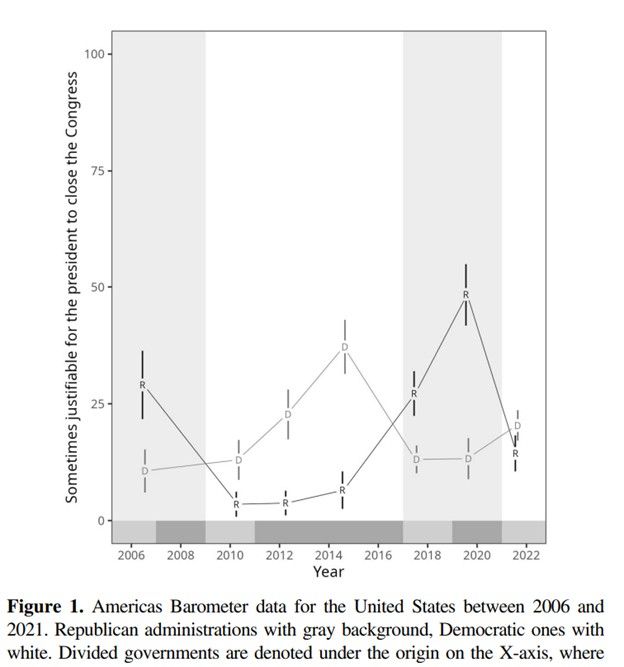
Tolerance for norm violations is bipartisan, depending on who’s president.
Littvay et al. show that while Republicans are more lenient of their president eroding norms, Democrats’ tolerance increases when they hold the presidency.
Read more: doi.org/10.1093/poq/...
06.10.2025 16:43 — 👍 2 🔁 2 💬 0 📌 0
Assistant Professor at the University of Houston researching media and politics.
allisonarcher.com
art & architectural historian / visual, material & religious culture
Political scientist studying American law and courts, state politics, and southern politics | Coonhound dad | Southern highlander | https://davidhughesphd.com/
Postdoc at University of Warsaw's Center for Excellence in Social Science studying political communication.
Other interests include: anonymity and identity online
My research: https://scholar.google.com/citations?user=Ua7qrSYAAAAJ
🏳️⚧️she/her
Senior Lecturer l University of Haifa
Political behavior, electoral politics, generational gaps, gender and politics, Israeli politics
https://liran.harsgor.com/
Political scientist at the University of Essex. Parties, voters, institutions, and representation. www.roizur.com
Postdoc, Institute of Political Science, Academia Sinica, Taiwan | political sociology, social inequality, comparative welfare states, comparative authoritarianism, quantitative methods | Website: https://www.laidingyi.com/
assoc prof pol sci #Northeastern; pol econ; STS; internatl regulation & governance; envtl justice; micro & nano plastics; #PlasticsTreaty, funk nite & karaoke queen; fiber arts; neurodiverse; mother of 2 kids & dog
Assistant Professor of Political Science at Carnegie Mellon Institute for Strategy & Technology (CMIST)
Ohio State PhD. International Security, Political Psychology, Middle East Politics
Opinions my own, don’t reflect employer, etc.
Researcher, likes data, graphs, infographics and telling stories with data. PhD in political analysis from Sussex uni - like all social science subjects. Mainly post about political analysis and my research within the Hastings & Rye area. Fabian member.
Political Science Professor @CSUN. Studies Latina/o politics, racial and ethnic politics, and immigration/detention. Likes to ride bikes.
Academic Bio: https://sites.google.com/view/jasonlmorinphd/home
Postdoctoral researcher, University of Helsinki.
political discourse | crisis communication | corpus linguistics | CADS
Nuoren tutkijan elämää -blogi (jenniraikkonen.fi)
Pic: Jonne Renvall
Asst Prof @ Santa Clara. Asian Am politics.
vivienleung.info
Researcher @ www.ics.ulisboa.pt. Formerly UNIL & UniLuzern. PhD. Social & Political Sciences from EUI. Elections, voting behavior, personalization, polarization
Associate Director, Carl Albert Center, University of Oklahoma // Political Scientist // Student of Congress
Associate Professor in Health Sciences at California State University Channel Islands. Medical sociologist & gerontologist. Focused on community-engaged work addressing well-being & equity among older adults and LGBTQIA+. Occasional film essayist. (he/him)
Writing a history of civil disobedience and the autobiography of my mother | https://eraldosouzadossantos.com/
Applied and translational sensory scientist. https://ttpphd.com
https://mastodon.social/@ttpphd
PFP: Sculpture of a distorted face and neck
Assoc prof @UDelaware | social neuroscientist interested "us vs them" and "human vs AI" | Mexican, Indigenous, Japanese First Gen | #UDPBS | @UDPOSCIR | 🧠
https://www.ifsnlab.org/