💻 Who actually wants “digitalisation”?
Alexander Kuo, @retobuergisser.bsky.social, @ainagallego.bsky.social, @siljahausermann.bsky.social survey five EU countries and find a clear mainstream-populist divide in support for digitalisation policies 👇
🔗 www.tandfonline.com/doi/full/10....
29.01.2026 18:15 — 👍 9 🔁 5 💬 0 📌 0

How Many People Use Voting Advice Applications? Survey Evidence From 15 Democracies Worldwide | Short Note | Politics and Governance
Diego Garzia, Frederico Ferreira da Silva
New article: "How Many People Use Voting Advice Applications? Survey Evidence From 15 Democracies Worldwide", in Politics and Governance (@CogitatioPaG) Download it for free here: www.cogitatiopress.com/politicsandg... #OpenAccess
30.01.2026 11:14 — 👍 0 🔁 0 💬 0 📌 0
maps.app.goo.gl/VxvFQSfbKudg...
16.01.2026 20:57 — 👍 1 🔁 0 💬 0 📌 0
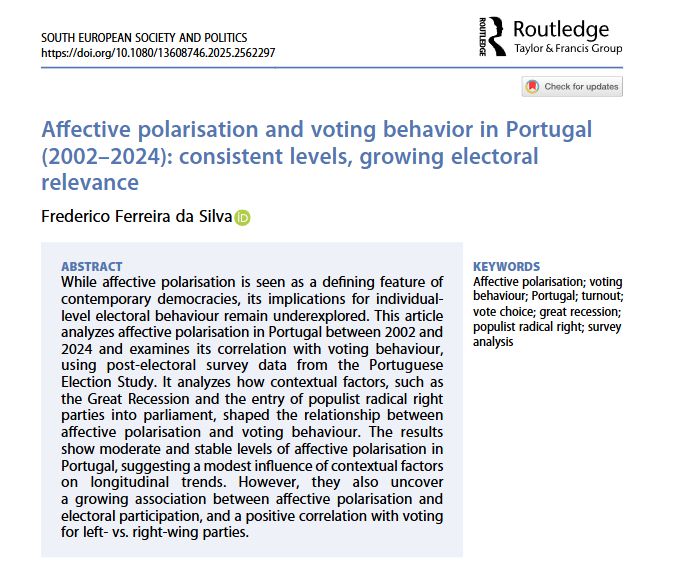
Assim, embora a polarização afetiva em Portugal não tenha vindo a aumentar, tem-se tornado mais relevante para a explicação do comportamento eleitoral dos portugueses.
06.10.2025 09:04 — 👍 0 🔁 0 💬 0 📌 0

Contudo, ao longo deste período, a correlação entre polarização afetiva e participação eleitoral aumentou significativamente ao longo das últimas duas décadas. Há ainda uma relação assimétrica com o sentido do voto, que beneficia sobretudo os partidos de esquerda.
06.10.2025 09:04 — 👍 0 🔁 0 💬 1 📌 0

Sympathy for Chega: 2022 (dark grey) and 2024 (light grey).
O crescimento do Chega na eleição de 2024, paradoxalmente, não contribuiu para um aumento da polarização afetiva. Mais votos significam avaliações mais positivas e por um maior número de eleitores. A normalização retira-lhe potencial de antagonismo entre o eleitorado.
06.10.2025 09:04 — 👍 0 🔁 0 💬 1 📌 0

A análise confirma o carácter moderado e estável da polarização afetiva em Portugal. Acontecimentos recentes como a Grande Recessão e as mudanças importantes no sistema partidário português não parecem ter tido um impacto significativo nos níveis de polarização afetiva.
06.10.2025 09:04 — 👍 0 🔁 0 💬 1 📌 0
Este antagonismo não reflete apenas diferenças ideológicas, mas uma divisão emocional entre grupos políticos, em que opositores são vistos como membros de um grupo externo, com desconfiança, antipatia e hostilidade.
06.10.2025 09:04 — 👍 0 🔁 0 💬 1 📌 0
Polarização afetiva é a tendência para os eleitores desenvolverem sentimentos positivos em relação aos partidos e negativos em relação aos rivais.
06.10.2025 09:04 — 👍 0 🔁 0 💬 1 📌 0
Inquérito pós-eleitoral para as eleições de 2025
O CEP - Comportamento Eleitoral Português - Programa de Estudo inserido no PASSDA, acaba de publicar os resultados de um grande inquérito pós-eleitoral para as eleições de 2025. O inquérito, conduzido...
O Estudo Eleitoral Português 2025, coordenado por mim, com o @fredericofs.bsky.social e a Ana Espírito Santo está aí. Este fim de semana o @jornalexpresso.bsky.social noticiou. O relatório está acessível no site do @ics-ulisboa.bsky.social aqui www.ics.ulisboa.pt/noticia/inqu... Segue fio:1/7
07.09.2025 18:39 — 👍 14 🔁 2 💬 1 📌 0

Ripping the public apart? Politicians’ dark personality and affective polarization
ALESSANDRO NAI, FREDERICO FERREIRA DA SILVA, LOES AALDERING, KATJANA GATTERMANN, DIEGO GARZIA
🌅📙 64.3
Do narcissistic leaders fuel political division? 🧠📊
These authors (🧵⬇️) find that when voters feel close to a leader with dark traits they become more polarized, disliking opposing parties even more. #AffectivePolarization #PoliticalPsychology
🔗https://buff.ly/ptbrrU6
29.08.2025 11:02 — 👍 10 🔁 7 💬 2 📌 0
Another shoutout to our latest @poqjournal.bsky.social !
17.06.2025 14:13 — 👍 3 🔁 0 💬 0 📌 0

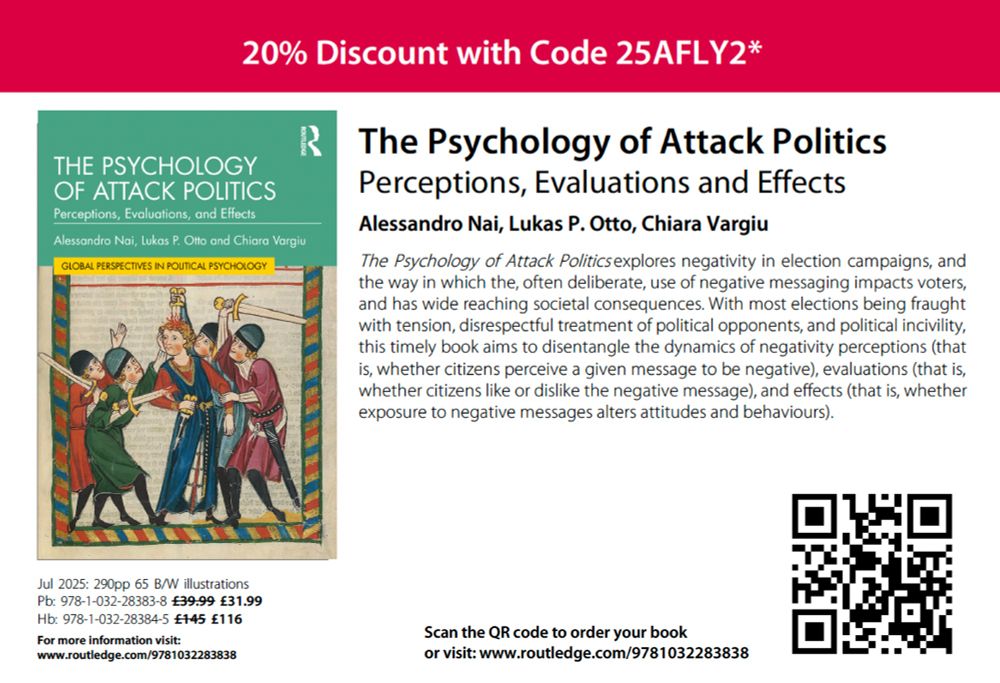
Our new book THE PSYCHOLOGY OF ATTACK POLITICS is out next month! 🔥📚
We offer a new look at negativity effects, via perceptions & evaluations🤔😱👿🤣
You can pre-order it with a nice 20% discount on the cover price (for paperbacks this makes it £32 or so)
Check out discount code & link in the flyer 👇
16.06.2025 10:39 — 👍 39 🔁 8 💬 1 📌 2

2 PhD positions in Electoral behavior
2 PhD positions to research how social group memberships become connected to vote choices
I'm recruiting 2 PhD researchers to work with me on a project studying how social groups influence vote choices!
Info on the position and how to apply 👉 www.kuleuven.be/personeel/jo...
Please share with interested students who would like to move to beautiful Leuven!
03.06.2025 07:35 — 👍 80 🔁 91 💬 1 📌 3
This paper has been a longtime favourite of Diego and I. We are really thrilled that it found such a great home in @poqjournal.bsky.social!
03.06.2025 08:22 — 👍 0 🔁 0 💬 0 📌 0
Whether polarization is high/low only tells part of the story; the extent to which such polarization is characterized by a disproportionate degree of affect/disaffect may entail distinct socio-political implications. The two aspects are complementary.
03.06.2025 08:22 — 👍 1 🔁 0 💬 1 📌 0
While citizens may not be more polarized than before in most Western democracies, contemporary AP is more heavily characterized by a disproportionate weight of out-group dislike. Even if polarization didn't increase everywhere, it became more negatively driven in many countries.
03.06.2025 08:22 — 👍 0 🔁 0 💬 1 📌 0

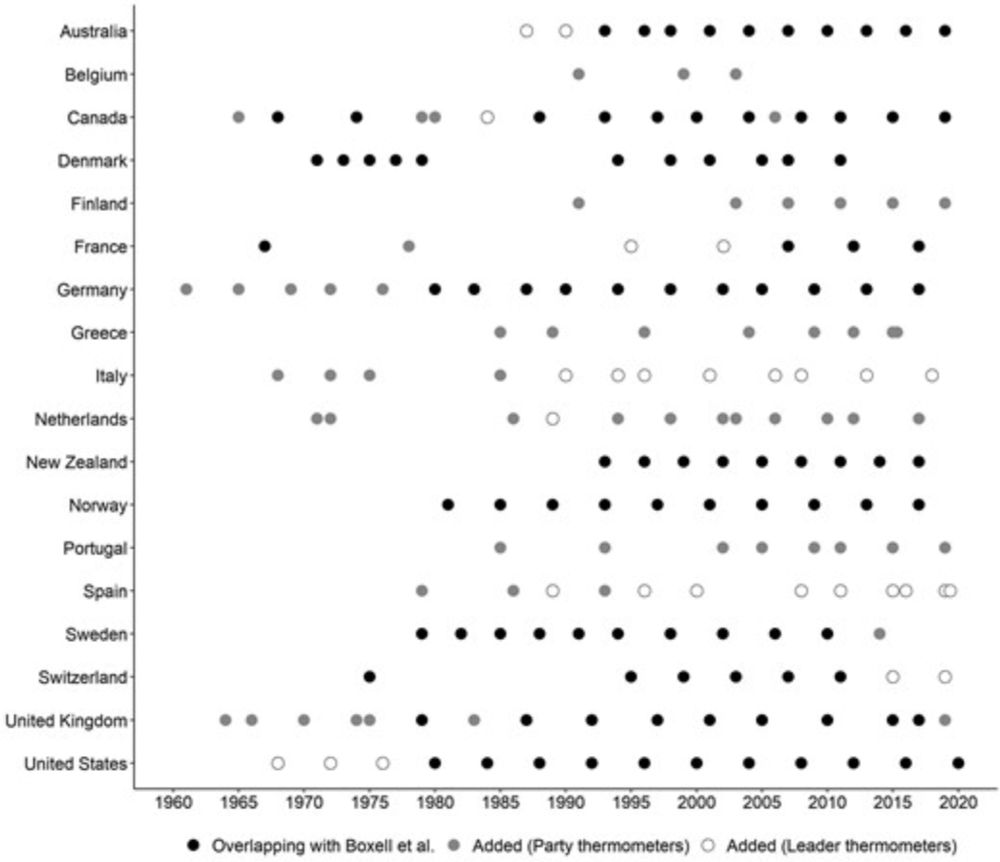
The difference between these two components yields a measure of polarity of affect. Our results show a pattern of increasing negativity of AP across 10 of the 12 countries. In recent elections in Canada, Greece, Italy, Spain, the UK, and the US, the weight of out-party hate trumps in-party love.
03.06.2025 08:22 — 👍 0 🔁 0 💬 1 📌 0
The results confirm a stronger relative importance of out-party hate vis-à-vis in-party love over time. Recently, values of out-party hate tend to approach values of in-party love. In Greece, Italy, Spain, and the United States, out-party hate has actually become a stronger force than in-party love
03.06.2025 08:22 — 👍 0 🔁 0 💬 1 📌 0

This becomes more evident through the measures of in-party love and out-party hate (Finkel et al. 2020), that we adapted to multi-party systems. These measures center the degree of in-/out-party affect around the mid-point of the thermometer, to capture their relative strength.
03.06.2025 08:22 — 👍 0 🔁 0 💬 1 📌 0
In this article, we try to address this puzzle by disaggregating AP indexes into its two constitutive terms: in-party and out-party (dis)affect. While both tend to decrease over time, the decline in out-party affect is significantly more pronounced.
03.06.2025 08:22 — 👍 0 🔁 0 💬 1 📌 0

Franklin University Switzerland hiring Post-doctoral Researcher in Sorengo, Ticino, Switzerland | LinkedIn
Posted 7:05:23 AM. Franklin University Switzerland…See this and similar jobs on LinkedIn.
🎓 Would you like to be a Postdoc at an American university on a research grant that won't be canceled?
📍 Join me at Franklin University Switzerland!
🧠 4-year fully-funded position in my SNF project DIVIDE
🔬 ≥80% working time on research
💰 ≈90k CHF annually
👉 Check: www.linkedin.com/jobs/view/42...
06.05.2025 07:03 — 👍 13 🔁 10 💬 0 📌 4

Postdoctoral Research Associate - EU Forscher*in - (salary level E 13 TV-L, 100 %)
#jobs 🚨🚨🚨
4 postdocs in Münster:
stellen.uni-muenster.de/jobposting/5...
I‘m involved in one appointment. More details will follow soon!
14.05.2025 18:43 — 👍 38 🔁 36 💬 1 📌 2
Nice piece on our article on affective polarisation and the dark personality of leaders, w @kgattermann.bsky.social @fredericofs.bsky.social Diego Garzia, Loes Aaldering
TLDR: dark traits of in-party leaders associated with higher affective polarisation in their (closest) followers
05.05.2025 06:47 — 👍 25 🔁 11 💬 2 📌 0
@areiljan.bsky.social
04.05.2025 19:07 — 👍 5 🔁 0 💬 0 📌 0
🚨3-Year Postdoc Position in Zurich @ipz.bsky.social
❓Political implications of labor market transformation
Plenty of flexibility, no teaching obligations, great research environment in an highly livable city.
Deadline: May 18, 2025.
tinyurl.com/postdoczurich
#polisky #poliscijobs #psjminfo
30.04.2025 12:27 — 👍 88 🔁 81 💬 2 📌 8
Professor of Political Science, University of Calgary https://lucasjacklucas.github.io/ | Co-Director, Canadian Municipal Barometer http://www.cmb-bmc.ca
JEPP is a flagship journal covering public policy, Europ. politics & the EU | Edited by B.Rittberger | https://www.tandfonline.com/journals/rjpp20 | https://www.linkedin.com/company/jepp/ | https://www.facebook.com/profile.php?id=61573881511255
Compte du Département de science politique de l'Université libre de Bruxelles / Account of the Department of Political Science of the Université libre de Bruxelles
Expert analysis of political data and global government developments from European Consortium for Political Research (ECPR). Listen to the latest election commentary on our podcast: http://bit.ly/3s4kgYj
political scientist at UAB | gricoc.github.io
Exploring the future of journalism
📬Join our newsletter: https://politics.us4.list-manage.com/subscribe?u=60081b78294f9bbf995e9bcf8&id=0a8e38824f
🕵🏾♀️ Send a confidencial tip https://reutersinstitute.politics.ox.ac.uk/do-you-have-confidential-tip-share-it-us
An academic collaboration between University of Reading, London School of Economics, and University of Southampton, designed to advance the research, teaching, and practice of public opinion and political behaviour measurement and analysis
poal.co.uk
Official account of South European Society and Politics, a leading journal for scholars interested in Southern Europe. Edited by Nicolò Conti and Bonnie Field.
https://www.tandfonline.com/toc/fses20/current
Political Scientist at @ForumMIDEM, @TUDresden. PhD @EUI. Research on the far right, migration, political parties, memory politics, Portuguese and Spanish politics. Based in 🇩🇪, with a heart in 🇵🇹 & 🇮🇹.
Professor of Political Science (https://ignacio-lago.owlstown.net/)
29. Consumidor nativo de rojões e sarrabulho (minhoto expatriado na capital).
Jornalista Renascença @rr.pt @sondagemsondagens.rr.pt
Coligação F1-comboios tem maioria absoluta.
Criar esta conta fez-me sentir em 2009.
Ambassador, Permanent Representative of Portugal to the United Nations in New York. Previously Political Director. Usual caveats apply.
Research Professor, Institute of Social Science, University of Lisbon, and media commentator. Comparative Authoritarianism and fascism, political elites, democratization. Latest book The Fascist Zenith, Cambridge University Press, 2025.
🧠 PhD Political Neuroscience @UvA_ASCoR
🌐 Politics of Adolescence & Democracy http://ippad.eu
📚 Social and Affective Neuroscience
🌌 Sci-Fi enthusiast
🐈 "No damn cat, and no damn cradle.”
Department of Political and Social Sciences @eui-eu.bsky.social.
We focus on contemporary challenges facing European politics and society.🌐 eui.eu/SPS
European Political Science Review (EPSR) is an #OpenAccess journal of the European Consortium for Political Research (ECPR).
Publishing original and substantial contributions to the study of comparative European politics.
A journal from @ecpr.bsky.social and @cambup-polsci.cambridge.org
Professor of Computational Science and Dean, School of Social Sciences, Singapore Management University. Political Scientist and co-founder of the European Political Science Association.
#datascience #rstats, Party politics, #LLMs, political methodology.
Political Scientist @DukeU. Here only my views