Very excited about forthcoming @sfjournal.bsky.social with Jessie Himmelstern
academic.oup.com/sf/advance-a...
How has job insecurity changed over the past 1/2ish century?

@tvanheuvelen.bsky.social
Associate Professor of Sociology at the University of Minnesota My blog: https://asocial.substack.com/
Very excited about forthcoming @sfjournal.bsky.social with Jessie Himmelstern
academic.oup.com/sf/advance-a...
How has job insecurity changed over the past 1/2ish century?

interesting paper on similarity of occupations www.sciencedirect.com/science/arti...
02.12.2025 21:28 — 👍 10 🔁 2 💬 0 📌 0Thanks! Hope all's well at Cornell.
02.12.2025 21:53 — 👍 1 🔁 0 💬 0 📌 0Hope you find this useful.
academic.oup.com/sf/advance-a...

We turn to the CPS monthly panel data because typical measures, like the January job tenure supplement, is increasingly missing folks who are bouncing in and out of work. So an important selection effect over time (Jessie deserves tons of credit for identifying this issue).
02.12.2025 17:01 — 👍 1 🔁 0 💬 1 📌 0
Two big things going on. Today, relatively few people are experiencing any insecurity. But those who are, are experiencing unusually intense insecurity.
So has insecurity gone up or down over time? Yes.
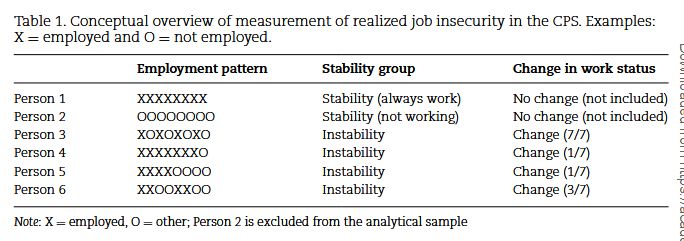
Weirdly enough, long-term trends in insecurity remain a bit of an open question. We use month-to-month CPS panel data to assess a fairly extreme version of job insecurity. People transitioning across work / non-work. And the frequency of these transitions.
02.12.2025 17:01 — 👍 0 🔁 0 💬 1 📌 0
Very excited about forthcoming @sfjournal.bsky.social with Jessie Himmelstern
academic.oup.com/sf/advance-a...
How has job insecurity changed over the past 1/2ish century?
Alright alright alright post-Thanksgiving full November #polisky eJobs update (11/1-11/30):
November 2024: 99 total positions (50 open to assistant TT)
November 2025: 69 total positions (22 open to assistant TT)
Check out our new paper (+ the accompanying web viz)!
25.11.2025 16:27 — 👍 25 🔁 7 💬 0 📌 0
The rise of stratification research in sociology, economics, and political science. My new blog. With a conclusion that European universities should rather sponsor inequality centers than to dismantle them. @eui-eu.bsky.social @eui-sps.bsky.social hermwerf.substack.com/p/the-rise-o...
18.11.2025 13:16 — 👍 34 🔁 10 💬 0 📌 1
New article in @sfjournal.bsky.social with @mvaldes1989.bsky.social and I. Lievore on the effect of edu expansion among parents on children's achievement
Do university-educated families lose their edge as education expands among parents?
Short answer: yes
1/2
academic.oup.com/sf/advance-a...
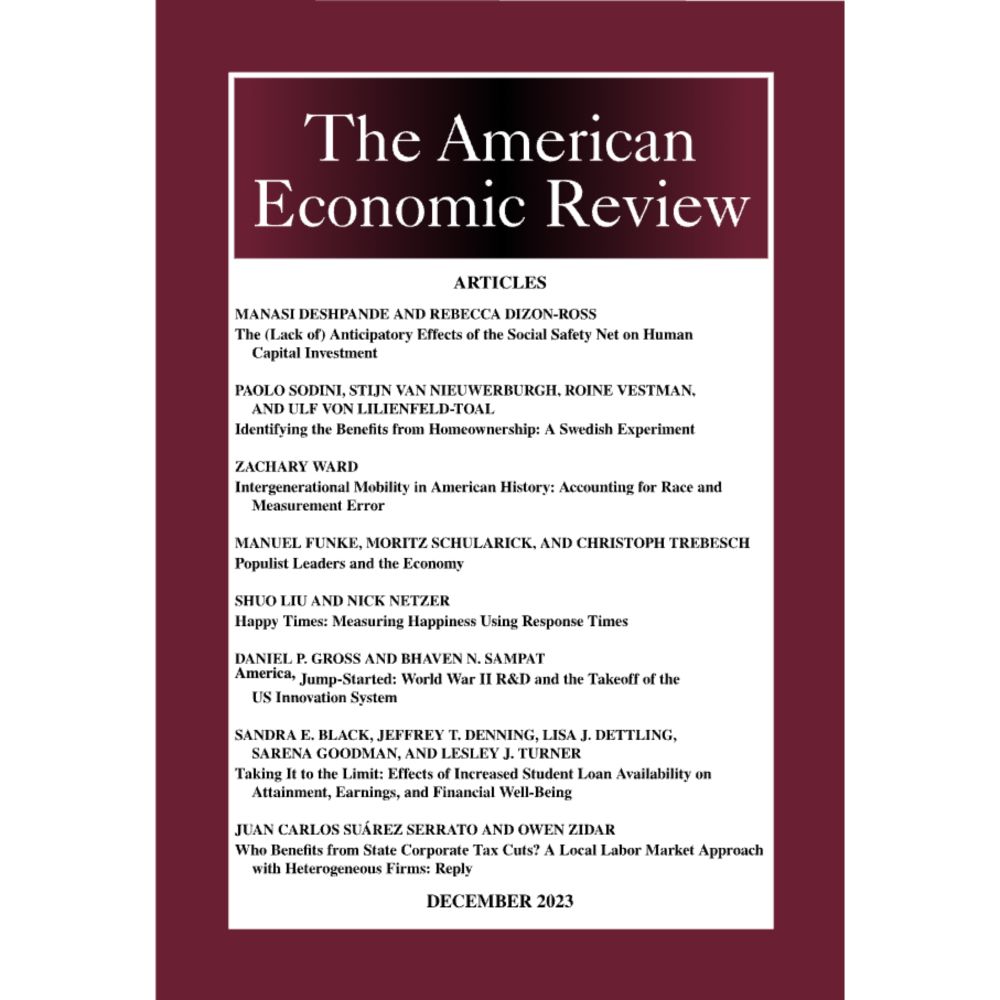
Forthcoming in the AER: "“Potential” and the Gender Promotion Gap" by Alan Benson, Danielle Li, and Kelly Shue. www.aeaweb.org/articles?id=...
10.11.2025 14:51 — 👍 31 🔁 12 💬 1 📌 5I think it’s fair to say that “field of study” becomes increasingly relevant to understand social and political patterns. Here a blog I wrote about the revival of my PhD work in political science, with a proper replication by @liesbethooghe.bsky.social et al. hermwerf.substack.com/p/field-of-s...
09.11.2025 09:34 — 👍 13 🔁 5 💬 0 📌 0

I tend to find "current sentiment" to be a little more helpful than "consumer expectations." The latter tends to have massive partisan swings. Current Sentiment looks ... really bad.
Expectations about as low as the mid 1970s and early 1980s.


Record low consumer sentiment, according to the Survey of Consumers at the University of Michigan
07.11.2025 17:53 — 👍 0 🔁 0 💬 1 📌 0
Interesting discussion on causality by @tvanheuvelen.bsky.social including our paper joint necessity of external, internal and construct validity:
substack.com/@asocial/not...
Will do!
07.11.2025 16:47 — 👍 1 🔁 0 💬 0 📌 0I don’t buy Kenworthy’s book hook line and sinker, but it is leading me to seriously consider dropping literally everything else for the next decade to figure out whether / how inequality matters.
07.11.2025 14:30 — 👍 3 🔁 0 💬 1 📌 0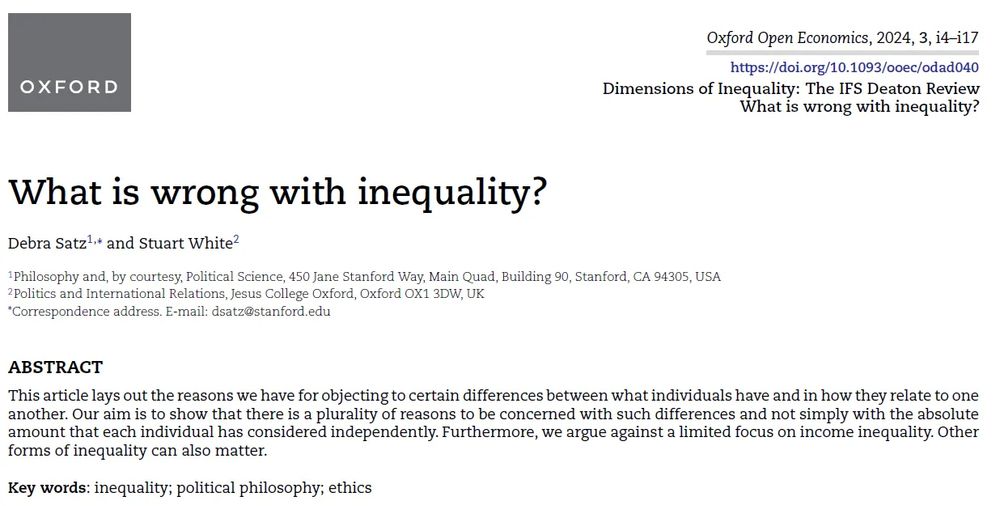

New blog post
asocial.substack.com/p/inequality...
An interesting swing at the question, "why does inequality matter," by a philosopher and political scientist.
Can't reply to this, for some reason:
www.amazon.com/Jackpot-Supe...
Jackpot kind of sets up the "big payoff" nature of the modern hyper rich. Then dwells on consequences.
global.oup.com/academic/pro...
Kenworthy's new book is a big challenge to fundamental empirics of "inequality matters"
This report makes sense. But just imagine if they had published 8 reports, each with a single bullet point! They would have been so much more productive!
07.11.2025 12:43 — 👍 1 🔁 0 💬 0 📌 0🎓 New paper accepted today, on the intergenerational educational mobility among immigrants in Denmark!
At first glance, immigrants seem more mobile than natives – but this is largely a data illusion. Poor register data quality drives the pattern.
w/ @rlandersoe.bsky.social
osf.io/preprints/so...
I really need to figure out how to become the Culvers distinguished chair of butter burgers and sociology. Why should business schools have all the fun, absurd named chairs
Should I send them a letter? Start dropping hints in the drive thru? This is my last remaining career goal.


At the blog I wrote about a few interesting new inequality studies:
* Authoritarianism is bad for global inequality measurement
* Aging is bad for subjective wellbeing
* Inequality might be bad for deaths of despair, but we need better studies
asocial.substack.com/p/inequality...
At the blog I wrote about a few interesting new inequality studies:
* Authoritarianism is bad for global inequality measurement
* Aging is bad for subjective wellbeing
* Inequality might be bad for deaths of despair, but we need better studies
asocial.substack.com/p/inequality...
Well, that is _super_ interesting. Great work, yet again!
13.10.2025 15:44 — 👍 1 🔁 0 💬 0 📌 0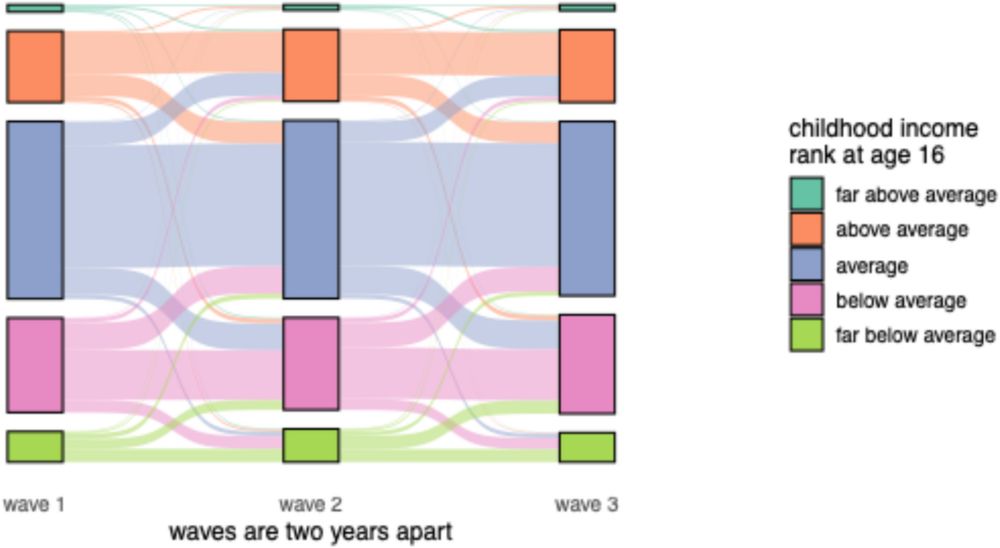
The GSS asked the same people about their childhood income rank three different times. 56% changed their answer, even though what was trying to be measured couldn’t change! We dig into this in a new article at @socialindicators.bsky.social.
doi.org/10.1007/s112...
🧵👇 (1/5)

At the blog, I wrote about two very interesting recent methods articles - Inference to the Best Explanation and External/Construct Validity.
Very thoughtful pushback against the ascendancy of the credibility revolution.
asocial.substack.com/p/inequality...
Hope you enjoy!
The Association for Public Policy Analysis & Management has announced that Zach Parolin @zparolin.bsky.social has won the David Kershaw Award.
www.appam.org/zachary-paro...
Enthusiastic congratulations to my good friend and occasional collaborator Zach!