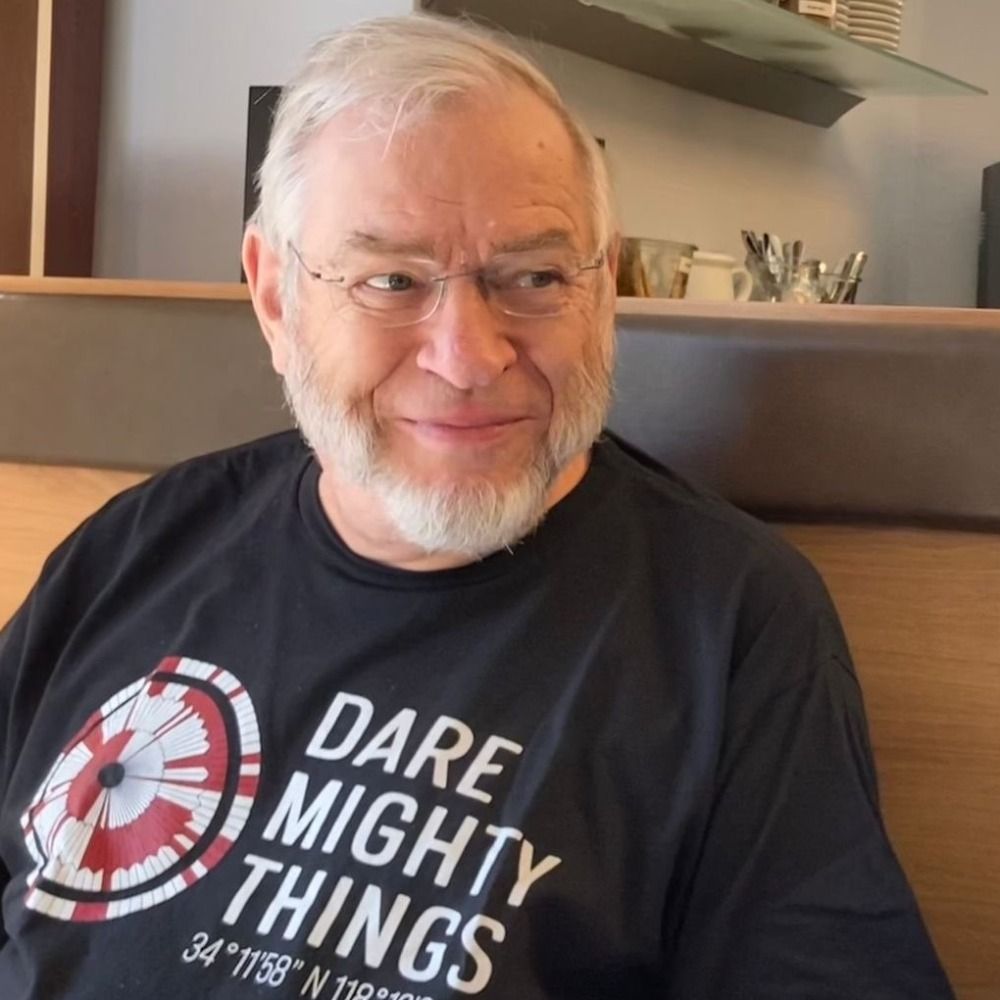
I tried an even harder example on Gemini Pro image generation and this is quite scary/amazing. I asked for a microscopy image of around 20 HeLa cells, GFP tagged 20% nuclear, 10% membrane, +1 nuclear staining, + overlap. Image below and prompt in the following post.
21.11.2025 17:32 — 👍 70 🔁 35 💬 8 📌 28

Promotional graphic for STM’s Innovation & Integrity Days Research Integrity Workshops on 9 December. The design features three workshop topics: 1) Forensic Scientometrics – Enhancing Research Integrity and Security for the Scholarly Ecosystem, 2) Communication and collaboration with Institutions, and 3) Helping your editors and reviewers understand research integrity issues. Text highlights that the workshops are new this year. Bright gradient background with STM and I&I Days branding.
Heading to Innovation & Integrity Days? Don’t miss the 9 Dec #ResearchIntegrity workshops: expert-led, interactive & focused on practical skills.
--> Forensic Scientometrics
--> Collaboration with Institutions
--> Supporting Editors & Reviewers
Join us! stm-assoc.org/events/stm-i... #STMinLondon
05.11.2025 15:30 — 👍 5 🔁 1 💬 1 📌 0
@hkoers.bsky.social @image-integrity.bsky.social @tonyhopedale.com @danielacuna.bsky.social
05.11.2025 15:33 — 👍 0 🔁 1 💬 0 📌 0

How to spot fake scientists and stop them from publishing papers
Journals are considering doing identity checks to expose fake authors — but there are downsides.
"By inventing fake scientists, paper mills can create a ready supply of publications and favourable peer reviews, ensuring more of the mills’ submissions get published [and] increase[d] credibility for paying customers" www.nature.com/articles/d41...
26.10.2025 23:11 — 👍 7 🔁 2 💬 0 📌 1
if you see this post, your actions are:
- if you have a spare buck, give it to Wikipedia, then repost this
- if you don't have a spare buck, just repost
your action is mandatory for the world's best source of information to survive
26.12.2024 12:03 — 👍 27369 🔁 35587 💬 260 📌 397

The new landing page for COSIG, available at cosig.net.
It reads:
Anyone can do post-publication peer review.
Anyone can be a steward of the scientific literature.
Anyone can do forensic metascience.
Anyone can sleuth.
However, investigating the integrity of the published scientific literature often requires domain-specific knowledge that not everyone will have. This open source project is a collection of guides written and maintained by publication integrity experts to distribute this domain-specific knowledge so that others can participate in post-publication peer review.
COSIG currently hosts 31 guides and was last updated on 25 September 2025. Guides can be downloaded as individual PDFs. A combined PDF with all guides included can be downloaded here.
COSIG has a new landing page! Check it out at cosig.net.
(Files for COSIG are still hosted on OSF!)
17.10.2025 12:40 — 👍 12 🔁 7 💬 1 📌 0
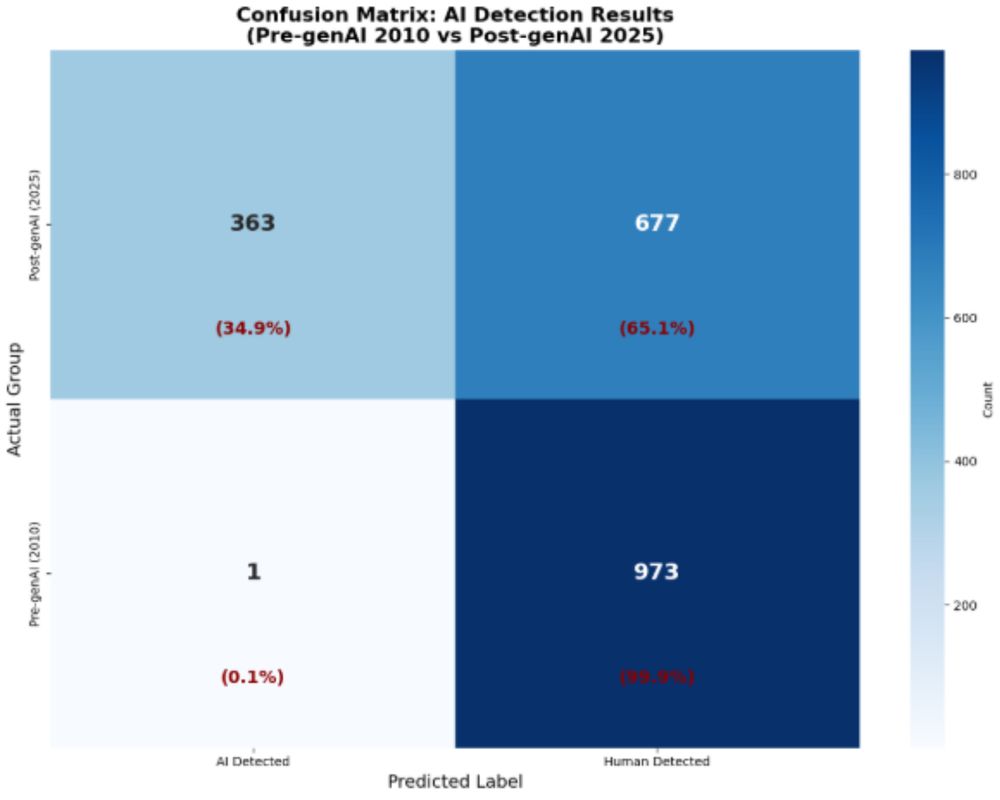
GenAI detection that actually works
Clear Skies is making genAI detection with Pangram available to subscribers in Oversight.
Adam @clearskiesadam.bsky.social brought this post to my attention and he does a good job of explaining the weaknesses and strengths in the current state of GenAI detection in the text of papers.
clearskiesadam.medium.com/genai-detect...
27.08.2025 19:27 — 👍 5 🔁 3 💬 0 📌 0

Rethinking Peer Review Using the Swiss Cheese Model to Better Flag Problematic Manuscripts
Click on the article title to read more.
A paper that combines #peerreview & cheese... what could be better? Answer: writing said paper with @abalkina.bsky.social @image-integrity.bsky.social & Marie Souliere. Read on to learn how the Swiss Cheese Model could help peer review & #researchintegrity onlinelibrary.wiley.com/doi/10.1002/...
19.08.2025 11:14 — 👍 26 🔁 16 💬 1 📌 0

Annual global scientific activity captured by WoS as measured by the number of actively publishing journals, the number of journals deindexed annually by WoS, the number of journals with retractions, the number of journals with PubPeer comments, and the number of journals with suspected paper mill products. It is visually apparent that deindexing now occurs at a level far below the level of occurrence of journals publishing suspected paper mill products. These patterns hold for Scopus and MEDLINE.
R.A.K. Richardson, S.S. Hong, J.A. Byrne, T. Stoeger,
& L.A.N. Amaral, The entities enabling scientific fraud at scale are large, resilient, and growing rapidly, Proc. Natl. Acad. Sci. U.S.A. 122 (32) e2420092122, https://doi.org/10.1073/pnas.2420092122 (2025).
A powerful new study, Richardson et al. @pnas.org reveals the scale of systematic research fraud: fake papers are doubling every 1.5 years - ten times faster than real science! Retractions and deindexing can't keep up: 📄 doi.org/10.1073/pnas... #ResearchFraud #Integrity #PaperMills #AcademicEthics
05.08.2025 12:34 — 👍 5 🔁 1 💬 0 📌 1
Reese and colleagues are doing incredibly important work to identify large scale credibility challenges for the research literature. The latest report is disquieting.
04.08.2025 20:52 — 👍 20 🔁 7 💬 0 📌 0
A do-or-die moment for the scientific enterprise
Reflecting on our paper “The entities enabling scientific fraud at scale are large, resilient, and growing rapidly”
Today, our article "The entities enabling scientific fraud at scale are large, resilient, and growing rapidly" is finally published in PNAS. I hope that it proves to be a wake-up-call for the whole scientific community.
reeserichardson.blog/2025/08/04/a...
04.08.2025 20:46 — 👍 337 🔁 205 💬 9 📌 44
hot off the press: huge infestation of crooked editors involved on paper mills unmasked. www.pnas.org/doi/abs/10.1...
04.08.2025 19:53 — 👍 22 🔁 7 💬 1 📌 1
Happy 15th anniversary, Retraction Watch
Once upon a time, a long time ago, two science journalists had an idea for a blog about retractions. And on Aug. 3, 2010, Retraction Watch launched, detailing in the first post why retractions matt…
Once upon a time, two science journalists had an idea for a blog about retractions. And on Aug. 3, 2010, Retraction Watch launched.
And now, 15 years and 6,700 posts later, that work seems more important than ever.
Happy 15th anniversary, Retraction Watch.
01.08.2025 20:38 — 👍 248 🔁 86 💬 6 📌 5
La haine et véhémence de mes harceleurs (qui prouvent malgré le point exact de l'article) est l'un des premiers moteurs de:
- ma motivation à ne pas flancher face à la mauvaise science
- mais aussi de la réussite de cet article (nature.com/articles/d41...) 🤣
Changez rien :)
26.07.2025 09:12 — 👍 31 🔁 8 💬 1 📌 0
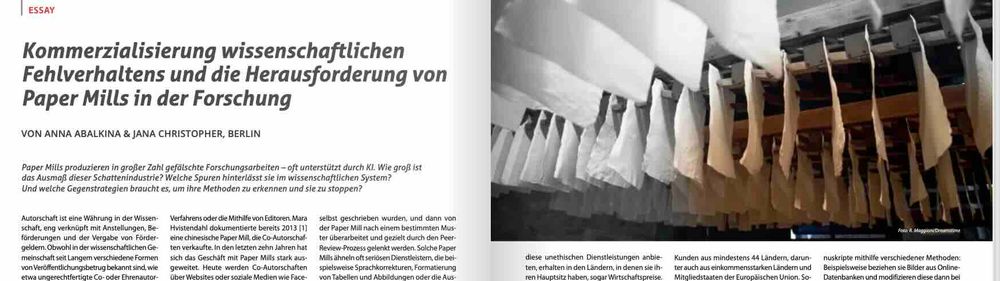
Screenshot aus dem im Post verlinkten Artikel. Darauf zu sehen: Überschrift "Kommerzialisierung wissenschaftlichen Fehlverhaltens und die Herausforderung von Paper Mills in der Forschung", darfunter Autorinnenzeile "Von Anna Abalkina & Jana Christopher, Berlin", wiederum darunter Vorspann mit dem Text: "Paper Mills produzieren in großer Zahl gefälschte Forschungsarbeiten – oft unterstützt durch KI. Wie groß ist das Ausmaß dieser Schattenindustrie? Welche Spuren hinterlässt sie im wissenschaftlichen System? Und welche Gegenstrategien braucht es, um ihre Methoden zu erkennen und sie zu stoppen?" Angeschnitten dann die ersten Sätze des Artikeltexts. Auf der rechten Seite ein KI-generiertes Aufmacherfoto von vielen Papierlappen, die zum Trocknen in langer Reihe von der Decke hängen.
#PaperMills fälschen in großer Zahl Forschungsarbeiten. Wie sehr schadet diese Schattenindustrie dem #Wissenschaftssystem? Wie kann man ihre Methoden erkennen und sie stoppen? – Thema eines Essays von @abalkina.bsky.social und @image-integrity.bsky.social: www.laborjournal.de/rubric/essay...
24.07.2025 08:45 — 👍 4 🔁 3 💬 2 📌 0

Jana Christofer and I wrote a piece on #papermills for Laborjournal. We discuss challenges of paper mills and AI for scientific publishing. Science needs immediate solutions to correct it and prevent it from massively produced fraud.
@image-integrity.bsky.social
www.laborjournal.de/rubric/essay...
15.07.2025 08:39 — 👍 24 🔁 10 💬 1 📌 1
This piece nicely summarizes the situation and features thoughts from @elisabethbik.bsky.social, @mumumouse2.bsky.social, @davidsanderssci.bsky.social, @image-integrity.bsky.social and myself.
10.07.2025 11:32 — 👍 3 🔁 1 💬 1 📌 0
Great piece from Renee Hoch and Joanna Clarke. „It is likely not a coincidence that in the genAI era publishers are seeing an increase in large-scale publication ethics issues, including peer review integrity rings, authorship integrity issues and paper mills“
01.07.2025 18:55 — 👍 2 🔁 0 💬 0 📌 0
Surely no real Journal would have you submit to a gmail address ?! 🤥
22.06.2025 14:35 — 👍 4 🔁 0 💬 0 📌 0

Amazing talk this morning by Hub Zwart ‘Trust in science in an era of social fragmentation’ @EMBLEvents #SciSoc2025
17.06.2025 08:13 — 👍 3 🔁 3 💬 0 📌 0

The great Prof Csaba Szabo speaking now about the reproducibility crisis #SciSoc2025
16.06.2025 14:51 — 👍 1 🔁 1 💬 1 📌 0
Good morning! Looking forward to two days at EMBL, starting today: EMBL Science and Society Conference: In science we trust?
@EMBLEvents #SciSoc2025
16.06.2025 07:13 — 👍 3 🔁 2 💬 0 📌 0

How to spot suspicious papers: a sleuthing guide for scientists
An open collection of tips and tools could help researchers and publishers to pick up on problematic research.
@cosig.net coverage in Nature news!
Collection of Open Science Integrity Guides
Anyone can do post-publication peer review.
Anyone can be a steward of the scientific literature.
www.nature.com/articles/d41...
11.06.2025 10:29 — 👍 19 🔁 10 💬 2 📌 0
COSIG logo:
COSIG (Collection of Open Science Integrity Guides)
Now available at cosig.net!
Anyone can do post-publication peer review.
Anyone can be a steward of the scientific literature.
Anyone can do forensic metascience.
Anyone can sleuth.
That's why we are launching COSIG: the Collection of Open Science Integrity Guides, an open source resource for all of the above.
cosig.net
04.06.2025 13:32 — 👍 102 🔁 58 💬 4 📌 8
"A literature that's ...polluted with junk is not only no good to anyone, it's a source of real harm, and it lends itself to ... bad-faith attacks on scientific research in general... We need to speak up more about this situation and we need to start cleaning house more vigorously" #Papermills 🧪
26.05.2025 08:14 — 👍 58 🔁 28 💬 0 📌 1

Many aspects of editing are common sense, says Jana Christopher, an image-integrity analyst at the Federation of European Biochemical Societies, who is based in Heidelberg, Germany. For instance, it’s OK to increase the image’s contrast so that a cell or feature pops out against the background, but the background still has to be visible. Altering brightness or saturation is also acceptable as long as the modification is applied equally across the whole image. Cropping is fine if the process doesn’t remove elements that would change the interpretation of the image — after all, Christopher notes, selecting a particular field of view under the microscope is in itself a form of cropping and selective reporting. “The bottom line is that the images need to represent accurately what was observed experimentally,” she says.
The do’s and don’ts of scientific image editing.
I think this one paragraph covers about 90% of the queries we get on this kind of stuff.
www.nature.com/articles/d41...
08.05.2025 12:37 — 👍 7 🔁 2 💬 0 📌 0
Trying to raise awareness of the sale of authorship of scientific papers by sharing adverts as they appear.
Formerly @author_for_sale on Twitter. Run by @nhwise.bsky.social in a personal capacity.
Consultant biostatistician @amsterdamumc, with PhD from @CWInl. Proponent of Registered Reports for RCT research. Research on ALL-IN prospective meta-analysis, anytime-valid statistics and https://en.wikipedia.org/wiki/E-values #stats #openscience
"Ah, I am wandering! Strange how the brain controls the brain!" Neuroscientist at the University of Michigan. Data Sleuth. #ARM. "Confoundoisseur". Unquestionably eccentric. Views are my own.
Heidelberg-Hamburg Infectious Diseases Imaging Association (HHH-IDIA).
The DFG-funded “Gerätezentrum” is tackling the challenge to provide guidance and support for advanced imaging infrastructure in BSL3 laboratories.
Defining pathogenic principles of major human pathogens and translating these findings into novel therapeutic and preventive strategies
art & architectural historian / visual, material & religious culture
Associate professor at ETH Zurich, studying the cellular consequences of genetic variation. Affiliated with the Swiss Institute of Bioinformatics and a part of the LOOP Zurich.
PhD student interested in studying science and health- related mis/disinformation, open science practices, and public participation in science
Cochrane is a global, independent, non-profit network that produces and promotes trusted, high-quality health information to improve health and healthcare worldwide.
Trusted evidence. Informed decisions. Better health.
Sentientism, food policy for desired/anticipated consumption patterns, plant-based food for climate, consumption behaviour, history and reporting of global goals, framing.
Co-Creating Ireland's Public Involvement in Open Research Roadmap
ENGAGED is building a national roadmap to shape public involvement in open research in Ireland. We believe that research can and does play an important role in tackling societal challenges.
UK-based retired software developer.
Art, Photography, Science, Music, Economics, Politics, Geology, Physics, Chemistry, Earth Science, Architecture, Archaeology
I can't send/receive DMs here.
Signal: alan.285
Peer-reviewed academic journal on research integrity and ethics.
An interdisciplinary forum across sciences, medicine, law, management, public policy, and history.
✒️ @gengyantang.bsky.social
Cat-owning philosophy academic | existentialism | phenomenology | new project: philosophy of AI
- https://matthewbarnard.phd/
UCU NEC/HEC UK Elected Representative
The Association of Learned and Professional Society Publishers - an International trade body which supports and represents not-for-profit organizations and institutions that publish scholarly and professional content.
Science reporter at Nature | ABSW award winner
I write about biology & neuroscience, academic publishing & integrity, Africa & the Middle East
Bioethics, medical ethics and research ethics/integrity. Associate professor at the University of Latvia. FAMILY project https://family-project.eu/, BEYOND project https://beyondbadapples.eu/, TRUSTPARENCY project https://trustparency-project.eu/
Wissenschaft | Sterne, Polar & Meer | Kunst, Philosophie.
Demokratie, Freiheit und Soziale Marktwirtschaft. 🇪🇺
Investigative reporter @sciencemagazine. Before: investigations for @statnews @sacbee_news @latimes. cpiller@charlespiller.com - Signal: cpiller.01 - Author of the book "Doctored: Fraud, Arrogance, and Tragedy in the Quest to Cure Alzheimer's"