To my knowledge, the former
21.02.2025 21:25 — 👍 1 🔁 0 💬 0 📌 0

A photo of a Brachioteuthis paralarva at night. It is transparent and blue, and it has a long neck. There are some orange chromatophores on the squid.

A blackwater photo of a Brachioteuthis paralarva. It is transparent and blue, and it has a long neck. There are some orange chromatophores on the squid.

A photo of a Brachioteuthis paralarva at night. It is transparent and blue, and it has a long neck. There are some orange chromatophores on the squid.

A blackwater photo of a Brachioteuthis paralarva. It is transparent and blue, and it has a long neck. There are some orange chromatophores on the squid.
Brachioteuthis squids have these extremely long necks as paralarva, which give them a very goofy appearance.
03.01.2025 20:59 — 👍 40 🔁 9 💬 1 📌 0

A small deep-sea squid with bright white light organs in the mantle, one round and one shaped like a crescent moon
And this was the #SQXmas2024 present we got most excited about at NIWA—a young Cycloteuthis, with ‘sun and moon’ photophores on the viscera in a configuration I’d never seen before. That’s a wrap for 2024—sending best fishes and squid tidings for the New Year!
26.12.2024 20:31 — 👍 34 🔁 7 💬 2 📌 0

10 different deep sea anglerfish, from different families. On the left - Centrophryne, Cryptopsaras, Himantolophus, Diceratias, Bufoceratias. On the right - Bufoceratias, Melanocetus, Lasiognathus, Thaumatichthys, and Chaenophryne. The fishes share little in common, save large mouths and a bioluminescent lure, mounted on a "rod" extending from the forehead - the length of this rod varies, though, as does the complexity of the light organ at its tip. Some light organs are plain and bulbous, others very complex and covered with tassels. Credit: Miya, M., Pietsch, T.W., Orr, J.W., Arnold, R.J., Satoh, T.P., Shedlock, A.M., Ho, H.C., Shimazaki, M., Yabe, M. and Nishida, M., 2010. Evolutionary history of anglerfishes (Teleostei: Lophiiformes): a mitogenomic perspective. BMC Evolutionary Biology, 10, pp.1-27.
You didn't think we'd get through the last week of #25DaysOfFishmas without one more anglerfish could you? But with 170+ species, how do you pick? Well, you just go with the weirdest one - today we're discussing Thaumatichthys, the wolftrap angler.
23.12.2024 10:34 — 👍 25 🔁 5 💬 2 📌 1
All kinds of life happening here! Octo with leeches, polychaete, sea star, demosponges, kelp?, & i think I see a wee psolus along w/ a lot of other critters. They're currently trying to avoid an iceberg, which is fascinating the hell out of me. #SchmidtOcean dive 767 #IntoSouthernOcean #MarineLife
21.12.2024 04:39 — 👍 22 🔁 2 💬 0 📌 0
Lovely swimming crinoid. #SchmidtOcean dive 767 #IntoSouthernOcean #MarineLife
21.12.2024 04:53 — 👍 29 🔁 9 💬 0 📌 0
I know! But technically… o_O
Big eye always on the left 😅
23.12.2024 08:24 — 👍 0 🔁 0 💬 1 📌 0

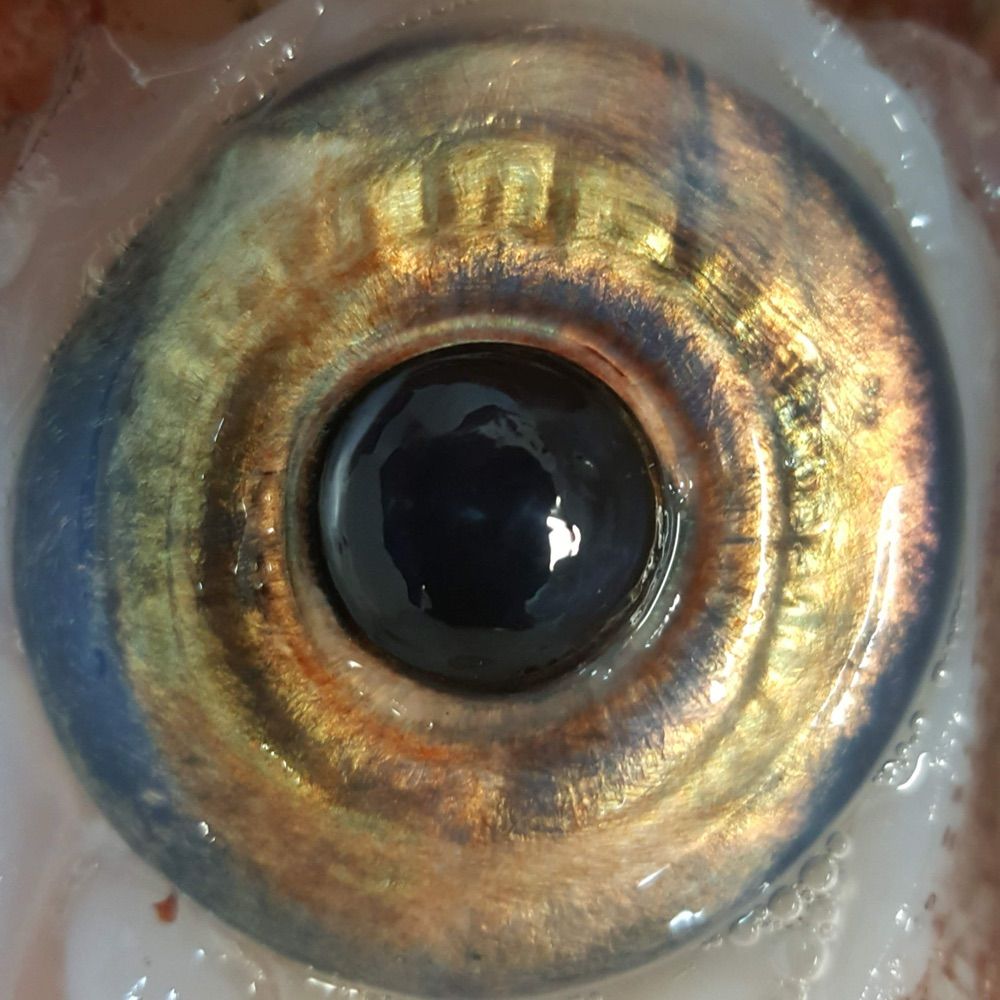
Shown are the two eye of Histioteuthis miranda, a species found in New Zealand. They have dimorphic eyes, one being larger than the other and where they derive their nickname, cockeyed squids.
The big left eye has a yellow tinted lens, which helps to discriminate downwelling blue sunlight from bioluminescent light many species use as countershading to camouflage in the deep sea.
They’re also known as cockeyed squids because they have one large and and one small eye.
They float sideways so the large eye looks up for prey or predators silhouetted against the downwelling light. The small eye looks down to spot bioluminescent signals.
Alt text has more info!
🦑🧪 #Inverts
23.12.2024 08:08 — 👍 18 🔁 2 💬 1 📌 0

The full body of a Histioteuthid squid. The large eye is always located on the left side of the squid (from the squids perspective, so on the right in this picture). They’re covered in photophores which can help to distinguish the specie, and usually have photophores at the tips of their arms, likely to help catch prey.
Ah, histioteuthidae , easily one of my favorite families of squids. They have many names, one being strawberry squids.
Strawberry, because their bodies are covered in photophores, which resemble the seeds of a strawberry. Plus their mantle is kinda strawberry shaped.
🦑 🧪 #Inverts
23.12.2024 08:08 — 👍 38 🔁 3 💬 1 📌 0
The party begins on Wednesday!
21.12.2024 11:12 — 👍 64 🔁 25 💬 0 📌 0
😂😂
23.12.2024 04:14 — 👍 0 🔁 0 💬 0 📌 0

Many Opalescent Inshore Squids (Doryteuthis opalescens) around a large mop of squid eggs. The squid are long squid shaped squids with their mantle making the majority of their length. They are somewhat silver and big eyes that almost look like googly eyes. Several squid are dead on the sea floor near the eggs. The mops are made up of many white egg capsules that resemble sausages with more tapered ends. They are almost completely a slightly translucent white, although there is a tiny brownish bit on many of their ends. Each capsule contains many eggs, upwards of 300 eggs. The mop takes up most of the frame.

A recently hatched Opalescent Inshore Squid (Doryteuthis opalescens) next to a person's finger. It is very small and is completely dwarfed by the persons finger. It appears to be only a couple of millimetres long. It is mostly transparent, with some orangish red chromatophores.
Opalescent Inshore Squid (Doryteuthis opalescens) lay their eggs in these large "mops" of eggs, which contain a bunch of egg capsules.
Each capsule can contain a couple hundred squid eggs, which seems like a lot until you see how big the squids are when they hatch!
22.12.2024 17:51 — 👍 47 🔁 6 💬 1 📌 0
Maybe, I guess it depends on how much pressure is needed to keep the shape of the fish. But ur right, it’s probably not much.
Other fish tend to blow out their eyes (pretty horrendous) when moved from the deep to shallow water, but this is due to their air filled swim bladders…
22.12.2024 20:16 — 👍 0 🔁 0 💬 1 📌 0


The deflated state is less exaggerated in the toadfish and I can’t find a pale toadfish picture.
But here’s a comparison of the blobfish in and out of water. Much different.
Between deep sea and shallow water you’d like see a big difference too, because the pressure is dramatically different
22.12.2024 11:26 — 👍 2 🔁 0 💬 0 📌 0
He said hello. Or help.
I don’t speak fish.
22.12.2024 10:35 — 👍 0 🔁 0 💬 0 📌 0
How else are they supposed to express their love?!
But seriously, these fish (and many others) use negative pressure to suck surrounding water and prey into their mouths. Lips are a great way to seal their mouth once they’ve captured their prey.
22.12.2024 10:34 — 👍 4 🔁 0 💬 1 📌 0

The face of a pale toadfish, which lays on a surface. It’s a bit deflated from the lack of water pressure holding its skin together.
However, neither species looks this deflated in their natural environment.
Because they have flabby skin, the water pressure in the deep sea keeps their shape together.
When they’re removed from that environment and pressure, their flesh sags into the shape you see before you.
#MarineLife 🧪
22.12.2024 10:03 — 👍 27 🔁 1 💬 3 📌 0

A more dorsal view of the pale toadfish laying on a flat surface. It’s a purple-brownish color with brown mottling all over.
This is a pale toadfish, Ambophthalmos angustus. You might have seen pictures of a deep sea blob fish that was popular a few years ago on the internet.
That species, and this fish, are both part of the Psychrolutidae family.
#MarineLife 🧪
22.12.2024 10:03 — 👍 67 🔁 5 💬 2 📌 0
Dats what I do! 😬
21.12.2024 07:50 — 👍 1 🔁 0 💬 0 📌 0
1) Baby Sagan is a dope ass name
2) Sea stars are amazing with their spindly legs
21.12.2024 07:36 — 👍 1 🔁 0 💬 1 📌 0
I spend most of my time studying organisms, and there’s always some new species, or crazy mechanism that astonishes me. That’ll always be the case
21.12.2024 07:12 — 👍 0 🔁 0 💬 0 📌 0
Yea, it’s always one large bump on the aboral side. Pretty easy to spot 😊
21.12.2024 05:27 — 👍 1 🔁 0 💬 0 📌 0
That sounds like an amazing time! Tide-pooling is one of my favorite pastimes. Though I haven’t been up to far Northern California to do that yet. I’ll have to make a note for when I’m back in the Bay.
21.12.2024 03:57 — 👍 0 🔁 0 💬 0 📌 0
The littoral zone/tide pools?? They do be running things there
21.12.2024 03:42 — 👍 0 🔁 0 💬 0 📌 0
It’s so cool and unique right? I think echinoderms are the only group to have such an organ system (but don’t quote me on that! 😅)
21.12.2024 02:20 — 👍 1 🔁 0 💬 1 📌 0
Super weird, but equally cool
21.12.2024 02:08 — 👍 0 🔁 0 💬 0 📌 0
It’s a super unique and cool system
21.12.2024 00:31 — 👍 1 🔁 0 💬 0 📌 0
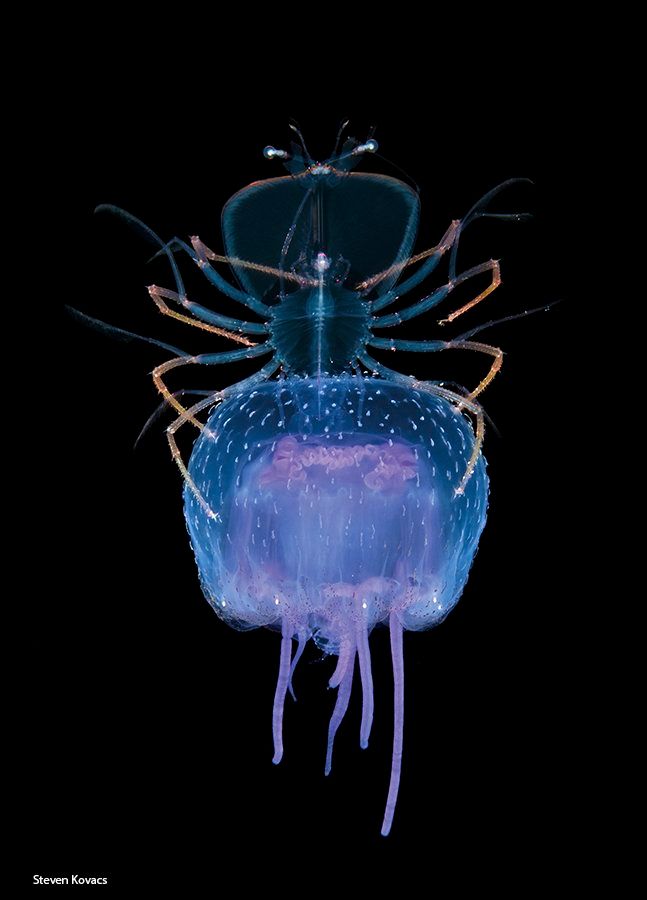
Phyllosoma (larval stage of a spiny or slipper lobster) riding a jellyfish in Kona, Hawaii. It is transparent with a broad flat head shield, and long long limbs (neither of which are so extreme in the adult). Photo by Steven Kovacs
https://twitter.com/ngfl3333/status/1567251570454151170
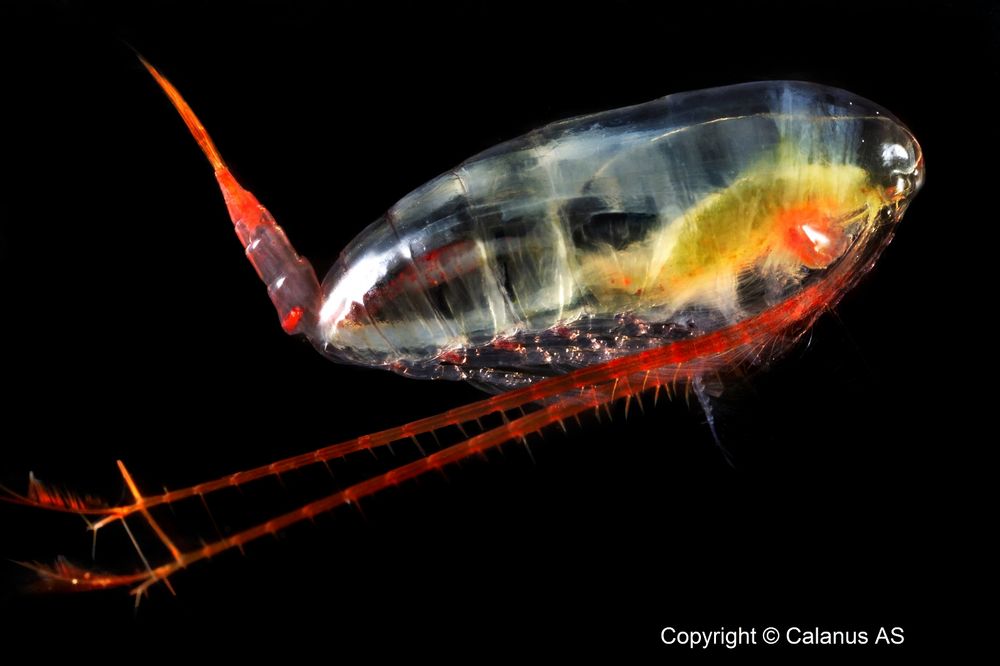
Copepod Calanus finmarchicus, seen in lateral view. It's a bit blobby and transparent, with long antennulae posed under the body. The abdomen (urosome) is pointed upwards and looks red.
https://www.feednavigator.com/Article/2019/04/09/Norwegian-plankton-developer-braced-for-growth
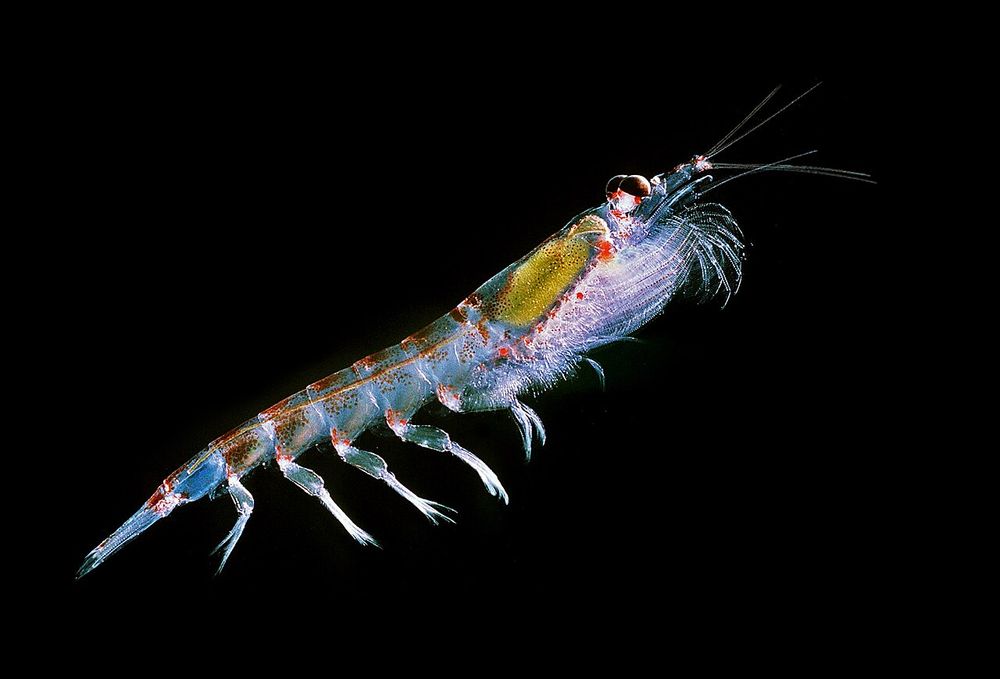
Antarctic krill Euphausia superba. In natural hovering position - the red organs produce the bioluminescence - the hepatopancreas is filled with green phytoplankton, the food of krill, the straight gut in the back is filled with the empty shells of phytoplankton - in the front you see the compound eyes
https://en.wikipedia.org/wiki/Antarctic_krill#/media/File:Antarctic_krill_(Euphausia_superba).jpg
Every night, some crustaceans migrate upwards, up to 1000m from the twilight zone, to feed. They poop on the way down, transferring nutrients to deeper waters.
Other species or larval stages maintain depth in the water column by riding gelatinous zooplankton!
#Crustmas 🧪🦑
20.12.2023 17:11 — 👍 256 🔁 86 💬 3 📌 10
Any idea the species of cuttlefish? Great pictures
20.12.2024 23:30 — 👍 1 🔁 0 💬 1 📌 0

The oral side of the 5 armed sea star. 5 long openings radiate from the center of the sea star to its arm tips.

One of the openings on the oral side of the sea star has been zoomed in on. In the crevice, there are small appendages that currently look a bit deflated. These are the tube feet!
Water taken in through the madreporite is eventually expelled through the tube feet.
These small appendages are located in the oral (bottom) side and help the sea star scuttle across the sea floor searching for food.
#MarineLife #Inverts 🧪
20.12.2024 23:16 — 👍 46 🔁 3 💬 2 📌 0
Trans person, scuba diver, chronic barefooter, unfortunate resident of Indiana,
Assistant Professor at University of Florida, Dept. of Biology
evolution • development • neurophysiology • behavior • light sensing systems
Lab Website: https://mcculloch.biology.ufl.edu
Aiming to take neuroscience into the future by going back to where it all began: the ocean. Here to share how we study the brains behind bioluminescence
Posts by @rijacobsen.bsky.social
www.marineneurolab.com
Executive Director, Monterey Bay Aquarium Our mission: to inspire conservation of the ocean. Chair, Monterey Bay Aquarium Research Institute; vice chair, David and Lucile Packard Foundation she/her www.MontereyBayAquarium.org
mother of marine worms (nemerteans) and Eddy. Biology professor at UW and invertebrate zoologist in Seattle.
Researching #deepsea #fish. Co-host of The Deep-Sea #Podcast @deepseapod.com. #TeamFish, Curator at The Museum of New Zealand Te Papa Tongarewa. #tech and #SciComm. Views are my own. #dyslexic, he/him
Cartoonist and creator of Octopolis, a sci-fi fantasy about the future where humans are extinct and octopuses have inherited the Earth. Get Issue #1 now at octopoliscomic.com
Te Aka Toro | New Zealand Ecological Society was formed in 1951 to promote the study of ecology and the application of ecological knowledge in all its aspects.
Why things evolve into crabs. Evolutionary biologist (species alive today AND fossils, and how to study them together). Canadian at UCSB and Harvard (she/her)
My science: https://scholar.google.com/citations?user=CKqoVjEAAAAJ&hl=en
Wild animal & author of GRIZZLED (March 3, 2026). Science Writer @ Nat Geo, NYT, WashPo, etc. Prev: KSJ @ MIT, Nat Geo Explorers. He/him. https://www.penguinrandomhouse.com/books/804002/grizzled-by-jason-bittel/
ISER provides a unique international platform for the exchange of ideas on contemporary topics in eye and vision research.
http://iser.org
At the back of your eyes.
https://webvision.med.utah.edu
Marine Biologist at Hull University. Interested in fisheries, crustaceans, stats, tropical ecology, teaching (no edubabble), diving, vision. Parkrun! Follows other Magni.
How do you do, fellow squids? 🌊 We're your frondly Aquarium with a mission to inspire conservation of the ocean. https://www.montereybayaquarium.org
Natural history museum, research institute, aquarium, planetarium, rainforest, & so much more — all under one living roof.
The premier international org of professionals who dedicate their work to advancing the science & practice of conservation.
Visit conbio.org to join.
Been studying squid since the age of 3
B.S. Marine Biology
Landscape photography 🏔️| Nature 🌿| Wildlife 🐿️
No AI - just the natural beauty of our planet
Marine biologist, evolutionary biologist, geneticist. Also @marine-omics.bsky.social
We study the evolution and development of visual systems.