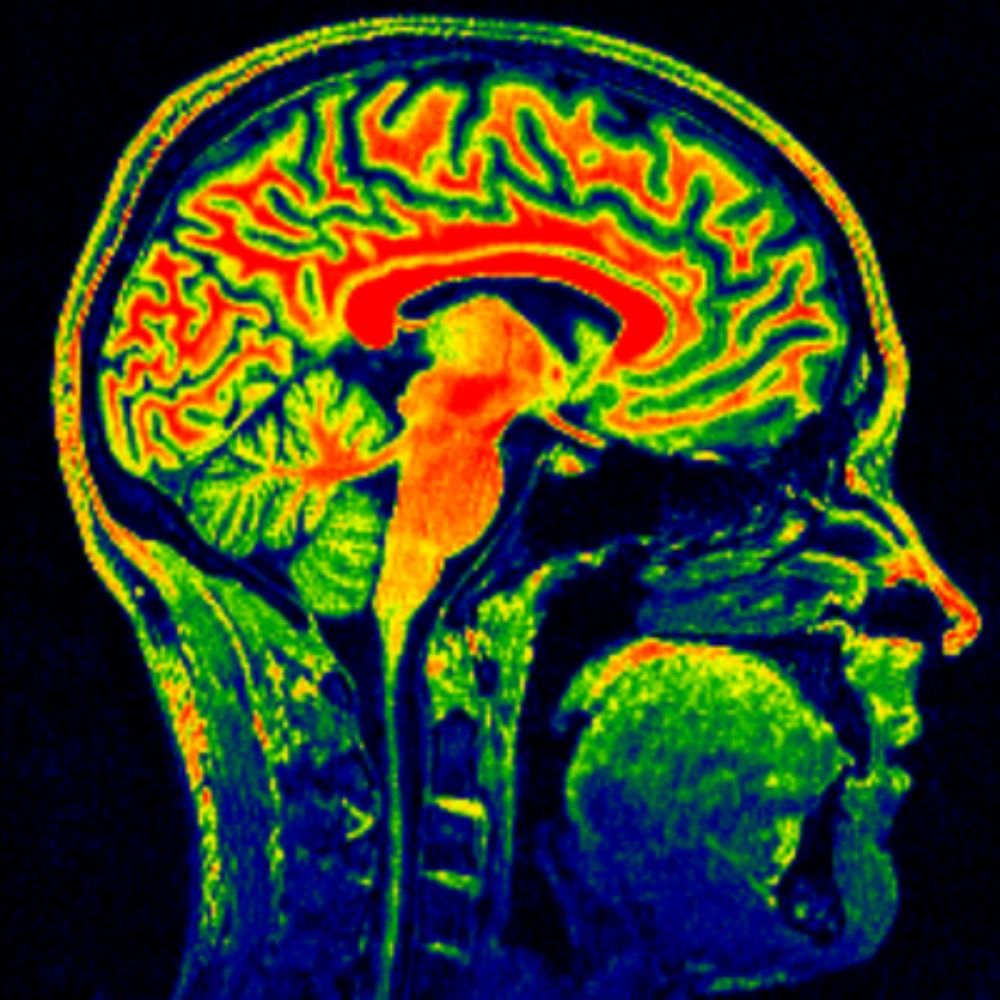
Does depression involve altered evaluation of multi-step plans?
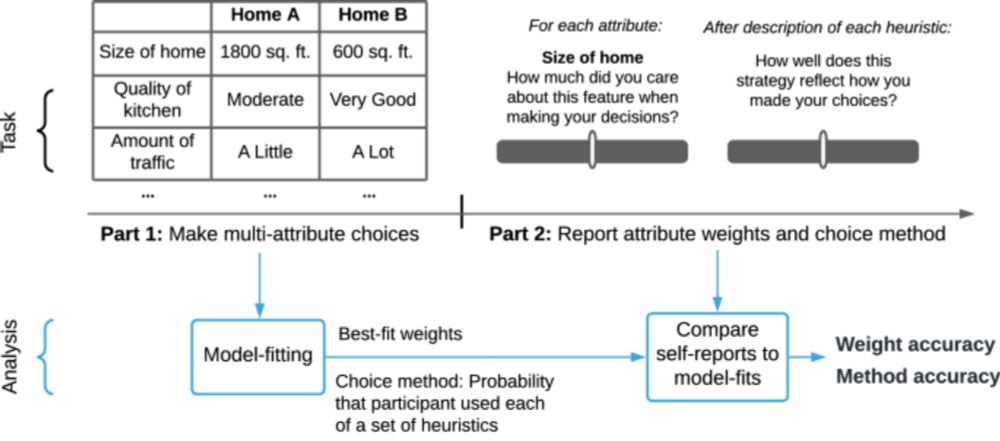
In our new preprint, we find that individuals with higher apathy-anhedonia report more pessimism about whether a plan will succeed, but in fact make better decisions that are more reflective of accurate multi-step evaluations.
20.08.2025 18:10 — 👍 4 🔁 0 💬 0 📌 0
3. Individual differences in decision-making and mental-health
4. Social decision-making
06.08.2025 16:35 — 👍 0 🔁 0 💬 1 📌 0
1. Testing complex models of planning using massive online game datasets (e.g., chess, Go)
2. Understanding how cognitive maps are shaped to enable adaptive planning
06.08.2025 16:35 — 👍 1 🔁 0 💬 1 📌 0
I will likely be able to recruit a PhD student in the upcoming cycle. Please get in touch if you're interested in any of the following areas:
06.08.2025 16:35 — 👍 0 🔁 0 💬 1 📌 0

Thrilled to announce that I'll be starting in January 2026 as an Assistant Professor of Psychology at Hunter College, City University of New York.
The lab will study the thought processes that underlie our decision-making.
06.08.2025 16:35 — 👍 56 🔁 5 💬 7 📌 0
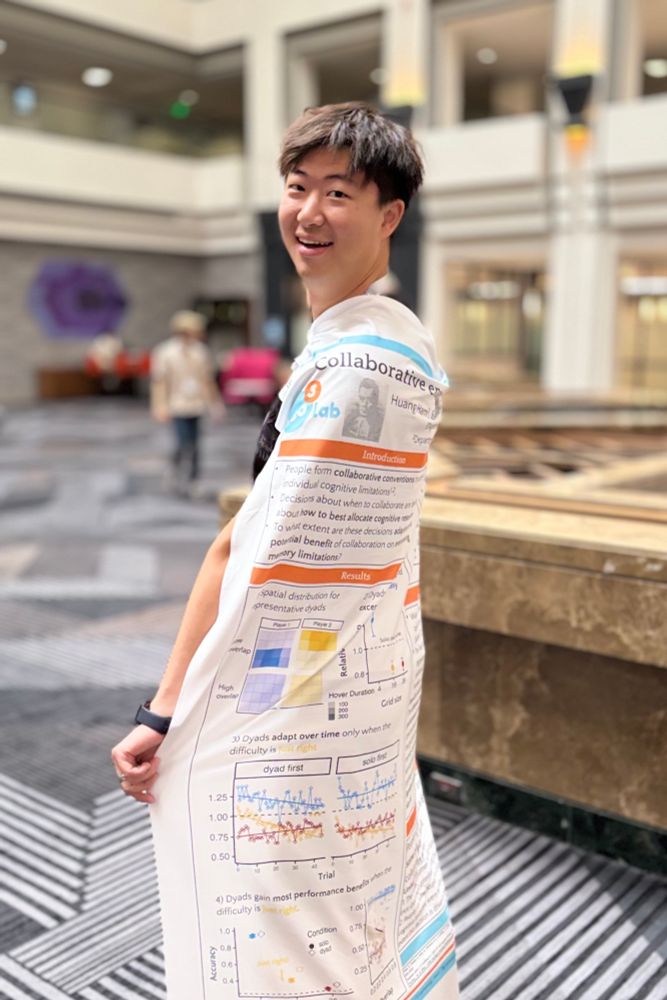
A smiling researcher at CogSci 2025 stands indoors wearing their scientific poster draped like a cape, with charts, graphs, and text visible on the fabric. The background shows a spacious conference hall with people walking and blurred architectural details.
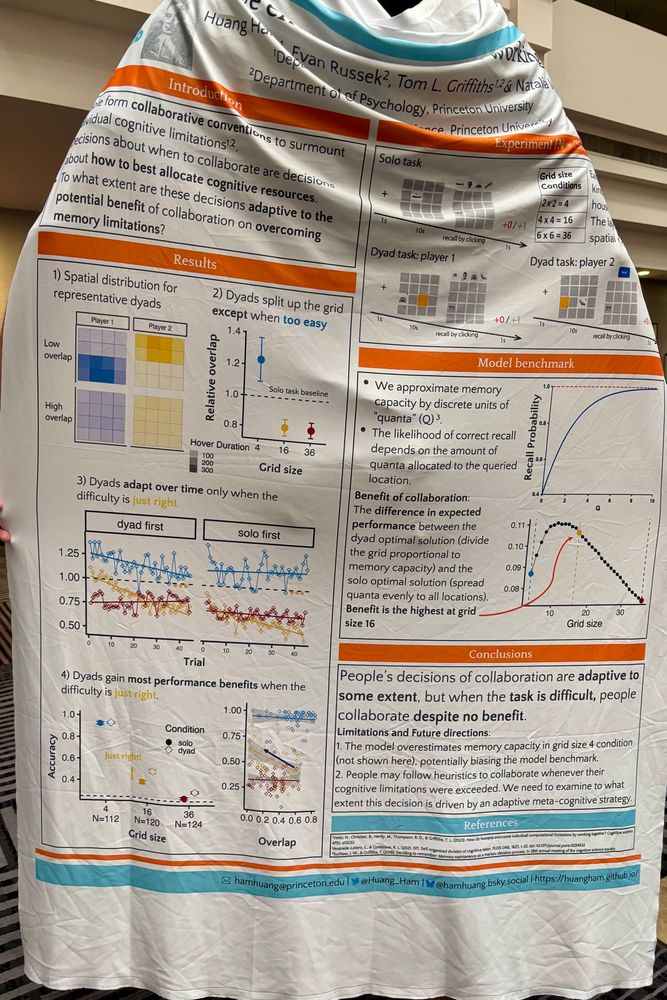
A research poster draped like a cape, showing charts, graphs, and text about collaborative memory and decision-making. The poster includes colorful data plots, grid diagrams, and sections labeled “Introduction,” “Results,” “Model Benchmark,” and “Conclusions.” The bottom includes the researcher’s contact information and social links
Because nothing says “ready to present” like literally wearing your findings at #CogSci2025
Ham Huang leveled up from poster session to superhero mode! 🦸
30.07.2025 17:51 — 👍 58 🔁 7 💬 1 📌 2
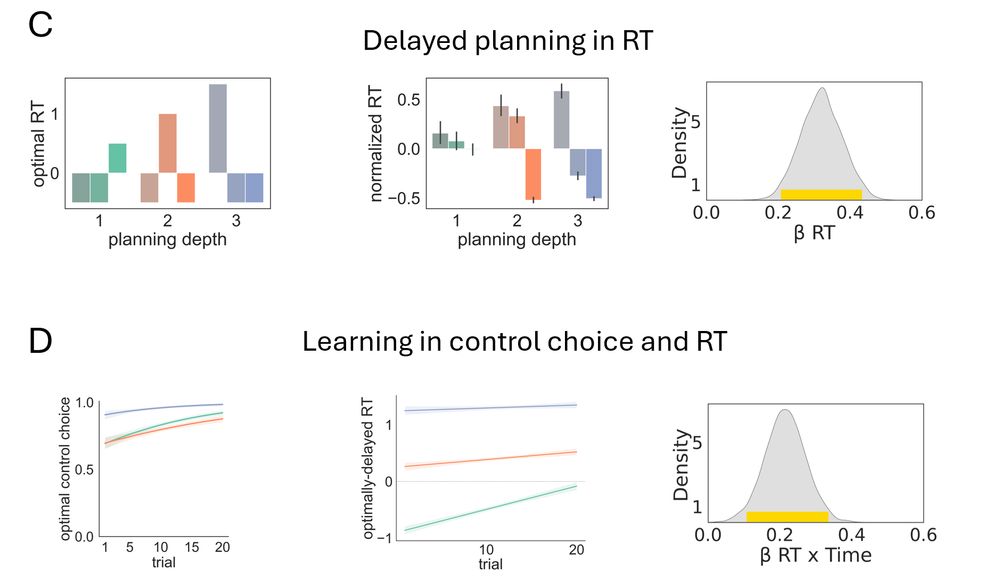
🚨New preprint! WHEN should we plan toward a goal? Most research focuses on how and where to plan, but the timing of planning initiation has been overlooked. We show humans leverage a cognitive map - called model-based meta-control - to learn when to deploy a plan.
🧵(1/15)
osf.io/preprints/ps...
05.07.2025 07:18 — 👍 65 🔁 13 💬 4 📌 3
We have an amazing group of speakers spanning psychology and AI research, all focused on using Chess or other multi-player games to gain insights on human and AI decision-making, and how they can inform each other.
10.06.2025 16:12 — 👍 0 🔁 0 💬 0 📌 0

I'm thrilled to announce that I will start as an Assistant Professor in Psychology & Cognitive Science at the University of Arizona in Jan 2026! My lab will investigate human planning and decision making through a combination of computational models, behavior, and fMRI (1/2)
05.06.2025 20:15 — 👍 60 🔁 5 💬 4 📌 2
nice! congrats!
08.05.2025 18:03 — 👍 2 🔁 0 💬 1 📌 0
Despite the world being on fire, I can't help but be thrilled to announce that I'll be starting as an Assistant Professor in the Cognitive Science Program at Dartmouth in Fall '26. I'll be recruiting grad students this upcoming cycle—get in touch if you're interested!
07.05.2025 22:08 — 👍 143 🔁 24 💬 17 📌 4
OSF
We are excited to post a new preprint with Shiyi Liang @shiyiliang.bsky.social:
'Reinforcement learning is positively associated with anhedonia symptoms' osf.io/preprints/ps...
(a bit late here – a version was online back in December)
@mpc-comppsych.bsky.social
19.03.2025 15:31 — 👍 31 🔁 12 💬 2 📌 0
So sorry for your loss, Laurence.
15.03.2025 19:51 — 👍 1 🔁 0 💬 0 📌 0
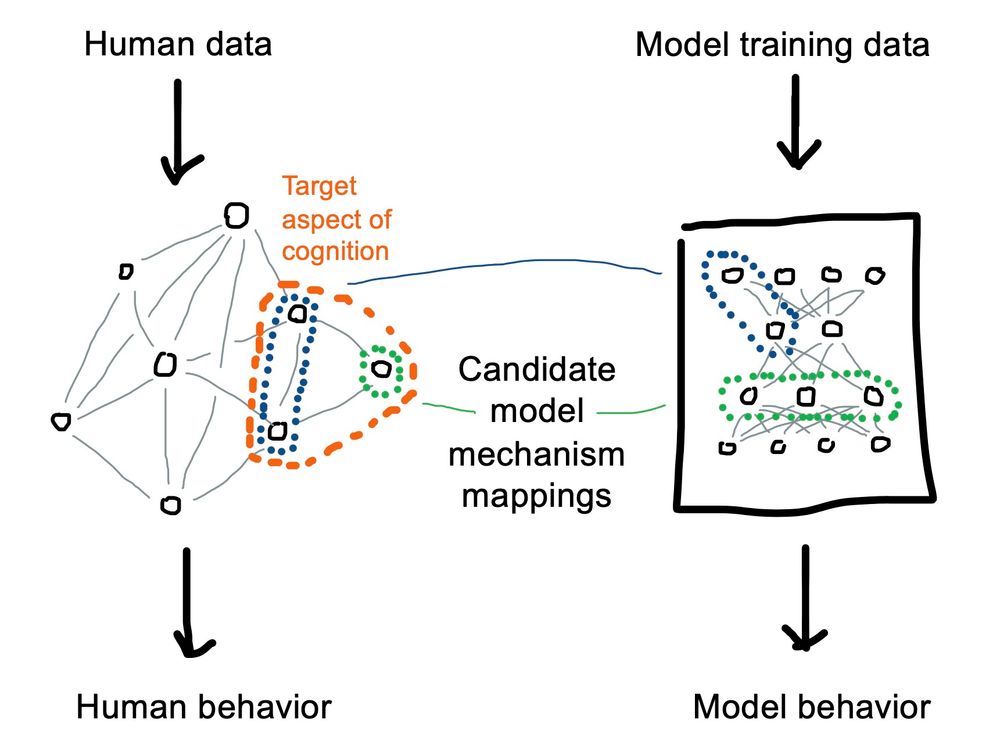
Figure 1. A schematic depiction of a model-mechanism mapping between a human learning system (left side) and a cognitive model (right side). Candidate model mechanism mappings are pictured as mapping between representations but also can be in terms of input data, architecture, or learning objective.
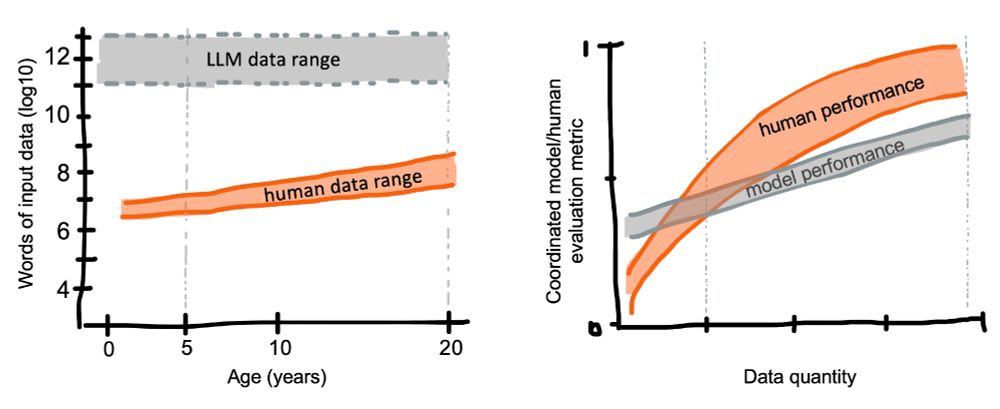
Figure 2. Data efficiency in human learning. (left) Order of magnitude of LLM vs. human training data, plotted by human age. Ranges are approximated from Frank (2023a). (right) A schematic depiction of evaluation scaling curves for human learners vs. models plotted by training data
quantity.
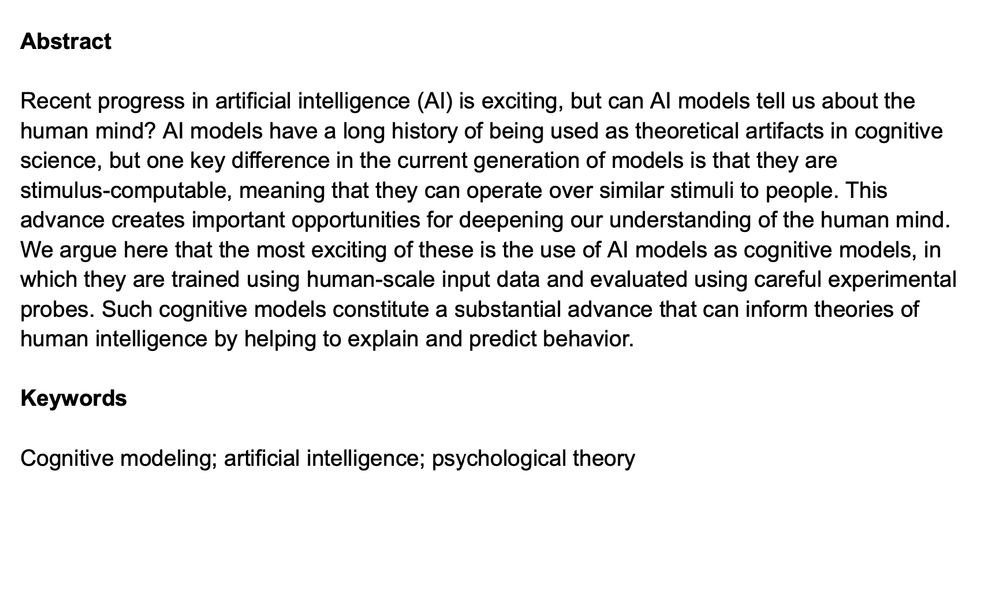
Paper abstract
AI models are fascinating, impressive, and sometimes problematic. But what can they tell us about the human mind?
In a new review paper, @noahdgoodman.bsky.social and I discuss how modern AI can be used for cognitive modeling: osf.io/preprints/ps...
06.03.2025 17:39 — 👍 63 🔁 25 💬 2 📌 0
❗RESEARCH OPPORTUNITIES❗
We're hiring for an ambitious @wellcometrust.bsky.social project exploring brain mechanisms of planning/inference in psychosis 🧠
Tackled at multiple scales: from single neurons to human behaviour/fMRI and neural networks.
Opportunities for 1 post-doc 1 clinical fellow 👀
20.02.2025 11:17 — 👍 22 🔁 22 💬 2 📌 1

🚨 Finally out! My new @annualreviews.bsky.social in Psychology paper:
www.annualreviews.org/content/jour...
We unpack why psych theories of generalization keep cycling from rigid rule-based models to flexible similarity-based ones, then culminating in Bayesian hybrids. Let's break it down 👉 🧵
10.02.2025 14:46 — 👍 118 🔁 41 💬 4 📌 2

📣 Absolutely elated to announce that in 2026, I’ll be joining Rutgers-Newark as TT Assistant Professor in the Dept of Psychology! Can’t wait to join this incredible community! 🤩 I’ve got some fun projects ahead as I wrap up my postdoc, but soon I’ll start recruiting at all levels so stay tuned. 1/3
09.02.2025 18:33 — 👍 102 🔁 7 💬 9 📌 5
GitHub - marcelbinz/Psych-201
Contribute to marcelbinz/Psych-201 development by creating an account on GitHub.
We are currently building the largest, cross-domain data set of human behavior as part of an open collaborative project. Contributions of any form are welcome, but especially experiments with meta-data from developmental, cross-cultural, or clinical studies.
More details: github.com/marcelbinz/P...
27.01.2025 12:40 — 👍 34 🔁 15 💬 2 📌 1
Employment Opportunities
Find and learn more about our open positions.Join our team
The new AI Lab at Princeton has positions for AI Postdoctoral Research Fellows for three research initiatives: AI for Accelerating Invention, Natural and Artificial Minds, and Princeton Language and Intelligence. Deadline is 12/31. More information here: ai.princeton.edu/ai-lab/emplo...
10.12.2024 14:41 — 👍 25 🔁 7 💬 1 📌 1
socosci
Xie Lab for Social Cognitive Science
Hello!!👋 I'm Sally Xie. Excited to share that in a few weeks, I'll be starting as an Assistant Professor @SFU Psych! 🏞️ @sfufass.bsky.social
I'm recruiting a lab manager & my first grad student. If you're interested in social cognition/perception & transformative experiences, check out socosci.com🦉!
26.11.2024 03:28 — 👍 100 🔁 32 💬 9 📌 4

Alignment is more than comparing similarity judgments! How well do pretrained neural networks align with humans in few-shot learning settings? Come check our poster #3904 at #NeurIPS on Wednesday to find out
10.12.2024 15:39 — 👍 14 🔁 4 💬 1 📌 2

Reinforcement Learning: An Overview
This manuscript gives a big-picture, up-to-date overview of the field of (deep) reinforcement learning and sequential decision making, covering value-based RL, policy-gradient methods, model-based met...
An updated intro to reinforcement learning by Kevin Murphy: arxiv.org/abs/2412.05265! Like their books, it covers a lot and is quite up to date with modern approaches. It also is pretty unique in coverage, I don't think a lot of this is synthesized anywhere else yet
09.12.2024 14:27 — 👍 270 🔁 73 💬 9 📌 5
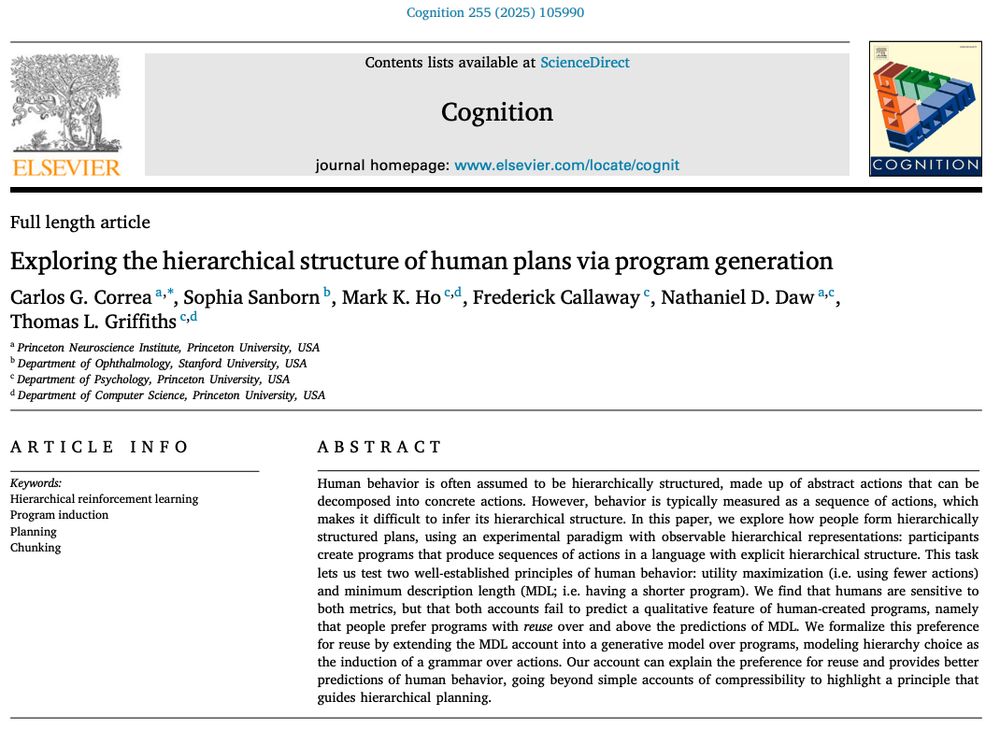
My paper on hierarchical plans is out in Cognition!🎉
tldr: We ask participants to generate hierarchical plans in a programming game. People prefer to reuse beyond what standard accounts predict, which we formalize as induction of a grammar over actions.
authors.elsevier.com/a/1kBQr2Hx2x...
03.12.2024 15:37 — 👍 100 🔁 37 💬 1 📌 3
bettinabustos.com
PhD student with Jiefeng Jiang @ uiowa. Memory, cognive control, costs of control, neuroimaging, computational modeling.
Prev @wustl and @utaustin
The official account of Princeton University. In the Nation’s Service and the Service of Humanity.
Postdoc at Brown University. Social neuroscientist researching how we make memories of networks; cognitive neuroscientist researching how we make networks of memories.
Misadventurer; reluctant optimist; amor fati.
https://jaeyoungson.com/
🏛️ educator, philosopher, strategist, museum nerd
👩🏼🏫 Art & Humanities, Teachers College, Columbia University
⌛️ MoMA/PS1, The Getty, MOCA
🏫 RSA | ICOM | AERA | AAHE | PES | INPE | JDS | IPPA | APA
#aesthetics #museums #philsky #edusky #academicsky #artsky
PhD student in Computational Cognitive Sciences | ENS-PSL. Currently working on the dynamics of impression formation, reputation management, and how it impacts our behavior.
https://mariusmercier.github.io
Postdoc @ Princeton AI Lab
Natural and Artificial Minds
Prev: PhD @ Brown, MIT FutureTech
Website: https://annatsv.github.io/
Behavior genetics, clinical psychology, Mets. Occasional politics.
Substack (free): https://ericturkheimer.substack.com/
Book Is Out! Understanding the Nature-Nurture Debate
https://shorturl.at/Ce2hf
Electronic Version: https://shorturl.at/Fq2jv
Philosophy PhD student @ washu (st louis)
Behavioral Scientist.
Lately, I've been thinking (and posting) about: AI+Psych, Personal Finance, Consumer Behavior. Civically engaged, so I occasionally post about that too.
Professor of Psychology, Hunter College and The Graduate Center, City University of New York; Laboratory for the Study of Youth Cognition and Suicide
Depts. of Psychology & Psychiatry, U. Wisconsin–Madison
Editor-in-Chief, Journal of Cognitive Neuroscience
Director, Psychology Research Experience Program (summer program for URM/low-income/1st-gen undergrads)
Professor of Neurosurgery, Baylor College of Medicine
PhD student @payampiray.bsky.social USC
Assistant Professor at Ohio State studying how we remember what we learn + how we learn from our memories
www.momentslab.org
Max Planck UCL Centre for Computational Psychiatry and Ageing
Research Fellow at the Applied Computational Psychiatry lab at UCL
Neuroscientist at the FIL, University College London 🔬🧠 Neurovascular coupling, ageing and dementia, and imaging analysis methods (SPM) http://www.peterzeidman.co.uk
🧠 Researcher: noorsajid.com
Prof of Neuroscience and Mental Health UCL_ICN
| Israel&UK politics | Travel adventures | Good food | Trees,wood & fires | Black cat