As we note, this non-effect could easily be a Obama specific--his judicial nominee strategy was focused on other areas beyond ideology.
09.12.2025 01:50 — 👍 1 🔁 0 💬 0 📌 0

My colleagues and I studied the effect on Obama nominees alone, pre- and post- Nov 2013. We find post-filibuster: faster confirmation times, higher confirmation rates, but not a big shift to appoint more liberal nominees (plotted here). www.degruyterbrill.com/document/doi...
09.12.2025 01:50 — 👍 2 🔁 1 💬 1 📌 0
Definitely potential for a post-filibuster effect, but not enough presidencies per party yet to really see (e.g., for Rs, impossible to untangle filibuster end from a pure Trump effect).
09.12.2025 01:50 — 👍 3 🔁 1 💬 1 📌 0

Blue digital grid background with University of Michigan ISR logo at the top followed by the headline text "Now On Bluesky" featuring the Bluesky logo and handle "@umisr.bsky.social" at the bottom.
Now on Bluesky: University of Michigan’s Institute for Social Research (ISR)! We’re a leading social science research institution, with studies on politics, health, inequality, and economic behavior. Follow for research highlights, behind-the-scenes looks, and insights from our scholars!
#Science
16.07.2025 17:32 — 👍 33 🔁 10 💬 1 📌 2
The research provides important insights into criminal adjudications in the U.S. and includes "expanding, testing, and disseminating novel plea-simulation software designed for both research and educational purposes."
2/2
25.05.2025 00:00 — 👍 1 🔁 0 💬 0 📌 0
File this under "cool research" . . . In 2019, the NSF funded Wilford's CAREER grant "A system of pleas: Using a role-playing simulation to test plea decision models."
1/
25.05.2025 00:00 — 👍 1 🔁 0 💬 1 📌 0

Home | Supreme Court Database
The Supreme Court Database is the definitive source for researchers, students, journalists, and citizens interested in the U.S. Supreme Court. The Database contains over two hundred pieces of informat...
Current SCDB flat data files (along with lots more info on the SCDB) are here: scdb.la.psu.edu
Online queryable data--one of my personal favorite features of the modern SCBD--are available through 2023 here: scdb.wustl.edu/analysis.php
4/4
20.05.2025 17:53 — 👍 2 🔁 0 💬 0 📌 0
The SCDB contains 247 pieces of info across 6 categories of variables: identifiers, background, chronological, substantive, outcome, and voting/opinion.
3/
20.05.2025 17:53 — 👍 2 🔁 0 💬 1 📌 0
The database "is a comprehensive, public, multi-user data resource containing information about every case decided by the United States Supreme Court from its first decision in 1791 to today."
2/
20.05.2025 17:53 — 👍 1 🔁 1 💬 1 📌 0
After a little STL tornado delay...let's get back to highlighting some great NSF-sponsored projects.
Today's highlight has significant STL connections and has made multiple generations of scholarship (and journalism and teaching) better: The U.S. Supreme Court Database (SCDB)
1/
20.05.2025 17:53 — 👍 3 🔁 1 💬 1 📌 0
Today's NSF Funding Highlight: The many dissertation improvement grants (and equivalents) funded by the NSF. These grants are small in size but help launch research agendas & careers. These awards=a better dissertation in scope and design. #LowCostHighImpact
15.05.2025 05:08 — 👍 3 🔁 1 💬 0 📌 0

🤞
15.05.2025 02:38 — 👍 2 🔁 0 💬 0 📌 0
The data have been frequently used and cited, with an impact that extends from scholars to policymakers to journalists. 3/
14.05.2025 02:13 — 👍 1 🔁 0 💬 1 📌 0
The data record things like details on the reform, whether juries are allowed to be informed of it, how state courts responded to the reform, and whether it was amended by the state legislature. 2/
14.05.2025 02:13 — 👍 0 🔁 0 💬 1 📌 0
Today's NSF Funding Highlight: In 2006, state tort reform was hugely salient, and that continues to endure. Avraham's "Database of State Tort Law Reforms" yielded a state-by-state database tracking state and DC laws. 1/
14.05.2025 02:13 — 👍 1 🔁 0 💬 1 📌 0
Users of the manual include judges (federal and state) but also attorneys, legal scholars, and law students (and likely many more). 4/4 #LowCostHighImpact
12.05.2025 21:17 — 👍 1 🔁 0 💬 0 📌 0
Coverage includes important but highly technical topics like DNA identification and genetic testing, expert testimony, statistical models, survey research, economic damages calculation, toxicology, and more. 3/
12.05.2025 21:17 — 👍 1 🔁 0 💬 1 📌 0
This project brings together a "committee of 10-12 members representing...legal and scientific/ engineering/ medical communities" to partner with the Federal Judicial Center to develop an updated "science for judges" manual. 2/
12.05.2025 21:17 — 👍 1 🔁 0 💬 1 📌 0
Today's NSF Funded Research Highlight: 2021's "Science for Judges-Development of the Reference Manual on Scientific Evidence, 4th Ed." by Mazza. Scientific evidence is everywhere in courts today. NSF funding of scientific evidence evaluation improves court processes & outcomes. 1/
12.05.2025 21:17 — 👍 4 🔁 2 💬 1 📌 0
The project uses jury simulations to "examine jurors' and juries' sensitivity to strong versus weak scientific information presented in court" and whether safeguards can improve jurors' inferences from scientific information. 3/3
12.05.2025 02:05 — 👍 1 🔁 0 💬 0 📌 0
As the investigators note, jurors are "non-experts who do not possess the necessary tools to differentiate between weak and strong scientific information when making decisions." 2/
12.05.2025 02:05 — 👍 1 🔁 0 💬 1 📌 0
NSF Funded Research Highlight of the Day: 2017's "Jurors' Use of Scientific Information" by Neal, Gervais, & Schweitzer. The project "addresses fundamental Qs about how humans reason w/ & make inferences & decisions based on the quality of relevant scientific data" w/ jurors. 1/
12.05.2025 02:05 — 👍 4 🔁 1 💬 1 📌 0
I'll feature recent & older grants. Some by people I know, some by folks I have never met. I will start in the law & science area but over time may veer beyond that. I'll use data on grants archived by the NSF, w/ titles, names, and abstracts sourced from there. 4/4
12.05.2025 02:02 — 👍 3 🔁 0 💬 0 📌 0
The projects yield publicly-available datasets that go on to serve as the backbone for books & articles & introduce students & policymakers to powerful new ways to think in depth about judges, lawyers, litigants, defendants, policies, & more. 3/
12.05.2025 02:02 — 👍 4 🔁 0 💬 1 📌 0
These funded projects are/were often low cost & high impact, tackling significant legal research Qs that help to better society, shape future practices & processes in courts, inform us on public opinion & policy effectiveness, & impact litigants. 2/
12.05.2025 02:02 — 👍 3 🔁 0 💬 1 📌 0
In the small way that I can--via posts on here in the coming weeks--I want to highlight/celebrate some important NSF-funded projects (& resulting societal knowledge) over the years. 1/
12.05.2025 02:02 — 👍 22 🔁 4 💬 1 📌 1
Useful thread about the restructuring of NSF. Expertise out. Political priorities in. Our science will suffer.
10.05.2025 02:56 — 👍 6 🔁 3 💬 0 📌 0

Richard Posner holding a cat
Richard Posner holding his cat. Priceless.
10.05.2025 02:31 — 👍 68 🔁 9 💬 2 📌 2
Supreme Qourt of the United States Washington, D. 4. 2054g
OFFICE OF
PUBLIC INFORMATION
For Immediate Release
May 9, 2025
For Further Information Contact:
Patricia McCabe (202) 479-3211
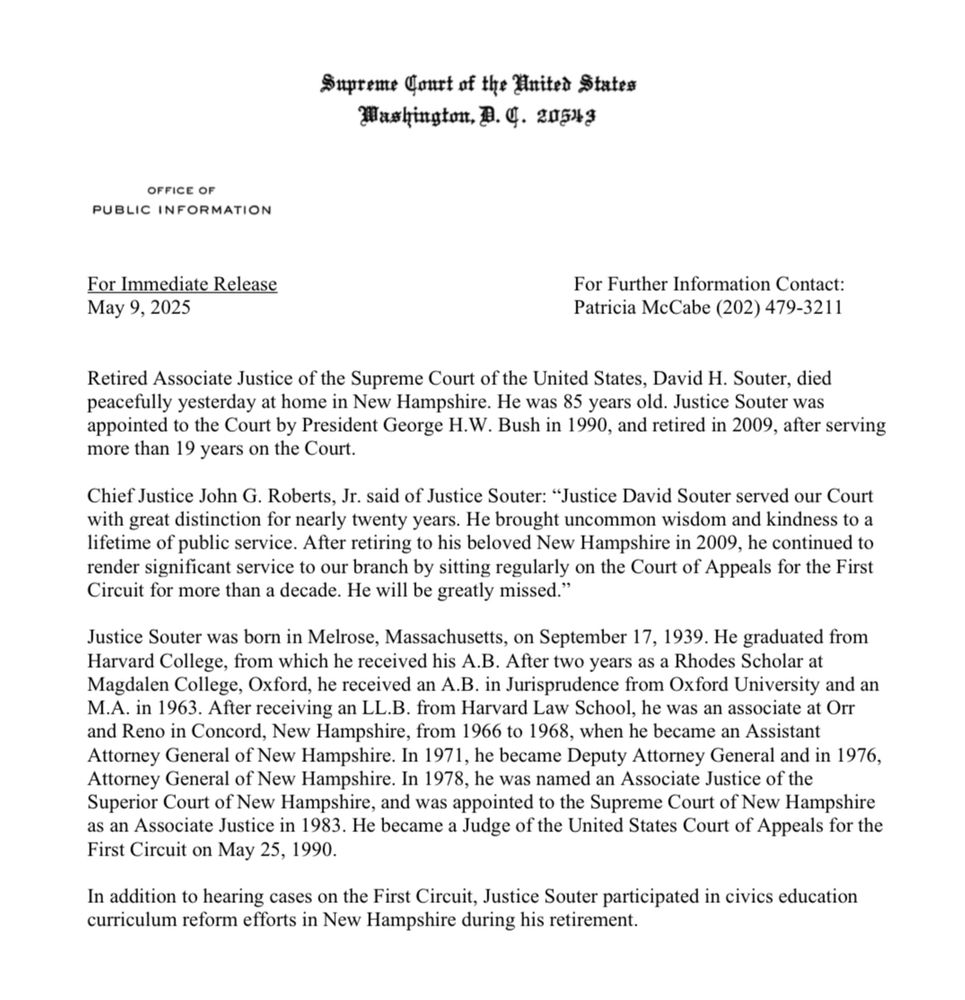
Retired Associate Justice of the Supreme Court of the United States, David H. Souter, died peacefully yesterday at home in New Hampshire. He was 85 years old. Justice Souter was appointed to the Court by President George H.W. Bush in 1990, and retired in 2009, after serving more than 19 years on the Court.
Chief Justice John G. Roberts, Jr. said of Justice Souter: "Justice David Souter served our Court with great distinction for nearly twenty years. He brought uncommon wisdom and kindness to a lifetime of public service. After retiring to his beloved New Hampshire in 2009, he continued to render significant service to our branch by sitting regularly on the Court of Appeals for the First Circuit for more than a decade. He will be greatly missed."
Justice Souter was born in Melrose, Massachusetts, on September 17, 1939. He graduated from Harvard College, from which he received his A.B. After two years as a Rhodes Scholar at Magdalen College, Oxford, he received an A.B. in Jurisprudence from Oxford University and an M.A. in 1963. After receiving an LL.B. from Harvard Law School, he was an associate at Orr and Reno in Concord, New Hampshire, from 1966 to 1968, when he became an Assistant Attorney General of New Hampshire. In 1971, he became Deputy Attorney General and in 1976, Attorney General of New Hampshire. In 1978, he was named an Associate Justice of the Superior Court of New Hampshire, and was appointed to the Supreme Court of New Hampshire as an Associate Justice in 1983. He became a Judge of the United States Court of Appeals for the First Circuit on May 25, 1990.
In addition to hearing cases on the First Circuit, Justice Souter participated in civics education curriculum reform efforts in New Hampshire during his retirement.
From the Supreme Court: Retired Justice David Souter died yesterday at the age of 85.
09.05.2025 13:07 — 👍 457 🔁 130 💬 15 📌 45
Politics, Groups, and Identities is an official journal of the Western Political Science Association. Visit our homepage: https://www.tandfonline.com/journals/rpgi20
Political scientist studying American law and courts, state politics, and southern politics | Coonhound dad | Southern highlander | https://davidhughesphd.com/
Human Rights Person (@humanrightsperson.bsky.social). Co-Founder, HRMI (@rightstracker.bsky.social). Center Director & Associate Professor. Music Enthusiast. Views are my own and are not endorsed by my employer; reposts & likes are not endorsements. He/Him
Research Development Associate | Weidenbaum Center on the Economy, Government, and Public Policy @ WashU | views my own
Donald R. Kinder Collegiate Professor of Political Science, Research Professor at the Center for Political Studies, University of Michigan
The University of Michigan's Center for Political Studies (CPS) posts about social science research, politics, policy, and free data resources.
Institute for Social Research (ISR) — a global leader in social science.
Exploring politics, health, inequality, and more at the University of Michigan.
Howard and Caroline Cayne Distinguished Professor of Law, WUSTL. Con law 📜, crim law/pro 👮, SCOTUSology 🏛. Cohost 🎤 @dividedargument.bsky.social.
Professor of Political Science, George Washington University | American politics, judicial politics, Supreme Court, public opinion | https://blogs.gwu.edu/bartels
Political science professor. Aspiring polyglot. Globetrotting citizen.
In-depth, independent reporting to better understand the world, now on Bluesky. News tips? Share them here: http://nyti.ms/2FVHq9v
Kirkland & Ellis Professor of Law, Harvard Law School. Aligning Election Law: https://global.oup.com/academic/product/aligning-election-law-9780197662151.
Political science, Syracuse University
Information effects, misperceptions, egg sandwiches
My book is "The Invented State: Policy Misperceptions in the American Public"
Assistant Prof of Political Science, judicial decision-making, separation of powers, agenda-setting at SCOTUS, 👧🏼👦🏼🐶
Incoming Postdoctoral Researcher @nuffieldcollege.bsky.social | Comparative political behavior, gender & representation | Political Science Ph.D. @ricepolisci.bsky.social
www.gdilandro.com
Professor at @washu.edu researching gender and politics and women’s political representation. More info at: www.dianaobrien.com
Assistant Professor at Georgia State College of Law
Reproductive Justice Scholar/Advocate + all things health law, FDA, social justice, and dogs. 🐶
Views are my own.
Postdoctoral Fellow at UT Austin | Judicial politics, American political institutions, Formal theory | Blessed to support the Bills, cursed to care about the Sabres | anthonytaboni.com
Political Scientist/Assistant Professor, Claremont Graduate University | 2019-20 APSA Congressional Fellow | Optimistic @WSUcougars & @Mariners fan | https://calgara.github.io