Eligibility:
• Presenting authors of a paper accepted by the Political Communication Division
• Usually only one presenting author per paper can receive a grant
Questions? Contact Rico Neumann (rico.neumann@fu-berlin.de)
#ICA26 #PolComm
05.02.2026 10:01 — 👍 0 🔁 0 💬 0 📌 0

📣 Travel Grants – ICA Political Communication Division
We invite applications for travel grants from ICA attendees without sufficient funding. These grants are especially directed at students and junior scholars from Tier B/C.
Apply here: forms.gle/iL6asnCvBF7x...
05.02.2026 10:01 — 👍 0 🔁 1 💬 1 📌 1
📢 Call for Papers | Communication and the Public
Special Issue: Co-Producing Environmental Publics: Technology, Communication & Ecological Transformation
🗓️ Abstract deadline: 20 March 2026
Please RT & share with interested colleagues 🌍📣
04.02.2026 20:31 — 👍 4 🔁 2 💬 0 📌 0

Handbook on Critical Discourse Studies
Edited by Bernhard Forchtner and Franco Zappettini
Featuring a series of engaging conversations with key figures in the field, this accessible Handbook outlines the crucial concepts of Critical Discourse Studies (CDS). Mapping the existing literature, contributors use qualitative and quantitative research to invite new engagements with CDS and to provide insight into primary debates.
📢 OUT NOW: Handbook on Critical Discourse Studies (2026)
www.elgaronline.com/edcollbook/b...
26.01.2026 09:51 — 👍 14 🔁 7 💬 1 📌 9

Postdoc position(s) at The Digital Democracy Centre
Application deadline: February 15th, 2026, 23:59 CET/CEST.
4 𝐎𝐩𝐞𝐧 𝐏𝐨𝐬𝐢𝐭𝐢𝐨𝐧𝐬 (𝐏𝐡𝐝, 𝐏𝐨𝐬𝐭𝐝𝐨𝐜, 𝐅𝐮𝐥𝐥 𝐏𝐫𝐨𝐟𝐞𝐬𝐬𝐨𝐫) 𝐚𝐭 𝐭𝐡𝐞 𝐃𝐃𝐂!!! 😯🤩
The DDC is expanding its team with *4* new opportunities for researchers passionate about the intersection of AI, media, democracy, & society.
Deadline: 📅 Feb 15 for 3 of these roles!
The Professorship deadline follows in March.🧵👇
21.01.2026 12:12 — 👍 28 🔁 33 💬 2 📌 1
Call for Abstracts open for the 3rd Annual Communication Horizons Conference at UC Davis. This year’s theme is Communication in the Age of AI and Algorithms
📌 Submission deadline: March 1, 2026 (AOE)
📌 Conference dates: May 15–17, 2026 T
communication.ucdavis.edu/horizonconf2...
15.01.2026 14:30 — 👍 1 🔁 0 💬 0 📌 0

Time is running out! You have just a few hours left to submit your work to #APSA2026, taking place September 3–6. The submission deadline is today, 11:59 p.m. Pacific.
👉 Submit now to the Polcomm Division: buff.ly/PRvg2Wq
#Polcomm
14.01.2026 15:36 — 👍 1 🔁 0 💬 0 📌 0
AMSTERDAM ❤️ ALSO BEAUTIFUL IN WINTER 😍 🎿🧀
One more week to apply to this postdoc position in Political Communication @ascor.bsky.social
Thank you for sharing 🫶
Please reach out if you have any questions.
@polcomm.bsky.social @fgkommpol.bsky.social @alessandronai.bsky.social
12.01.2026 10:48 — 👍 12 🔁 15 💬 0 📌 0

The 📚 Encyclopedia of Political Communication 📚 is now out in the wild, and a first awesome batch of entries is available in open access!
Read them, love them, use them for your courses! 🔥
Check the 🧵 below to access them
Plz repost for maximum diffusion
08.01.2026 13:28 — 👍 30 🔁 15 💬 1 📌 2
Going Local? Localized Rhetoric in Congressional Communications
In the face of the purported nationalization of political discourse in the United States, to what extent do congressional representatives still engage locally through their public communications? B...
🚨NEW PAPER
Going Local? Localized Rhetoric in Congressional Communications
Is congressional comms really nationalized?
Analyzing 9M+ social media posts from Members of Congress, I show that local messaging is still common & strategic. New ML + domain sharing data
www.tandfonline.com/doi/full/10....
07.01.2026 10:11 — 👍 11 🔁 7 💬 1 📌 1
This may be of interest to researchers of #PolComm #DiscourseStudies #TeamRhetoric
@polcomm.bsky.social @ecpr-polcom.bsky.social @critdiscstuds.bsky.social @liprg.bsky.social @discoursenet.bsky.social @theframelab.bsky.social @jlanpol.bsky.social
18.12.2025 13:04 — 👍 5 🔁 3 💬 0 📌 0

A Show for Us: How Racial and Partisan Cues About Television Audiences Affect Exposure Intentions
Stewart M. Coles
Assistant Professor
Department of Communication
University of Illinois Urbana-Champaign
Current explanations for political divides in entertainment media use identify divergent preferences for or evaluations of content. According to the theory of normative social behavior (TNSB), extratextual information such as cues about the audience may also influence exposure intentions due to viewers’ perceptions of ingroup norms. Social media users discuss and form communities around entertainment content while conveying partisan and racial identities. A preregistered experiment exposed Black and white partisans (N = 1,259) to tweets in which a television show was endorsed by co- or out-partisans who were racial in- or out-group members. Exposure intentions were stronger when endorsement came from co-partisans; however, this effect was stronger for white partisans. Treatment effects were mediated by perceived ingroup norms and perceptions of how much of the audience consisted of ingroup members. Implications of multiple identities (i.e., race and partisanship) for the TNSB and the study of partisan entertainment divides are discussed.
Accepted for publication in Human Communication Research. The final article will be available, upon publication, via its DOI: 10.1093/hcr/hqaf032
Forthcoming at @hcr-journal.bsky.social: "A Show for Us: How Racial and Partisan Cues About Television Audiences Affect Exposure Intentions"! More to follow once the final version is published, but just glad this will be out in the world soon! #PolComm #PoliSci #Politics #MediaStudies
16.12.2025 16:44 — 👍 12 🔁 6 💬 1 📌 2
After 3 years and 5,322 emails (and counting) our Encyclopedia of Political Communication is finally out at @elgarpublishing.bsky.social
📚 Three volumes
⭐ 431 entries
🎓 581 wonderful authors from across the world
A very short 🧵
10.12.2025 16:05 — 👍 159 🔁 59 💬 7 📌 18
5️⃣Meltzer (2025) shows how intersectional identities shape responses to political messages.
6️⃣Rovira-Sancho (2025) makes the case for ethnography to capture lived identities in social movements.
09.12.2025 17:13 — 👍 0 🔁 0 💬 0 📌 0
3️⃣Neumann (2025) calls for conceptual precision and multi-level approaches to studying affective polarization.
4️⃣Orchard & Santos (2025) highlight identity-based information repertoires in news use.
09.12.2025 17:13 — 👍 0 🔁 0 💬 1 📌 0
1️⃣ McGregor & @kcoe.bsky.social Coe (2025) argue that political communication scholarship must adopt a clearer stance on the role of identity.
2️⃣Boyer (2025) introduces the Political Group Communication framework with four archetypes of group-based communication.
09.12.2025 17:13 — 👍 1 🔁 0 💬 1 📌 0

We’re excited to share Issue 32 of the Political Communication Report!
This issue explores the emerging role of identity in Political Communication and features 6 contributions! You can also read interviews with award winners!
politicalcommunication.org/issue/winter...
09.12.2025 17:13 — 👍 3 🔁 0 💬 1 📌 1

The ICA review deadline is now Dec 12.
If you’re able to submit your #PolComm reviews ahead of the new deadline, it would greatly help us keep the process running smoothly.
Thanks so much for your time and commitment! 💙
08.12.2025 14:59 — 👍 3 🔁 1 💬 0 📌 0

Abstract: Recent political communication scholarship finds that groups and identities play a central role in the crises faced by political and media systems globally, particularly in democracies. Yet an individualist orientation in the literature has resulted in key theoretical and conceptual limitations, preventing a broader group-centric theoretical framework from emerging. We synthesize disparate bodies of theory on groups, politics, and communication to offer three basic propositions underlying a group theory of political communication. First, it is the group—not the individual—that is the fundamental organizing unit of social and political life. Second, groups are constituted through communication, which is central to how they define their politics. Third, groups and politics are reciprocally influencing forces through political communication, oriented around power. We offer a framework for studying the role of groups in political communication at the micro, meso, and macro levels, providing a concrete agenda for the study of groups in political communication.
🚨New pub alert!🚨 Now available open-access in @journal-of-comm.bsky.social, we (w/ @dkreiss.bsky.social, @danlane.bsky.social, & @shannimcg.bsky.social) critique political communication's "Identity Turn" and offer instead a foundation for studying #polcomm from a *group* perspective. 🧵
03.12.2025 18:04 — 👍 82 🔁 41 💬 2 📌 2

📢 Reminder: Call for Applications — Editor(s) of Political Communication
There’s still time to apply to be the next editor(s) of Political Communication!
📅 Deadline for application packages: December 31, 2025
Full details here: shorturl.at/gl8XO
01.12.2025 14:05 — 👍 2 🔁 0 💬 0 📌 0

Who shares which sources on social media, and why does this matter politically? Our open-access @polcommjournal.bsky.social article shows how far-right French Twitter/X users strategically post and cite sources to achieve their goals. doi.org/10.1080/1058... #polisky #commsky #migcitsky A 🧵:
21.11.2025 07:19 — 👍 42 🔁 19 💬 3 📌 2

Call for Papers: AI, Public Opinion, and Democratic Resilience
Special Issue of the International Journal of Public Opinion Research
Guest Editors: Homero Gil de Zuñiga and Hugo Marcos-Marne
Editor-In-Chief: Porismita Bora
Call for papers:
IJPOR has a call for a special issue on AI, public opinion and democratic resilience.
1000 word initial abstract submission
🗓️: deadline February 15, 2026
@ddc-sdu.bsky.social @aimediademlab.bsky.social @algosoc.org @polcomm.bsky.social #commsky
academic.oup.com/ijpor/pages/...
20.11.2025 07:47 — 👍 12 🔁 13 💬 0 📌 2
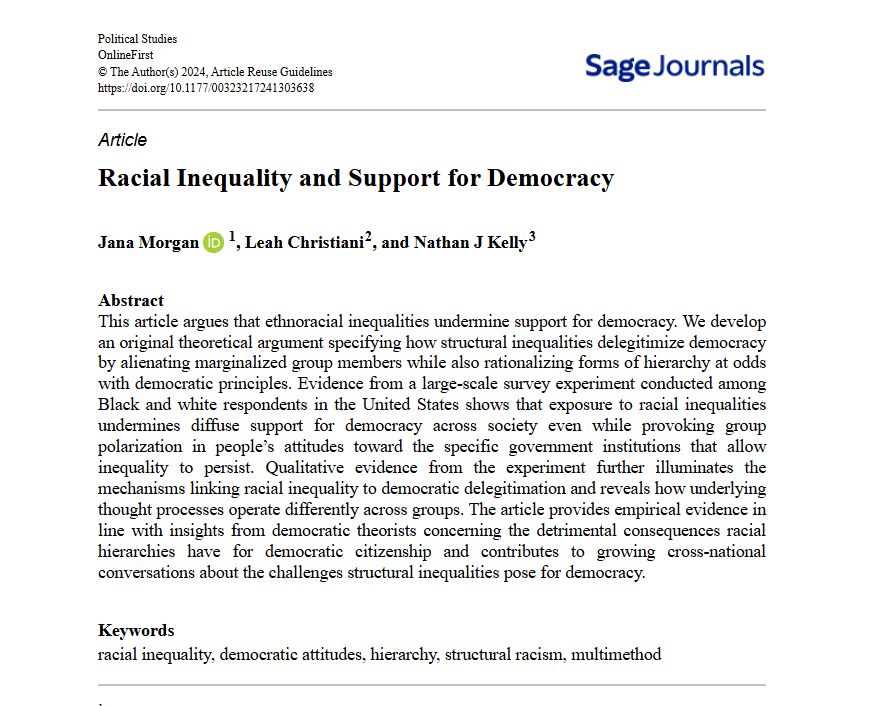
IN NEW ISSUE: Racial Inequality & Democracy - @janamorgan.bsky.social, @leahchristiani.bsky.social & Nathan J Kelly argueethnoracial inequalities undermine support for democracy. Read in @polstudies.bsky.social: buff.ly/VaeXszt
@polstudiesassoc.bsky.social @uoypolitics.bsky.social @sagepub.com
16.11.2025 22:01 — 👍 5 🔁 3 💬 0 📌 1
📖DDC PUBLICATION UPDATE📖
@hannescools.bsky.social on...
THE EVOLVING ROLE OF JOURNALISTS AS GATEKEEPERS IN THE AGE OF (GENERATIVE) ARTIFICIAL INTELLIGENCE
...in The Handbook of Artificial Intelligence and Journalism.
17.11.2025 09:03 — 👍 2 🔁 1 💬 0 📌 0

📢 ONE WEEK REMINDER!: the Department of Politics and International Relations and Oxford School of Global and Areas Studies seeks to appoint an Associate Professor in the Politics of Latin America.🗓️ CLOSES: Noon (GMT), Mon 24 Nov: www.politics.ox.ac.u...
17.11.2025 12:00 — 👍 4 🔁 5 💬 0 📌 0

🚨 Call for Papers!
The Polcomm Section invites submissions for #APSA2026, taking place September 3–6.
Next year’s theme is “Democracy Under Threat: How to Understand, Protect & Rebuild.”
👉 Submit now: buff.ly/PRvg2Wq
14.11.2025 13:55 — 👍 5 🔁 2 💬 0 📌 0
Don´t forget to submit your work to the Polcomm Section for the APSA Annual Meeting!
07.11.2025 16:36 — 👍 2 🔁 1 💬 0 📌 0

How News Media, Climate Anxiety, and Trust Shape Pro-Climate Behaviour Across Eight Countries - Waqas Ejaz, Mary Sanford, Richard Fletcher, 2025
Despite the importance of climate news in shaping public engagement, little is known about how different types of media – mainstream and non-mainstream – relate...
Research by our own @waqasejaz.bsky.social and others proves that climate journalism truly matters.
Drawing on online survey data from 🇧🇷🇫🇷🇩🇪🇮🇳🇯🇵🇵🇰🇬🇧🇺🇸 they show that mainstream news use is consistently associated with pro-climate behavioural intentions (using less energy, flying less often)
06.11.2025 11:09 — 👍 6 🔁 4 💬 1 📌 0
Associate Professor in Political Communication & Journalism @ascor.bsky.social
Co-Leader 'The Future of European Democracy' @acesuva.bsky.social | Media-Politics Relations, EU/European Politics, Election Campaigns, Political Behaviour
Political Communication is an international journal publishing theory-driven empirical research at the intersection of politics and communication.
https://www.tandfonline.com/journals/upcp20
Postdoc at ETH Public Policy Group & Immigration Policy Lab. Political Communication, Public Opinion, NLP.
STL native, UM-St. Louis x Michigan State alum. (Full) Prof at Newhouse School (Syracuse U, USA) studying gaming + emerging media. Launch Editor, Global Perspectives of Communication (Oxford x ICA).
danbischof.com
Political Scientist: studying democracy with experiments & data
Professor | University of Münster
Associate Professor | Aarhus University
(he/him | "Sie" als Anrede brauche ich nicht)
A flagship journal of @PolStudiesAssoc.bsky.social
Find us on https://journals.sagepub.com/home/psw
This is the home of the ACSJ Division of ICA on BlueSky. Follow us for all news on our activities, and all things related to activism research and social justice.
🔬 Researching changing forms of political engagement in an unstable and unpredictable global environment
📍 University of Leeds, UK
🧑💻 https://cdp.leeds.ac.uk
Associate Professor at the School of Communication & Information, Rutgers University | Research on politics, tech, trust, misinformation network science, computational social science | PI at http://chip50.org, http://covidstates.org, http://naiom.net
Postdoc in Dept of Communication at U of Missouri || Ohio State Alum || Polcomm, information integrity, computational methods, social media, emerging media
100% human. Views my own. ❤️ ☮️
https://qinlicomm.github.io
Excellent research on communication and media and high-level education at the University of Zurich – Established 1903 🌐 www.ikmz.uzh.ch
The Centre for Democratic Futures is an interdisciplinary research network collaborating internationally from the University of Southampton
email us: cdf@soton.ac.uk
https://www.southampton.ac.uk/research/institutes-centres/centre-for-democratic-futures
We are the Democratic Innovations Related Group of the American Political Science Association.
Follow us for updates on events and publications in the field.
ECREA section promoting thought-provoking research on the dynamic relationship between #media, #communication and #democracy 👇https://t.co/7NN8ijQSh8
Associate Professor at UMass Amherst studying the civic impacts of media distribution. I work in our Journalism Department and also co-edit the Distribution Matters series for The MIT Press. Opinions mine.
Mastodon: @josh@sciences.social
🟢 We are the EU | Global Dialogue office of the Heinrich-Böll-Stiftung (@boell.de), the German Green political foundation, located in Brussels 🌻🇪🇺
Posts by @jmlanfranco.bsky.social
All our socials: https://linktr.ee/boell_eu