A very, very brief history of time
From tracking the heavens to formulating relativity and entropy, understanding time has been a major human endeavour, says a University of Melbourne expert
“Time is intimately tied up with the structure of space and the way things work. It’s not a blank canvas upon which you impose your existence, it’s part of your machinery and existence – the passage of time.”
#time #science #curiosity
pursuit.unimelb.edu.au/articles/a-v...
06.02.2026 19:54 — 👍 0 🔁 0 💬 0 📌 0

How brains construct reality with Karl Friston
We tend to think of the mind as something that passively perceives an objective world. But perception is active, inferential, and deeply shaped by uncertainty. In this interview with the Institute of ...
We often think of the mind as something that passively perceives an objective world. | https://bit.ly/49UAMxr
In this interview, neuroscientist Karl Friston argues that the brain is not a mirror of reality but a prediction machine, constantly constructing the world it experiences.
#philsci
28.01.2026 18:30 — 👍 12 🔁 6 💬 0 📌 0

AI cannot automate science – a philosopher explains the uniquely human aspects of doing research
While AI can streamline certain parts of the scientific process, a philosopher argues that it cannot replace human expertise and collaboration.
AI can speed up research, but it can’t automate science. Pattern-finding isn’t discovery. Humans still decide what counts as evidence, which questions matter, and whether results survive replication and debate into consensus.
#AI #Science #Neuroscience #research #philosophy #AIphilosophy
23.01.2026 13:07 — 👍 0 🔁 0 💬 0 📌 0

From Generalisation to Deliberation
I write about the human ability to move from generalisation to deliberation
If human deliberation is grounded in episodic memory and lived, embodied experience, what would it take for AI to get anything like that grounding?
Thank you @arjensenius.bsky.social for a nice article on my trial lecture.
#AI #BRAIN #embodiedAI #AIresearch
www.arj.no/2026/01/09/g...
16.01.2026 11:16 — 👍 3 🔁 0 💬 0 📌 0

Is AI pretending to be intelligent, or is it really? @blaiseaguera.bsky.social #Technology #Books
Researcher and CTO at Google, Blaise Agüera y Arcas, argues that AI's intelligence lies in its ability to make predictions.
Read the full article: bigthink.com/books/blaise...
14.01.2026 17:03 — 👍 7 🔁 3 💬 0 📌 1

Why You Should Welcome Life's Surprises with Gratitude
- Research News
Each time you have an experience that defies your expectations, your brain becomes slightly more fine-tuned.
Perhaps you should start the new year with welcoming life's surprises?🤔
Your brain becomes slightly more fine-tuned every time you have an experience that defies your expectations!🧠
Read about @olgasko.bsky.social's research here:
www.uio.no/english/rese...
05.01.2026 13:41 — 👍 2 🔁 1 💬 1 📌 0


From a workshop on collaboration skills, two things stood out as essential foundations of good teamwork: TRUST & COMMUNICATION:
👉Reliability, transparency & a space where it’s safe to ask, challenge & learn.
👉Clarity on goals, roles, expectations & feedback.
Strong science is built together!
18.12.2025 13:29 — 👍 2 🔁 0 💬 0 📌 0


Seeing my own child take part in an eye-tracking study today reminded me how hard research is: babies move, get distracted, and don’t follow instructions…yet every single data is precious.🧠👶
A little reminder: research needs participants, stubborn researchers, and funding to exist at all.💙
01.12.2025 12:28 — 👍 2 🔁 0 💬 0 📌 0
 23.11.2025 21:09 — 👍 0 🔁 0 💬 0 📌 0
Animals seamlessly combine what they see and hear. This study presents a simple, biologically inspired model that predicts how visual and auditory cues are integrated across humans, monkeys, and rats.
🔗 buff.ly/HfMDRkH
19.11.2025 16:15 — 👍 10 🔁 2 💬 0 📌 0

Sources: Nature (https://www.nature.com/articles/d41586-018-05133-8), National Human Genome Research Institute (https://www.genome.gov/ human-genome-project), The Guardian (https://www.theguardian.com/uk-news/2018/jun/18/dna-fingerprinting-30-years-on), National Institutes of Health (https://ghr.nlm.nih.gov/primer/testing/genetictesting), Science (https://science.sciencemag.org/content/337/6096/816).
🧪RIP James Watson, one four scientists credited with deciphering the structure of DNA.
It was Rosalind Franklin’s X ray diffraction image that revealed the double helix structure.
08.11.2025 02:28 — 👍 135 🔁 48 💬 7 📌 2

1/ Want to try your hand at science communication but don’t know where to start?
We put together seven tried and tested tips for communicating preprinted research with suggestions and resources that can help you on social media and beyond! #SciComm
🔗 buff.ly/1jesQg5
06.11.2025 21:03 — 👍 8 🔁 4 💬 1 📌 1

Brain Dynamics of Mental Manipulation
Humans effortlessly juggle their internal thoughts, but the neuronal dynamics that support mental manipulation are largely unknown. Leveraging the high spatiotemporal fidelity of intracranial recordin...
What happens in the brain when we manipulate our thoughts?
We asked 30 epilepsy patients to mentally invert short melodies.
Intracerebral #iEEG recordings suggest brain synchrony and sensory inhibition are key for mental manipulation:
doi.org/10.1101/2025...
#neuroskyence #musicscience
22.10.2025 05:25 — 👍 37 🔁 13 💬 1 📌 1

Figure from Alnes et al., 2025
Our new paper on auditory processing in NREM sleep is online! We study how iERP and HFA responses in the temporal lobe are modulated by slow waves of sleep:
www.sciencedirect.com/science/arti...
Congratulations to Sigurd Alnes for his brilliant work and to the entire team!
06.11.2025 07:55 — 👍 10 🔁 3 💬 0 📌 0

Our brains evolved to survive, not to find truth | Samuel McKee
We like to believe that reason is our pathway to truth. Yet from Popper’s demand for falsifiability to Darwin’s doubt about the mind’s origins, a more unsettling picture is emerging. In an age that pr...
📖A fascinating read on how our mental architecture is shaped more for social cohesion and survival than for discovering objective truth. Evolution has given us a brain that’s brilliant… but maybe not built to find the truth of the word.🌟🧠
#evolution #brain
iai.tv/articles/our...
04.11.2025 19:51 — 👍 4 🔁 0 💬 0 📌 0

From MRI to Ozempic: breakthroughs that show why fundamental research must be protected
In these financially straitened times, funders must recognize that great discoveries often arise from work that was looking for something completely different.
We praise innovation, yet starve the science that makes it possible. The history of discovery shows a simple truth: transformative breakthroughs arise from questions without immediate utility. Support curiosity, not just impact!!!🔬🧠
www.nature.com/articles/d41...
#research #curiosity #science
01.11.2025 17:55 — 👍 1 🔁 0 💬 0 📌 0
🚨 Join me for a hands-on #iElectrodes tutorial at #PracticalMEEG!
📍 Online • 🗓 Thursday, Oct 30 • 14:00–17:00 CET
Learn how to localize intracranial electrodes — and explore many other great toolboxes:
cuttingeeg.org/practicalmee...
#iEEG #ECoG #SEEG
12.09.2025 07:40 — 👍 5 🔁 3 💬 0 📌 0

🧠🚨The first brain-wide map of neural activity during complex behaviour has been created!
Read the study here: lnkd.in/dh8hwxjw
#brain #neuroscience #nature #brainmapping #behavior
10.09.2025 15:40 — 👍 2 🔁 0 💬 0 📌 0
«As statistical machines, the models make predictions by generalizing on the basis of learnt associations, leading them to produce answers that are plausible, but sometimes wrong.»
08.09.2025 18:29 — 👍 0 🔁 0 💬 0 📌 0

Pioneering journal eLife faces major test after loss of impact factor
The open-access title’s bold publishing model has brought long-bubbling conflicts to the fore.
📉 Big shift in publishing: eLife has lost its Impact Factor, raising debate over its bold open-review model, and the continuing dominance of traditional metrics.
🔗 Full story in Nature: www.nature.com/articles/d41...
#OpenScience #AcademicPublishing @elife.bsky.social
08.09.2025 07:40 — 👍 1 🔁 0 💬 0 📌 0
🧠🎶 New research shows your brain doesn’t just hear sounds, it reshapes itself in real time.
Scientists at Aarhus University & Oxford developed FREQ-NESS, a new method to map brain networks by their frequencies.
#Neuroscience #Brainwaves #MusicAndTheBrain
02.09.2025 20:42 — 👍 2 🔁 0 💬 0 📌 0

Predictive encoding of auditory sequences in the human prefrontal cortex
Humans extract regularities from the environment to form expectations that guide perception and optimize behavior. Although the prefrontal cortex (PFC) is central to this process, the relative contrib...
🤔How does the human brain predict unexpected sounds?
Our new study shows that the prefrontal cortex doesn’t work as a single unit. Instead, the orbitofrontal and lateral prefrontal cortex make distinct, time-sensitive contributions. #iEEG #BrainLesion #OFC #LPFC
doi.org/10.1101/2025...
29.08.2025 08:08 — 👍 10 🔁 5 💬 1 📌 0
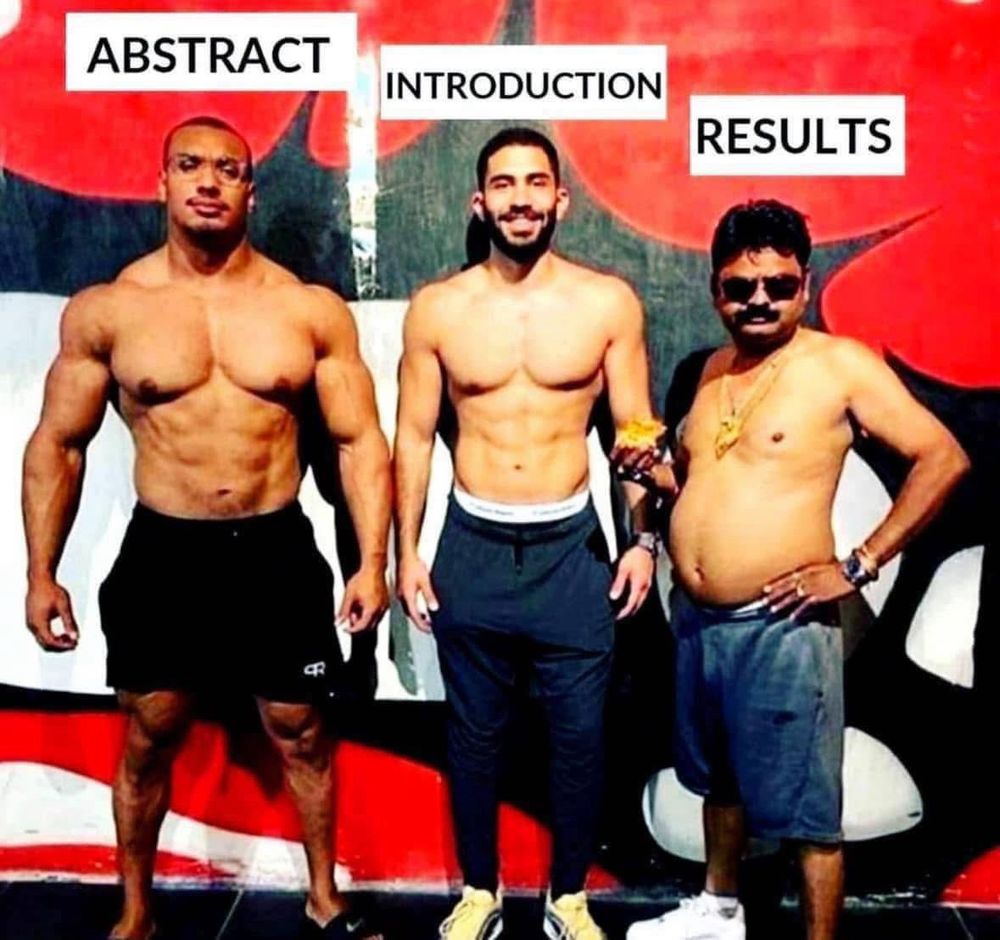
Science in one picture 🧠🔬😁
#research #academicword #science
27.08.2025 19:30 — 👍 1 🔁 0 💬 0 📌 0
Cognitive neuroscience, stupid jokes and philosophy
M.Sc Cognitive Science | IIT Gandhinagar | Human and Computer Vision
Math Assoc. Prof. (on leave, Aix-Marseille, France)
Interest: Prob / Stat / ANT. See: https://sites.google.com/view/sebastien-darses/research?authuser=0
Teaching Project (non-profit): https://highcolle.com/
Trinity College Dublin. IrrationalityLab. Interested in human decision-making. https://www.ktsetsoslab.net/join-us
PI @ Auditory Neuroscience Laboratory, Medical University of Gdańsk, Poland. | I’m into sound. | Family guy. | Guitar player/electronic musician.
Brain scientist at Cambridge & Helsinki | Assistant Professor U Catolica del Maule | Creator of 'Talking Brains' 🧠🎙️
https://www.ccc-lab.org/canalesjohnson.html
Cognitive neuroscientist, studying social affective behavior || University of Lübeck || imp.uni-luebeck.de
I'm a scientist studying resilience w/ children & families who experience adversity, like homelessness & loss.
RG: www.researchgate.net/profile/J-J-Cutuli/publications
Substack: https://joewillard.substack.com/
PhD researcher 👩🔬
Cognitive neuroscientist 🧠
Brain-body interaction 🫀🫁🧠
Lifespan development 👵
Music cognition!!! 🎹🎵🎶
Science communicator #scicomm
Working at:
MPI for Human Cognitive & Brain Sciences, Leipzig
MPI for Human Development, Berlin
Learn from the world’s biggest thinkers. Curious / Thoughtful / Open / Constructive. Changing media with @freethinkmedia.
Neuroscientist at University of Iowa Neurosurgery, researching into the neural bases of auditory perception. Also a musician.
Professor of Cognitive Neuroscience at the FIL, UCL, using human neuroimaging to study how our prior knowledge influences the way we perceive the world. https://www.fil.ion.ucl.ac.uk/team/visual-perception-team/
Staff scientists / RSE @LCBC_UiO & @LifebrainEU. She/Her.
PhD Cognitive Neurosciences 🧠
@rladies.org Global Team.
#Rstats #Nerd 🌈🏳️🌈
https://Drmowinckels.io
Reformed neuroscientist. Advocate for sexual health & sex worker rights. Often found in the park with the crows. I also like ducks 🏳️🌈🏳️⚧️ (he/him) 🇵🇸
Associate Professor at the University of Birmingham ∙ Neuroeconomics, Decision Neuroscience, and Behavioral Economics ∙ Previously at the University of Zurich and Ohio State ∙ #StandWithUkraine
A global, inclusive community of researchers who believe rigorous research deserves to be discoverable, widely disseminated and freely accessible, working to advance science for the benefit of all.
Vi gir deg siste nytt fra forskning innenfor helse- og sosialvitenskap, samfunnsvitenskap, ledelse, diakoni og teologi.
VID er en av de største private høgskolene i Norge. Du finner oss i Oslo, Bergen, Stavanger, Sandvika, Tromsø og Helgeland.
Nyheter om forskning, fag, kunstnerisk arbeid og samfunnsdebatt fra Kristiania.
The Norwegian Reproducibility Network (NORRN) is a peer-led network that aims to promote and enable rigorous, robust and transparent research practices in Norway