À la recherche du temps perdu: will AI and 150 years of human movement research drive the next Neuroscience revolution?
Click on the article title to read more.
…been silent for a while, reappeared with a piece in @jphysiol.bsky.social on #MotorControl #Neurophysiology and #AI #history -> behavioral research holds valuable insights that new AI methods can leverage to understand brain function.
tinyurl.com/cbc64ff6
#neuroscience #NeuroAI #cognitivescience
18.03.2025 07:51 — 👍 2 🔁 2 💬 0 📌 0
Sure, we do have upcoming PhD positions. Please send me your CV via email. Thanks!
12.03.2025 16:23 — 👍 0 🔁 0 💬 0 📌 0
#neuroscience #neuroskyence #eeg #TMS #brainstimulation #motioncapture #motorcontrol
29.02.2024 13:36 — 👍 0 🔁 0 💬 0 📌 0

The role of dorsal premotor cortex in joint action inhibition - Scientific Reports
Scientific Reports - The role of dorsal premotor cortex in joint action inhibition
The third is on how interpersonal motor coordination is regulated via neurophysiological #inhibition. Here we confirm a dissociation between fast and slow inhibition and provide evidence that dorsal #premotor areas are key for motor co-adaptations. t.ly/EJStV
29.02.2024 12:23 — 👍 1 🔁 0 💬 1 📌 0

Submovement interpersonal coupling is associated to audio-motor coordination performance - Scientific Reports
Scientific Reports - Submovement interpersonal coupling is associated to audio-motor coordination performance
The second is on the multiple time-scales of #interpersonal #motor coordination. Here we demonstrate that submovement coordination is a potentially fundamental mechanism that participates in interpersonal motor coordination regardless of the sensory domain mediating the interaction. t.ly/szd0h
29.02.2024 12:21 — 👍 0 🔁 0 💬 1 📌 0
What a week this has been! 3 papers out and its still Thursday!
Definitely too much, now I should brace for 6 months of rejections 😀
29.02.2024 12:18 — 👍 1 🔁 0 💬 1 📌 0
Human Motor Neurophysiology Post-doc position in Ferrara, Italy - #EEG #TMS #BrainStimulation #MoCap
Come join us!
#Neuroscience #neurojobs
tinyurl.com/54396vd6
30.12.2023 11:38 — 👍 4 🔁 3 💬 1 📌 0

Lawful good: Bayesian models
Neutral good: Social network analysis
Chaotic good: Dynamical systems theory
Lawful neutral: Drift diffusion
True neutral: Information theory
Chaotic neutral: Agent-based models
Lawful evil: Symbolic logic
Neutral evil: Neural networks
Chaotic evil: Quantum mechanics
I have a bunch of things I have to get done, so naturally I decided to procrastinate by making an alignment chart of mathematical models
19.12.2023 01:03 — 👍 230 🔁 77 💬 17 📌 9

Brain-wide topographic coordination of traveling spiral waves
bioRxiv - the preprint server for biology, operated by Cold Spring Harbor Laboratory, a research and educational institution
Have you wondered whether fast spatiotemporal brain dynamics like traveling waves are local, confined to just one region, or whether they are shared across many regions simultaneously? The latest work from Zhiwen Ye in my lab has the answer! Thread-
www.biorxiv.org/content/10.1...
17.12.2023 06:40 — 👍 23 🔁 7 💬 1 📌 0
This one has a similar vibe, yet with a tiny bit more "evolutionary" and "vintage" flavour ;))
"The great end of life is not knowledge but action"
by Thomas H. Huxley
(found here: tinyurl.com/2p98w2kd )
14.12.2023 15:36 — 👍 1 🔁 1 💬 0 📌 0
(channeling my inner Daniel Wolpert)
The sole reason our brains have memory is to help us take better decisions and actions in future.
13.12.2023 17:14 — 👍 7 🔁 1 💬 3 📌 0
Indeed! I thought you referred to "intra-effector" synergies, but I totally see your point now, and it partially resonates with other stuff we're doing (e.g., tinyurl.com/42a9dwvh ). Thanks for the useful suggestion! I'll let you know if something interesting pops out!
13.12.2023 13:48 — 👍 1 🔁 0 💬 1 📌 0
Unfortunately not, but very interesting indeed! …here we only measured the FDI during an index finger ad/abduction. To do that we would probably need a more “complex” task…
Rather, we’re working on cortico-muscle (or better force) coherence in alpha range with great satisfaction ;)
13.12.2023 11:26 — 👍 0 🔁 0 💬 1 📌 0
Sad but very true. As for the Italian case, there's one clear reason: the National Scientific Habilitation, introduced in 2012, filters applications based on 3 thresholds (different for each area) on #pub last 5Y, #citations last 10Y, h-index last 10Y.
Classic example of Goodhart's law.
13.12.2023 10:06 — 👍 3 🔁 0 💬 0 📌 0
We suggest this may reflect a non-linear mapping between corticospinal excitability and multiscale movement oscillations, potentially linked to the hierarchical organization of descending motor pathways.
12.12.2023 17:47 — 👍 0 🔁 0 💬 0 📌 0
Surprisingly, unlike motor output oscillations, which decrease in amplitude as their frequency increases, corresponding changes in corticospinal excitability maintain a similar magnitude across different timescales.
12.12.2023 17:47 — 👍 0 🔁 0 💬 1 📌 0
We delivered #TMS over M1 while participants were performing a visuomotor task involving isometric force production and assessed #corticospinal excitability modulation time-locked to task-instructed force modulation, as well as to #submovements and #tremor in the motor output.
12.12.2023 17:46 — 👍 0 🔁 0 💬 1 📌 0
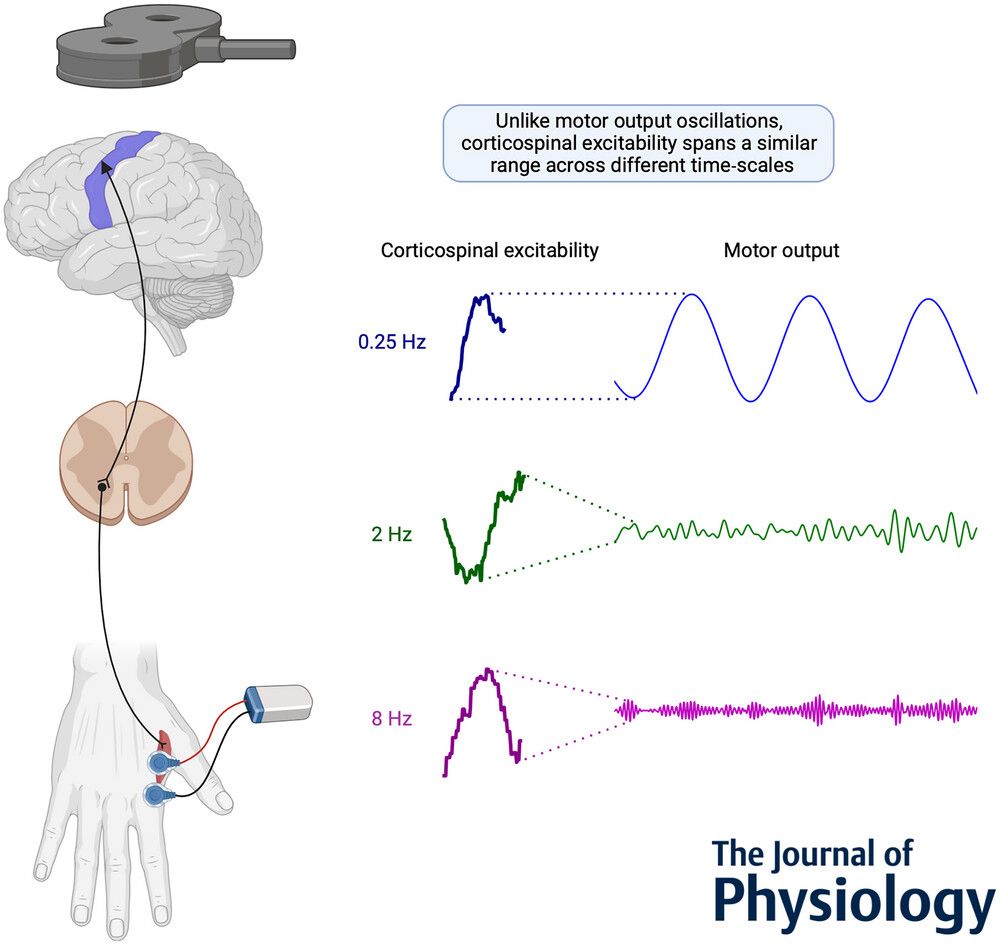
Graphical abstract of the paper in Journal of Physiology describing that unlike motor output oscillations, corticospinal excitability (as measured via TMS) spans a similar range across different time-scales. Namely the instructed one at 0.25Hz, that of submovements at 2Hz and that of tremor at 8Hz.
Hi everyone! Here is my first paper on Bsky: "Scale-invariant Changes in Corticospinal Excitability Reflect Multiplexed Oscillations in the Motor Output" in Journal of Physiology
By Marco Emanuele, me, Giacomo Koch, Luciano Fadiga and Alice Tomassini
#Neuroscience #BrainStim
tinyurl.com/yka2w7hb
12.12.2023 17:45 — 👍 7 🔁 2 💬 2 📌 0
On Wednesday, I'll be 'debating' Sven Bestmann about sample size. Does 'Sky has any interesting (controversial?) views on this which are particularly relevant for the paradigms ans methods use for sensorimotor control research? Please RT
11.12.2023 09:42 — 👍 7 🔁 5 💬 3 📌 0
this is a cool one!
11.12.2023 17:26 — 👍 1 🔁 0 💬 0 📌 0

Powered by Gorilla
Make the world a better place by participating in cutting edge behavioural research. Powered by Gorilla
How predictable is neuroscience? Can LLMs outperform humans? Please participate in the BrainGPT.org survey to help us find out. You choose between two versions of a neuro abstract: the original vs. one with altered results. Which is which? research.sc/participant/... 1/2
11.12.2023 10:50 — 👍 21 🔁 35 💬 2 📌 0
Cool! so quick! thanks!
11.12.2023 14:48 — 👍 1 🔁 0 💬 0 📌 0
Hi, I just made a Feed to collect "Brain Stimulation" content - hope you find it useful (-> add "Brain Stimulation" in your txt) #neuroscience
@markrubin.bsky.social
bsky.app/profile/did:...
11.12.2023 14:41 — 👍 6 🔁 2 💬 1 📌 0
...AND WE ARE HIRING: Postdoc for 12 months (+18 further months possible extension already funded) in beautiful Trento/Rovereto on the Dolomite Alps to work on EEG modeling with a brain stimulation perspective CVs to paolo.belardinelli@gmail.com PLEASE RT lavoraconnoi.unitn.it/en/research-...
10.12.2023 15:01 — 👍 2 🔁 2 💬 0 📌 0
When it comes to awesome diagrams in early biomechanics works, Borelli remains undefeated. (From De Motu Animalium, 1680)
10.12.2023 22:05 — 👍 9 🔁 1 💬 0 📌 0

Diagram of a person doing a vertical jump on an early pressure plate with a string connected to a cap on their head to measure the height of the jump.
Source: Etienne Jules Marey (1895). Movement. New York: D. Appleton & Co.
There are some next-level diagrams in old scientific books and articles. This one from Movement (1895) by EJ Marey. Fig 101: Method of simultaneously recording the foot pressure on the ground and the changes in elevation of the body during a jump.
I heard he sketched it himself in MS Paint.
06.12.2023 01:48 — 👍 11 🔁 2 💬 1 📌 1
Recent MSc Neuroscience graduate (University of Sheffield) with expertise in TMS and tES. Passionate about neuromodulation and computational neuroscience.
Postdoctoral Research Fellow at institutducerveau.bsky.social | Interested in motor learning, brain stimulation & electrophysiology. Fascinated by the cerebellum.
Postdoc researcher at Neuroscience & Society (Italian Institute of Technology and Sapienza University of Rome)
Cognitive neuroscientist studying visual perception, attention, and eye-movements. Views are my own.
Canadian living in the UK || Assistant Professor @Northumbriauni.bsky.social || Sport, Exercise & Rehabilitation 🇬🇧 || @nuneurofunc.bsky.social
CNRS scientist (neurolinguistics). LPL, ILCB & Aix-Marseille University.
ERC Consolidator Laureate (2025) for the project ‘LaDy’ (‘Language in the Dyad’)
Husband of Elin. Dad of Scott & Alessio.
#science #cycling & #wine
(personal account)
🔧 Researcher in Biomechanics and Robotics
🌱 Climate Activist
⛺️ Happy Camper
🇫🇷 Montpellier, France
Cognitive Scientist at Max Planck, Professor of Psychology
https://www.falkhuettig.com/
Author of 'Looking Ahead: The New Science of the Predictive Mind' published by Cambridge University Press on 6 March 2025.
We study the relationship between objects, concepts, and language from an embodied & grounded cognition perspective—Led by Anna Borghi
https://sites.google.com/view/annaborghilab
@Sapienza University of Rome, Italy
@ISTC-CNR, Rome, Italy
Interested in how we think (concepts, inner speech) and interact with objects (affordances) and other people. Sapienza University and ISTC-CNR, Rome. Body Action Language Lab @ballabrome.bsky.social - https://sites.google.com/view/anna-m-borghi - she/her
٣٤ ⋅ Doctor ⋅ Specialist Registrar (ST7) in Neurology 🧠 ⋅ PhD candidate @uclqsion.bsky.social — #HD-YAS https://orcid.org/0000-0002-0679-0117
Cognitive Neuroscience/Lazy Violinist
Interested in Computational modeling، neuroimaging and neurostimulation
All things neurotech 🧠 | Postdoc in transcranial ultrasound stimulation 🔊 University of Oxford | jaketoth.tech
PhD candidate
Neuromodulation: tACS/tDCS/otDCS
Psychiatric Disorders: SCZ/MDD/BD/OCD/GAD
Auditory EEG/ERP Researcher, Consultant, Audiology Doctoral Student www.charleswasserman.com
UF BME Professor; Neuromechanist merging humans and machines (mobile EEG, bionic prostheses, robotic exoskeletons, virtual reality)
PI of Neuroscience of Speech and Action (NoSA) Lab | Senior Lecturer at Lancaster University | Co-host of Drs Confess pod | Lover of speech, ears, action, and brains