thanks
23.01.2026 19:06 — 👍 1 🔁 0 💬 0 📌 0
Philippe Meidinger
@physpm.bsky.social
pht, PhDc
38 Followers |
114 Following |
26 Posts |
Joined: 13.11.2024 |
1.8898
@physpm.bsky.social
pht, PhDc
thanks
23.01.2026 19:06 — 👍 1 🔁 0 💬 0 📌 0Sorry if this is a basic question, but what is the best way to present descriptive data?
21.01.2026 14:07 — 👍 0 🔁 0 💬 1 📌 0Hello, could you give me your email address? I'll send you the article ☺️
Rgds

À Noël, le carnage des animaux n’émeut pas grand monde
Par @luciedelaporte.bsky.social et @jadelindgaard.bsky.social

A table showing profit margins of major publishers. A snippet of text related to this table is below. 1. The four-fold drain 1.1 Money Currently, academic publishing is dominated by profit-oriented, multinational companies for whom scientific knowledge is a commodity to be sold back to the academic community who created it. The dominant four are Elsevier, Springer Nature, Wiley and Taylor & Francis, which collectively generated over US$7.1 billion in revenue from journal publishing in 2024 alone, and over US$12 billion in profits between 2019 and 2024 (Table 1A). Their profit margins have always been over 30% in the last five years, and for the largest publisher (Elsevier) always over 37%. Against many comparators, across many sectors, scientific publishing is one of the most consistently profitable industries (Table S1). These financial arrangements make a substantial difference to science budgets. In 2024, 46% of Elsevier revenues and 53% of Taylor & Francis revenues were generated in North America, meaning that North American researchers were charged over US$2.27 billion by just two for-profit publishers. The Canadian research councils and the US National Science Foundation were allocated US$9.3 billion in that year.

A figure detailing the drain on researcher time. 1. The four-fold drain 1.2 Time The number of papers published each year is growing faster than the scientific workforce, with the number of papers per researcher almost doubling between 1996 and 2022 (Figure 1A). This reflects the fact that publishers’ commercial desire to publish (sell) more material has aligned well with the competitive prestige culture in which publications help secure jobs, grants, promotions, and awards. To the extent that this growth is driven by a pressure for profit, rather than scholarly imperatives, it distorts the way researchers spend their time. The publishing system depends on unpaid reviewer labour, estimated to be over 130 million unpaid hours annually in 2020 alone (9). Researchers have complained about the demands of peer-review for decades, but the scale of the problem is now worse, with editors reporting widespread difficulties recruiting reviewers. The growth in publications involves not only the authors’ time, but that of academic editors and reviewers who are dealing with so many review demands. Even more seriously, the imperative to produce ever more articles reshapes the nature of scientific inquiry. Evidence across multiple fields shows that more papers result in ‘ossification’, not new ideas (10). It may seem paradoxical that more papers can slow progress until one considers how it affects researchers’ time. While rewards remain tied to volume, prestige, and impact of publications, researchers will be nudged away from riskier, local, interdisciplinary, and long-term work. The result is a treadmill of constant activity with limited progress whereas core scholarly practices – such as reading, reflecting and engaging with others’ contributions – is de-prioritized. What looks like productivity often masks intellectual exhaustion built on a demoralizing, narrowing scientific vision.

A table of profit margins across industries. The section of text related to this table is below: 1. The four-fold drain 1.1 Money Currently, academic publishing is dominated by profit-oriented, multinational companies for whom scientific knowledge is a commodity to be sold back to the academic community who created it. The dominant four are Elsevier, Springer Nature, Wiley and Taylor & Francis, which collectively generated over US$7.1 billion in revenue from journal publishing in 2024 alone, and over US$12 billion in profits between 2019 and 2024 (Table 1A). Their profit margins have always been over 30% in the last five years, and for the largest publisher (Elsevier) always over 37%. Against many comparators, across many sectors, scientific publishing is one of the most consistently profitable industries (Table S1). These financial arrangements make a substantial difference to science budgets. In 2024, 46% of Elsevier revenues and 53% of Taylor & Francis revenues were generated in North America, meaning that North American researchers were charged over US$2.27 billion by just two for-profit publishers. The Canadian research councils and the US National Science Foundation were allocated US$9.3 billion in that year.

The costs of inaction are plain: wasted public funds, lost researcher time, compromised scientific integrity and eroded public trust. Today, the system rewards commercial publishers first, and science second. Without bold action from the funders we risk continuing to pour resources into a system that prioritizes profit over the advancement of scientific knowledge.
We wrote the Strain on scientific publishing to highlight the problems of time & trust. With a fantastic group of co-authors, we present The Drain of Scientific Publishing:
a 🧵 1/n
Drain: arxiv.org/abs/2511.04820
Strain: direct.mit.edu/qss/article/...
Oligopoly: direct.mit.edu/qss/article/...
Bonjour,
Merci de votre retour.
Belle journée
Très heureux de recevoir la bourse doctorale de @arthritiscanada.bsky.social
Témoigner d'un succès est important, souligner ses échecs l'est tout autant
Pour 5 bourses, seulement une a reçu un retour favorable
C'est capital à mes yeux de contribuer à un narratif qui met en lumière cet aspect
Bonjour,
Sera t-il possible de consulter un replay de cet événement svp ?
Bonne journée
@floriannaye.bsky.social
16.09.2025 14:15 — 👍 0 🔁 0 💬 0 📌 0
Après plusieurs interpellations publiques et internes par des personnes racisées dans des événements écolos comme le festival Les Résistantes, la parole antiraciste se libère.
Vert a mené l’enquête👇

Abstract submission and travel grant application for the 9th World Conference on Research Integrity are open. Please consider to submit an abstract and to reshare this message. lnkd.in/eJ9hmaRs
27.06.2025 09:15 — 👍 14 🔁 18 💬 1 📌 3Merci du partage
02.07.2025 14:50 — 👍 1 🔁 0 💬 0 📌 0🚨Offre de bourse de thèse🚨 [pour les 🇫🇷phones]
Le laboratoire GAEL (Grenoble) offre une bourse de thèse de 3 ans en *économie* sur le projet PREFALIM: analyse de l’impact des interventions de politiques publiques sur les préférences alimentaires des consommateurs.
Pour plus d'infos me contacter!

Is red meat bad for you? New meta study of 44 studies finds it depends on the sponsor.
If the sponsor was impartial, most studies find it's bad for you.
If the sponsor was the red meat industry, most studies are structured to find no problems.
pubmed.ncbi.nlm.nih.gov/40379522/
@floriannaye.bsky.social
17.05.2025 22:03 — 👍 1 🔁 0 💬 0 📌 0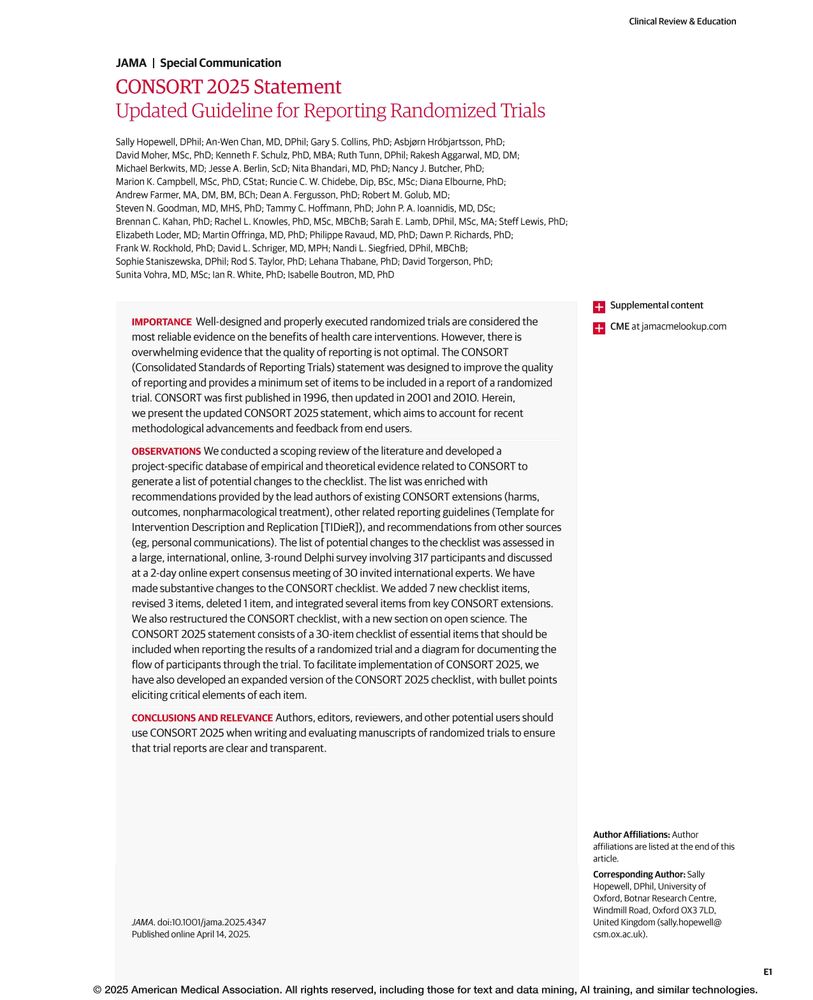
Image shows PDF.
Authors, editors, reviewers, and other potential users should use CONSORT 2025 when writing and evaluating manuscripts of randomized trials to ensure that trial reports are clear and transparent.
Learn more in this Special Communication. https://ja.ma/3Yyu0Hh

The h-index is frequently used, but it has many shortcomings. Colleagues at #ScholCommLab made two educational videos explaining why it should never be used in isolation when evaluating researchers. Read more in our guest blog by @stefhaustein.scholcommlab.ca & team sfdora.org/2025/04/07/i...
07.04.2025 16:33 — 👍 20 🔁 10 💬 0 📌 3
Il paraît que c’est ‘impossible’ d’aller en train au Maroc. La bonne nouvelle, c’est que c’est faisable, et accessible !
Dans cet article se trouve tous les détails, avec le prix de chaque étape et l'empreinte carbone du voyage. Hâte de lire vos retours !
bonpote.com/aller-au-mar...
@floriannaye.bsky.social
24.03.2025 13:27 — 👍 1 🔁 0 💬 0 📌 0@floriannaye.bsky.social
23.03.2025 01:58 — 👍 0 🔁 0 💬 0 📌 0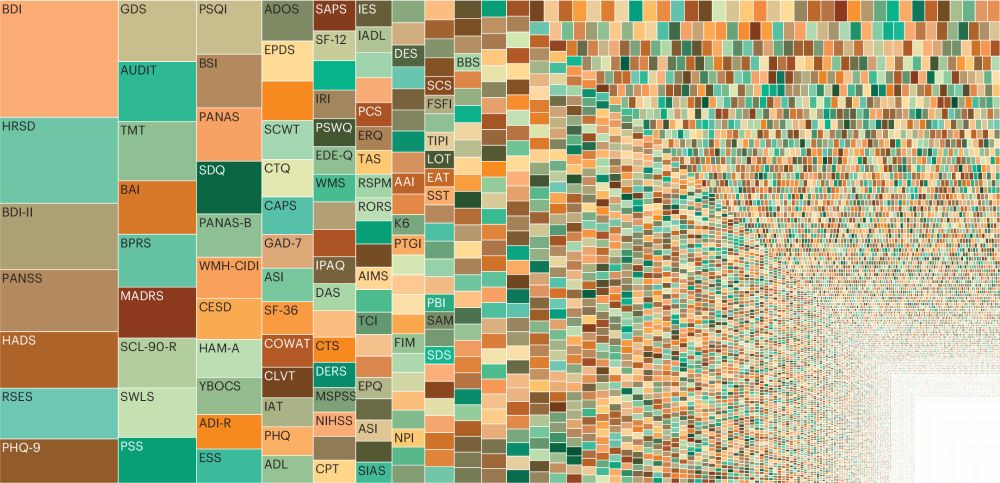
New comment by @faridanvari.bsky.social and friends arguing that psychology is fragmented into the study of too many constructs and measures with too few links.
www.nature.com/articles/s41...
"Concentrez-vous les antispécistes" (@clemovitch.com)
Viktorovitch a raison en soi dans ce qu'il dit – c'est-à-dire à quel point l'animalisation est une arme incroyablement dangereuse pour de nombreuses catégories d'humains qui sont ainsi ramenées à une infériorité méprisable

GROSSE ANNONCE !
Du 14 au 18 juillet, au cœur des Alpes, le Cortecs organisera sa première École douteuse, une école d’été autogérée de la pensée critique. Le nombre de place est limité et les candidatures ouvriront prochainement.
Plus d'info ci-dessous.
cortecs.org/non-classe/j...
@floriannaye.bsky.social
02.03.2025 23:24 — 👍 1 🔁 0 💬 0 📌 0@floriannaye.bsky.social
28.02.2025 20:28 — 👍 1 🔁 0 💬 0 📌 0Génial merci
12.02.2025 15:40 — 👍 0 🔁 0 💬 0 📌 0Bonjour,
Sera t-il possible de voir en différé cette intervention ?
Belle journée
@floriannaye.bsky.social
11.02.2025 22:17 — 👍 0 🔁 0 💬 0 📌 0@floriannaye.bsky.social
05.02.2025 17:14 — 👍 1 🔁 0 💬 0 📌 0@floriannaye.bsky.social
01.02.2025 22:13 — 👍 1 🔁 0 💬 0 📌 0