Can Gottesman–Kitaev–Preskill (GKP) encoding turn homodyne detection into a practical tool for revealing Bell nonlocality?
The answer is yes, and in fact GKP states also lead to strong and robust multipartite nonlocality with homodyne detection!
Today on arXiv: arxiv.org/abs/2601.16189 1/n.
23.01.2026 07:43 — 👍 10 🔁 3 💬 1 📌 0
Thanks a lot to Gianmichele Blasi and Géraldine Haack from Uni Geneva, Yuri Minoguchi and @entangledanarchist.bsky.social from Vienna for the amazing collaboration where we combined tools from quantum transport, condensed matter and thermodynamics to arrive at this cool result!
19.01.2026 11:36 — 👍 1 🔁 0 💬 0 📌 0
This phenomenon is rooted in the spectral rigidity also encountered in random matrix theory, and ubiquitous in fermionic systems. Thus, rigidity of the resulting time signal in this clock is remarkably robust: thermal noise, disorder, and finite size effects only perturbatively affect the scaling.
19.01.2026 11:36 — 👍 0 🔁 0 💬 1 📌 0
Therefore, when two excitations (ticks) are too close to each other, the following excitation arrives a bit later, correcting for the previous error. This leads to an exponentially reduced variance growth compared to independent errors.
19.01.2026 11:36 — 👍 0 🔁 0 💬 1 📌 0
For independent errors, the timing variance usually grows linearly in time. Here, the fermionic excitations are intrinsically correlated due to the Pauli statistics. This prevents excitations from clustering too closely together but also from being too far apart.
19.01.2026 11:36 — 👍 0 🔁 0 💬 1 📌 0

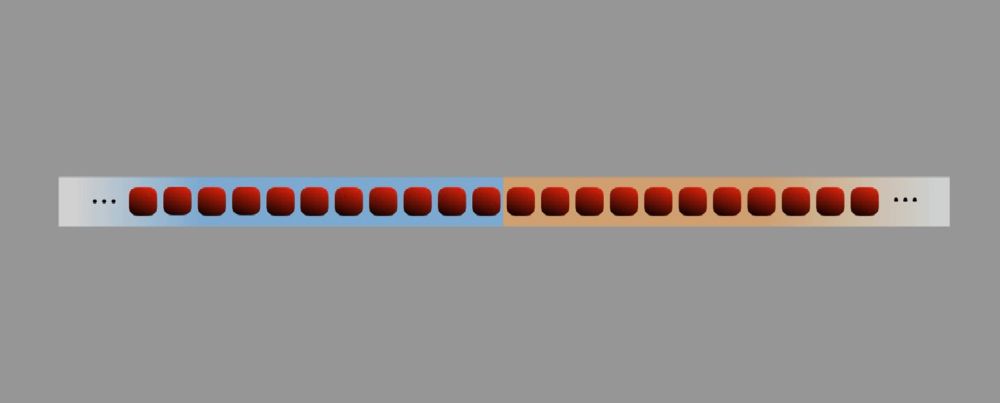
Chain of quantum two level systems. Excitations traveling from left to right, each time marking a tick when they leave on the right.
From one tick to the next, small timing uncertainties in clocks usually add up because of the independence of errors. Using fermions tunneling through a quantum wire as clock ticks, we found a way to build a clock where errors cancel out rather than accumulate. arxiv.org/abs/2601.10785
19.01.2026 11:36 — 👍 12 🔁 4 💬 1 📌 0

Bell Inequality Violations Without Entanglement? It's Just Postselection
Recently Wang et al. have reported a violation of a Bell inequality without entanglement [arXiv:2507.07756]. We show that their result is an artifact of postselection. It is well known that postselect...
Glad someone took the time to debunk the (obviously nonsensical) claim that Bell inequalities could be violated w/o entanglement. It is astonishing (to say the least) that this claim was made by experienced authors & that it passed peer review in the first place, does not reflect well on the journal
20.08.2025 09:22 — 👍 45 🔁 7 💬 2 📌 1
A fun project with Seok Hyung, Jeongrak ( @perp-waterfall.bsky.social ), @nellynghy.bsky.social , and Paul Boes. We dusted off some old notes because there seemed to be renewed interest in what differentiates thermal operations from Gibbs-preserving maps.
arxiv.org/abs/2507.16637
23.07.2025 07:27 — 👍 14 🔁 3 💬 0 📌 0
time-reversal with indefinite causal order
15.07.2025 06:48 — 👍 0 🔁 0 💬 0 📌 0
sounds fishy 🐟
10.07.2025 08:12 — 👍 0 🔁 0 💬 1 📌 0
Congrats to Jake and all the collaborators for this fantastic work. They take the well studied problem of cooling quantum systems and use cool mathematics from group and graph theory to systematically characterize and solve that problem.
13.06.2025 08:48 — 👍 6 🔁 0 💬 0 📌 0
In that sense, I'd put thermo on a level above, a meta-theory.
11.06.2025 20:02 — 👍 4 🔁 0 💬 0 📌 0
Good question! Well, I think it would indeed be more appropriate to put thermo on a different level of the hierarchy. Thermo is based on very general principles and those are usually fulfilled by microscopic theories which is why we see emergent thermodynamic phenomena in QTFs or also GR.
11.06.2025 20:02 — 👍 2 🔁 0 💬 1 📌 0
Thanks and congrats of course too 😀 Will be a volume with exciting theory
02.06.2025 12:38 — 👍 1 🔁 0 💬 0 📌 0
The beautiful artistic illustration in the first post is by Alexander Rommel (www.aerroscape.de), copyright by Alexander Rommel / TU Wien. I also thank my fantastic collaborators from @tuwien.at, @iqoqi-vienna.bsky.social, Chalmers and Malta from the @aspects-quantum.bsky.social consortium!
02.06.2025 10:44 — 👍 0 🔁 0 💬 1 📌 0
What this project also shows in my opinion is how important it is to create an informal, inviting and friendly discussion culture in science where also junior people happily express their opinions and thoughts; and how such an environment can seed exciting scientific projects. go.nature.com/4jWxUm7
02.06.2025 10:44 — 👍 2 🔁 0 💬 1 📌 0
Here, you can see an animation of the excitation travelling around a ring of 50 sites (y-axis = occupation probability, x-axis = where).
02.06.2025 10:44 — 👍 1 🔁 0 💬 1 📌 0
For example with quantum clocks it is possible to circumvent such limitations. The ring-clock does this by counting cycles completed by a single quantum particle traveling a ring. Since coherent transport is dissipation-free, this clock breaks the linear entropy-precision bound exponentially.
02.06.2025 10:44 — 👍 0 🔁 0 💬 1 📌 0
Generally, the more accurate a clock is, the more entropy it produces. For a wide range of classical stochastic clocks this is proved by the so-called "Thermodynamic Uncertainty Relation", which provides a linear relationship between clock precision and entropy.
02.06.2025 10:44 — 👍 0 🔁 0 💬 1 📌 0
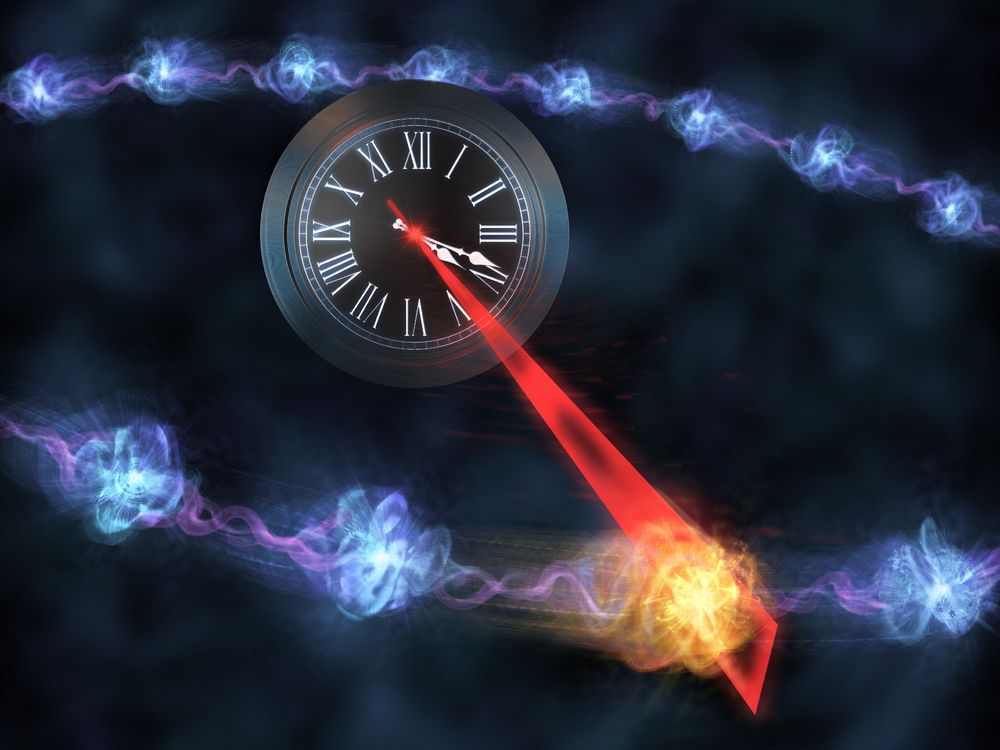
Copyright by Alexander Rommel / TU Wien.
What started as informal discussions on the Danube beach in Vienna during QTD2023 has been published at last. Trying to come up with an experimentally feasible quantum clock we came across a rich model – the ring clock – that overturned a common wisdom in the community. doi.org/10.1038/s415...
02.06.2025 10:44 — 👍 14 🔁 6 💬 1 📌 2
 12.05.2025 15:05 — 👍 4 🔁 0 💬 1 📌 0
Fantastic, congrats!
02.05.2025 07:40 — 👍 0 🔁 0 💬 1 📌 0
We are excited for Fundamental Limits of Quantum Technologies conference, Dublin, 25-29 August. Only three weeks left until the abstract submission deadline, don't delay! All details at www.aspects-quantum.com/flqt2025
07.04.2025 13:35 — 👍 7 🔁 2 💬 0 📌 2
Gozo QI - Expression of Interest
I really like no timetable free discussion workshops. It seems like the Benasque Quantum Information Workshop has gotten too many applicants to cater for the demand.
Having organised a couple confer...
Sms alot of people wanna go to Benasque QI than one can fit in the beautiful tiny village.
Having organised a bunch of stuff in Malta, I feel the urge to organise a straggler event on the island of Gozo.
If interested, fill this form so I can gauge interest - share!
forms.gle/azwrJe8AidrS...
31.03.2025 09:56 — 👍 6 🔁 1 💬 0 📌 0
We’re organising a conference in Dublin! Fundamental Limits of Quantum Technologies 2025 — everything from error mitigation on NISQ devices, through control constraints on complex quantum systems, to quantum thermodynamics and energetics, and much more! Abstract submission and registration open! 👇
25.03.2025 15:13 — 👍 10 🔁 6 💬 1 📌 0

Higher-Order Quantum Operations
An operational description of quantum phenomena concerns developing models that describe experimentally observed behaviour. $\textit{Higher-order quantum operations}\unicode{x2014}$quantum operations ...
Wrote up a little tutorial + review on higher-order quantum operations. If you love quantum channels, you can think of these as linear maps that act on channels themselves in manner fully consistent with quantum theory! I hope it helps future students / researchers! 🤗
arxiv.org/abs/2503.09693
14.03.2025 09:10 — 👍 31 🔁 10 💬 0 📌 1
Congrats Shintaro!
07.02.2025 13:49 — 👍 0 🔁 0 💬 1 📌 0
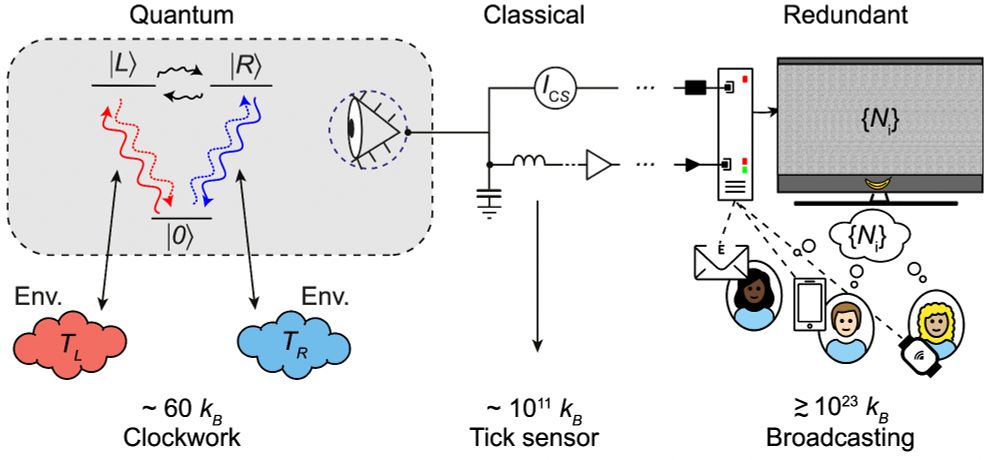
Depiction of the quantum-classical transition in a microscopic clock. A quantum clock transitions between three discrete states, driven by thermal noise. These transitions are amplified by a sensor into a classical signal, which can be shared among classical observers as an objective record of the passage of time.
Latest preprint from the ASPECTS consortium! arxiv.org/abs/2502.00096 Experiments by the amazing @naresgroup.bsky.social and theory by @mathsmire.bsky.social of @quitphysics.info We measured the entropy cost of generating and recording ticks in a microscopic clock
1/6 🧵👇
04.02.2025 18:52 — 👍 8 🔁 4 💬 1 📌 0
Das ist der offizielle Account der Parlamentsdirektion. Hier erhalten Sie Updates & Hintergründe zum parlamentarischen Geschehen.
Community-Regeln: http://parl.at/dQ5-
Nature Portfolio’s high-quality products and services across the life, physical, chemical and applied sciences is dedicated to serving the scientific community.
Official account of the Faculty of Physics (U of Vienna)
- Research updates
- Events, news & outreach
Impressum: https://physik.univie.ac.at/en/imprint/
Postdoctoral researcher @MPI-PKS Dresden
Quantum Condensed Matter Theory
Going in for sport for living | Struggling with Physics for passion
Quantum physicist, tenure-track assistant professor at the University of Parma; previously: Marie Skłodowska-Curie postdoctoral fellow at Scuola Normale Superiore, Pisa, Italy (https://qinfo.sns.it/)
Associate Professor at Cornell University
quantum Shannon theory, quantum information theory, quantum error correction, quantum communication, quantum algorithms, quantum computational complexity theory, quantum machine learning
Researching quantum information theory at the RIKEN Center for Quantum Computing in Japan.
A mathematician pretending to be a physicist or vice versa, depending on your point of view.
Assistant Professor (RTdB) at @sns.it. Succeeding at failing to understand quantum mechanics.
Quantum physics seminar. Online talks on recent breakthroughs for a broad audience - by researchers, for researchers. Join our mailing list on our website https://qmeets.eu!
Quantum Information PhD student at Scuola Normale Superiore of Pisa (Italy)
Physics & Reading & Music. Any permutation of the vowels is acceptable.
IOP Publishing is a society-owned scientific publisher, providing impact, recognition and value for the scientific community. IOP Publishing’s portfolio includes more than 90 journals.
Mathematician at UCLA. My primary social media account is https://mathstodon.xyz/@tao . I also have a blog at https://terrytao.wordpress.com/ and a home page at https://www.math.ucla.edu/~tao/
News, views and information for the global physics community. physicsworld.com
Associate Professor at the National University of Singapore. Quantum Metrology, Quantum Optics, Superresolution. https://blog.nus.edu.sg/mankei/
Quantum Physicist | views my own | following is not endorsement
Formerly known as Vienna Scientific Cluster (VSC)
https://asc.ac.at
• Most powerful supercomputers in Austria
• Research, education, user support
• HPC & AI training: https://events.asc.ac.at
scientist in quantum computing | dj | alt things | etc.
not here for any of that.
发布中文当我想的时候
jaykayz.com
Quantum information theorist. Lover of physics, math and good books.