Its a cycle.
Actions-> Results-> Beliefs -> Actions
We need more stories that help people learn from what’s working.
Not just what’s going wrong.
Not just what “has to happen by 2050.”
Real examples of action that others can see, understand & build on.
Here's a 🧵on advice & tips for sharing #climate stories that actually inspire action.
16.02.2026 08:13 — 👍 87 🔁 54 💬 1 📌 11
@obssea4clim.bsky.social
@ai4pex.bsky.social
@expect-project.bsky.social
@optimesm-eu.bsky.social
@terradt.bsky.social
@impetus4cs.bsky.social
@crices-h2020.bsky.social
@wcrp-cmip.org
@tipesm.bsky.social
@esm2025.bsky.social
@thierryaaron.bsky.social
@columbiauniversity.bsky.social
26.01.2026 10:23 — 👍 4 🔁 0 💬 0 📌 0

🥵 2024 El Niño pushed us over 1.5°C, making it the hottest year on record:
heatwaves
floods
hunger for +110 mln people
$3.4 trn in costs
Could such extremes trigger tipping points too?
@aromanou.bsky.social #NASA explains in next #ClimTipWebinar
Join 👉 3 Feb 2–3pm CET
bit.ly/climtip-webi...
26.01.2026 10:19 — 👍 8 🔁 6 💬 1 📌 0
Today, ESM2025 officially comes to an end!
Since 2021, our European consortium has been building a new generation of Earth System Models to support mitigation & adaptation strategies aligned with the Paris Agreement. Watch these clips of our final video to see how far we've come!
🧵👇
#ESM2025isOver
30.11.2025 17:03 — 👍 15 🔁 4 💬 1 📌 2

Goodbye to my incredible lead author team for Chapter 8 in IPCC's 7th assessment report. I will miss you all. IPCC, TSU, amazing LAM1 colleagues from all 3 working groups. I will miss Paris... All this till LAM2, thankfully. #IPCC_AR7 #LAM1
05.12.2025 20:30 — 👍 10 🔁 1 💬 0 📌 0
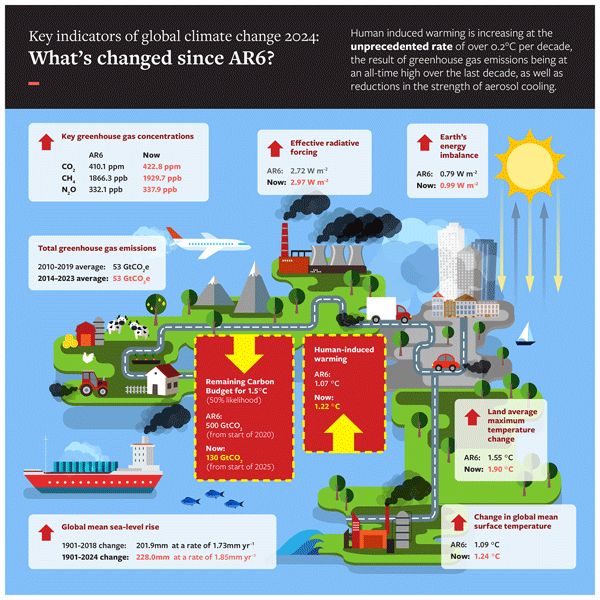
Indicators of Global Climate Change 2024: annual update of key indicators of the state of the climate system and human influence
Abstract. In a rapidly changing climate, evidence-based decision-making benefits from up-to-date and timely information. Here we compile monitoring datasets (published at https://doi.org/10.5281/zenodo.15639576; Smith et al., 2025a) to produce updated estimates for key indicators of the state of the climate system: net emissions of greenhouse gases and short-lived climate forcers, greenhouse gas concentrations, radiative forcing, the Earth's energy imbalance, surface temperature changes, warming attributed to human activities, the remaining carbon budget, and estimates of global temperature extremes. This year, we additionally include indicators for sea-level rise and land precipitation change. We follow methods as closely as possible to those used in the IPCC Sixth Assessment Report (AR6) Working Group One report. The indicators show that human activities are increasing the Earth's energy imbalance and driving faster sea-level rise compared to the AR6 assessment. For the 2015–2024 decade average, observed warming relative to 1850–1900 was 1.24 [1.11 to 1.35] °C, of which 1.22 [1.0 to 1.5] °C was human-induced. The 2024-observed best estimate of global surface temperature (1.52 °C) is well above the best estimate of human-caused warming (1.36 °C). However, the 2024 observed warming can still be regarded as a typical year, considering the human-induced warming level and the state of internal variability associated with the phase of El Niño and Atlantic variability. Human-induced warming has been increasing at a rate that is unprecedented in the instrumental record, reaching 0.27 [0.2–0.4] °C per decade over 2015–2024. This high rate of warming is caused by a combination of greenhouse gas emissions being at an all-time high of 53.6±5.2 Gt CO2e yr−1 over the last decade (2014–2023), as well as reductions in the strength of aerosol cooling. Despite this, there is evidence that the rate of increase in CO2 emissions over the last decade has slowed compared to the 2000s, and depending on societal choices, a continued series of these annual updates over the critical 2020s decade could track decreases or increases in the rate of the climatic changes presented here.
Our new paper updating key metrics in the IPCC is now out, and the news is grim:
⬆️ Human induced warming now at 1.36C
⬆️ Rate of warming now 0.27C / decade
⬆️ Sharp increase in Earth's energy imbalance
⬇️ Remaining 1.5C carbon budget only 130 GtCO2
essd.copernicus.org/...
18.06.2025 23:10 — 👍 659 🔁 482 💬 24 📌 67
Warming is accelerating. Tipping risks increasing. Net zero may not stop temperature rise.
‼️ Our joint policy brief outlines what new Earth System modelling means for EU climate policy.
👏 with @esm2025.bsky.social @optimesm-eu.bsky.social @tipesm.bsky.social #nextgems @rescueclimate.bsky.social
07.12.2025 17:24 — 👍 9 🔁 5 💬 0 📌 0

🌍 Earth System Insights: from our Horizon Projects Briefing 6 European Horizon projects gathered their insights together for an in-depth forum with the European Commission (DG RTD & DG CLIMA). Here’s what they had to say 👇 🔗 bit.ly/4pgvktX #ClimateAction #EarthSystem #HorizonEU
03.12.2025 13:58 — 👍 7 🔁 6 💬 2 📌 2
@esm2025.bsky.social
@ai4pex.bsky.social
@obssea4clim.bsky.social
@expect-project.bsky.social
@optimesm-eu.bsky.social
@terradt.bsky.social
@tipesm.bsky.social
@impetus4cs.bsky.social
@crices-h2020.bsky.social
@wcrp-cmip.org
@rescueclimate.bsky.social
@pik-potsdam.bsky.social
28.11.2025 13:29 — 👍 2 🔁 0 💬 0 📌 0

Large parts of the #Amazon face savanna-like dry seasons if deforestations levels reach 25%.
In the next #ClimTip webinar #JuliaPongratz @lmumuenchen.bsky.social talks about the state and future of the rainforest from the latest findings.
👉 Join on 2 Dec 2025 at 2–3pm CET
bit.ly/climtip-webi...
28.11.2025 13:27 — 👍 4 🔁 3 💬 1 📌 0

Shell ready to invest more in Italy if drilling permits unlocked
Shell is ready to invest more in Italy to boost hydrocarbon production, the head of the energy group's Italian unit said on Wednesday, urging the government to allow new drilling.
This is corporate manslaughter!
Every new well that Shell sinks kills more people.
Recent cutting-edge work by #climate scientists demonstrates how we can now attribute the deaths that will be caused from individual oil & gas projects...
www.nature.com/articles/s44...
28.11.2025 03:51 — 👍 92 🔁 56 💬 2 📌 1
@esm2025.bsky.social
@ai4pex.bsky.social
@obssea4clim.bsky.social
@expect-project.bsky.social
@optimesm-eu.bsky.social
@terradt.bsky.social
@tipesm.bsky.social
@impetus4cs.bsky.social
@crices-h2020.bsky.social
@wcrp-cmip.org
@rescueclimate.bsky.social
@pik-potsdam.bsky.social
03.11.2025 21:46 — 👍 2 🔁 0 💬 0 📌 0

⚖️ Most scientists agree #Greenland melt will likely tip the Atlantic currents, but can the #WestAntarcticIceSheet melt stabilize it?
Sacha Sinet @utrechtuniversity.bsky.social shares his findings soon to appear in @science.org #AMOC
Join #ClimTipWebinar 4 Nov 2-3pm CET
🔗 bit.ly/climtip-webi...
03.11.2025 21:43 — 👍 15 🔁 9 💬 1 📌 0

📈 It matters not just much our planet heats up, but how fast that happens.
Join today's #ClimTip webinar with Jan Swierczek-Jereczek from @ucm.es on this process called rate-induced tipping and the stability of Antarctic Ice Sheet.
7 October, 2025
2:00–3:00 pm CEST
👉 bit.ly/climtip-webi...
07.10.2025 09:53 — 👍 3 🔁 2 💬 0 📌 0
@esm2025.bsky.social
@ai4pex.bsky.social
@obssea4clim.bsky.social
@expect-project.bsky.social
@optimesm-eu.bsky.social
@terradt.bsky.social
@impetus4cs.bsky.social
@crices-h2020.bsky.social
@wcrp-cmip.org
@rescueclimate.bsky.social
@tipesm.bsky.social
@pik-potsdam.bsky.social
@exeter.ac.uk
01.10.2025 10:39 — 👍 3 🔁 0 💬 0 📌 0

Image of the Earth precariously balancing on a jenga tower with text that reads: "Out of Balance". Image credit: "Out of Balance" (Digital collage from Ai generated art with typography) by Kuat Abeshev.
⚠️ New study in @nature.com shows convincing observational evidence that the Greenland Ice Sheet, Atlantic Ocean currents (AMOC), Amazon rainforest & South American monsoons – are all losing resilience.
Read more tinyurl.com/26heycew
#ClimTip @tum.de @pik-potsdam.bsky.social @exeter.ac.uk
01.10.2025 10:36 — 👍 8 🔁 8 💬 1 📌 1
@maiaresilience.bsky.social
@ai4pex.bsky.social
@obssea4clim.bsky.social
@expect-project.bsky.social
@optimesm-eu.bsky.social
@terradt.bsky.social
@impetus4cs.bsky.social
@crices-h2020.bsky.social
@wcrp-cmip.org
@tipesm.bsky.social
@esm2025.bsky.social
@metoffice.gov.uk
@exeter.ac.uk
26.08.2025 09:42 — 👍 3 🔁 0 💬 0 📌 0
9/ Collapse this century looks unlikely, but weakening is almost certain and carries serious risks⚠️
“This is no excuse for complacency. A “big freeze” in Europe may not be imminent, but the urgency to act has never been greater. The AMOC’s future depends on our actions today," says the author
26.08.2025 09:31 — 👍 1 🔁 0 💬 1 📌 0

Climate impacts of a weakened Atlantic Meridional Overturning Circulation in a warming climate
The global and regional impacts of the AMOC slowdown on climate change in the 21st century are isolated and quantified.
8/ A weaker AMOC could shift rainfall belts, bringing drought to parts of the tropics.
❄️ Europe may face stormier winters and drier summers, ⬆️ the US east coast faster sea-level rise,
🌾 while ecosystems and food security worldwide could be disrupted.
www.science.org/doi/10.1126/...
26.08.2025 09:31 — 👍 2 🔁 0 💬 1 📌 0

6/ 2️⃣ Pacific circulation is too weak. In extreme cases, a Pacific Meridional Overturning Circulation (PMOC) forms – a reversed version of Pacific circulation today.
🌊 If strong enough, it could replace Atlantic sinking and trigger collapse.
But under realistic warming, it stays weak or absent.
26.08.2025 09:31 — 👍 1 🔁 0 💬 1 📌 0

5/ 1️⃣ 🌬️ Southern Ocean winds act like a pump, hauling deep water to the surface.
⚖️ That upwelling must be balanced by sinking elsewhere. Unless the Pacific fully takes over, some sinking will always remain in the Atlantic.
26.08.2025 09:31 — 👍 2 🔁 0 💬 1 📌 0

Continued Atlantic overturning circulation even under climate extremes - Nature
Climate models suggest that the Atlantic Meridional Overturning Circulation is unlikely to collapse this century, owing to stabilization from wind-driven upwelling in the Southern Ocean.
4/ To see AMOC’s response, authors used 34 climate models under two extreme scenarios:
1) quadrupling CO₂; 2) adding huge freshwater from Greenland.
In both cases the AMOC weakened, but didn’t completely shut down.
‼️ The explanation comes down to two stabilising factors:
tinyurl.com/264rmmrt
26.08.2025 09:31 — 👍 1 🔁 0 💬 1 📌 0
Real-time embedded parallel C software engineer, retired. Left the toys of NASA JPL for the winds of Wellington, NZ. My book connects money with Thermodynamics. The Laws of Thermodynamics are RADICALLY Anti-Capitalistic. NOT here to chat. *311.8ppm
Oceans. Climate. Society. And everything in between. Climate scientist and numerical modeler, aka Anastasia Romanou. NASA-GISS/Columbia U. Views my own. Profile image credit ECCO-JPL-NASA!!!
Your voice in the EU 🇪🇺
Updates, news, and insights from the European Parliament - the heart of European democracy.
Privacy policy: https://www.europarl.europa.eu/pdf/data_protection/data-protection-notice-bluesky-en.pdf
European Research Council, set up by the EU, funds top researchers of any nationality, helping them pursue great ideas at the frontiers of knowledge. #HorizonEU
27 EU governments making decisions together in the European Council & Council of the EU.
Learn, participate, share. Latest news @press.consilium.europa.eu
#eucouncil #euco
President of the @ec.europa.eu
Mother of seven. Brussels-born. European by heart. 🇪🇺
L'AFP : d'abord les faits 🌍
https://u.afp.com/liens
Euractiv is an independent pan-European media network. We are an essential, trusted source for news, analysis and debate on EU politics and policy. www.euractiv.com
« Le Monde » est un journal français fondé par Hubert Beuve-Méry en 1944. C'est aussi un compte Bluesky qui poste l'actualité en continu de façon automatisée.
Nobody knows politics and policy like we do.
Greenpeace's EU advocacy team in Brussels. Working on climate, energy, farming, forests, trade, pollution, lobby transparency, democracy and more
www.greenpeace.eu
The #CopernicusClimate Change Service (#C3S) & #CopernicusAtmosphere Monitoring Service (CAMS), implemented by @ecmwf.int on behalf of the @ec.europa.eu.
The EU channel for scientists & researchers: opportunities to fund your ideas, updates from EU-funded science, and scientific resources you can use in your work.
News and information from the European Commission. Social media and data protection policy: http://europa.eu/!MnfFmT
Sentientism, food policy for desired/anticipated consumption patterns, plant-based food for climate, consumption behaviour, history and reporting of global goals, framing.
Founding Director | Max Planck Institute of Geoanthropology
www.gea.mpg.de
mathematics, sustainability, climate extremes, texmacs, FOSS, cycling, Reading UK #RdgUK
Lecturer in Maths and Stats at #UniversityOfReading
A global network of social scientists focused on political conflicts around climate change, headquartered at Brown University. https://cssn.org/
Graduate student at Cardiff University - researching the role of science and scientists in the climate movement. PhD in Ecology. Activism. Climate communications.
Bsky archive of Official Horizon EU profile for the EU's Research & Innovation Programme.
europa.eu/!Xf47NRP
check out also @creativeeurope.bsky.social and @euerasmusplus.bsky.social
atm powered by @gogash.bsky.social