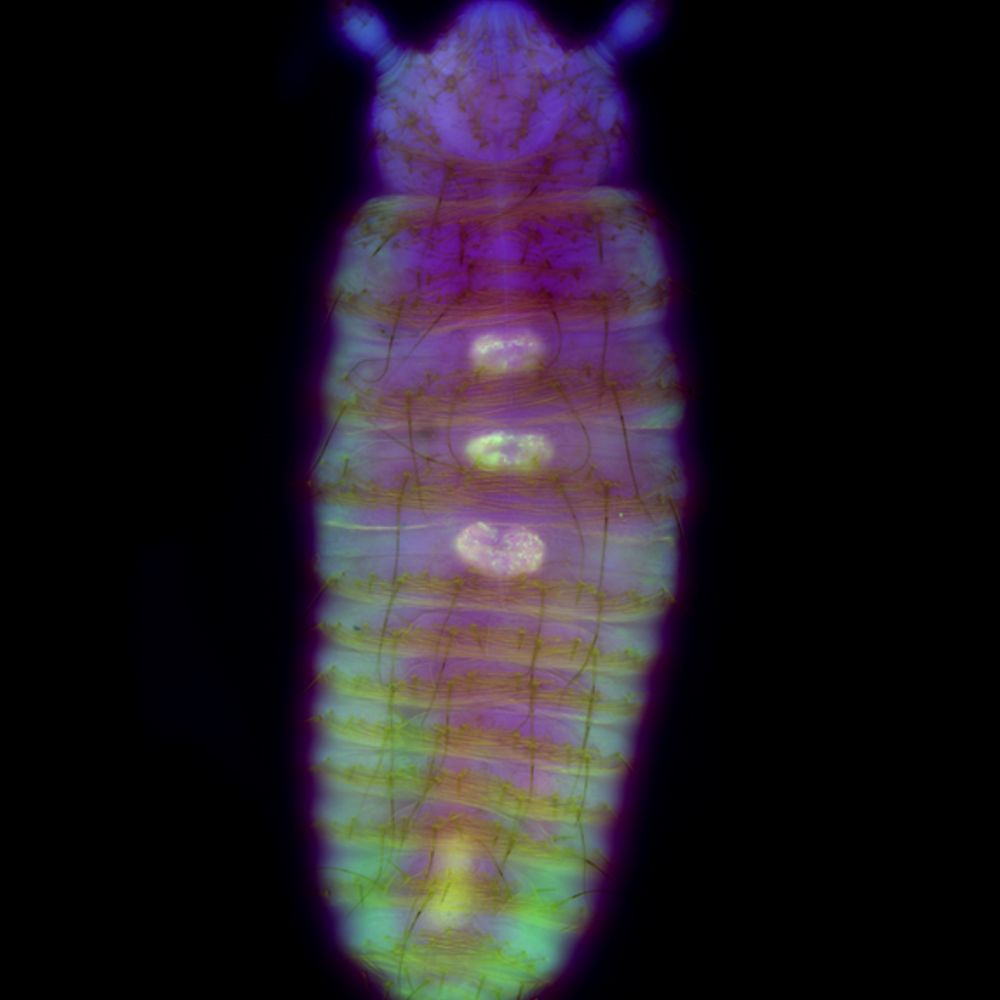
![(A) An adult female in the field on Sicyos angulatus. (B) Back view of an adult female reared on cucumber, whose hindleg organs are covered with fungal hyphae (arrowheads). (C) Magnified image of the hindleg organ. (D to L) Morphology of hind tibia of adult male [(D) to (F)], immature adult female [(G) to (I)], and mature adult female [(J) to (L)]. [(D), (G), and (I)] Brightfield images. [(E), (H), and (K)] Scanning electron microscope (SEM) images. [(F), (I), and (L)] Magnified SEM images. (M to O) Peculiar behavior of egg-laying adult female. After laying each egg (M), the female rhythmically scratches the hyphae-covered hindleg organ with tarsal claws of the opposite hindleg (N) and then rubs the egg surface with the claws in a skillful manner (O). Also see movie S1. (P to R) Egg mass covered with fungal hyphae at 0-day (P), 3-day (Q), and 10-day (R) intervals after oviposition. Reddish color of 10-day eggs reflects the body color of developing nymphs inside.](https://cdn.bsky.app/img/feed_thumbnail/plain/did:plc:vqgovau5gkirnk3ss5qwjdmz/bafkreiatozcclrv3q5pr2susooiojtvkwr6kwnd22hwxh3ijzh7lpi276q@jpeg)
(A) An adult female in the field on Sicyos angulatus. (B) Back view of an adult female reared on cucumber, whose hindleg organs are covered with fungal hyphae (arrowheads). (C) Magnified image of the hindleg organ. (D to L) Morphology of hind tibia of adult male [(D) to (F)], immature adult female [(G) to (I)], and mature adult female [(J) to (L)]. [(D), (G), and (I)] Brightfield images. [(E), (H), and (K)] Scanning electron microscope (SEM) images. [(F), (I), and (L)] Magnified SEM images. (M to O) Peculiar behavior of egg-laying adult female. After laying each egg (M), the female rhythmically scratches the hyphae-covered hindleg organ with tarsal claws of the opposite hindleg (N) and then rubs the egg surface with the claws in a skillful manner (O). Also see movie S1. (P to R) Egg mass covered with fungal hyphae at 0-day (P), 3-day (Q), and 10-day (R) intervals after oviposition. Reddish color of 10-day eggs reflects the body color of developing nymphs inside.
What looked like a hearing organ on a tiny stinkbug’s leg turned out to be something far stranger: a fungal nursery that mother bugs use to coat their newly laid eggs in protective symbiotic hyphae, shielding their offspring from parasitic wasps.
Learn more in Science: https://scim.ag/4nDrDNm
01.11.2025 21:14 — 👍 134 🔁 33 💬 0 📌 6
If you work on insect symbionts this call for papers might be of interest: symbionts as mediators of ecological interactions.
Particular topics of interest:
-Ecological & environmental factors that influence insect-symbiont relationships
-How symbionts mediate interactions
-Symbiont phenotypes
27.03.2025 16:19 — 👍 0 🔁 1 💬 0 📌 0
How do animals compensate for trait loss?
In beetles, symbiosis is a consistent strategy. Where the repeated loss of endogenous digestive enzymes is offset by functionally convergent symbioses: www.cell.com/current-biol...
Excited to share our latest, out today in @currentbiology.bsky.social!
20.01.2025 16:19 — 👍 97 🔁 36 💬 2 📌 2

Latin American journals are open-access pioneers. Now, they need an audience
SciElo, other platforms work to help journals reach readers around the world
Latin America is a leader in nonprofit open-access, with pioneering platforms like Scielo and Redalyc. But it still struggles to have their journals valued at home, as researchers’ perfomances often depend on them publishing on mainstream commercial journals.
www.science.org/content/arti...
06.12.2024 12:56 — 👍 42 🔁 11 💬 0 📌 3
Throwback to this amazing research from my colleagues at Biocomm—with much more to look forward to! 🐝
27.11.2024 17:18 — 👍 2 🔁 0 💬 0 📌 0
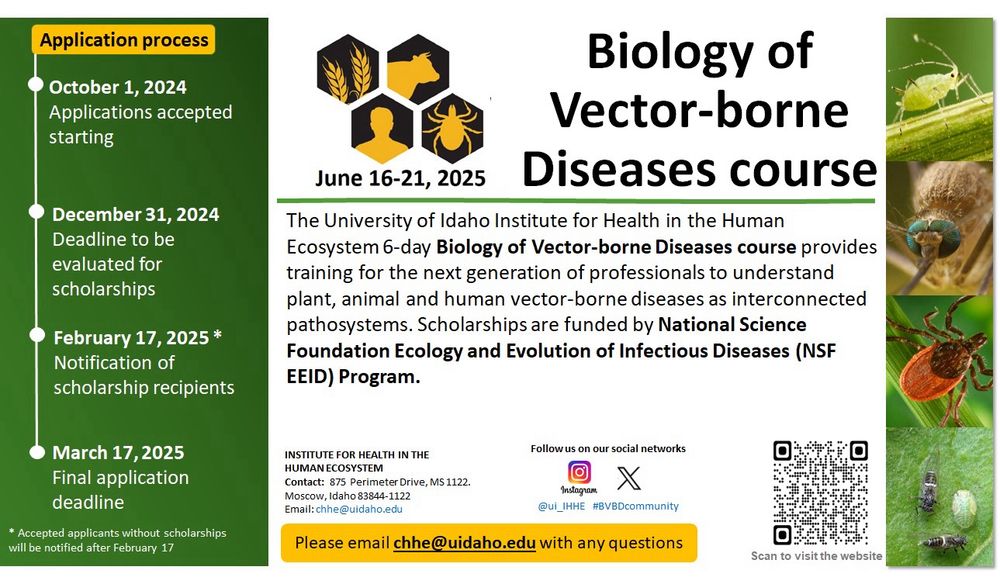
We’re excited to consider applicants for scholarships for our 2025 Biology of Vector-borne Diseases course! See our advert below. Please re-skeet to trainees and colleagues, as graduate students to faculty and practitioners across plant, animal and human health can apply.
23.11.2024 18:14 — 👍 36 🔁 31 💬 1 📌 1