How does behavior spread? Interactions beyond pairwise ties really do matter empirically, but that doesn't mean behavior spreads better on clustered networks. Two complementary studies paint picture of complex contagions sociologicalscience.com/articles-v12... www.pnas.org/doi/10.1073/...
21.01.2026 13:37 — 👍 1 🔁 0 💬 0 📌 0
Our lab is looking to fill a post-doc position to do research on human-AI interaction. More details here www.christophriedl.net/jobs.html
21.01.2026 13:24 — 👍 0 🔁 1 💬 0 📌 0

New paper out in Sociological Science sociologicalscience.com/articles-v12...
16.10.2025 19:21 — 👍 1 🔁 0 💬 1 📌 0
Across three different analytical methods we provide evidence for complex contagion: the contagion process cannot be understood as independent cascades but rather as a process in which signals from multiple sources amplify each other through synergistic interdependence
16.10.2025 19:21 — 👍 0 🔁 0 💬 1 📌 0

How does behavior spread? Do interactions beyond pairwise ties matter? We build on hypergraphs to explore higher-order social influence and study a country-scale randomized experiment
16.10.2025 19:21 — 👍 0 🔁 0 💬 1 📌 0
How does behavior spread? New insights on complex contagion in social networks with causal evidence from a country-scale field experiment @davidlazer.bsky.social sociologicalscience.com/articles-v12...
16.10.2025 17:51 — 👍 17 🔁 4 💬 0 📌 0
Emergent properties have functional benefits and realign internal group structure. Results mirror collective intelligence principles: effective performance requires both alignment on shared objectives and complementary contributions across members.
08.10.2025 16:26 — 👍 2 🔁 0 💬 1 📌 0

We find multi-agent systems have capacity for emergence - they are real "teams" that are more than the sum of their parts. And we can steer them with clever prompts. The ToM condition in particular leads to stable specialization and goal-directed complementarity across agents
08.10.2025 16:26 — 👍 1 🔁 0 💬 1 📌 0
Experiments use a simple guessing game without direct agent communication and only minimal group-level feedback with three randomized interventions: plain, agents with personas, and personas with an instruction to "think about what other agents might do" (a ToM prompt)
08.10.2025 16:26 — 👍 0 🔁 0 💬 1 📌 0
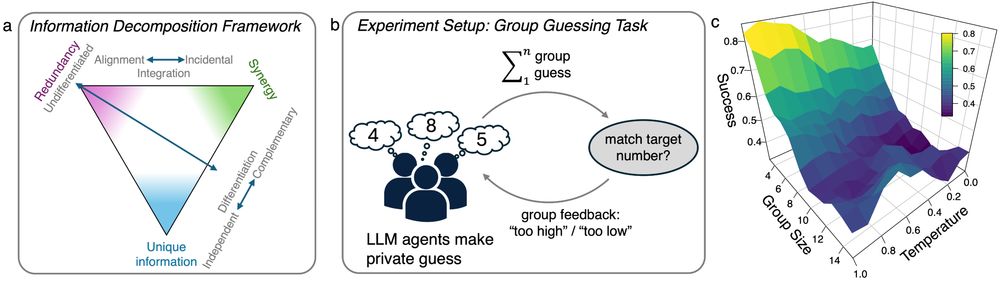
When are multi-agent LLM systems merely a collection of individual agents versus an integrated collective with higher-order structure? New paper shows multi-agent LLM systems have capacity for emergent coordination and how to steer them ...
08.10.2025 16:26 — 👍 1 🔁 0 💬 1 📌 0

📌 Save the Date!
The flagship conference of the Network Science Society - 𝗡𝗲𝘁𝗦𝗰𝗶 𝟮𝟬𝟮𝟲 - is coming to Northeastern University’s Network Science Institute, 𝗝𝘂𝗻𝗲 𝟭-𝟱, 𝟮𝟬𝟮𝟲.
Prepare to share ideas, discoveries & challenges in network science.
Registration opens soon! 🔗 www.netsci2026.com
30.09.2025 16:56 — 👍 44 🔁 37 💬 0 📌 8
OSF
osf.io/preprints/ps...
23.09.2025 13:35 — 👍 0 🔁 0 💬 0 📌 0

New paper on quantifying human-AI synergy in a large dataset with AI-alone, human-alone, and human-AI together.
23.09.2025 13:35 — 👍 0 🔁 0 💬 1 📌 0
aka people with higher theory of mind write better prompts and get better answers from AI. AI on the other hand is quite bad responding to moment-to-moment fluctuations in ToM
23.09.2025 13:35 — 👍 0 🔁 0 💬 1 📌 0
Crucially we find that solo-ability and collaboration-ability are distinct traits. And it turns out social skills (theory of mind) predict AI collaboration ability AND AI response quality.
23.09.2025 13:35 — 👍 0 🔁 0 💬 1 📌 0

Who benefits from AI and on which task? And how can we measure human-AI synergy?
23.09.2025 13:35 — 👍 2 🔁 0 💬 1 📌 0

Rivalry can backfire! We study the role of peer effects on top of known economic effects like competition pubsonline.informs.org/doi/abs/10.1...
30.07.2025 17:22 — 👍 0 🔁 0 💬 0 📌 0
The basic pattern is a tradeoff: reaching more people via random ties or exploit social reinforcement via clustered ties. Paper with @allisonwan.bsky.social @davidlazer.bsky.social @criedl.bsky.social (7/7)
10.07.2025 19:13 — 👍 0 🔁 0 💬 0 📌 0
Clustered networks are even less advantageous when individuals in the network are connected to more people, can influence their neighbors for longer periods of time, or when they require more adopting neighbors to benefit for social reinforcement (6/7)
10.07.2025 19:13 — 👍 1 🔁 0 💬 1 📌 0
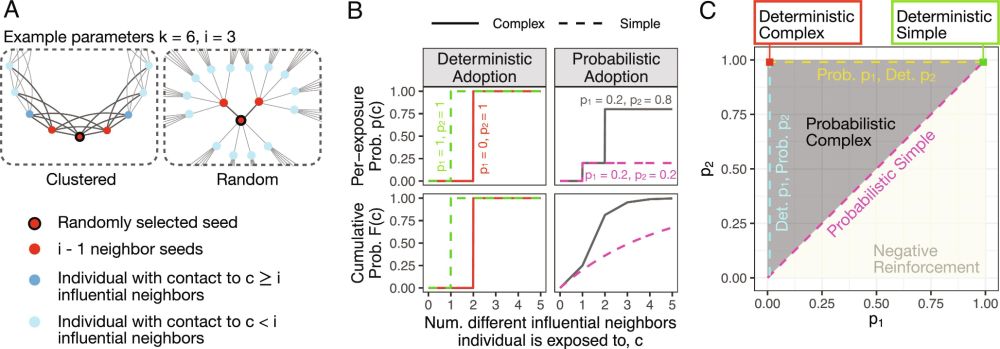
While faster spread on clustered networks is possible it does not represent the dominant pattern. Social reinforcement is necessary but insufficient condition for clustered network to diffuse better but faster spread on clustered networks is no test for social reinforcement (5/7)
10.07.2025 19:13 — 👍 0 🔁 0 💬 1 📌 0

Even with strong social reinforcement random networks spread behavior better than clustered networks. Clustered networks outspread random networks in only a small region of the space we model and mostly only when behavior is near deterministic (4/7)
10.07.2025 19:13 — 👍 0 🔁 0 💬 1 📌 0

We develop a novel model of behavior diffusion with tunable probabilistic adoption and social reinforcement parameters that contains many prior diffusion models as special cases (3/7)
10.07.2025 19:13 — 👍 0 🔁 0 💬 1 📌 0
Complex contagion theory suggests socially reinforced behaviors spread more on clustered networks. But when spread is modeled with realistic probabilistic adoption, in most cases behaviors spread equally-if not better-on random networks (2/7)
10.07.2025 19:13 — 👍 0 🔁 0 💬 1 📌 0
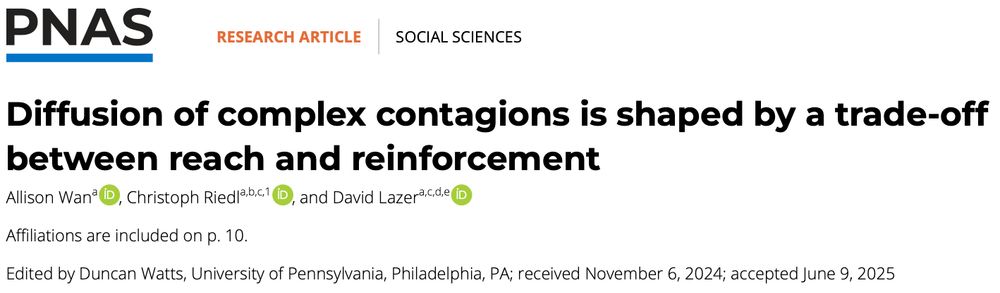
How does social network structure amplify or stifle behavior diffusion? Turns out, complex contagions are more complicated than we thought … (1/7)
10.07.2025 19:13 — 👍 20 🔁 6 💬 2 📌 1
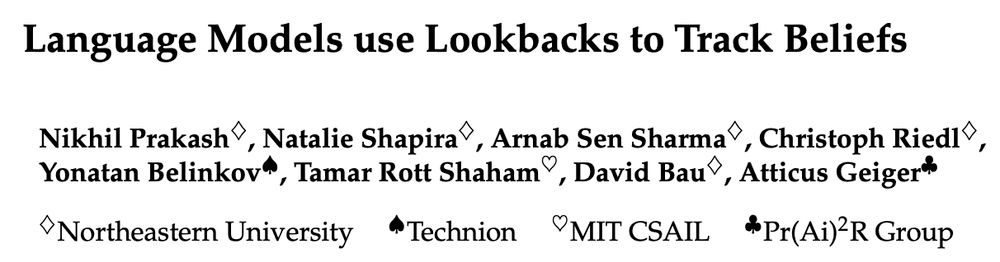
How do language models track mental states of each character in a story, often referred to as Theory of Mind?
We reverse-engineered how LLaMA-3-70B-Instruct handles a belief-tracking task and found something surprising: it uses mechanisms strikingly similar to pointer variables in C programming!
24.06.2025 17:13 — 👍 58 🔁 19 💬 2 📌 1
SOCIAL MEDIA TITLE TAG
SOCIAL MEDIA DESCRIPTION TAG TAG
Join us for our “Human-AI Teaming for People and Planet,” workshop at the CI'25 in San Diego human-ai-teaming-at-ci2025.netlify.app
06.07.2025 16:42 — 👍 0 🔁 0 💬 0 📌 0
Author: Artificial Intuition, Fluency & Empathy, DL Playbook, Patterns for Generative AI, Patterns for Agentic AI
https://twitter.com/IntuitMachine
https://intuitionmachine.gumroad.com
https://medium.com/intuitionmachine
BostonCHI is a non-profit, volunteer-only association of professionals from the New England area in the field of Human-Computer Interaction (HCI or alternatively CHI).
Official account of the 2026 International School and Conference on Network Science in Boston, Massachusetts, USA. June 1-5, 2026. Official hashtag: #NetSci2026
netsci2026.com
Professor at Wharton, studying AI and its implications for education, entrepreneurship, and work. Author of Co-Intelligence.
Book: https://a.co/d/bC2kSj1
Substack: https://www.oneusefulthing.org/
Web: https://mgmt.wharton.upenn.edu/profile/emollick
Associate Professor @NortheasternLDN , @NUnetsi | Researcher @LASIGE (Computer Scientist by training working on Network Science/Complex Systems)
https://andreiasofiateixeira.com
https://branmorrighan.com
The National Deep Inference Fabric, an NSF-funded computational infrastructure to enable research on large-scale Artificial Intelligence.
🔗 NDIF: https://ndif.us
🧰 NNsight API: https://nnsight.net
😸 GitHub: https://github.com/ndif-team/nnsight
Postdoc at the interpretable deep learning lab at Northeastern University, deep learning, LLMs, mechanistic interpretability
phd student in cs at princeton
A LLN - large language Nathan - (RL, RLHF, society, robotics), athlete, yogi, chef
Writes http://interconnects.ai
At Ai2 via HuggingFace, Berkeley, and normal places
AI @ OpenAI, Tesla, Stanford
Interpretable Deep Networks. http://baulab.info/ @davidbau
Associate Professor, Yale Statistics & Data Science. Social networks, social and behavioral data, causal inference, mountains. https://jugander.github.io/
Networking the complexity community since 1999.
Official news channel of the @cssociety.bsky.social
Edited by @cgershen.bsky.social
Dreaming of a cloudy sky | Associate Prof. | Computer Science & BioFrontiers, CUBoulder | Ext. Faculty, Santa Fe Institute | www.peleglab.com
Lambent Society Founder | Professor | Hourglass Emergence + Computation | Flourishing | Kitchen Alchemist + Vegetarian | if ‘missing’, check Wilderness
Researcher, scientist. Professor at the Network Science Institute @Northeastern and director of the Social Urban Networks Lab. Formerly @uc3m & @mit
Assistant Professor at Northeastern University, Psychology of Misinformation Lab
Network Scientist | Assistant Research Professor at Northeastern University