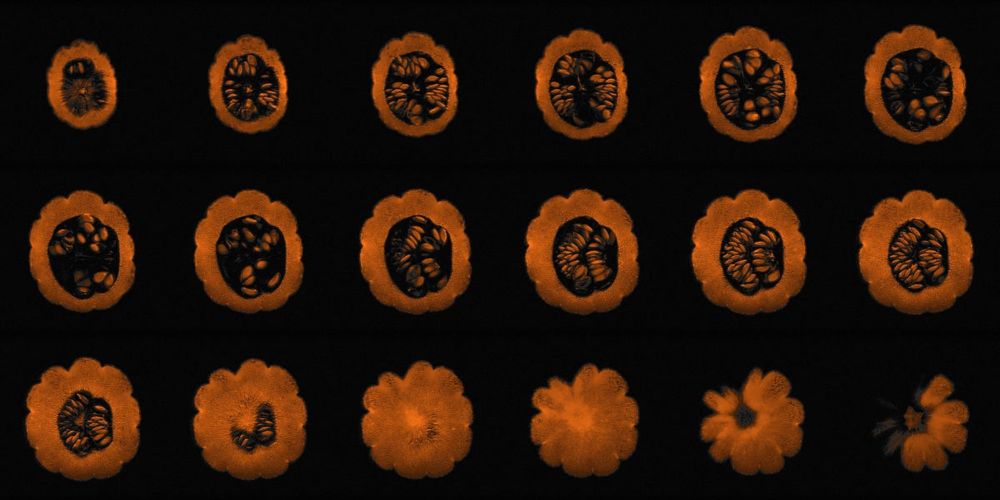
Whole-body Single-cell Spatial transcriptomic atlas of adult Danionella ~1 cm long
scRNAseq
MERFISH (500-gene)
HCR
Endothelial cell podxl+ (Fig S8)
Vascular vs Visceral mural cell (Fig S10)
Peter Reddien lab bioRxiv 2026
www.biorxiv.org/content/10.6...
10.02.2026 12:57 — 👍 21 🔁 7 💬 0 📌 1

Our updated @napari.org video plugin includes a small widget to play videos with sound. github.com/danionella/n...
29.01.2026 10:08 — 👍 13 🔁 3 💬 0 📌 0
Congratulations to Urs Lucas Bohm, junior leader a @ipnp.bsky.social, for his latest achievement: he is recipient of the ATIP-Avenir award for his work on spinal cord network contribution to motor behaviors, using voltage imaging techniques in zebrafish! Keep going, Urs! @inserm.fr #motordisease
29.06.2025 08:59 — 👍 5 🔁 1 💬 0 📌 1
This is great -- thanks for your efforts and the documentation. We've got it up and running for tERK stains. Some kinks for us work out but running registrations in a few seconds is so very satisfying!
21.05.2025 14:30 — 👍 13 🔁 1 💬 1 📌 0
I‘m really glad it works for you and thanks a lot for sharing! Watching this video is satisfying to me, too!
21.05.2025 21:50 — 👍 0 🔁 0 💬 0 📌 0
Welcome, Kim!
18.05.2025 15:35 — 👍 1 🔁 0 💬 0 📌 0
Haven't tried but it might work. Is the part at the same resolution as the whole? Same-to-same or same-to-similar sample? Consider posting photos & details here: github.com/danionella/w...
Warpfield determines transformations between 3D volumes only, and can apply them to 3D volumes and coordinates.
12.05.2025 16:55 — 👍 1 🔁 0 💬 1 📌 0
Who wouldn't want to do that?
Unfortunately I don't think this would be a good tool for it. You probably need many discontinuities and flips to go from car to artichoke. Although not (yet) strictly enforced, this library tends to generate smooth fields and local displacements.
12.05.2025 09:56 — 👍 2 🔁 0 💬 1 📌 0
Since alt-text doesn't seem to render for videos, here are the video credits: Registration of artichoke 3D MRI using warpfield. Data by Alexandr Khrapichev, Oxford (source: Wellcome Collection, CC BY).
12.05.2025 05:33 — 👍 6 🔁 0 💬 0 📌 0
Introducing warpfield, an open source Python library for GPU-accelerated non-rigid 3D registration. Warps and aligns gigavoxel volumes within seconds (not hours). For 3D microscopy, region-to-region and cell-to-cell matching.
A collaboration with @mh123.bsky.social 🚀
github.com/danionella/w...
12.05.2025 05:25 — 👍 195 🔁 54 💬 7 📌 3

Vocal ontogeny in Mus musculus
Infants of many species produce distress calls when in need of parental care. As they mature and gain independence from caregivers, juveniles stop producing infant calls and begin producing adult-like...
Another study to share, led by my grad student Nicole Pranic! Before diving in, I'll add that Nicole (who is clever, tenacious, and interested in neural changes that underlie developmental changes in social behaviors) is looking for a post-doc position! Please RT!
www.biorxiv.org/content/10.1...
26.03.2025 19:03 — 👍 27 🔁 12 💬 1 📌 1
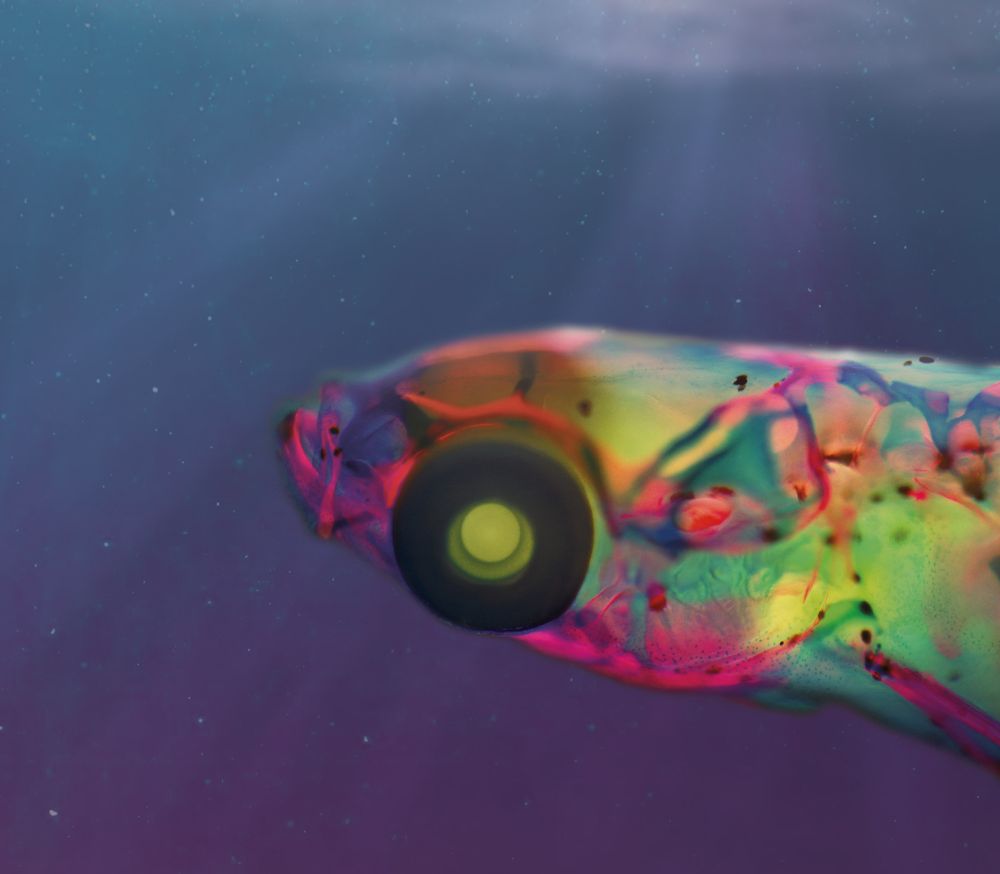
We’re seeking a postdoc/student excited about animal communication, brain-wide circuits, microscopy, singing fish (Danionella), wacky ideas and who likes to: get things done, experiment, analyze, ask, learn, help and cooperate. jlab.berlin
03.11.2024 12:22 — 👍 44 🔁 32 💬 1 📌 2
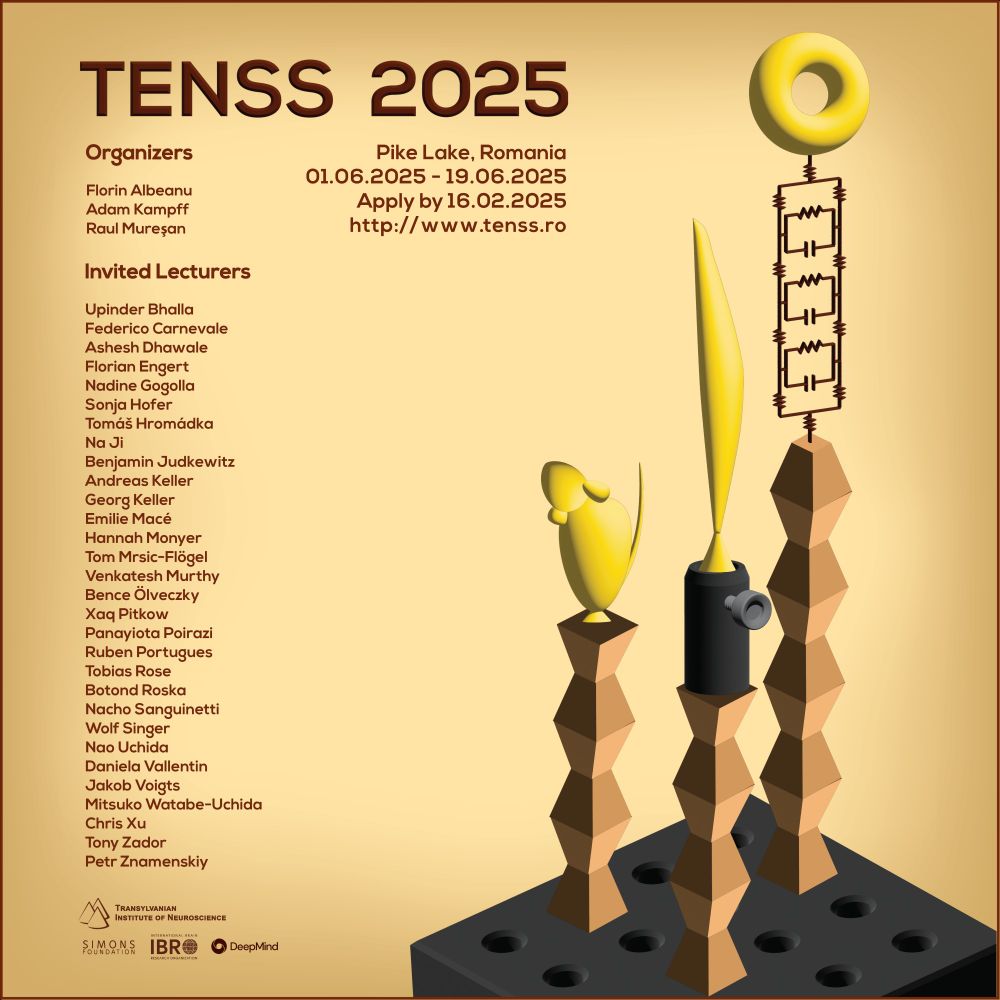
Interested in understanding how things work? In particular the tools you use to study the brain? Join us at TENSS 2025 where we brainstorm ideas, build and debug microscopes, electrophysiology and behavior rigs amidst the picturesque Transylvanian hills! tenss.ro
Apply by: February 16th!
14.01.2025 04:58 — 👍 59 🔁 39 💬 2 📌 5
If you want to understand the brain, should you work as a neuroscientist in the lab? Or teach the subject for students? Or simply read textbooks and papers while having a normal job? In this blog post, I share some thoughts on this topic. gcamp6f.com/2025/01/08/a...
08.01.2025 23:25 — 👍 15 🔁 4 💬 0 📌 0
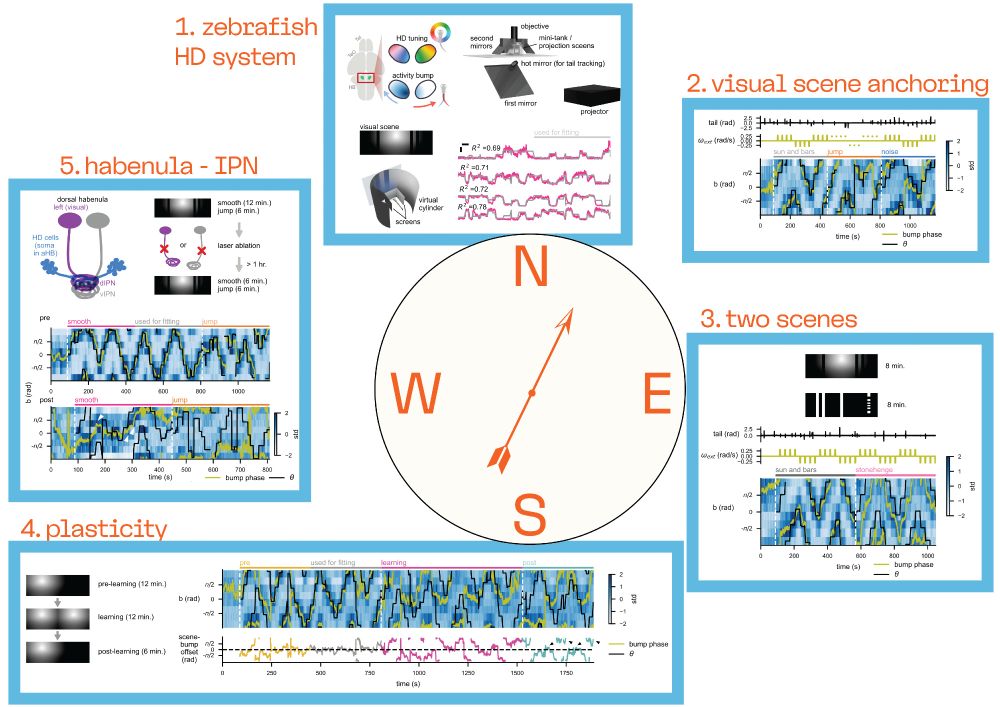
1/3 How does visual input affect the heading direction (HD) network?
In our latest lab preprint, Ryosuke presents "visual landmarks" to larval zebrafish and shows that the HD network tethers to the visual environment. The experiments are again inspired by the beautiful recent work in Drosophila.
20.12.2024 08:34 — 👍 36 🔁 17 💬 2 📌 1
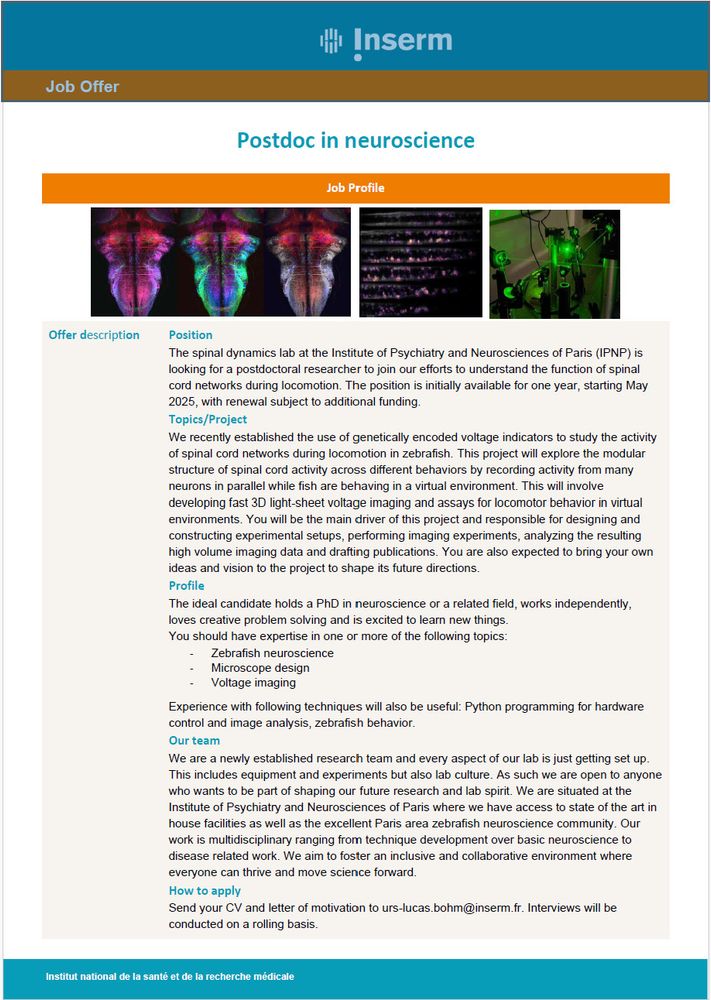
job offer for a postdoctoral position working on zebrafish spinal cord imaging
job offer! I am looking for a postdoc to join the nascent team. Come work with us to build microscopes and study spinal cord circuits. #ZebrafishCareers
18.12.2024 17:31 — 👍 6 🔁 5 💬 0 📌 1
Why not?
18.12.2024 06:39 — 👍 0 🔁 0 💬 1 📌 0

Come join us! Please repost 🙏🏼
12.12.2024 14:32 — 👍 19 🔁 10 💬 0 📌 2
Nice! Do you expect the same effect for 2D and 3D interpolations?
12.12.2024 08:41 — 👍 1 🔁 0 💬 1 📌 0
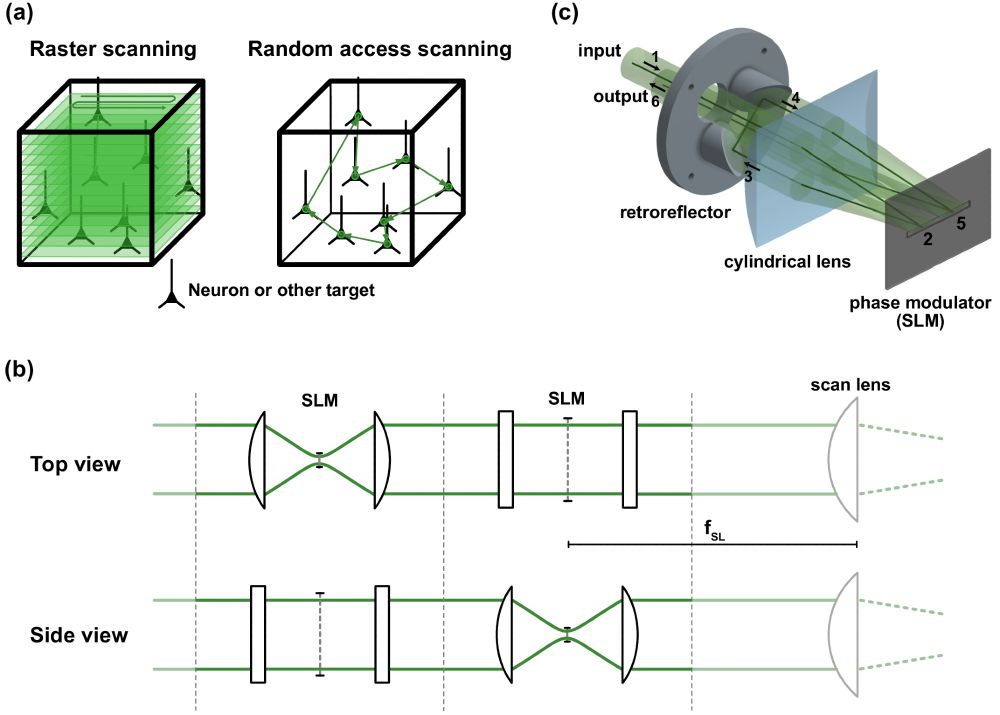
High-speed 3D random access two-photon imaging at ≥ 300 kHz – with SPARCLS: opg.optica.org/optica/fullt...
By the outstanding @carolineberlage.bsky.social and team, including @urslucasboehm.bsky.social, @andrewplested.bsky.social et al.
10.12.2024 20:17 — 👍 44 🔁 11 💬 1 📌 5
Could you add me, please?
04.12.2024 07:24 — 👍 1 🔁 0 💬 1 📌 0
Next stop: brain. We are interested in brain-wide circuits underlying acoustic communication (from hearing to sound production), which we currently study with the volumetric whole-brain microscope developed by @mh123.bsky.social and Jörg Henninger. www.nature.com/articles/s41...
29.11.2024 20:49 — 👍 5 🔁 2 💬 0 📌 0
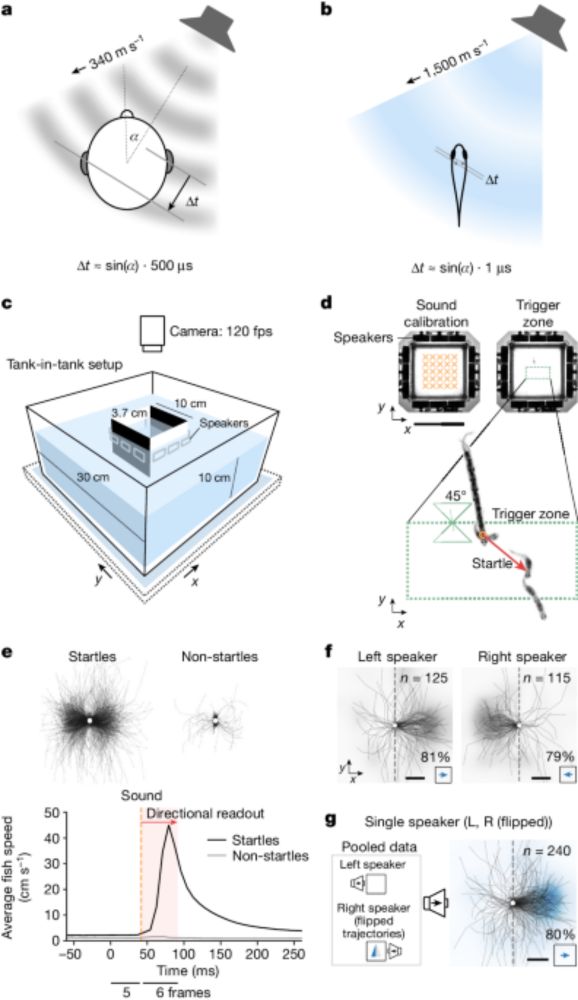
The mechanism for directional hearing in fish - Nature
A study demonstrates that the fish Danionella cerebrum is able to discriminate the direction of sound by comparing the relative phase of pressure and particle motion.
How do they know who is talking? Sound localization by fish was long considered physically impossible, and yet it was shown behaviorally. With underwater sound illusions and laser vibrometry, Johannes Veith and @tomchaigne.bsky.social identified an underlying mechanism www.nature.com/articles/s41...
29.11.2024 20:49 — 👍 3 🔁 0 💬 1 📌 0
Danionella clicks can reach 140 dB! How can a tiny fish under 12 mm produce such unusually loud sounds? Verity Cook found a unique sound production apparatus that shoots a specialized cartilage against the swim bladder, accelerating at over 20000 m/s^2: www.pnas.org/doi/10.1073/...
Video with sound
29.11.2024 20:49 — 👍 1 🔁 0 💬 1 📌 0
by the one and only @urslucasboehm.bsky.social, who just joined bluesky
13.11.2024 14:08 — 👍 9 🔁 2 💬 0 📌 0
Could you add me, please?
13.11.2024 14:01 — 👍 1 🔁 0 💬 0 📌 0
It's woefully incomplete, but I've made the start of a starter pack for folks interested in microscopy. Suggestions for who else to include (including yourself!) are very welcome.
go.bsky.app/SaYfAX3
19.09.2024 16:35 — 👍 124 🔁 53 💬 61 📌 3
Group leader CRG; Associate Faculty ToL Sanger Institute.
Genome regulation, chromatin, cell types, and evolution. https://www.sebepedroslab.org
Theoretical neuroscientist interested in brain-body interactions and evolution of adaptive behavior. Associate Professor at Scripps Research Institute in San Diego.
Neuroscientist and science writer
Job: Neurobiology @ USC
Likes: Bikes, crypto, techno
What’s next?
Computational neuroscientist @princetonneuro.bsky.social deciphering natural and advancing artificial intelligence.
Neuroscience, Connectomics & Connectome decoding, Machine learning, Research Group Leader LMB Cambridge; co-founder of http://ariadne.ai
kornfeldlab.org
Neuroscientist at the Humboldt University of Berlin, violinist and chamber music enthusiast
Neurobiologist interested in the circuit basis of territorial behaviors and their relevance for human fear and anxiety. Interim Head of EMBL Rome.
Bio-Acousto-Magneto-Neuro-Chemical Engineer
Max Delbrück Professor @Caltech
Investigator @HHMI
Fulbright-Tocqueville Chair @PhysMedParis @ESPCI_Paris '24-5
shapirolab.caltech.edu
Researcher in machine learning and computer vision for science. Senior Group Leader at HHMI Janelia Research Campus. Supporter of DEIB in science and tech. CV: https://bit.ly/BransonCV
High-end modular and portable #lightsheet microscopy for inside and outside the lab / Flamingo project / Imaging development, physiology and anatomy in live specimens and cleared tissues. Former @morgridgeinstitute.bsky.social, @mpi-cbg.de
huiskenlab.com
Neuroscience & functional ultrasound imaging. Vision and brain states. Professor at University Medical Center Göttingen. https://brainwidenetworks.uni-goettingen.de/ Co-Spokesperson, EKFZ Center for Optogenetic Therapies. https://ekfz.uni-goettingen.de/en/
Paris-based PhD student in neuroscience with a sense for atmosphere and a strong opinion on the gustatory aesthetic of soups.
Prof. @ucsantabarbara.bsky.social - Runs a lab slslab.org - Works on computation, neuroscience, behavior, vision, optics, imaging, 2p / multiphoton, optical computing, machine learning / AI - Blogs at labrigger.com - Founded @pacificoptica.bsky.social
Research Associate in the Bass Lab at Cornell University. Developing methods and tools for Danionella dracula (the Dracula fish) to uncover neurobiological mechanisms of social behavior.
Assistant Professor of Physics & Neuroscience at Princeton University. Studying how C. elegans nervous system processes information to generate actions.
Biophysicists in training, PhD at Princeton University
Engineer-becoming-neuroscientist, tinkerer at heart 🧠⚙️🧪🔬🐟
PhD Candidate @ Vision to Action lab, Champalimaud Foundation, Portugal. Currently studying sensorimotor integration in zebrafish. he/him