👉 Key takeaway message: it’s not chronological age that matters, but individual differences in cognitive processes. Older adults can learn and use CBT skills—and we shouldn’t withhold therapy based on assumptions about rigidity.
01.10.2025 02:01 — 👍 1 🔁 0 💬 0 📌 0
Older adults' skills were comparable to children, with younger adults doing best. BUT - after accounting for individual differences in cognitive flexibility (particularly perseveration), there were no age differences in skills.
01.10.2025 02:01 — 👍 0 🔁 0 💬 1 📌 0
Many people assume that older adults are too rigid in their ways of thinking to benefit from therapeutic techniques like cognitive restructuring. But our research shows that’s not the case.
01.10.2025 02:01 — 👍 0 🔁 0 💬 1 📌 0

Developmental Differences in Cognitive Restructuring Skill Acquisition across the Lifespan: Age Differences between Children, Adults and Older Adults, and the Role of Cognitive Flexibility - Cognitive Therapy and Research
Purpose Replacing irrational or unhelpful thoughts with more rationale and helpful ones is a core skill in Cognitive Behavioural Therapy, but there is limited research examining the neuropsychological mechanisms underpinning this process. This study examined age-differences in cognitive restructuring skill acquisition between children, younger adults and older adults; whether individual differences in cognitive flexibility influences the ability to learn cognitive restructuring across the lifespan; and whether cognitive flexibility explains age-differences in cognitive restructuring ability. Method Participants were 114 individuals with anxiety disorders, including 35 children (aged 7–12, M = 9.14, SD = 1.44), 32 younger adults (aged 18–53, M = 23, SD = 7.84) and 47 older adults (aged 61–78, M = 66.81, SD = 4.43). Participants completed neuropsychological measures of cognitive flexibility and learned cognitive restructuring, which was coded for quality and efficacy. Results More than half the participants of all ages showed good quality cognitive restructuring skill acquisition with only brief instruction. Older adults showed comparable cognitive restructuring skills to children, with slightly better skills among younger adults. However, after accounting for individual differences in cognitive flexibility, there were no age-differences in cognitive restructuring quality. Greater perseveration was associated with poorer cognitive restructuring skill acquisition in younger and older adults, and mediated age-differences in cognitive restructuring skill acquisition. Conclusions Among younger and older adults, individual differences in perseveration, rather than chronological age, underpins the ability to learn cognitive restructuring. There is little evidence that cognitive flexibility plays a role in cognitive restructuring skill acquisition among children.
🚨 New paper: You can teach an old (person) new therapy tricks. More than half of children, younger and older adults showed good cognitive restructuring skills. Individual differences in cognitive flexibility (perseveration) predicts skill, not age. bit.ly/3IARYx2 #CBT #ClinPsy #MentalHealth
01.10.2025 02:01 — 👍 5 🔁 1 💬 1 📌 0
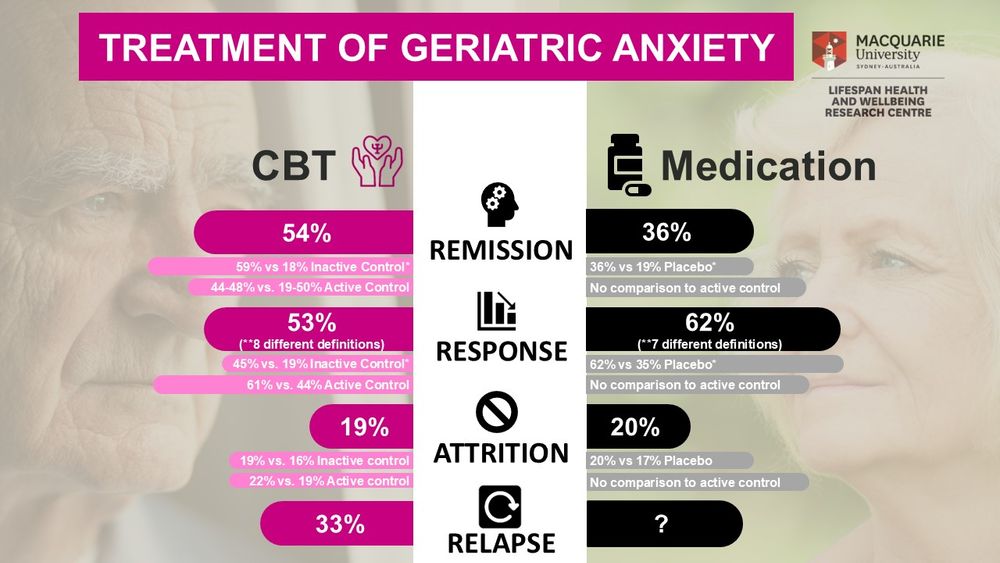
🔎 Which anxiety treatments work best for older adults?
📊7x more likely to recover with CBT (54%)
📊2x more likely with meds (36%) (vs controls)
😬 We found 13 definitions of ‘treatment response’ - messy!
📄 Open access: bit.ly/3ZRZ6KP
🔁 Please share!
#Anxiety #OlderAdults #ClinPsy #MentalHealth
30.06.2025 02:13 — 👍 3 🔁 1 💬 1 📌 0
Even better! I’m a big fan of exposure-based treatments - and the clinicians that do them 👏
24.05.2025 01:02 — 👍 1 🔁 0 💬 0 📌 0
Thanks for sharing our findings. Inhibitory learning theory predicts BE would be best. I thought it was possible there would be no group differences. However the results (small preference for BE, but little penalty from doing CR first) aligns with clinical experiences. 👉🏻✨ threat expectancy change
24.05.2025 00:01 — 👍 0 🔁 0 💬 0 📌 0
It's always encouraging to hear that the findings resonate with clinical experience. Treatment tolerability is a key consideration. There was only a small difference between BE and doing cognitive restructuring before exposure - with both approaches emphasising change in threat expectancies (key).
23.05.2025 23:51 — 👍 2 🔁 0 💬 1 📌 0
Both of these approaches that emphasise threat expectancy change are better than habituation-focused exposure. But if clients are willing, BE might be preferable given that there are consistently small benefits for clinical outcomes, plus it is faster (? more time for extra exposure trials)
23.05.2025 23:43 — 👍 1 🔁 0 💬 1 📌 0
Yes, this is correct. There is very little penalty for doing cognitive work first, which is what inhibitory learning models suggest. This is great news, given that cognitive restructuring often increases clients willingness to attempt exposure tasks.
23.05.2025 23:40 — 👍 1 🔁 0 💬 1 📌 0
So pleased you were able to share this with your supervision group! I’d love to hear what the feedback was, and how this relates to others’ experience in clinical practice?
21.05.2025 10:20 — 👍 1 🔁 0 💬 2 📌 0
Exposure therapy is such a powerful treatment technique. Our findings support that either application of exposure that ALSO focused on changing threat beliefs, was great! Habituation-focused exposure without the cognitive work, was less effective.
21.05.2025 10:18 — 👍 1 🔁 0 💬 0 📌 0
Absolutely! There was a non-significant, small effect size difference when using cognitive restructuring first - so there isn’t any real penalty from doing the cognitive work first.
21.05.2025 10:16 — 👍 0 🔁 0 💬 1 📌 0

What’s the most effective way to deliver exposure therapy for anxiety? We tested:
🔹 Behavioural experiments (BE)
🔹 Cognitive restructuring before exposure
🔹 Habituation-based approaches
BE had the best outcomes.
🧠 How do you implement exposure?
🔗 bit.ly/3YTlR0n
#mentalhealth #ClinPsy
20.05.2025 11:26 — 👍 34 🔁 14 💬 3 📌 2
Reader in Developmental Psychopathology at the University of Bath.
Family-based Intervention for Child and Adolescent Mental Health textbook out now: http://cambridge.org/9781108706063
Asst. Prof of Medicine/Psychiatry @ Weill Cornell. Palliative care/CL psychiatry doc, researcher in #hapc #pallipsych, Psychosocial AE @ @jpsmjournal.bsky.social , NIA Beeson Scholar. Most importantly hubby to Nuri and companion to Frasier the dog.
Geriatric psychiatrist, computer scientist
Neuropsychiatrist/Geriatric Neuropsychiatrist/Brain injury medicine/bioethics/neuroethics/behavioral-cognitive neurology/interested in the neurobiology of catatonia/Professor at University of Washington/educator/Book review editorJNCN/all views are mine
Geriatric psychiatrist & health services researcher interested in #aging #dementia. Lead National Dementia Workforce Study (NDWS.org) with Joanne Spetz, PhD. #GoBlue (but opinions my own)
Research lab at KITE, Toronto Rehab led by Dr. Andrea Iaboni
Assoc Prof, Dept of Psychiatry, University of Toronto
#geriatrics #psychiatry #aging research
Focus on technology for quality #dementia care.
Translational Consultation-Liaison Psychiatry Lab | University of Pennsylvania Perelman School of Medicine | Clinical Neuroimaging + Medical Informatics. https://ericaballer.wixsite.com/baller-lab
Social Welfare PhD Candidate @Penn | Social Worker | Cancer care, substance use, Adolescent and Young Adults | She/her
Clinical Psychologist | Interests in Psycho-Oncology, clinical and research | Views=Mine
National Cancer Control Programme lead on survivorship care and psycho-oncology. Curious about everything. Public health enthusiast. All opinions my own. 🇮🇪
Associate Professor, SPH, HKUMed; Director, HKUMed JCICC; President, International Psycho-oncology Society IPOS
she/her/她
🎗️Ψ 🏥
Assistant Professor, UT Southwestern | Simmons Comprehensive Cancer Center. #PsychoOncology #AYASM
Always 🙋🏻♀️ to noodles
Infectious Diseases/Antimicrobial Stewardship Pharmacist & ID PGY2 Residency Director @ UAB | #WarEagle |
Psycho-Oncology,
Photography,
Genealogy.
(Only just feathering my new nest here, so any attempt at a witty bio shall have to wait for a while & yep, that’s what I said on Mastodon as well 🫣😁).
Dublin, Ireland.
Old Age Psychiatrist
Deputy Chief Medical Officer
RCPsych London Division Chair
Crazy single cat lady
Mummy to 11yr old Dan
Professor of Psychiatry and Medicine Tufts University Chairman Psychiatry emeritus Tufts Medical
Center Past President American Psychiatric Association Views my own
Child and adolescent c-l, emergency & interventional psychiatrist, learning, growing. Interested in improving the continuum of wellbeing for kids, families, and communities. she/her. Views my own, not medical advice, not views of my employer
MacMillan Clinical Psychologist & Clinical Academic, Nottingham University Hospitals NHS Trust & University of Nottingham.
Working to improve the well-being of people with cancer. Emphasis on prevention.
#psychooncology #prehab #prognosis