Rallied by thy neighbor: how minority spatial concentration increases voter turnout | The Journal of Politics: Vol 0, No ja
New paper out in the @thejop.bsky.social with @rafaelahlskog.bsky.social & @grahn.bsky.social
Your neighbours shape your politics — but can living near people like *cause* higher turnout?
We studied 20,000+ queer individuals across the entire Swedish population to find out
doi.org/10.1086/740816
11.02.2026 09:13 — 👍 37 🔁 21 💬 2 📌 1

The UPPGAP spring 2026 seminar series is here!
We’ve got fantastic speakers and fresh research on gender and politics lined up for the semester 🌟
26.01.2026 14:54 — 👍 3 🔁 2 💬 0 📌 0

We're happy to announce at least three vacant PhD positions starting in fall 2026! Read more and apply here: www.uu.se/en/departmen...
08.12.2025 13:06 — 👍 12 🔁 12 💬 0 📌 3

Elin Bjarnegård and Michal Grahn elected to the leadership of SWEPSA – Department of Government – Uppsala University
@elinbja.bsky.social and I are leading SWEPSA (Swedish Political Science Association) for the coming two years! Looking forward to it! :)
www.uu.se/en/departmen...
08.12.2025 10:30 — 👍 19 🔁 3 💬 0 📌 0


Friday brought good news and bad news. Today I am now allowed to share the good.
Via the generous donation of the Wallenberg Foundation and the Swedish Royal Academy of Sciences, I now have a few million euros to help understand more about the selective inclusion of LGBTQ+ citizens
03.12.2025 17:33 — 👍 165 🔁 10 💬 29 📌 0
Huge congratulations to the best @turnbulldugarte.com & @rafaelahlskog.bsky.social for getting Wallenberg fellowships (equivalent to two ERC grants!!!) So well-deserved!!
03.12.2025 09:46 — 👍 21 🔁 5 💬 1 📌 0

Yesterday, I had a lovely opportunity to present co-authored work on how to counter femonationalism at
@mzesunimannheim.bsky.social . Engaged audience and great feedback! Thanks to @wurthmann.bsky.social for the invite!
@katharinalawall.bsky.social, @sophiemainz.bsky.social, @turnbulldugarte.com
03.12.2025 08:16 — 👍 18 🔁 5 💬 0 📌 0

Early this week, Cherry Miller and I had the pleasure of giving a PhD course in feminist research designs and methods to a talented group of 9 PhD students at @helsinki.fi So much talents and creativity in their projects! @uppgap.bsky.social
26.11.2025 09:28 — 👍 13 🔁 3 💬 0 📌 0

a group of people are dancing in a doorway
ALT: a group of people are dancing in a doorway
Excited to share that @vetenskapsradet.bsky.social has awarded generous funding for my new project on the emotional dynamics of feminist alliances in the EU! Here’s to 4 more years of doing the research I love — together with Josefina Erikson 🥳🎉
24.11.2025 13:03 — 👍 10 🔁 2 💬 1 📌 0

a cartoon of donald duck holding a stack of money
ALT: a cartoon of donald duck holding a stack of money
So happy to have received a new, generous grant (500k EUR) from @vetenskapsradet.bsky.social to continue exploring the causes and consequences of voluntary segregation among lesbians, gays and bisexuals in Sweden. This time with a dream team of @rafaelahlskog.bsky.social & @turnbulldugarte.com
21.11.2025 08:16 — 👍 47 🔁 7 💬 10 📌 1
A fun way to start the wknd:
We have received the reviews of ”Rallied by thy neighbor: how minority spatial concentration increases voter turnout." […] I am delighted to conditionally accept your article for publication in The Journal of Politics.
@rafaelahlskog.bsky.social @turnbulldugarte.com
14.11.2025 18:45 — 👍 21 🔁 6 💬 0 📌 0

European voters say no to tariffs
- Uppsala University
🇪🇺 Europeans say no to tariffs!
Check out the @uu.se press release on our new @jeppjournal.bsky.social study exploring what Europeans really think about trade barriers in an era of rising global tensions.
www.uu.se/en/press/pre...
Full paper: doi.org/10.1080/1350...
16.10.2025 05:51 — 👍 19 🔁 8 💬 0 📌 0

The UPPGAP program for the fall 2025 is out. Check it out!
15.08.2025 09:30 — 👍 7 🔁 5 💬 0 📌 0
The UPPGAP program for the fall 2025 is out. Check it out!
15.08.2025 09:30 — 👍 7 🔁 5 💬 0 📌 0

Check out this Elgar Encyclopedia entry on Political behavior of LGBT+ people penned by @wurthmann.bsky.social and myself. The piece summarizes what we know about queer political behavior and identifies some the remaining gaps. 🏳️🌈
www.researchgate.net/publication/...
14.08.2025 09:24 — 👍 11 🔁 7 💬 0 📌 0

Excited to share that @grahn.bsky.social and I have co-authored a new chapter, "The Political Behavior of Lesbians, Gays, Bisexuals and Trans+ People", for the upcoming Elgar Encyclopedia of Gender and Politics (ed. Zoe Lefkofridi).
#LGBTQ
www.researchgate.net/publication/...
06.08.2025 12:30 — 👍 28 🔁 10 💬 3 📌 0

Hur polariserade är vi - egentligen? av RFSL | Stockholm Pride
Vad händer med sakfrågorna när hbtqi-personers rättigheter görs till symbolfrågor i ett bredare s.k kulturkrig?
If you are attending Stockholm Pride this year (and speak Swedish), come and see this panel on the growing polarization around LGBTQ+ rights, featuring a great lineup, including myself. :) program.stockholmpride.org/sv/events/29...
09.07.2025 11:56 — 👍 11 🔁 3 💬 0 📌 0
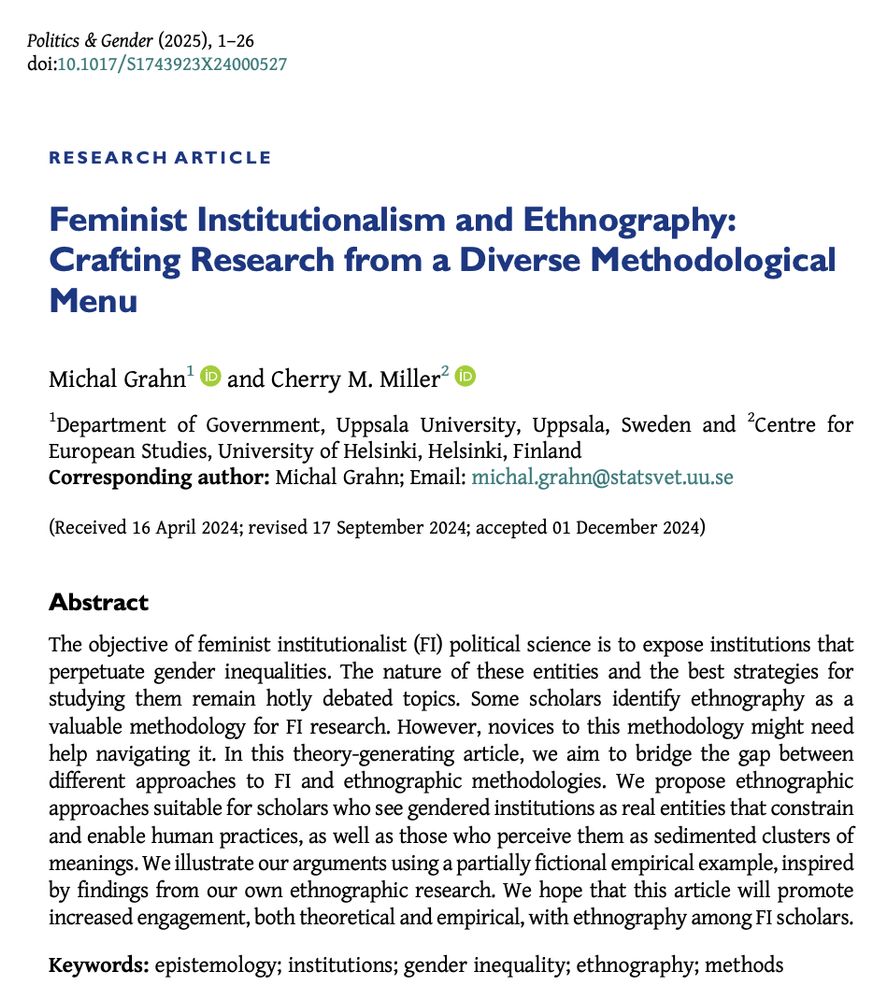
Research article "Feminist Institutionalism and Ethnography: Crafting Research from a Diverse Methodological Menu" by Michal Grahn & Cherry M. Miller.
Abstract begins: The objective of feminist institutionalist (FI) political science is to expose institutions that perpetuate gender inequalities. The nature of these entities and the best strategies for studying them remain hotly debated topics. Some scholars identify ethnography as a valuable methodology for FI research. However, novices to this methodology might need help navigating it. In this theory-generating article, we aim to bridge the gap between different approaches to FI and ethnographic methodologies. We propose ethnographic approaches suitable for scholars who see gendered institutions as real entities that constrain and enable human practices, as well as those who perceive them as sedimented clusters of meanings.
📢New issue of #PAG21 is out!📢
In "Feminist Institutionalism and Ethnography" @grahn.bsky.social & Cherry M Miller propose ethnographic approaches for scholars looking to research the gendered outcomes of institutions.
🌟Available #OpenAccess🌟 polisky gendersky
buff.ly/4jmQsMv
04.07.2025 13:03 — 👍 12 🔁 8 💬 0 📌 0
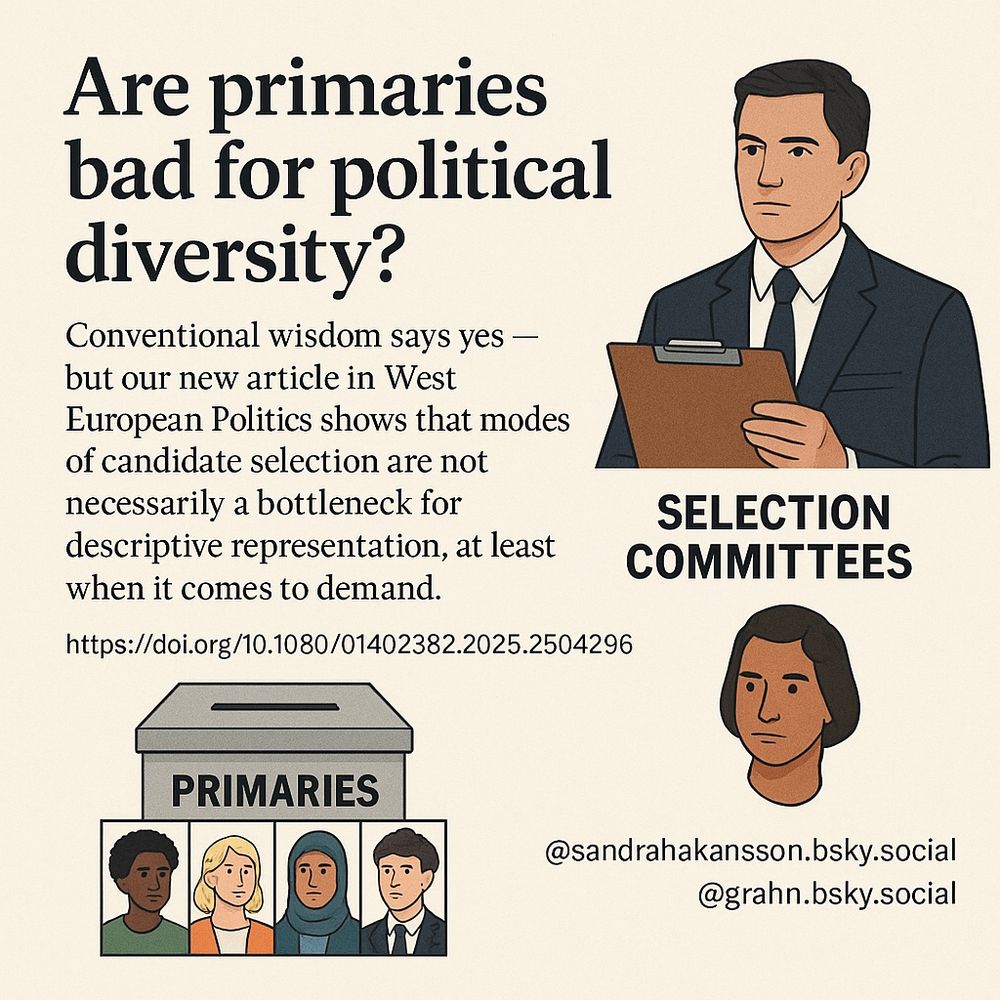
🧵1/ Are primaries bad for political diversity? Conventional wisdom says yes—but our article in @wepsocial.bsky.social shows that candidate selection modes are not necessarily a bottleneck for representation, at least when it comes to demand. 🗳️👥 @sandrahkansson.bsky.social
doi.org/10.1080/0140...
06.06.2025 09:44 — 👍 32 🔁 19 💬 2 📌 0
Check out this new piece in @wepsocial.bsky.social by UPPGAP's very own @sandrahkansson.bsky.social & @grahn.bsky.social on representation outcomes of different candidate selection methods in 🇸🇪 gendersky polisky
04.06.2025 20:36 — 👍 6 🔁 1 💬 0 📌 0

Screenshot of a journal article abstract from West European Politics, titled “Inclusive or exclusive? Candidate selection methods do not affect descriptive representation” by Michal Grahn and Sandra Håkansson from the Department of Government, Uppsala University, Sweden. The article is marked as open access and published by Routledge.
The abstract text is highlighted in yellow and states that while exclusive candidate selection methods (e.g., selection committees) are often thought to produce more descriptively representative outcomes than inclusive methods (e.g., primaries), such claims are usually based on cross-sectional comparisons. The authors conducted a conjoint experiment in Sweden involving 6,400 party members and 1,300 selection committee members, assessing preferences for candidate profiles based on gender, age, and immigrant background. The findings show that both groups exhibited similar preferences for underrepresented candidates across both selection modes. The study concludes that both inclusive and exclusive procedures can equally promote descriptive representation within supportive institutional contexts.
Below the abstract, the listed keywords are: Political recruitment; descriptive representation; political parties; primaries; conjoint experiment.

A dot plot titled "Candidate preferences among rank-and-file party members and SCMs, in primary and ballot creation contexts." The y-axis lists candidate characteristics: Gender (Men, Women), Immigrant background (No, Yes), Age (18–35, 36–64, 65+), Education (No higher education, University degree), and Employment sector (Public, Private). The x-axis represents marginal means, ranging from 0.4 to 0.55, with a vertical dashed reference line at 0.5.
For each characteristic, three groups are shown with their respective point estimates and 95% confidence intervals:
Red squares for “Party members, primary context”
Blue circles for “Selectors, primary context”
Green diamonds for “Selectors, ballot creation context”
The graph shows how different groups of selectors and party members vary in their marginal means when evaluating candidate characteristics. Confidence intervals are horizontal bars, and all estimates are clustered around the 0.5 mark, with some group differences, especially notable in age and education.
Below the figure, a note explains that the values represent marginal means with 95% confidence intervals, calculated separately for each group, with standard errors clustered at the respondent level.
Online first: "Inclusive or exclusive? Candidate selection methods do not affect descriptive representation" by @grahn.bsky.social & @sandrahkansson.bsky.social
doi.org/10.1080/0140...
#AcademicSky #Polisky
04.06.2025 18:49 — 👍 30 🔁 18 💬 1 📌 1

Today we hosted @marinampuig.bsky.social, who presented her insightful research on intersectionality and political representation. Thanks for joining our seminar! 🌟
12.05.2025 12:23 — 👍 4 🔁 0 💬 0 📌 1
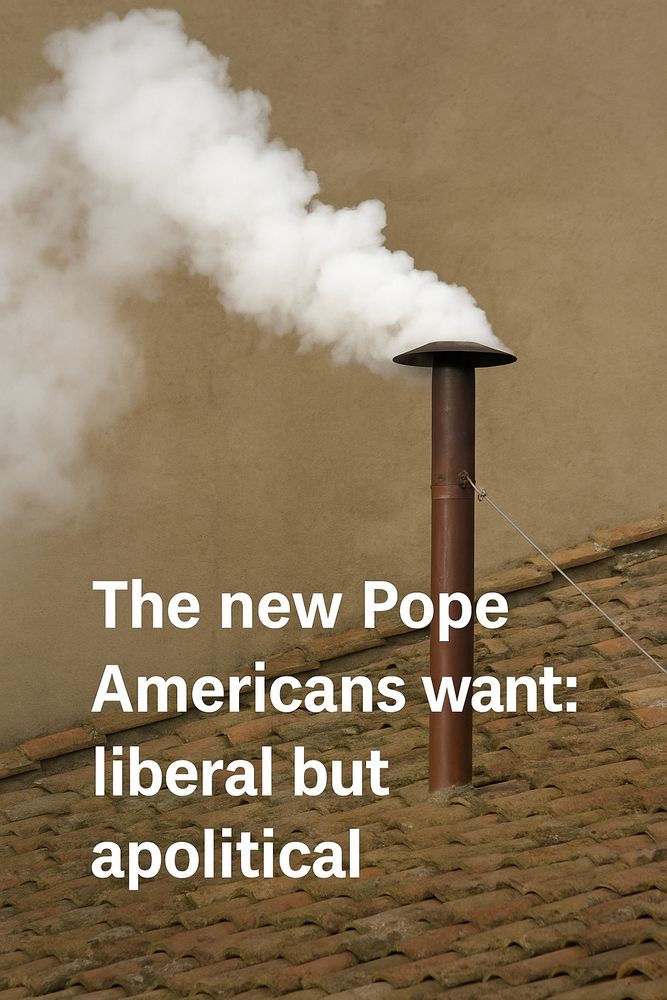
🧵 What kind of POPE do AMERICANS want?📸
Before the Conclave, @sophiemainz.bsky.social and I asked 1,500 U.S. adults to choose among hypothetical papal candidates.
Results: Americans prefer a liberal and *non-political* Pope. The latter might be challenging for Leo XIV.
Results ⬇️
Polisky Datasky
09.05.2025 09:00 — 👍 45 🔁 21 💬 16 📌 9
More new research by our UPPGAPers 💫
06.05.2025 13:50 — 👍 0 🔁 0 💬 0 📌 0
Thank you for having me @uppgap.bsky.social! Lots of great feedback, new insights, and engaging conversations!
30.04.2025 13:36 — 👍 8 🔁 3 💬 0 📌 0

Researchers sitting at a table and listening to a presentation during the Gender and Politics seminar at the Department of Government, Uppsala University.
Yesterday, we had the pleasure of hearing @gventurini.bsky.social present her work on how Italian political parties balance candidate experience with efforts to diversify their lists. Thanks for joining us and share your insights! 💫
29.04.2025 11:35 — 👍 9 🔁 2 💬 0 📌 1
Political scientist 🇿🇦🏳️🌈
he/him
https://turnbulldugarte.com
[trying to spend less time on social media]
#ihadablackdog
https://youtu.be/XiCrniLQGYc?si=q-gQTNXfScmgtl4k
Professor of Political Science, @uu-polisci.bsky.social, Uppsala University 🇸🇪 • Climate Change • Crisis • Disasters • Global Environmental Politics • International Relations • Public Policy.
Politics, Groups, and Identities is an official journal of the Western Political Science Association. Visit our homepage: https://www.tandfonline.com/journals/rpgi20
Assistant Professor of Canadian Politics at Queen's University | LGBTQ2S+ politics, Canadian politics, and gender and politics
Assistant Professor, Political Studies, Queen's University. They/them. Canadian politics, LGBTQ+ politics, parties, elections, representation, gender, sexuality. qalbaugh.com
Historian, writer, and teacher of early American gender, culture, & politics; Assoc. Prof; Public Historian; Author of FIRST FAMILY (Hanover Square) & FOUNDING FRIENDSHIPS(OUP)
cassandragoodhistorian.com | same handle on insta & Mastodon
Sociologist @USPUCSD. Study gender, migration, state violence, agency. Direct http://mmfrp.org. Books: Undocumented Politics(2018) & Banished Men(2023). #AcademicMama
Postdoc at University of Hamburg, previously at Leuphana University Lüneburg | PhD from Gothenburg University | Political behavior, Comparative Politics, Gender and Politics, far right, young men.
gefjonoff.com
Political Scientist, Scholar of Women, Gender and Politics, Dean, Faculty of Arts and Social Sciences, Fellow Royal Society of Canada, Distinguished Professor, Simon Fraser University
Professor of Political Science @lund-university.bsky.social
Statsvetenskapliga institutionen vid Uppsala universitet.
Political Science in Uppsala — Est. 1622 🏛️
Cutting-edge research & education at Sweden’s oldest polisci dept. 📚
Proud home of @skytteprize.bsky.social 🏆
https://www.uu.se/en/department/government
Postdoc and Policy Analyst | Redistributive Public Policies | Climate Justice | Gender and Politics
Thinking and writing on feminist IR, war preparedness and protection, misogynistic incel violence, sex and international security
Associate Professor, Political Science, University of Copenhagen. Parties, representation, recruitment, gender, youth, harassment/violence, engagement/affiliation, campaigning.
Assistant professor at Dept of Government, Uppsala University, researching gender and politics. Gender equality policy, social movements, religious institutions, political parties.
Political scientist | SEI, Sussex PhD | MA in 🇮🇹 🇫🇷 🇵🇱 | Euroscepticism, Poland, CEE, Italy, EU early women | @repjournal.bsky.social co-editor & founding co-editor of @PRXjournal.bsky.social | Montalcini scholar 2014 | #EUsky 🇪🇺 | #Firstgen
Researcher∙ intersectionality, political representation, social movements ∙ (ella/she)
Author "The Politics of Intersectional Practice" Bristol University Press
Banting Postdoctoral Fellow, York University, Canada
Honorary Fellow, University of Edinburgh, Scotland
Settler | She/her
drashleechristoffersen.com
PhD candidate in Political Science | 📍 Department of Government | Uppsala University.
Doing research on social and political trust, interested in🏳️🌈🏳️⚧️ politics & 🏳️🌈🏳️⚧️ history.