Check out @ohdearz.bsky.social great talk at the CfA colloquium on feedback and outflows from nearby galaxies at www.youtube.com/watch?v=Z4Nh.... And thanks for the shout-out for the AtomDB CX model!
24.02.2026 19:29 — 👍 8 🔁 3 💬 1 📌 0
@astrofermi.bsky.social
Astronomy grad student at Ohio State 🔭✨Cosmic Rays | Stellar Feedback | Transients 💫
Check out @ohdearz.bsky.social great talk at the CfA colloquium on feedback and outflows from nearby galaxies at www.youtube.com/watch?v=Z4Nh.... And thanks for the shout-out for the AtomDB CX model!
24.02.2026 19:29 — 👍 8 🔁 3 💬 1 📌 0
David Hogg has written a white paper on doing astrophysics in the age of LLMs. It looks to be thought-provoking. My initial reaction is that either LLMs will destroy the field or they will force a reckoning with and re-imagining of the current system that often prioritizes output over quality. 🧪
12.02.2026 03:58 — 👍 134 🔁 38 💬 17 📌 10Thank you 😊
18.12.2025 01:23 — 👍 0 🔁 0 💬 0 📌 0My first-author paper on the Ambiguous Nuclear Transient (ANT) AT2020adpi recently got published😄
Read it here 👇🏻
ANTs are a new class of transient events that do not fit into the broad categories of standard AGN variability or TDEs!

Very excited to share the NASA/ESA/STScI press release of our team's work on Apep! It's a terrific writeup, complete with a brand new beautiful visualisation of the nebula geometry.
1/? ⚛️🔭🧪
science.nasa.gov/missions/web...

Aurora Science 🔭🧪
What do the colors of the aurora tell you 👇
I discussed this paper in OSU astro coffee today and a fellow graduate student came up with the title "Treebeard vs Scary Barbie" 😃
10.11.2025 22:37 — 👍 2 🔁 0 💬 0 📌 0Excited to attend the @astrosociety.org gala tonight & receive the Nancy Grace Roman Award! I read about her life & career on my way here. Did you know she was responsible for making NASA data archives public so that everyone could benefit, not just PIs? Such an amazing impact on our field. 🔭
09.11.2025 00:02 — 👍 52 🔁 7 💬 5 📌 1Another title for this article could be: “Superman Outshines Scary Barbie”
www.cnn.com/2025/11/06/s...


Happy Halloween 🎃 from Lana Purr Ray
01.11.2025 02:39 — 👍 2 🔁 0 💬 0 📌 0
From Kylee Carden: Though moons are ubiquitous in our Solar System, we have not yet found one elsewhere (an exomoon). Today’s paper investigates whether we could find moons by precisely tracking the positions of a star and planet. 🔭✨☄️
astrobites.org/2025/09/25/e...
Congratulations Emily 🥹♥️🥰🫶🏻
17.09.2025 03:49 — 👍 0 🔁 0 💬 0 📌 0
Did you know LUMA was founded 10 years ago by Prof. Catherine Espaillat? We celebrated our 10th anniversary at AAS this January 🎉 . Learn more about LUMA at our website
31.08.2025 13:38 — 👍 6 🔁 4 💬 0 📌 0
A pika sits on a mossy rock.

Tighter crop of the same pika, focusing on its head.

An even tighter crop, focusing more on the pika's eye.
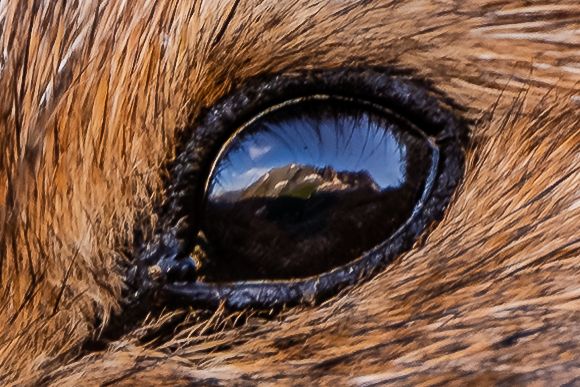
An extremely tight crop of the pika's eye, emphasizing their reflection of an early morning mountain scene.
"Pat, why do you carry that ridiculous 600mm lens on long hikes?"
Buddy, I can see mountains reflected in the eyes of a trailside pika.
My first ever ToO got approved!! I am so excited for the new observations of the ambiguous nuclear transient I am studying. Paper coming soon to arXiv 😃
31.07.2025 04:49 — 👍 3 🔁 0 💬 0 📌 0OSU astronomy undergrad alum Trinity Webb and OSU astro PhD student @astrojennifer.bsky.social led this Chandra program showing diffuse X-rays coincident with very young stars identified with JWST! Here's this great work: ui.adsabs.harvard.edu/abs/2024ApJ....
23.07.2025 23:04 — 👍 24 🔁 6 💬 0 📌 0Postdoc in #stellarastro at the ICCUB in Barcelona ☄️
Everyone I know from the astro community in Barcelona is lovely, so I can highly recommend it!

Magnificent portrait of a woman, 1620, by Artemisia Gentileschi. She was born on this day in 1593.
08.07.2025 17:33 — 👍 1115 🔁 130 💬 23 📌 7
RCW 38 a young star cluster about 5,500 light-years away containing roughly 2,000 stars.
The cluster is rich in star-forming activity, with gas, dust, and newly formed stars, including some still wrapped in their birth cocoons!
(Credit: ESO/VVVX survey)

Just saw the exciting news that Enrico Ramirez-Ruiz (prof at @ucscscience.bsky.social and my PhD advisor) was named the president of the @astrosociety.org!! 🎉🔭 news.ucsc.edu/2025/06/enri...
25.06.2025 21:50 — 👍 35 🔁 4 💬 0 📌 1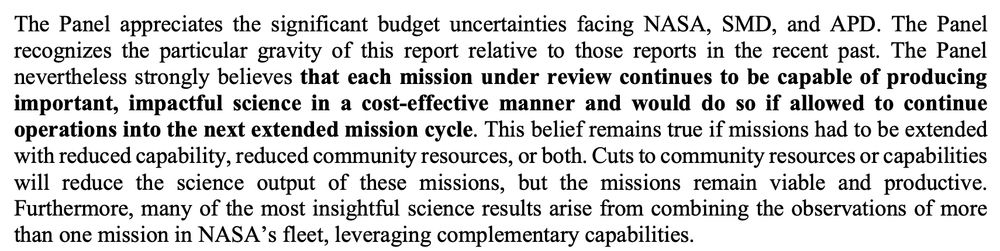
The Panel appreciates the significant budget uncertainties facing NASA, SMD, and APD. The Panel recognizes the particular gravity of this report relative to those reports in the recent past. The Panel nevertheless strongly believes that each mission under review continues to be capable of producing important, impactful science in a cost-effective manner and would do so if allowed to continue operations into the next extended mission cycle. This belief remains true if missions had to be extended with reduced capability, reduced community resources, or both. Cuts to community resources or capabilities will reduce the science output of these missions, but the missions remain viable and productive. Furthermore, many of the most insightful science results arise from combining the observations of more than one mission in NASA’s fleet, leveraging complementary capabilities.
The 2025 #NASA astrophysics senior review report is public. "Every mission received the highest possible rating for... scientific return", & are "producing important, impactful science in a cost-effective manner". Some important screenshots: assets.science.nasa.gov/content/dam/...
04.06.2025 02:23 — 👍 70 🔁 16 💬 2 📌 0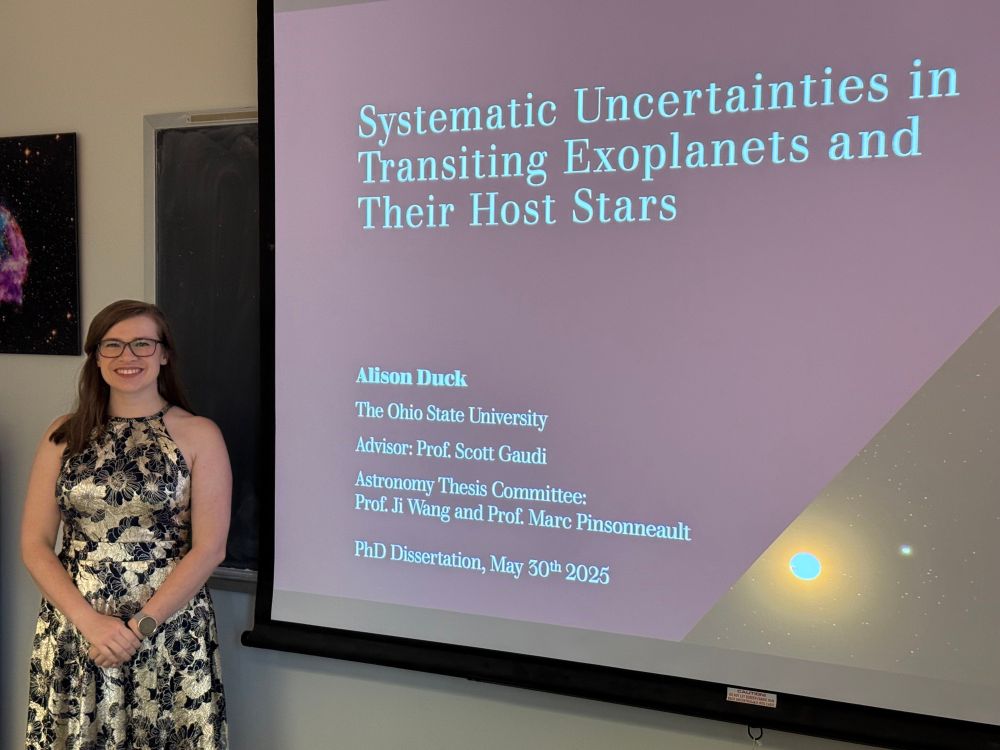
Introducing Dr. Alison Duck, PhD (Astronomy), The Ohio State University (and soon Jet Propulsion Lab)!
@astroalison.bsky.social
 20.05.2025 02:10 — 👍 6791 🔁 446 💬 46 📌 29
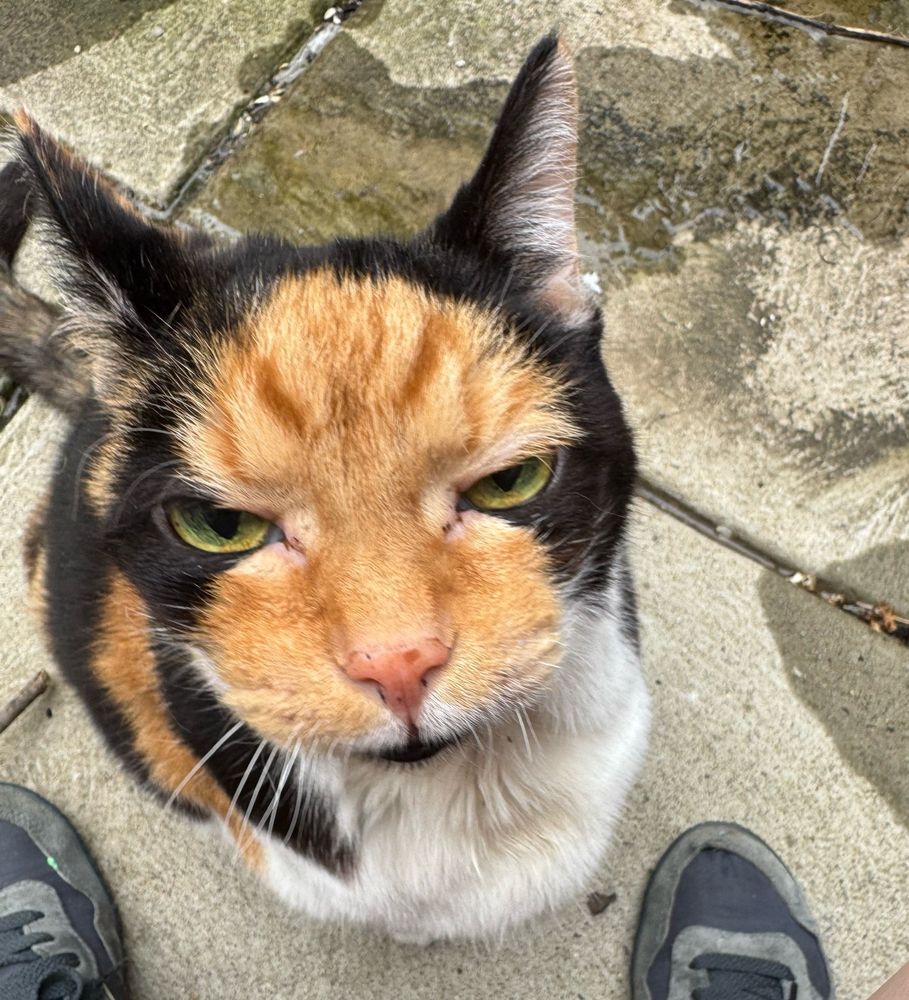
Tinsel the calico glares at you with a furrowed brow
“I asked chatGPT-“ ok, and I asked Tinsel, and she said you’re an uninspired, vapid dork who needs a computer to think for them.
10.05.2025 02:17 — 👍 18402 🔁 2895 💬 343 📌 76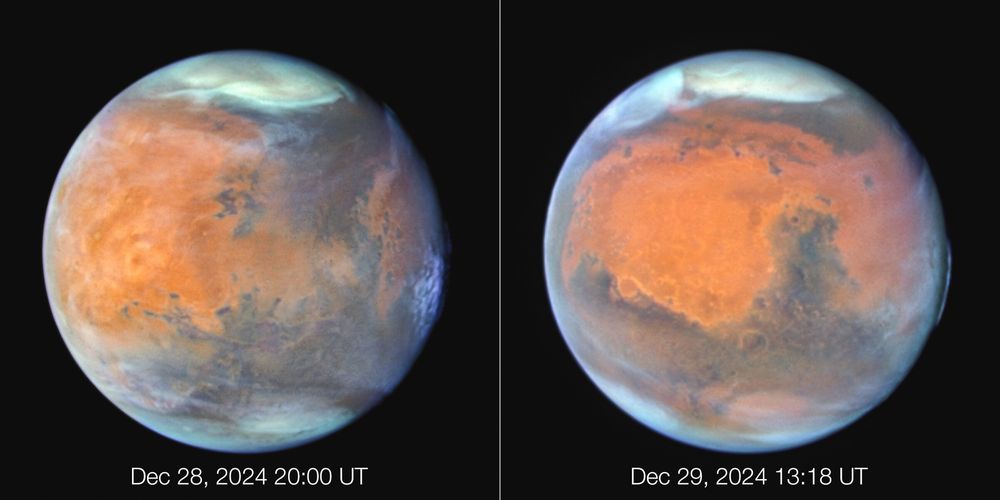
Two views of planet Mars on a black background of space observed by the Hubble Space Telescope. At left, text: December 28, 2024 20:00 UT. At right, text: December 29, 2024 13:18 UT. In both images, its atmosphere is clear and the surface appears detailed. Most of the planet is shades of orange. At left, the brightest orange area appears in the left half. At right, the brightest orange area is centered and takes on the rough shape of a sleeping mask. In both views, darker surface features are noticeable on the lower half of the planet. These have a mix of orange, blue, and gray hues. At the top and bottom, white regions mark the planet’s polar caps. The entire limb of the planet, its visible edge, has a blue hue. The blue doesn’t form an even circle at the edges, and appears thinner toward the left and right, and thicker in some areas.
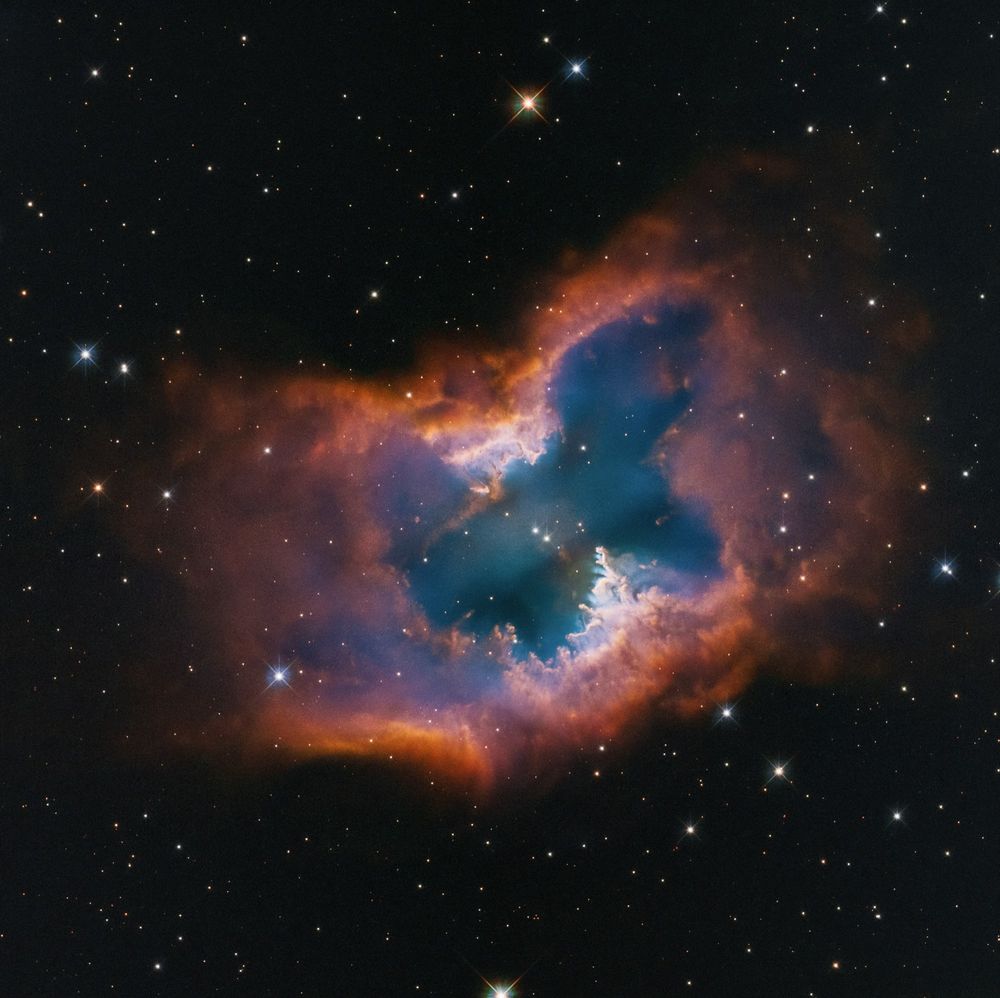
The planetary nebula NGC 2899 is shaped like a single macaroni noodle, with its edges pointed up, but its edge-on central torus is semi-transparent in the middle. The top and bottom edges are thick and orange. The center is semi-transparent blue and green. The wider central region looks roughly like a moth, also filled with semi-transparent blue and green. There are two pinpoint-like white stars with diffraction spikes toward the center. Immediately below them, slightly toward the right, is a smaller blue orb, a central star. The next layer of gas and dust is whiter, with some thicker pillars that look like they are rising up at bottom center. The colour fades into reds and purples, and then to orange.
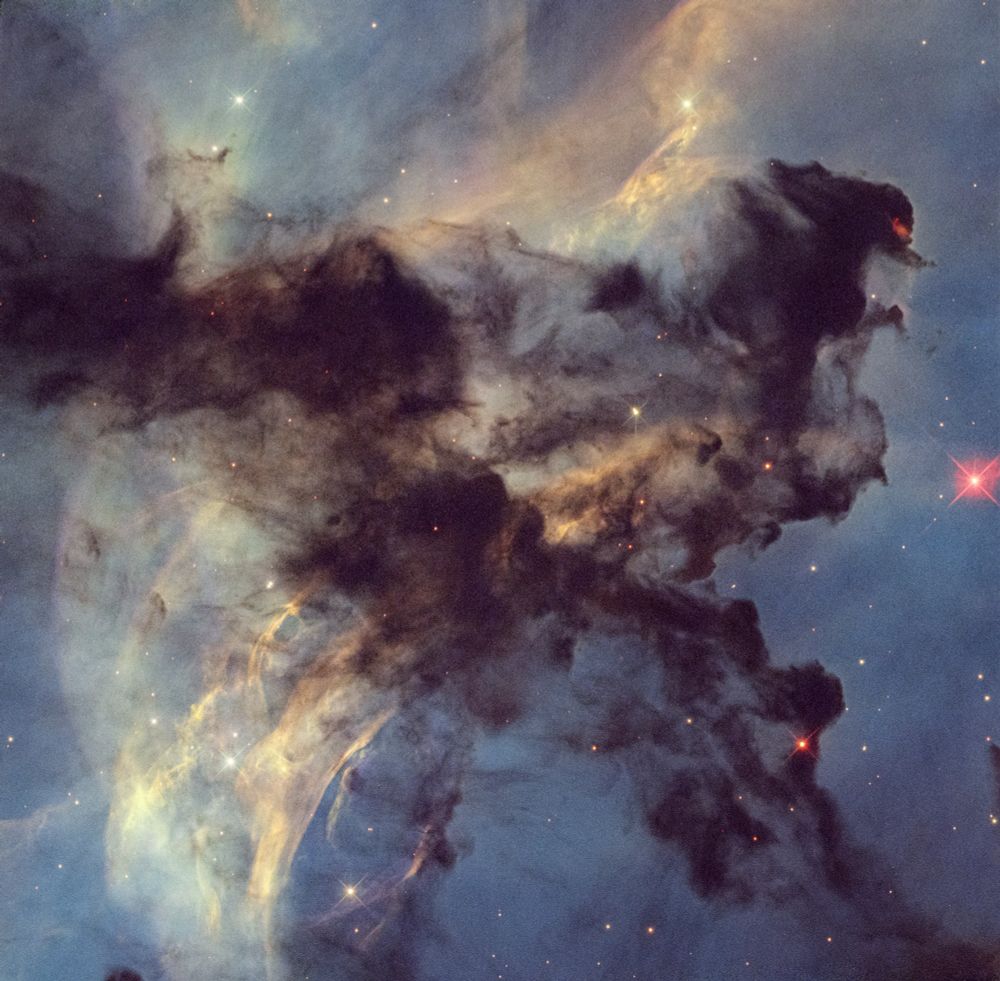
A tiny portion of the Rosette Nebula. Very dark gray material shaped like a V extends from just below top left all the way down to the lower right corner and back up toward the top right. It looks like thick smoke that has billowed out irregularly, thicker along the line from top left to bottom right, and looser on the piece that goes toward the top right. Behind the dark gray on the left side, from the bottom left to top center, there is dust that looks like arced claw marks that appears in light orange and yellow. The background at top left is hazier and some blues are covered in semi-transparent orange wisps, which makes sections take on green hues. In the bottom right, the background is bluer. There are a few bright red and purple stars scattered along the right half, most toward the bottom. The largest star is at right-center, just at the edge. It is red and has four diffraction spikes.
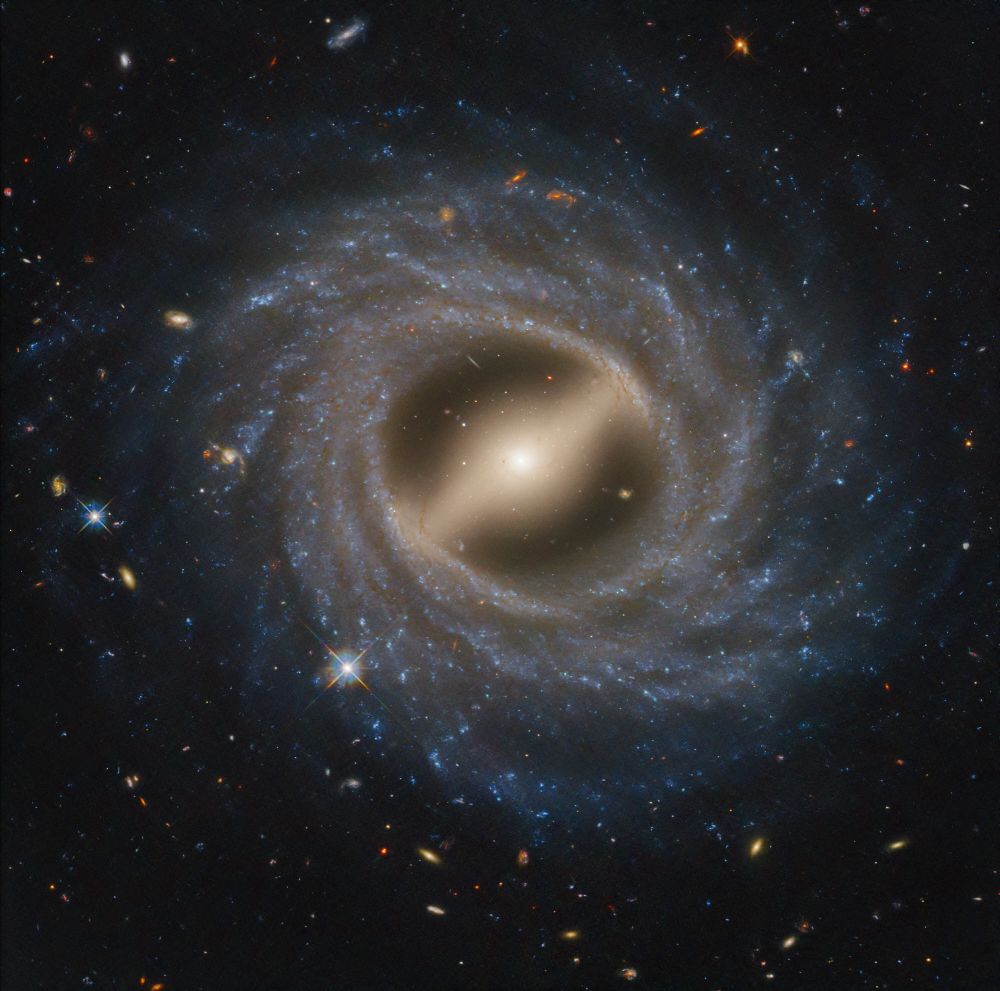
Barred spiral galaxy NGC 5335 observed by the Hubble Space Telescope takes up the majority of the view. At its center is a milky yellow, flattened oval that extends bottom left to top. Within the oval is a bright central region that looks circular, with the very center the brightest. In the bright central region is what looks like a bar, extending from top left to bottom right. Around this is a thick swath of blue stars speckled with white regions. Multiple arms wrap up and around in a counterclockwise direction, becoming fainter the farther out they are. Both the white core and the spiral arms are intertwined with dark streaks of dust. The background of space is black. Thousands of distant galaxies in an array of colors are speckled throughout.
Happy anniversary, Hubble! 🎂
Celebrate 35 years since this NASA/ESA space telescope was launched into orbit with four anniversary images! They roam from the planet Mars to dramatic images of stellar birth and death to a neighbouring galaxy.
Read more 👉 www.esa.int/Science_Expl...
#Hubble35 🔭 🧪
My personal favorites are From Eden, Work Song, and Almost. Maybe because I really love the lyrics of these songs and they are very refreshing to hear on a stressful day 🙂
19.04.2025 02:00 — 👍 1 🔁 0 💬 0 📌 0
From Astrobites: There is a tradition in Astronomy to post silly science papers to the arXiv on Aprils Fools day. We’ve collected them all for 2025 and provided some “peer review”. 🔭✨☄️
astrobites.org/2025/04/03/a...

A highly detailed composite image of a star-forming region of space known as 30 Doradus. X-ray wind and gas takes the shape of a massive purple and pink bouquet with an extended central flower, or perhaps a leaf from a maple tree. The hazy, mottled shape occupies much of the image, positioned just left of center, tilted slightly left. Inside the purple and pink gas and wind cloud are red and orange veins, and pockets of bright white light. The pockets of white light represent clusters of young stars. One cluster at the heart of 30 Doradus houses the most massive stars astronomers have ever found. The hazy purple and pink bouquet is surrounded by glowing dots of green, white, orange, and red. A second mottled purple cloud shape, which resembles a ring of smoke, sits in the lower righthand corner.
Hubble data was combined with Chandra X-Ray Observatory, Spitzer, and ALMA Observatory data for this composite image of 30 Doradus, seen in X-ray, visible, infrared, and radio. The massive young stars in 30 Doradus send strong winds out into space. Credit: NASA/CXC/JPL /ESO/NAOJ/NRAO/ALMA. 🔭 🧪
04.04.2025 15:14 — 👍 188 🔁 33 💬 4 📌 0