📣 Calling fish biologists & conservation scientists!
We’re convening a session at #ICBF2026 (UBC, Vancouver):
Bridging experimental biology & conservation
If your research connects mechanism to real-world application- from lab to field- we want your abstract!
Apply by March 3rd! 🐟🌎
icbf2026.com
11.02.2026 15:42 — 👍 10 🔁 4 💬 0 📌 0

Replication studies: a win-win for early-career training and behavioral ecology
Replicating previous research builds confidence that results are real and meaningful. But close replications are rare due to limitations in resources and d
How do we know our research results are REAL? We replicate them! Most folks agree but lament on how hard it is to publish these replications.
My dearest gentle reader, lament no more! Delighted to unveil: Replication Studies, a new section of Behavioral Ecology 1/
academic.oup.com/beheco/artic...
10.02.2026 19:42 — 👍 206 🔁 106 💬 4 📌 8
We're building ShoalBase: a global database of fish social systems. Undergrad or other students wanting research experience in behavioural ecology, data synthesis or evolution - please DM! www.shoalbase.org
11.02.2026 15:34 — 👍 2 🔁 1 💬 0 📌 0
New paper out!
Social context should be integrated into comparative and environmental physiology
11.02.2026 02:38 — 👍 1 🔁 1 💬 0 📌 0

🔍 I am looking for a 5-mo research technician to join my lab at CEAB-CSIC!
The position will work on the DRYFISH project and combines fieldwork in drying Mediterranean streams with laboratory experiments with fish
📄 Details here: tinyurl.com/4ckf357j
📅 Deadline: 17 Feb 26
10.02.2026 10:34 — 👍 5 🔁 4 💬 0 📌 0
Excited to see this out, our detailed commentary on the importance of social context for comparative physiology. Led by @shaunkillen.bsky.social out now in @jexpbiol.bsky.social here journals.biologists.com/jeb/article/...
10.02.2026 10:16 — 👍 5 🔁 2 💬 0 📌 0

When studying animal physiology we carefully control temperature, oxygen…but often ignore who animals live with.
Social context such as parents (1), social environment (2), litter mates (3) can shape physiology and later plasticity (4). We discuss it in this commentary 👉 doi.org/10.1242/jeb....
09.02.2026 13:49 — 👍 18 🔁 10 💬 0 📌 1

Further integrating social context into comparative and environmental physiology
Summary: Social environments affect all aspects of animal physiology. We highlight how overlooking social effects might lead to inaccurate physiology-based predictions of species’ responses to environ...
🚨New paper out now! Excited to see this commentary, led by @shaunkillen.bsky.social, showing that social context is key in comparative physiology and must be integrated! Read more here: doi.org/10.1242/jeb.... #ComparativePhysiology #Behaviour #Ecophysiology @sbohvm.gla.ac.uk @jexpbiol.bsky.social
09.02.2026 14:05 — 👍 15 🔁 7 💬 0 📌 0
kind of funny that an olympian said they are here to represent "compassion, respect, and love for others" and some people automatically knew that was a statement against them
07.02.2026 22:25 — 👍 39660 🔁 7215 💬 306 📌 144

We face two potential missteps in ecophysiology: 1) measuring animals under socially unrealistic conditions & 2) extrapolating results to nature, where social dynamics alter trait expression, plasticity, & evolutionary outcomes. Our new commentary in @jexpbiol.bsky.social : doi.org/10.1242/jeb....
09.02.2026 13:24 — 👍 44 🔁 15 💬 0 📌 4
Thank you! Not sure why I'm having so much trouble with links lately!
09.02.2026 10:46 — 👍 1 🔁 0 💬 1 📌 0
Catch-and-release stress in Atlantic salmon shortly before spawning can affect next generation. Offspring show ↓ activity & exploration, & ↑ aggression, all traits that matter during early life. Read here: besjournals.onlinelibrary.wiley.com/doi/10.1002/... Great work from Magadalene Papatheodoulou!
09.02.2026 08:54 — 👍 15 🔁 2 💬 2 📌 2
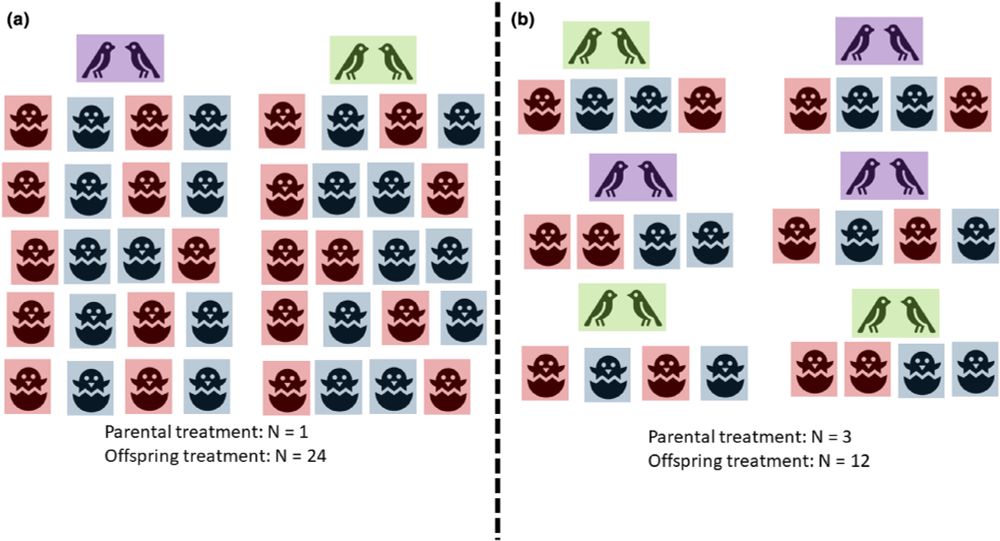
Principles of experimental design for ecology and evolution
Here I argue that we do not discuss experimental design, often until it is too late. This editorial seeks to begin a conversation about how and where to replicate appropriately.
The principles of experimental design in ecology and evolution has 20k downloads, but unfortunately I still have to reject ~20% of papers without review because they lack replication at the right level. More discussion among mentors and mentees please.
onlinelibrary.wiley.com/doi/full/10....
07.02.2026 04:57 — 👍 35 🔁 14 💬 1 📌 0
Can't wait to start this cross disciplinary project with a fantastic team, including @kochhanndaiani.bsky.social, @katjaenberg.bsky.social, Nick Hanley, Kath Sloman, and many others. Linking fish welfare, rural livelihoods, and rainforest conservation. Postdoc (x2) and tech positions forthcoming. 🙂
04.02.2026 21:48 — 👍 14 🔁 2 💬 0 📌 0

I have two #PhD scholarships available on either the ecophysiology or movement ecology of the Pilbara leaf-nosed #bat at @murdoch.edu.au 🦇
Apply now: www.murdoch.edu.au/study/schola...
Lab website: www.nicholaswulab.com
26.01.2026 07:06 — 👍 11 🔁 12 💬 0 📌 0


Our new paper in @globalchangebio.bsky.social: artificial light at night creates an ecological trap for wild reef fish. Settlement ↑ under artificial light (up to 8× higher), but survival ~50% lower due to predation, disrupted settlement timing, and altered metabolic rhythms: doi.org/10.1111/gcb....
26.01.2026 09:12 — 👍 15 🔁 3 💬 1 📌 1
Finally moving beyond the fiction of a constant metabolic baseline will give us a more realistic foundation for bioenergetics, ecology, and evolution! (9/9)
23.01.2026 17:32 — 👍 0 🔁 0 💬 1 📌 0
We are not saying SMR is useless. We are saying it should be treated as state-dependent, or explicitly time-integrated across the sleep–wake cycle, depending on the biological question. (8/9)
23.01.2026 17:32 — 👍 1 🔁 0 💬 1 📌 0
These effects may have implications for repeatability, heritability, metabolic scaling, behaviour–metabolism links, thermal performance curves, and even “calming effects” of conspecifics. Sleep architecture is a hidden axis in ALL of these. (7/9)
23.01.2026 17:32 — 👍 0 🔁 0 💬 1 📌 0

Derived traits are affected too. Because aerobic scope = MMR − SMR, state-biased SMR estimates can inflate or shrink apparent performance capacity, even if maximum performance is unchanged. (6/9)
23.01.2026 17:32 — 👍 0 🔁 0 💬 1 📌 0

Environmental or treatment effects can also be missed entirely. If a factor affects a sleep-dominant process and SMR is measured during wake (or vice versa), any metabolic change may never be detected. (5/9)
23.01.2026 17:32 — 👍 0 🔁 0 💬 1 📌 0

This creates systematic measurement bias. SMR measured only during sleep underestimates daily maintenance costs; SMR measured only during wake overestimates them. The size and direction of the bias depend on sleep duration and sleep architecture. (4/9)
23.01.2026 17:32 — 👍 0 🔁 0 💬 1 📌 0

Wake, NREM sleep, and REM sleep each prioritise different physiological processes, with distinct energetic demands. How maintenance is defined and what constitutes SMR depends entirely on WHEN you measure it. (3/9)
23.01.2026 17:32 — 👍 1 🔁 1 💬 1 📌 0
Basal and standard metabolic rate are treated as fixed traits: the minimum cost of staying alive. But many core maintenance processes are not continuously active. Instead, they are temporally partitioned across wakefulness and different sleep states. (2/9)
23.01.2026 17:32 — 👍 0 🔁 0 💬 1 📌 0

Thread: In our new paper in Biological Reviews, we argue that one of physiology’s most basic assumptions is wrong. There is no single, static “baseline” metabolic rate. Instead, sleep-wake cycles quietly subvert how BMR and SMR are usually interpreted. onlinelibrary.wiley.com/doi/10.1002/... (1/9)
23.01.2026 17:32 — 👍 9 🔁 2 💬 1 📌 0
Congrats @helenanorman.bsky.social on an amazing poster!
16.12.2025 17:34 — 👍 8 🔁 1 💬 0 📌 0
phd student yale eeb | behavioral disease ecologist | sociality🐃🍻, parasites🪱🦠, immunity💉, and movement 🛰️ https://will-rogers.github.io
Med-peds ID doc in the Northeast US, former peds chief, former Fulbright scholar to Russia. Deputy Editor of ID at theMedNet.org. Lover of 🐕🍯🌿🐿️🦅
MSc & BSc (Hons) in bat behaviour/physiology @uwinnipeg.bsky.social 🦇 (she/her)
Veterinary Medicine, Wildlife Conservation & Diseases 🔬
https://kristinamuise.weebly
Science Communications Officer for @biologists.bsky.social | PhD at McMaster University | #SciComm | Marine biology | Worms 🪱| Invertebrates | Views are my own | Honduras -> USA -> Canada -> UK
Animal communication, neuroethology
Postdoc @MPIBR
Naked-mole rat research 🍠
Scientific illustrator: behance.net/alem3
Postdoctoral researcher at Bristol University with the Ecology of Vision lab. Interested in insect conservation, light pollution, sensory ecology, and kindness 🕷️🌈🦋 (She/Her)
Associate Professor, Bristol University 🧪
Resilience loss ⚖️ Early warning signals ⚠️ multiple stressors 🏭 biodiversity change 🌍 rewilding 🦫
🔗 experimentalconservation.com
Editor at Biology Letters.
Sex, conflict, sociality, evolution, plovers. Associate Professor UVMB. Budapest. (he/him)
Assistant Professor of Philosophy at Colorado State. Views my own, etc.
Animal Philosophy, Social & Political Philosophy, Feminist Philosophy, Latin American Philosophy, Philosophy of Biology
assistant professor @lewisandclark
she/her | hapa🍚
previously: @cefemontpellier @utaustin
fun times: 🤽🏽♀️🧘🏽♀️🏊🏽♀️🏃🏽♀️🏋🏽♀️🖌️🪡🧵
PhD candidate at Tufts University | stress physiology, neuroendocrinology, behavior 🐥🐦 | (he/him) 🏳️🌈
Early Career Researcher | How wild animals cope with changing environments | Thermal biology/imaging | Nature Photography | Melted Cheese
Associate Professor, Department of Biology, Wilfrid Laurier University 🇨🇦
Evolutionary Genetics & Behavioural Ecology #DrosLife #ScienceDoughnuts #JournalKlatch
ORCID: 0000-0002-8708-2728
Postdoctoral researcher in ecophysiology, evolutionary ecology and ecosystem functioning 🦎🦋
SETE, Moulis - CNRS France
U of Winnipeg ecologist; behavioural ecology; wildlife biology; fisheries; families; birds; climate change; surf-fishing; wood-working; lifelong student of natural history.
Brazilian ichthyologist. Exploring fish diversity, phylogeny, and biogeography.
Currently at Federal University of Rio de Janeiro, Brazil
Biology professor in the Theoretical Ecology Group, Deputy Head of Department of Biological Sciences, University of Bergen. Sustainability, evolutionary ecology, marine ecology, fisheries, food from the ocean.
PhD Candidate, Illinois State University | Ecophysiology & development of ectotherms | Animal responses to thermal shifts | Turtles, Fish, etc.
(he/him) 🐈⬛Cat dad 🏊🏼♂️Swimmer ☕Coffee Addict
Spatial ecologist studying mostly how anthropogenic activities impact seabird movements and behaviours 🐧🐦🌊 Postdoc at University College Cork 🇮🇪☘️