OSF
🚨 New preprint: What does the research landscape of behavioral reinforcement learning look like 🌍?
We developed an LLM-powered bibliometric analysis to characterize article clusters, investigate their connections, and examine the distribution of topics across the landscape.
osf.io/6c2va_v1
17.10.2025 07:25 — 👍 28 🔁 12 💬 2 📌 2
🌍 Neue Studie vom @ipb.bsky.social an der @unierfurt.bsky.social: Zustimmung zu Klimaschutzmaßnahmen steigt, wenn ihre #Wirksamkeit verständlich erklärt wird. Beispiel #Tempolimit auf deutschen Autobahnen 🚗💨: Wer das CO₂-Einsparpotenzial kannte, unterstützte es stärker – teils noch 1,5 Jahre später.
25.08.2025 12:41 — 👍 4 🔁 1 💬 1 📌 1
🚨 New preprint 🚨
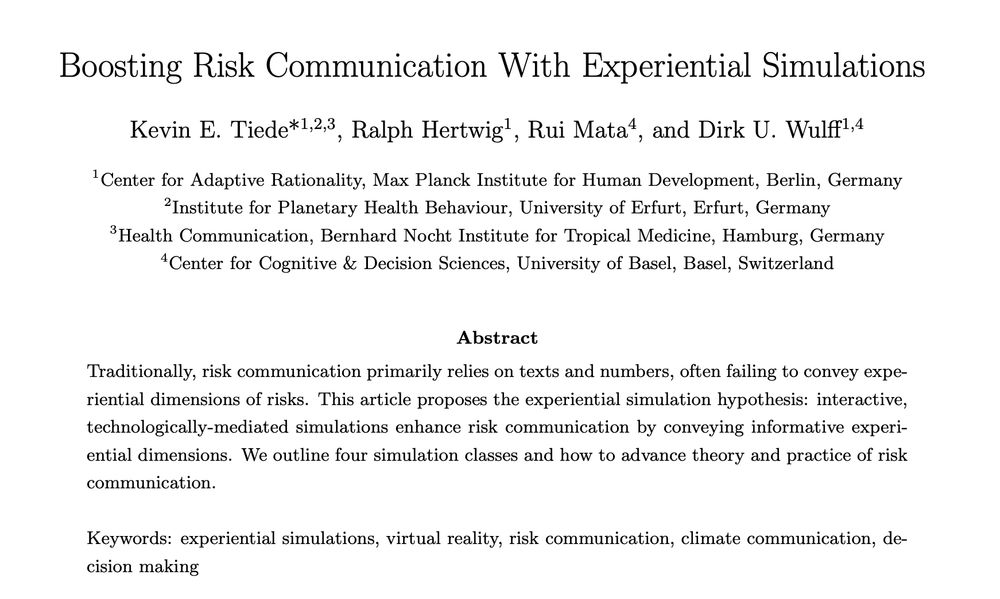
How to improve risk communication?
In this new piece, spearheaded by @kevinetiede.bsky.social, we argue that traditional risk communication often fails to convey experiential dimensions of risk, and that experiential simulations can help fill this gap.
doi.org/10.31234/osf...
20.06.2025 14:34 — 👍 6 🔁 3 💬 0 📌 0

Summer Institute
🚨 Applications for the 22nd Summer Institute on Bounded Rationality are now open!
🌐 Join us in Berlin @mpib-berlin.bsky.social from June 17–25, 2025 to explore "Decision Making in a Digital World".
✏️ Application deadline is March 9 - more info at 👇!!
www.mpib-berlin.mpg.de/research/res...
04.02.2025 14:42 — 👍 27 🔁 26 💬 0 📌 2
APA PsycNet
Read the full paper here (Open Access): psycnet.apa.org/fulltext/202...
Let us know if you have any thoughts and comments on the paper!
08.01.2025 12:33 — 👍 0 🔁 0 💬 0 📌 0
Our findings demonstrate that how people evaluate described and experienced options depends on the learning mode of the other option in the choice set, highlighting a previously overlooked boundary condition of discrepancies between description- and
experience-based choice.
08.01.2025 12:33 — 👍 0 🔁 0 💬 1 📌 0
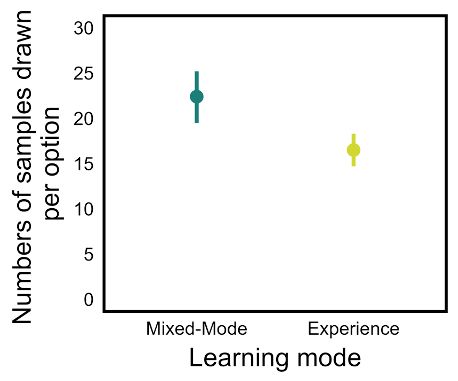
Finally, participants searched for more information when there was only one experienced option in the mixed-mode condition than when both options were experienced in the pure-experience condition.
08.01.2025 12:33 — 👍 0 🔁 0 💬 1 📌 0
Also, there was no DE gap when operationalized as over/underweighting of rare events based on the latent payoff distribution in the mixed-mode condition. Further, participants’ choices were not biased toward the described or experienced option.
08.01.2025 12:33 — 👍 0 🔁 0 💬 1 📌 0
In the mixed-mode condition, however, the value and probability weighting functions did not differ between the described and the experienced options, suggesting that people evaluated them based on a joint representation despite the different learning modes.
08.01.2025 12:33 — 👍 0 🔁 0 💬 1 📌 0
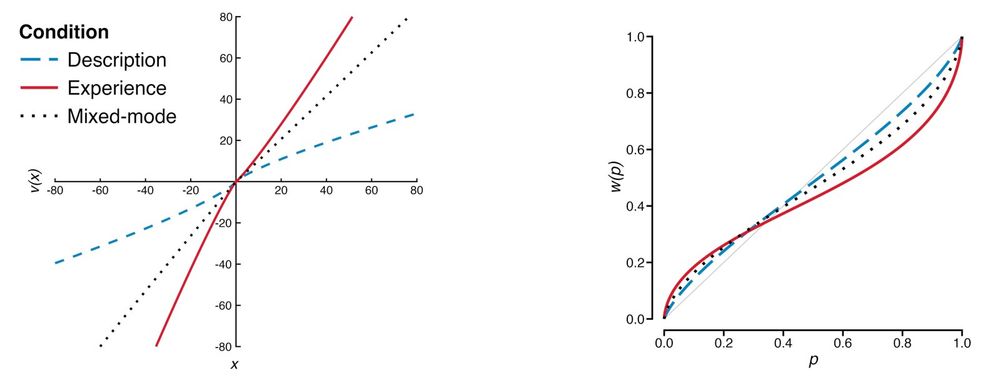
Using CPT’s value and probability weighting functions to characterize how observed outcome and probability information was subjectively distorted in people’s choices, we found clear differences between the pure description and experience conditions in line with previous research.
08.01.2025 12:33 — 👍 0 🔁 0 💬 1 📌 0
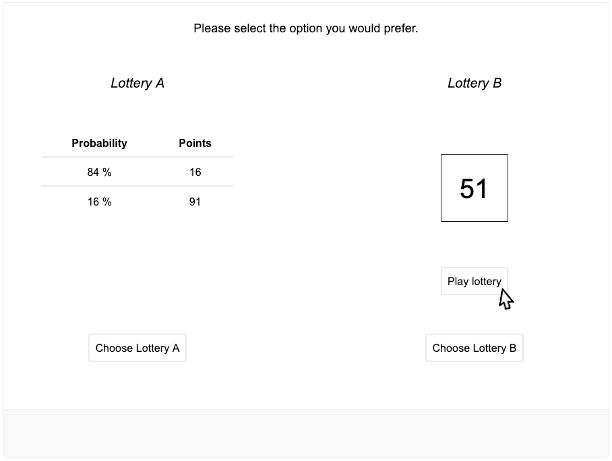
To test this, we studied risky choices between options that are presented in either the same or in different learning modes—that is, choices between two described or two experienced options or between a described and an experienced option (i.e., a mixed learning mode; see image).
08.01.2025 12:33 — 👍 0 🔁 0 💬 1 📌 0
In this research, we studied how the evaluation of risky options, choice, and search behavior depend on the choice context in terms of learning mode (description vs. experience).
08.01.2025 12:33 — 👍 0 🔁 0 💬 1 📌 0
Research on the description–experience (DE) gap has primarily compared scenarios where all options are either described or experienced through sampling. However, it's unclear how decisions are made when learning modes between options are inconsistent.
08.01.2025 12:33 — 👍 0 🔁 0 💬 1 📌 0
APA PsycNet
New year, new research: In our latest paper published in JEP:LMC, my co-authors Thorsten Pachur, Wolfgang Gaissmaier and I answer the question: “Is there a description–experience gap in choices between a described and an experienced option?” (psycnet.apa.org/fulltext/202...)
08.01.2025 12:33 — 👍 3 🔁 2 💬 1 📌 0
Normalien | Cognitive Science MSc (Data Science & Modeling) from l'École Normale supérieure
Doctoral student & Normalien in cognitive neuroscience at the École Normale Supérieure Paris - PSL University, Human Reinforcement Learning Team | Interested in decision modeling & photography
PhD student at CBDR, University of Zurich: https://cbdr-lab.net/lob. Interested in decision making, uncertainty, modeling, and EMA.
University Assistant (Praedoc)/ Ph.D. candidate @univienna
Social & Economic Psych Group
antibiotic use, antimicrobial resistance
Postdoc Max Planck Institute for Human Development
Heisenberg Professor for Medical Risk Literacy & Evidence-Based Decisions, Charité Universitätsmedizin Berlin & Senior Research Scientist, Max Planck Institute for Human Development, Center for Adaptive Rationality
Post-Doctoral Fellow @unipotsdam.bsky.social, visiting @arc-mpib.bsky.social | PhD @hertieschool.bsky.social | Democracy, Technology, Behavioral Public Policy | Website: https://christophabels.com
PhD candidate working on cultural evolution online, attention economy, and online behaviour from a Psych/Ling angle 📚 or more generally languages, illustrations, coding & music
We research the interplay between the environment and human well-being and brain health, at the Max Planck Institute for Human Development, Berlin
@mpib-berlin.bsky.social
https://www.mpib-berlin.mpg.de/research/research-centers/environmental-neuroscience
Postdoc | Humboldt University | Max Planck Institute for Human Development | Decision-making, Movement Ecology, Animal Behaviour 🐥🐟
Post-doctoral researcher @ Max Planck Institute for Human Development Berlin
Predoctoral Researcher in Cognitive Psychology | Technical University of Munich | Decision Making, Information Search, Computational Modeling & Philosophy of Science
Cognitive psychologist and decision scientist. Risk, attention, adaptive cognition, computational modeling, process tracing, research methods. https://www.msl.mgt.tum.de/en/brm/home/
physician, educator, mentor, empathy advocate, grandpasoarous. MINTie. Former President, Society of Behavioral Medicine (SBM). Fellow: SBM; Academy of Communication in Healthcare. Adjunct Professor, Alpert Medical School, Brown U. Views are my own.
Our mission is to foster person-centred healthcare and shared decision making worldwide. Our vision is that healthcare decisions are well-informed, and based on collaboration between persons and their health care providers.
Science communicator at Max Planck Institute for Human Development @mpib-berlin.bsky.social | Podcast host and producer unravelingbehavior.org
Behavioral Social (Meta) Scientist @wu_vienna
- Department of Strategy and Innovation | Curious about the processes underlying #DecisionMaking #OpenScience #Inequality #Wellbeing
Offizieller Account von kachelmannwetter.com
Es posten: Clemens Grohs /CG, Peter Hinteregger /PH, Fabian Ruhnau /FR, Lars Dahlstrom /LD, Frank Abel /FA
Assistant Prof of Environmental Behavioral Sciences at Stanford Doerr School of Sustainability. Director of the Stanford Climate Cognition Lab https://climatecognition.stanford.edu