YouTube video by Corridor Crew
VFX Artists React to Bad & Great CGi 211 Ft. Joe Letteri
This video on Avatar 2/3 reignited this feeling: youtu.be/ueJTdtmZ5R4?.... Weta Workshop wanted to transfer actor faces to CGI Na'vi faces, which have different facial structure. So they built an anatomically inspired facial muscle model and fit it using gaussian splat meshes from video.
01.02.2026 06:06 — 👍 2 🔁 1 💬 1 📌 0
Wonderful team effort with @jan-ache.bsky.social, Fathima Iqbal, @sirinlieb.bsky.social, @merterginkaya.bsky.social, @sanderliessem.bsky.social, and others. Thanks to @erc.europa.eu #HorizonEurope #MSCA and @dfg.de for funding.
05.01.2026 16:24 — 👍 8 🔁 2 💬 0 📌 0
Thrilled to start 2026 with our latest preprint, in which we dive into a dedicated forward-walking circuit in the fly brain: doi.org/10.64898/202.... This effort was spearheaded by the fantastic @chrisjdallmann.bsky.social with help from a bunch of talented people in the lab.
05.01.2026 17:15 — 👍 26 🔁 8 💬 0 📌 0
Happy New Year from seasonally beautiful Newcastle-upon-Tyne! Get in touch if you are interested in our #PhDstudentship to research the neurobiological basis of social behaviour and its dysfunction in Drosophila melanogaster. Deadline for applications: 23rd January.
04.01.2026 20:01 — 👍 4 🔁 2 💬 0 📌 0

Re-exposure to reward re-evaluates related memories
To adapt behavior in changing environments, animals must continuously re-evaluate previously learned associations. This flexibility of memory systems …
Carolin Warnecke together with Hanna, Dennis, Bene & Kerstin from my lab show that re-exposure to reward diminishes multiple associated olfactory memories.
We’re hiring 2 postdocs—DM/email me for details. #Postdoc #Hiring
www.sciencedirect.com/science/arti...
20.12.2025 18:49 — 👍 21 🔁 9 💬 0 📌 1
Thanks Tyler!!
20.12.2025 07:25 — 👍 1 🔁 0 💬 0 📌 0
We are extremely grateful to the #maleCNS team, incl. @janelia-flyem.bsky.social, @jefferis.bsky.social and lab, and many, many others. Backstory >> bsky.app/profile/jeff... Website >> male-cns.janelia.org
19.12.2025 07:02 — 👍 2 🔁 0 💬 0 📌 0

Author list from the preprint.
We, in this case, are stellar postdocs and shared first-authors @sanderliessem.bsky.social and @skasin.bsky.social with a team from @uni-wuerzburg.de, @hhmijanelia.bsky.social and @columbiauniversity.bsky.social in a collaboration between the Ache and Card labs & friends.
19.12.2025 07:02 — 👍 4 🔁 0 💬 1 📌 0
Overall, DNs form parallel, loosely-overlapping ensembles that span a continuum from command-like neurons to synergistic population codes. Upstream, distinct combinations of sensory feature detectors differentially recruit DN ensembles to enable flexible, context-dependent behavioral control.
19.12.2025 07:02 — 👍 3 🔁 1 💬 1 📌 0

A big correlation matrix comparing the output similarity of all DNs in the fly.
5th, it turns out - very! Based on their output similarity in the VNC, we were able to cluster all 1300 DNs into functional ensembles covering the entire behavioral space of the fly. DNs previously associated with specific behaviors clustered together. So these clusters align with specific behaviors
19.12.2025 07:02 — 👍 1 🔁 1 💬 1 📌 0

Illustration of the landing and takeoff pathways.
At this point, we’ve shown that landing and takeoff are controlled by separate, parallel populations of neurons on each sensorimotor level - from feature detection to pre-motor assemblies. Despite being triggered by the same visual stimulus. How widespread is this parallel processing architecture?
19.12.2025 07:02 — 👍 2 🔁 0 💬 1 📌 0

Visual tuning of landing DNp10, which responds to upward moving dark stripes and looming stimuli.
Despite relying on a different set of sensory feature detectors, landing DNs are responsive to frontal looming stimuli. But their response differs from that of takeoff DNs, showing that the networks upstream of each DN ensemble encode different parameters of the same stimulus.
19.12.2025 07:02 — 👍 1 🔁 0 💬 1 📌 0

Visual tuning and leg movements for a set of landing DNs
4th, we asked whether the variants of the landing movements driven by different DNs are matched to their sensory tuning - it turns out they are! Different Landing DNs receive visual input from different spatial directions, and the sensory tuning matches the movements they drive.
19.12.2025 07:02 — 👍 1 🔁 0 💬 1 📌 0
This makes sense, functionally, because landing is only relevant in the context of flight, and the landing motor pattern would disrupt other actions, such as walking or courtship, when evoked in the wrong context.
19.12.2025 07:02 — 👍 1 🔁 0 💬 1 📌 0

Electrophysiological recordings of landing DN during activation of upstream sensory feature detectors, and plot showing landing and takeoff DNs receive input from separate populations.
Our connectome analysis predicts functional connectivity, which we verify by patching/optogenetic activation experiments in behaving flies. Importantly, though, actual connectivity is heavily state-dependent, so that sensory activity gets routed into landing pathways only during flight.
19.12.2025 07:02 — 👍 3 🔁 1 💬 1 📌 0

Anatomy of visual inputs to the landing DNs alongside their respective activation phenotypes.
3rd we went upstream to ask how DNs get recruited by sensory systems. We identified all visual inputs to landing and takeoff DN ensembles - and find they are recruited by separate, parallel sets of visual feature detectors. And core input neurons to the landing pathway drive landing phenotypes.
19.12.2025 07:02 — 👍 1 🔁 0 💬 1 📌 0

Connectivity diagrams of and leg movements driven by specific landing DNs.
One neat little feat: within each ensemble, individual DNs make unique connections to motor neurons via specific interneurons, which enable variations of the core motor pattern - leading to landing movements with unique leg kinematics, such as reaching overhead, suitable for landing on the ceiling.
19.12.2025 07:02 — 👍 2 🔁 1 💬 1 📌 0

Anatomy and analysis of the Core Landing Motor Ensemble.
2nd we identified the Core Motor Assemblies linking DN ensembles to motor neurons. These assemblies predict movement sequences driven by DNs, such as extensions of all legs for landing through inhibition of leg flexors and excitation of extensors. Again, circuits for landing and takeoff > separated.
19.12.2025 07:02 — 👍 1 🔁 0 💬 1 📌 0
Neurons within each ensemble drive similar movements of the entire body, which we confirmed using optogenetics and behavioral tracking.
19.12.2025 07:02 — 👍 2 🔁 1 💬 1 📌 0

Analysis and anatomy of Landing DN Ensemble
1st we analyzed pathways for landing and takeoff - behaviors elicited by the same visual stimulus that involve different body movements. Comparing output connectivity of all descending neurons (DNs) to known DNs for landing and takeoff, we identify separate DN ensembles controlling each behavior.
19.12.2025 07:02 — 👍 1 🔁 0 💬 1 📌 0

Landing and takeoff sensorimotor pathways illustrated alongside fly drawings showing behavioral responses.
How do animals channel sensory information into motor pathways to generate flexible behavioral output? Excited to share a new preprint addressing this question by leveraging the new #maleCNS connectome, behavioral experiments, and in-vivo recordings: doi.org/10.64898/202.... A long🧵...
19.12.2025 07:02 — 👍 69 🔁 29 💬 3 📌 1
Deadline for this post-doc position in my lab extended to Jan 11th!
12.12.2025 15:01 — 👍 8 🔁 18 💬 0 📌 0
Happy to share our current opinion on the insulin and octopamine systems and their role in shaping neuronal circuits, energy homeostasis, and behavior in #Drosophila, other insects, and 🧑🦱.
18.11.2025 11:04 — 👍 12 🔁 3 💬 0 📌 0
Thank you @katrinvogt.bsky.social! I had a great time with all the impressive science going on in Konstanz!
10.11.2025 09:20 — 👍 1 🔁 0 💬 0 📌 0

Male CNS Connectome
A team of researchers has unveiled the complete connectome of a male fruit fly central nervous system —a seamless map of all the neurons in the brain and nerve cord of a single male fruit fly and the ...
Exciting news for #drosophila #connectomics and #neuroscience enthusiasts: the Drosophila male central nervous system connectome is now live for exploration. Find out more at the landing page hosted by our Janelia FlyEM collaborators www.janelia.org/project-team....
05.10.2025 15:40 — 👍 144 🔁 69 💬 2 📌 8
Now out in @nature.com: Our study discovering a neural circuit in Drosophila that predictively inhibits proprioceptor axons during voluntary leg movements, such as walking and grooming. www.nature.com/articles/s41...
17.09.2025 15:14 — 👍 72 🔁 30 💬 4 📌 2

Person standing in a park with a stroller while enjoying a tasty Dürüm.
Couldn’t be more excited about this paradigm shifting result.
15.09.2025 09:11 — 👍 15 🔁 0 💬 3 📌 1
🪰 How do dozens of tiny fly muscles cooperate to move a leg?
We’re excited to share the first 3D, data-driven musculoskeletal model of Drosophila legs based on Hill-type muscles, running in OpenSim and MuJoCo simulation environments.
Preprint: arxiv.org/abs/2509.06426
12.09.2025 21:26 — 👍 63 🔁 20 💬 1 📌 2
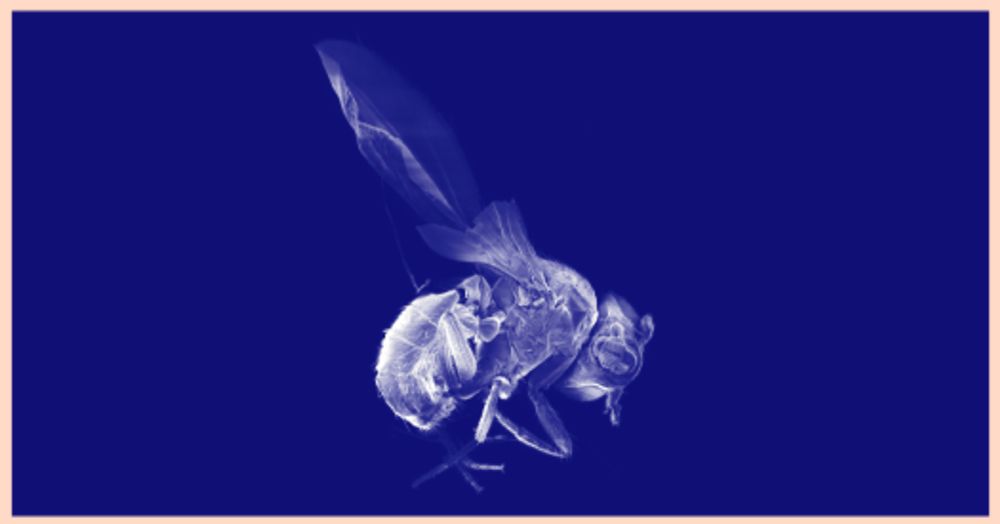
Harvard University lays off fly database team
The layoffs jeopardize this resource, which has served more than 4,000 labs for about three decades.
FlyBase, a Drosophila database, will lose a third of its team in early October because the Harvard grant that covered the employees’ salaries was canceled. Scientists warn that losing FlyBase could devastate fly research.
By @claudia-lopez.bsky.social
www.thetransmitter.org/community/ha...
13.08.2025 19:32 — 👍 123 🔁 129 💬 3 📌 12
the beatles are walking across a zebra crossing on a city street .
ALT: the beatles are walking across a zebra crossing on a city street .
We thank @dfg.de and the #NeuroNex program for generously funding our work, and our neighbours and colleagues at @uni-wuerzburg.de, especially the Department of Neurobiology and Genetics (Charlotte Förster, Chris Wegener, and @silkesachse.bsky.social).
Stay tuned - more walking papers on the way...
28.07.2025 06:18 — 👍 2 🔁 0 💬 0 📌 0
Thinking about what brains are doing and how they ended up doing it.
🇩🇪 Postdoc in @sleeblab.bsky.social
🪲 Quantitative ethology, neuroethology and behavioural ecology
🔧 Developing open science software (mostly #rstats) and hardware
The Department of Neuroscience at the Faculty of Health and Medical Sciences at the University of Copenhagen, Denmark.
We aim to conduct high-quality research on brain function, brain diseases, and their treatments.
Learn more here: https://in.ku.dk/
Postdoc in Nose lab at UTokyo | Neurobiology | Drosophila larval locomotion
Postdoc @ Waddell lab, University or Oxford | PhD - TIFR Mumbai | ex ASAPbio 2023 Fellow, Fulbright Scholar @Yale.edu
Neurobiologist. Learning. Memory. Motivation. Dopamine.
VP for Research, T.H. Smoot Professor
Depts Chemical and Biomolecular Engn, Pathology, Oncology, INBT
Johns Hopkins University
3D multi-omic, CAR T therapy, cell migration and mechanics
Lab: https://wirtzlab.johnshopkins.edu
Fascinated by the evolution of the brain | Senior Research Associate at EBaB lab (University of Bristol) | 2025 PI Fellow (Company of Biologists) | Section Speaker Neurobiology DZG | he/him
https://linktr.ee/max.farnworth
Spinal cord and motor control scientist; PI at NINDS
@Penn Prof, deep learning, brains, #causality, rigor, http://neuromatch.io, Transdisciplinary optimist, Dad, Loves outdoors, 🦖 , c4r.io
Identifying the neural basis of innate social behaviors using molecular and genetic tools @Harvard @HHMINEWS
Neuroscientist and Research Director @CNRS. «Orientation&Coordination» team. Head direction, interneurons, memory. Saints-Pères, Paris 👩🔬🧠
Behaviour • Circuit neuroscience • Connectomics • Microscopy • Drosophila • Zebrafish • PhD • MRC-LMB • Cambridge • Konstanz • Go • Aquaria • Art • Film • He/Him •
searching for principles, adaptive behaviors, empirical approach, integration | doing comp neuroscience & psychiatry | PI @cmc-lab.bsky.social | previously @maxplanckcampus.bsky.social (Peter Dayan & Nikos Logothetis)
Research Scientist in the Dudman lab @HHMIJanelia. PhD @Oxford, BSc @RoyalHolloway.
dopamine | foraging | decision-making | hippocampus | reinforcement learning
🧠🧪👩🔬🐭💻
Wondering what mice are thinking about.
Drosophila Neuroscientist | Assistant professor at UC Berkeley in Neuroscience and MCB (@berkeleymcb.bsky.social)
https://www.fisherlab.science/
Neurogeneticist interested in the relations between genes, brains, and minds. Author of INNATE (2018) and FREE AGENTS (2023)
I study how brains make decisions
fellow in White Lab @ NIMH
Postdoc University of Würzburg, Neuroscientist with a knack for art
Neuroscientist in the making...
PhD student Arber lab
@FMIscience.bsky.social @biozentrum.unibas.ch
MD from @SantAnnaPisa @Unipisa
Neuroscientist
https://scholar.google.com/citations?user=1-OkubgAAAAJ
On the job market