The image shows the paper's title and abstract.
New WP on political violence in democracies with the fantastic @dianebolet.bsky.social and @bjarneck.bsky.social. Sadly very topical, but with some positive results
osf.io/preprints/so...
1/

@bjarneck.bsky.social
PhD-researcher in Political Science at ULB Brussels | political behaviour, elections, European politics | bjarneck.eu
The image shows the paper's title and abstract.
New WP on political violence in democracies with the fantastic @dianebolet.bsky.social and @bjarneck.bsky.social. Sadly very topical, but with some positive results
osf.io/preprints/so...
1/
📊 New Dataset Release: Belgian Electoral Panel Survey 2024 🇧🇪
We’re excited to announce the release of a new dataset from a 4-wave panel survey conducted during the 2024 Belgian elections!
📥 Download the dataset now:
www.sodha.be/dataset.xhtm...
For @ecprtheloop.bsky.social, I argue that it's time for Europe to finally develop a clear Ukraine strategy — one focused on enabling victory.
07.08.2025 13:15 — 👍 6 🔁 1 💬 0 📌 0I wrote in an earlier thread (see below) on the implications. Most importantly: there is room for elites to shape opinions if they justify aid clearly. But framing it as a trade-off with the domestic economy – as Scholz has done – risks undermining support. 4/4
02.06.2025 08:18 — 👍 0 🔁 0 💬 0 📌 0

Support for decreasing aid is driven by national-level economic concerns as well as strong national identities. Personal financial concerns do not play a role, and citizens in countries that contribute relatively more are not more sceptical. 3/4
02.06.2025 08:18 — 👍 1 🔁 0 💬 1 📌 0
We find few signs of war fatigue. Many Europeans are satisfied with current aid, although this might partially reflect non-attitudes. Considerable shares even want to increase aid, and only a small minority (~10%) categorically rejects it. 2/4
02.06.2025 08:18 — 👍 1 🔁 0 💬 1 📌 0
New publication in the Journal of European Public Policy together with @eliemichel.bsky.social.
We study public opinion toward supporting Ukraine in 6 European countries and ask whether citizens want to increase, sustain, or decrease support. 1/4
Paper (OA): doi.org/10.1080/1350...
More broadly, the winner-loser gap literature might have focused too much on electoral losers. If anything, we find that they actually want *more* democracy to influence policy. It’s rather the electoral winners that we might need to worry about. 6/6
16.05.2025 07:59 — 👍 2 🔁 0 💬 0 📌 0The main implication is that affective polarization might undermine the accountability mechanism between parties and government voters. Obviously, opposition to referendums is not inherently problematic, and more research is needed to unpack this mechanism. 5/6
16.05.2025 07:59 — 👍 1 🔁 0 💬 1 📌 0
We indeed find a strong winner-loser gap in referendum support, especially among affectively polarized citizens. Yet, this difference is completely attributed to electoral winners, who become much less supportive if they are affectively polarized. 4/6
16.05.2025 07:59 — 👍 1 🔁 0 💬 1 📌 0Additionally, we theorize that these dynamics are strongest among affectively polarized citizens. Affective polarization should make electoral defeat more painful for losers, whereas it should reinforce the impulse of winners to protect their party in government from outside interference. 3/6
16.05.2025 07:59 — 👍 0 🔁 0 💬 1 📌 0The winner-loser gap in satisfaction with democracy is well-known, but little research has studied its consequences. We argue that losers should be more supportive of electoral alternatives such as referendums, while winners desire their party to govern without constraint. 2/6
16.05.2025 07:59 — 👍 2 🔁 0 💬 1 📌 0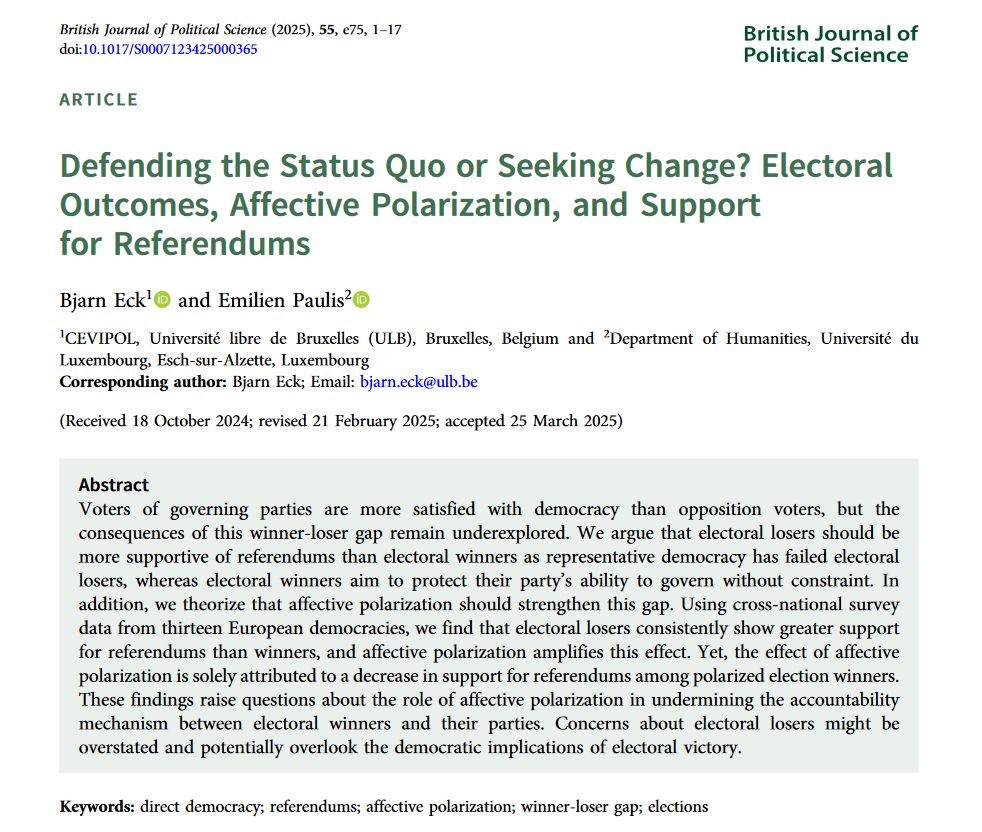
New paper out in @bjpols.bsky.social, co-authored with Emilien Paulis.
Using survey data from 13 European democracies, we show that electoral winners are less supportive of referendums, especially when they are affectively polarized. 1/6
Paper: doi.org/10.1017/S0007123425000365
I agree with @kajakallas that the EU should become a beacon of freedom. So when do we start?
Here I offer six ways to actually light the beacon and step into the role history has chosen for us. Our response to the current uncertainty can be firm and long term. A thread.🧵1/17
While the former seems not a concern for European leaders, the latter should be. In fact, the current aid strategy to Ukraine (letting it fight the war, but not win the war) might undermine support for continued (and increasing) aid on the long run if setbacks on the battlefield surge. (12/12)
06.12.2024 14:05 — 👍 0 🔁 0 💬 0 📌 0
Second, we know from American literature that the public is capable of incurring battlefield casualties, provided two conditions: the public believes the war has a just cause and it still has enough potential to reach its goals. (11/12)
press.princeton.edu/books/paperb...
And that is just a financial calculation. The political and security costs of a Russian win in Ukraine, for the EU and for European democracies, remains unforeseen. (10/12)
06.12.2024 14:05 — 👍 0 🔁 0 💬 1 📌 0
But that requires solid justification. Mixing up economic concerns with aid to Ukraine (as Scholz has done) might have a depressing effect on the latter, while supporting Ukraine is far less costly than letting Russia win the war. (9/12)
www.ifw-kiel.de/publications...
These findings have several implications, of which I discuss two here. First, there is still room for European leaders to increase support to Ukraine, as well as to shape public opinion on this topic – the high selection of the midpoint on our scale seems partially rooted in non-attitudes. (8/12)
06.12.2024 14:05 — 👍 0 🔁 0 💬 1 📌 1Furthermore, people who identify along national lines are also clearly more sceptical of sending aid to Ukraine. It shows that attitudes to Ukraine are not solely an economic consideration, in line with findings in the European integration literature. (7/12)
06.12.2024 14:05 — 👍 0 🔁 0 💬 1 📌 0With regards to economic concerns, we find that people with pessimistic views of the domestic economy are clearly less supportive of aiding Ukraine. At a personal level, we find no evidence for this: concerns about personal incomes do not drive attitudes toward supporting Ukraine. (6/12)
06.12.2024 14:05 — 👍 0 🔁 0 💬 1 📌 0We propose two factors that should shape these attitudes: economic concerns (national and individual) and national (vs. European) identities. (5/12)
06.12.2024 14:05 — 👍 0 🔁 0 💬 1 📌 0
We find few signs of war fatigue: many are satisfied with current aid, and a slight majority even supports an increase. Around 10% categorically opposes any aid in each country. Importantly, opinions seem unrelated to existing aid: larger contributors (NL, PL) do not witness more scepticism. (4/12)
06.12.2024 14:05 — 👍 0 🔁 0 💬 1 📌 0We asked respondents if they want to increase, decrease, or maintain their country's current support level (0-10 scale). We argue that this better reflects political debates on Ukraine, which have focused on adjusting aid levels (increasing/decreasing) rather than ceasing support entirely. (3/12)
06.12.2024 14:05 — 👍 0 🔁 0 💬 1 📌 0Fielded more than two years after the start of the war (just after the 2024 EP elections), we believe that this should provide a clear picture of public opinion on supporting Ukraine, uncontaminated by initial rally effects. (2/12)
06.12.2024 14:05 — 👍 0 🔁 0 💬 1 📌 0
Just uploaded this new preprint co-authored with @eliemichel.bsky.social, and sharing here already because of the public relevance of the data.
We study public opinion toward supporting Ukraine in six European countries: BE, DE, HU, IT, NL, and PL. (1/12)
doi.org/10.31219/osf...
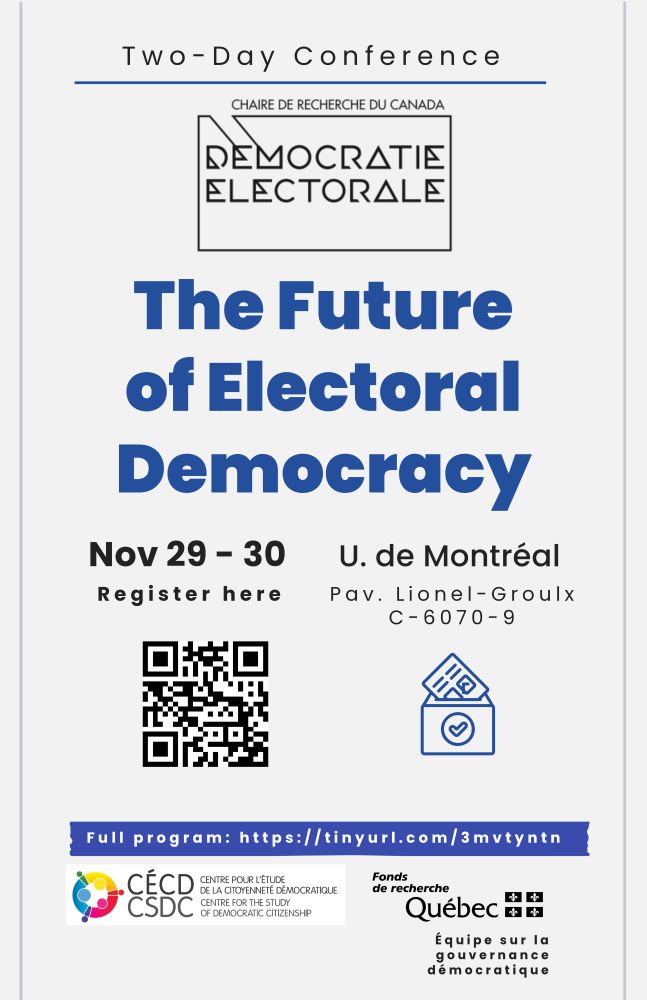
Much looking forward to the Future of Electoral Democracy conference!
Over the next two days, current and former students of the CRC in Electoral Democracy will be at UdeM to present their work, think about research, and recall memories of all the fun we had at the CRC over the last eight years!

Happy to share this new article in European Union Politics, written with @bjarneck.bsky.social. In the paper, we ask: have high and growing levels of income inequality undermined support for the EU, as some have claimed? Existing studies have produced very mixed results in this regard (1/5)
23.01.2024 14:33 — 👍 8 🔁 2 💬 1 📌 1The project is collectively funded by the Belgian @frsFNRS-@FWOVlaanderen Excellence of Science (EOS) research programme.
20.11.2023 10:18 — 👍 0 🔁 0 💬 0 📌 0The website offers more detailed information about the project’s scope and aims, the research team, (planned) data collections, publications, and general announcements.
20.11.2023 10:18 — 👍 0 🔁 0 💬 1 📌 0