🔟 Instagram Passive Active Use Measure (iPAUM): Development, validation and relation to self-esteem
✍ Katrine B. Tølbøll, Jennifer Stead, Anke C. Plagnol
doi.org/10.5817/CP20...

@cyberpsy.bsky.social
Cyberpsychology: Journal of Psychosocial Research on Cyberspace is a diamond open-access, peer-reviewed journal published by Masaryk University.
🔟 Instagram Passive Active Use Measure (iPAUM): Development, validation and relation to self-esteem
✍ Katrine B. Tølbøll, Jennifer Stead, Anke C. Plagnol
doi.org/10.5817/CP20...

9️⃣ Factors associated with connectedness to social media influencers among Italian and Dutch young adults
✍ Maria Rosaria Nappa, Sara Pabian, Mara Morelli, Angela Costabile, Elena Cattelino , Roberto Baiocco
doi.org/10.5817/CP20...

8️⃣ What’s the optimal usage pattern? Latent profile analysis of Chinese young adults’ social networking site use and its association with subjective well-being
✍ Xue-Qin Yin, Jin-Liang Wang, Xiang Niu, Sebastian Scherr, James Gaskin, Dean McDonnell
doi.org/10.5817/CP20...

7️⃣ When sadists become internet trolls: The mechanism of aggressive humor and self-concept clarity
✍ Shuqing Gao, Yuqin Yang, Bo Jiang, Guoyan Wang
doi.org/10.5817/CP20...

6️⃣ Caught in the daily scroll: How upward social comparison fuels daily anxiety during short video use among Chinese young adults
✍ Zhiwei Yang, Qian Nie, Xiaoqin Wang, Halley M. Pontes, Zhaojun Teng
doi.org/10.5817/CP20...

5️⃣ Decoding user disclosure intentions in generative AI: Exploring the influence of system attributes on trust and privacy concerns within the extended technology acceptance model
✍ Jing Niu, Bilal Mazhar, Yilin Ren, Inam Ul Haq
doi.org/10.5817/CP20...

4️⃣ Evaluating strengths, limitations, and future directions of ChatGPT in psychological analysis within case conceptualization: A qualitative analysis
✍ Matilde Buattini, Donald Barjami, Lorenza Paponetti, Dalila Torres, Rosita Borlimi, Gabriele Caselli
doi.org/10.5817/CP20...

3️⃣The role of social norms for online prosocial & antisocial behavior among adolescents in Singapore
✍Ruth Wendt, Vivian Hsueh Hua Chen
doi.org/10.5817/CP20...

2️⃣ Striving for accuracy attenuates the positive relationship between cyberbullying bystanders’ dispositional empathy and tendencies to help victims
✍ Cheng-Hong Liu, Fa-Chung Chiu, Po-Sheng Huang, Ting-Huan Lin, Chia-Lin Chang
doi.org/10.5817/CP20...

1️⃣ Habitual checking, delayed tasks: Why parental mediation fails to moderate adolescent mobile habits and procrastination
✍ Jinghan Ma, Yungeng Li
doi.org/10.5817/CP20...

🌱 The first issue of the year is out, launching Volume 20!
It brings 10 articles on topics like adolescent mobile habits, cyberbullying bystanders, social norms in teens’ online interactions, trust & privacy in generative AI, and more.
🔓 #OpenAccess: cyberpsychology.eu/issue/view/2...
Enjoy! ⭐

Our editors, Lenka Dědková and Joris Van Ouytsel, along with Brad Bushman (Editor of Psychology of Violence), participated in a lively Q&A session at the Workshop on Aggression 2025 in Brno.
Thank you to all participants for the thoughtful questions.💡

🔟 Understanding bystanders’ behaviour to cyberhate: An explanatory approach from the theory of normative social behaviour
✍ Olga Jiménez-Díaz, Joaquín A. Mora-Merchán, Paz Elipe, Rosario Del Rey
doi.org/10.5817/CP20...

9️⃣ The impact of persuasion literacy training on anthropomorphization, privacy, and self-determined interactions with intelligent voice assistants
✍ André Markus, Maximilian Baumann, Jan Pfister, Astrid Carolus, Andreas Hotho, Carolin Wienrich
doi.org/10.5817/CP20...

8️⃣ Beyond algorithm aversion: How users trade off decisional agency and optimal outcomes when choosing between algorithms and human decision-makers
✍ Gabi Schaap, Paul Hendriks Vettehen, Tibor Bosse
doi.org/10.5817/CP20...

7️⃣ Intolerance of uncertainty and emotion dysregulation mediate relations between fear of negative evaluation and problematic social media use severity
✍ Elyse F. Hutcheson, Christian Montag, @jonelhai.bsky.social
doi.org/10.5817/CP20...

6️⃣ The longitudinal comorbidity of specific problematic internet use and psychological distress: A cross-lagged panel network analysis
✍ Wenting Xu, Zeyang Yang, Zhihao Yan, Yuanli Liu, Mark Griffiths
doi.org/10.5817/CP20...

5️⃣ Family strains and online gains: Longitudinal relationship between harsh parenting and problematic internet use via relative deprivation and online basic psychological need satisfaction
✍ Zongyuan Wang, Qinxue Liu, Zien Ding, Di Qi
doi.org/10.5817/CP20...

4️⃣ Unraveling the positive and negative roles of positive body-focused social media interactions in adolescents’ body image
✍ Ilse Vranken, Lara Schreurs, Mireia Montaña Blasco, Laura Vandenbosch
doi.org/10.5817/CP20...

3️⃣ A mediation analysis of the influence of sleep on the relationship between smartphone screen time and youth mental health
✍ Silvia Marin-Dragu, Matt Orr, Penny Corkum, Benjamin Rusak, Alexa Bagnell, Sandra Meier
doi.org/10.5817/CP20...

2️⃣ A double-edged sword: Exploring associations between engagement with mental health content by social media influencers and psychological well-being
✍ Jaroslava Kaňková, Sofie Vranken, Jörg Matthes
doi.org/10.5817/CP20...

1️⃣ Not so ephemeral after all: Longitudinal associations between emerging adults' engagement with ephemeral social media features, production stress, and social capital
✍ Michaela Forrai, Kevin Koban, Jörg Matthes
doi.org/10.5817/CP20...

☃️ The final issue of the year is here!
Vol. 19, No. 5 has just been published with 10 articles about influencer mental-health, sleep and smartphone use, algorithm vs. human decision-making, and many more.
🔓📖 The full issue is #OpenAccess here: cyberpsychology.eu/issue/view/2...
Enjoy reading!🎀

We’re thrilled to welcome Emmelyn Croes as our new Associate Editor! 🎉
Assistant Professor at @tilburg-university.bsky.social, she studies how people connect across online and offline media—from video calls to chatbots—and how social influencers shape well-being and behavior.
Welcome, Emmelyn!✨
We are grateful to all the authors, reviewers, editors, and assistants who made this issue possible - your hard work and dedication are deeply appreciated! 🙏
18.09.2025 11:44 — 👍 0 🔁 0 💬 0 📌 0
1️⃣1️⃣
Meme-ingful connections: Unleashing the power of memes, GIFs, and emojis in relationship-oriented online communication
Rachel X. Peng, Jin Chen
doi.org/10.5817/CP20...
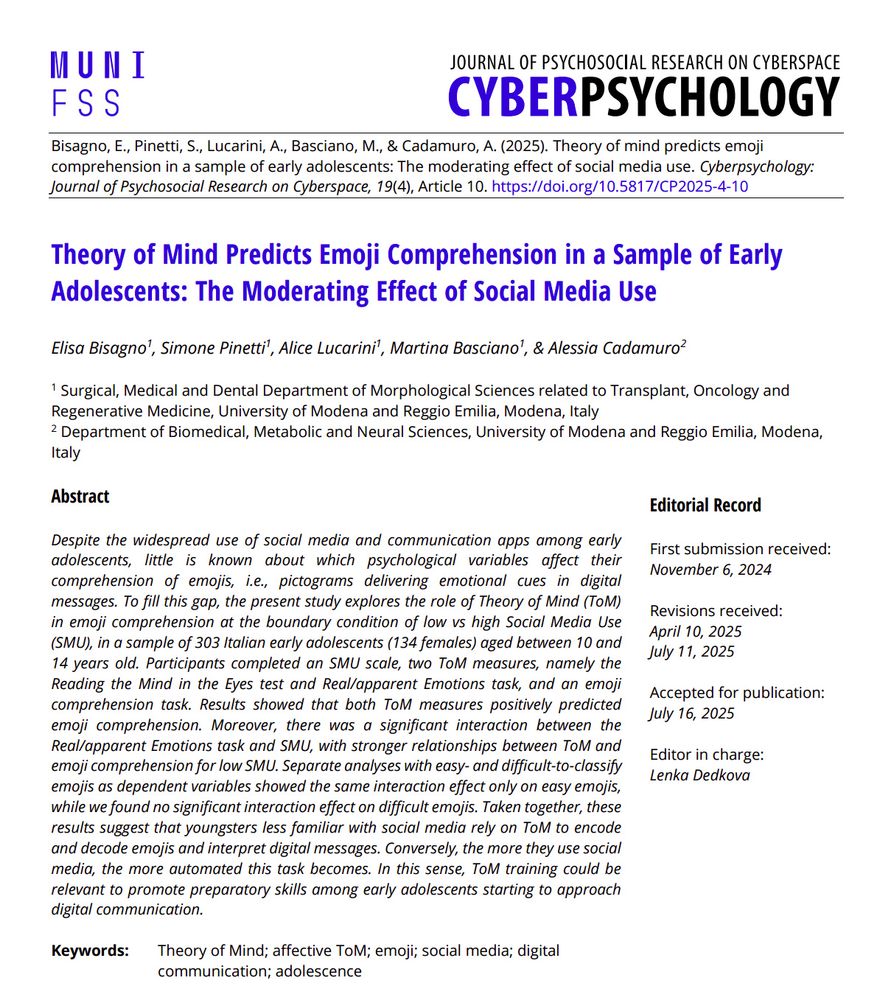
🔟
Theory of mind predicts emoji comprehension in a sample of early adolescents: The moderating effect of social media use
Elisa Bisagno, Simone Pinetti, Alice Lucarini, Martina Basciano, Alessia Cadamuro
doi.org/10.5817/CP20...

9️⃣
Fear of missing out mediates the relationship between intolerance of uncertainty and problematic smartphone use severity
Nisha Yao, Caleb Hallauer, Elyse Hutcheson, Jon Elhai
doi.org/10.5817/CP20...

8️⃣
Convergent and divergent predictors of extensive use time and problematic TikTok use
Ágnes Zsila, Mara S. Aruguete, Reza Shabahang, Ágnes Buvár, Gábor Orosz
doi.org/10.5817/CP20...

7️⃣
Unravelling social network usage patterns: A study based on unsupervised learning
Alfredo Zarco-Alpuente, Víctor Ciudad-Fernández, Marta Carrique-Martínez, Lucas Serrano-Pastor, Elisabeth Malonda-Vidal, Anna Llorca-Mestre, Rafael García-Ros, Paula Samper-García
doi.org/10.5817/CP20...