The Psychological Impact of Digital Isolation: How AI-Driven Social Interactions Shape Human Behavior and Mental Well-Being
Felix Eling
3697-3705
Apr 30, 2025
Education
The Psychological Impact of Digital Isolation: How AI-Driven Social Interactions Shape Human Behavior and Mental Well-Being
Felix Eling
Faculty of Health Sciences, Department of Pharmacy, Gulu College of Health Sciences, Gulu City, Northern Uganda
DOI: https://dx.doi.org/10.47772/IJRISS.2025.90400265
Received: 13 March 2025; Revised: 22 March 2025; Accepted: 25 March 2025; Published: 30 April 2025
ABSTRACT
The increasing integration of artificial intelligence (AI) in social interactions has transformed how humans experience companionship, communication, and mental well-being. This review examines the psychological impact of AI-driven social interactions, focusing on virtual assistants, AI chatbots, and digital companions. It explores the benefits, risks, and ethical concerns associated with AI companionship. A systematic review methodology was employed, detailing inclusion criteria, databases searched, and analysis techniques. Findings suggest that while AI can offer emotional relief and support, over-reliance may disrupt real-world social bonding. Ethical concerns such as data privacy, emotional manipulation, and regulatory gaps are highlighted. The study underscores the need for balanced AI integration in human socialization. The study also addresses gaps in previous literature by examining AI’s influence on different demographic groups and cultural contexts.
Let me tell you a story. Perhaps you can guess where this is going... though it does have a bit of a twist.
I was poking around Google Scholar for publications about the relationship between chatbots and wellness. Oh how useful: a systematic literature review! Let's dig into the findings. 🧵
05.12.2025 22:35 — 👍 669 🔁 348 💬 21 📌 88

A figure demonstrating the different aspects of the corpus described in the tweet. There is a main isomorphic 3D view of a level in the Portal 2 co-op game, with some portals, lasers, and the blue and orange players. Inset, there are first-person captures of the blue and orange player views. There is also a box containing the transcribed dialogue with timestamps and labels for the discursive acts. Finally, there is a box containing a task and a list of subtasks. Some subtasks are already crossed out, with the time that they have been completed. The last subtask ("Player 2 places portal 4 on wall 4") is marked incomplete.
The dialogue is as follows:
Blue: Can you put your other portal up here? (tagged as directive)
Orange: Where? (tagged as request for clarification)
Blue: On uh, on this wall. (tagged as directive)
Blue: So that it uh points at the circle. (tagged as directive)
Orange: Okay. (tagged as commit)
The full list of subtasks is:
Task: Redirect lasers
Subtask: Player 1 places portal 1 on wall 1. (completed)
Subtask: Player 1 polaces portal 2 on wall 2 or 3. (completed)
Subtask: Player 2 places portal 3 opposite of portal 2. (completed)
Subtask: Player 2 places portal 4 on wall 4. (incomplete)
A couple years (!) in the making: we’re releasing a new corpus of embodied, collaborative problem solving dialogues. We paid 36 people to play Portal 2’s co-op mode and collected their speech + game recordings.
Paper: arxiv.org/abs/2512.03381
Website: berkeley-nlp.github.io/portal-dialo...
1/n
05.12.2025 18:54 — 👍 100 🔁 30 💬 3 📌 8
OSF
New preprint w/ Malin Styrnal & @martinhebart.bsky.social
Have you ever computed noise ceilings to understand how well a model performs? We wrote a clarifying note on a subtle and common misapplication that can make models appear quite a lot better than they are.
osf.io/preprints/ps...
04.12.2025 18:53 — 👍 58 🔁 23 💬 1 📌 4
1) With the conventional alpha = 5% and a huge sample, you may have extremely high power for your effect of interest – say, 99.9%. That means beta (type-II error rate) = 0.1%. Are you sure that you want your type-I error rate to be 50x the size of your type-II error rate? >
31.10.2025 08:13 — 👍 11 🔁 1 💬 1 📌 0

This plot shows the number of users in the Study 1 sample that self-described as 'addicted' to Instagram versus those who were 'at risk' of clinical addiction. The ratios for the addiction symptom scale are 9:371 and for the perceived addiction 69: 311, suggesting a much greater proportion of users self-perceive as addicted than are actually addicted to Instagram
Excited to see these studies (finally) published in Scientific Reports! 🚨
S1: More social media users perceived themselves as addicted than met clinical addiction criteria.
S2: Increasing perceived addiction hurt perceived control over use and increased self-blame for overuse.
Thread below... 🧵
29.11.2025 02:33 — 👍 38 🔁 24 💬 4 📌 4

Two plots side by side showing time in weeks on x axis and probability of returning to work on the y axis. The left hand plot shows the trajectory of two groups (self-efficacy improved or not improved), while the right hand plot shows the probability difference between the two groups.
geomtextpath can really help make a plot easier to interpret. Nice to avoid using a legend. #rstats #dataviz
02.12.2025 13:09 — 👍 139 🔁 20 💬 3 📌 2

Implicit racial attitudes accounted for ~2.5% of variance in behavior beyond explicit racial attitudes, an effect size that was *just* over our agreed upon threshold for what would constitute a practically significant effect. Explicit racial attitudes still explained much more variance (~45%).
02.12.2025 14:13 — 👍 22 🔁 5 💬 1 📌 5
Things I currently think you should be considering in your proposals. Although this thread will be NIH-centric, my guess is that some of this applies to NSF, etc. Much is synthesized from public information. Much of this is what we've advised all along, just with, um, more emphasis.
Here we go:
25.11.2025 15:27 — 👍 40 🔁 17 💬 1 📌 3

📍Excited to share that our paper was selected as a Spotlight at #NeurIPS2025!
arxiv.org/pdf/2410.03972
It started from a question I kept running into:
When do RNNs trained on the same task converge/diverge in their solutions?
🧵⬇️
24.11.2025 16:43 — 👍 102 🔁 27 💬 5 📌 5
Is the “standard workflow” holding back fMRI analysis?
Mass-univariate analysis is still the bread-and-butter: intuitive, fast… and chronically overfitted. Add harsh multiple-comparison penalties, and we patch the workflow with statistical band-aids. No wonder the stringency debates never die.
18.11.2025 22:13 — 👍 40 🔁 13 💬 1 📌 2

Delighted to share our new Perspective article @natrevneuro.nature.com, led by the great @edoardochidichimo.bsky.social : "Towards an informational account of interpersonal coordination". With @loopyluppi.bsky.social, Pedro Mediano, @introspection.bsky.social, Victoria Leong and Richard Bethlehem.
19.11.2025 14:27 — 👍 36 🔁 15 💬 1 📌 2

new paper by Sean Westwood:
With current technology, it is impossible to tell whether survey respondents are real or bots. Among other things, makes it easy for bad actors to manipulate outcomes. No good news here for the future of online-based survey research
18.11.2025 19:15 — 👍 762 🔁 389 💬 41 📌 125

A table showing profit margins of major publishers. A snippet of text related to this table is below.
1. The four-fold drain
1.1 Money
Currently, academic publishing is dominated by profit-oriented, multinational companies for
whom scientific knowledge is a commodity to be sold back to the academic community who
created it. The dominant four are Elsevier, Springer Nature, Wiley and Taylor & Francis,
which collectively generated over US$7.1 billion in revenue from journal publishing in 2024
alone, and over US$12 billion in profits between 2019 and 2024 (Table 1A). Their profit
margins have always been over 30% in the last five years, and for the largest publisher
(Elsevier) always over 37%.
Against many comparators, across many sectors, scientific publishing is one of the most
consistently profitable industries (Table S1). These financial arrangements make a substantial
difference to science budgets. In 2024, 46% of Elsevier revenues and 53% of Taylor &
Francis revenues were generated in North America, meaning that North American
researchers were charged over US$2.27 billion by just two for-profit publishers. The
Canadian research councils and the US National Science Foundation were allocated US$9.3
billion in that year.

A figure detailing the drain on researcher time.
1. The four-fold drain
1.2 Time
The number of papers published each year is growing faster than the scientific workforce,
with the number of papers per researcher almost doubling between 1996 and 2022 (Figure
1A). This reflects the fact that publishers’ commercial desire to publish (sell) more material
has aligned well with the competitive prestige culture in which publications help secure jobs,
grants, promotions, and awards. To the extent that this growth is driven by a pressure for
profit, rather than scholarly imperatives, it distorts the way researchers spend their time.
The publishing system depends on unpaid reviewer labour, estimated to be over 130 million
unpaid hours annually in 2020 alone (9). Researchers have complained about the demands of
peer-review for decades, but the scale of the problem is now worse, with editors reporting
widespread difficulties recruiting reviewers. The growth in publications involves not only the
authors’ time, but that of academic editors and reviewers who are dealing with so many
review demands.
Even more seriously, the imperative to produce ever more articles reshapes the nature of
scientific inquiry. Evidence across multiple fields shows that more papers result in
‘ossification’, not new ideas (10). It may seem paradoxical that more papers can slow
progress until one considers how it affects researchers’ time. While rewards remain tied to
volume, prestige, and impact of publications, researchers will be nudged away from riskier,
local, interdisciplinary, and long-term work. The result is a treadmill of constant activity with
limited progress whereas core scholarly practices – such as reading, reflecting and engaging
with others’ contributions – is de-prioritized. What looks like productivity often masks
intellectual exhaustion built on a demoralizing, narrowing scientific vision.

A table of profit margins across industries. The section of text related to this table is below:
1. The four-fold drain
1.1 Money
Currently, academic publishing is dominated by profit-oriented, multinational companies for
whom scientific knowledge is a commodity to be sold back to the academic community who
created it. The dominant four are Elsevier, Springer Nature, Wiley and Taylor & Francis,
which collectively generated over US$7.1 billion in revenue from journal publishing in 2024
alone, and over US$12 billion in profits between 2019 and 2024 (Table 1A). Their profit
margins have always been over 30% in the last five years, and for the largest publisher
(Elsevier) always over 37%.
Against many comparators, across many sectors, scientific publishing is one of the most
consistently profitable industries (Table S1). These financial arrangements make a substantial
difference to science budgets. In 2024, 46% of Elsevier revenues and 53% of Taylor &
Francis revenues were generated in North America, meaning that North American
researchers were charged over US$2.27 billion by just two for-profit publishers. The
Canadian research councils and the US National Science Foundation were allocated US$9.3
billion in that year.

The costs of inaction are plain: wasted public funds, lost researcher time, compromised
scientific integrity and eroded public trust. Today, the system rewards commercial publishers
first, and science second. Without bold action from the funders we risk continuing to pour
resources into a system that prioritizes profit over the advancement of scientific knowledge.
We wrote the Strain on scientific publishing to highlight the problems of time & trust. With a fantastic group of co-authors, we present The Drain of Scientific Publishing:
a 🧵 1/n
Drain: arxiv.org/abs/2511.04820
Strain: direct.mit.edu/qss/article/...
Oligopoly: direct.mit.edu/qss/article/...
11.11.2025 11:52 — 👍 608 🔁 435 💬 8 📌 62
For undergraduates curious about complex systems research, applications are now open for the 2026 Undergraduate Complexity Research (UCR) program — a fully funded, 10-week summer research experience at the Santa Fe Institute.
Apply by Jan. 14, 2026: santafe.edu/ucr
17.11.2025 18:30 — 👍 7 🔁 11 💬 1 📌 0

Atkinson Hyperlegible Font - Braille Institute
Read easier with Atkinson Hyperlegible Font, crafted for low-vision readers. Download for free and enjoy clear letters and numbers on your computer!
periodic reminder of the existence of Atkinson Hyperlegible, a free font available from the Braille Institute designed to improve readability for people with low vision
I use it in talks because it's pretty and also because, as an audience member, I am perpetually squinting at people's slides
17.11.2025 04:19 — 👍 652 🔁 324 💬 20 📌 20

A busy figure showing how reduction of different types of multimodal signals reduces over experimental rounds (with a comparison of how a non-linear signal following a power law can be transformed to a linear slope using a log-transformation).
Our paper @sarabogels.bsky.social covering our pre-registered multi-year research is now finally out in Cognition. We show that in conversations people reduce their multimodal signals non-linearly; the steeper this non-linear drop-off the more communicative success.
www.wimpouw.com/files/Bogels...
11.11.2025 16:49 — 👍 34 🔁 15 💬 3 📌 0
Remembering the time in grad school when a Black PhD student at the next desk over was doing computer vision research. He was testing out a facial recognition tool using his own face as a reference, but it wasn't working. So he asked a (white) colleague to try it, and of course it worked for her.
29.10.2025 22:33 — 👍 13 🔁 7 💬 0 📌 0
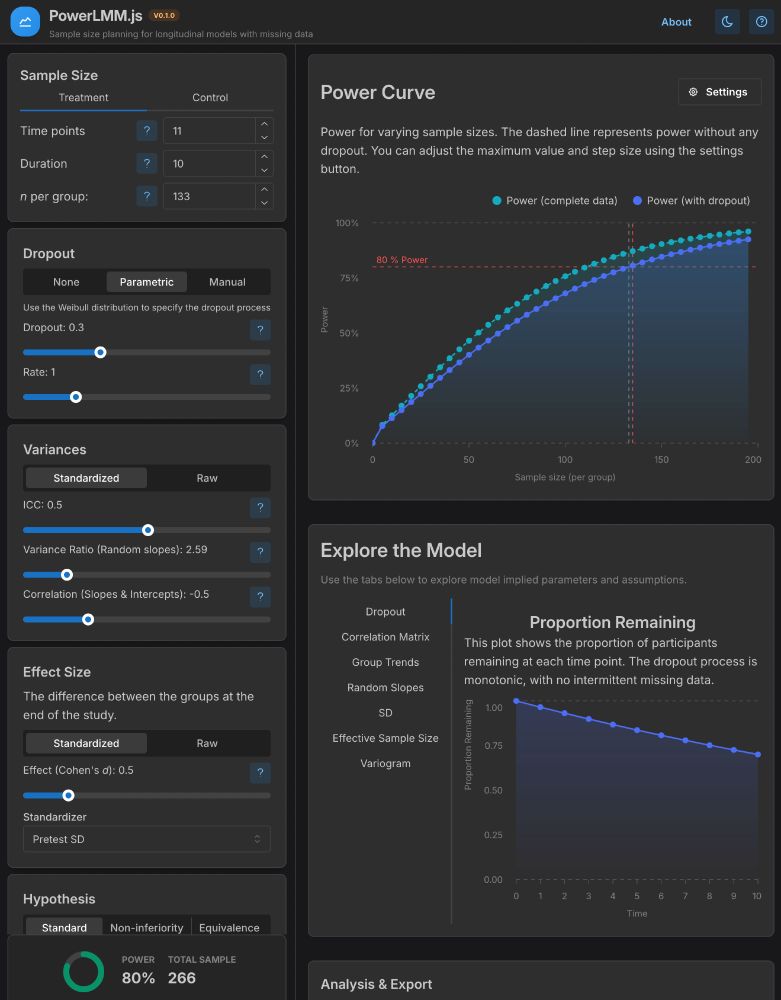
Screenshot of https://powerlmmjs.rpsychologist.com/
🎉 @rpsychologist.com 's PowerLMM.js is the online statistics application of the year 2025 🎉
powerlmmjs.rpsychologist.com
- Calculate power (etc) for multilevel models
- Examine effects of dropout and other important parameters
- Fast! (Instant results)
28.10.2025 14:37 — 👍 83 🔁 32 💬 2 📌 1


Fundamental features of social environments determine rate of social affiliation www.pnas.org/doi/10.1073/...
18.10.2025 10:34 — 👍 13 🔁 7 💬 0 📌 0
These results are also worth reiterating the title of @ianhussey.mmmdata.io's recent blog post: if researchers find Cohen's d = 8, no they didn't
mmmdata.io/posts/2025/0...
15.10.2025 13:27 — 👍 18 🔁 6 💬 0 📌 0

Excited to share our new paper out in PNAS: “Neural predictors of hidden, persistent psychological states at work.” Full paper at bit.ly/47oaGRR
We brought portable fNIRS into the field to predict the subjective work-related “lenses” of business leaders. Check out the thread below for more! 1/8
14.10.2025 22:23 — 👍 11 🔁 4 💬 1 📌 1

In between-Ss experiments: without a reference point, people say playing a prank is bad but give the same ‘bad’ rating to committing a war crime.
Not in within-Ss experiments or when giving reference points for judgments.
From @vladchituc.bsky.social
www.crockettlab.org/s/1-s20-S001...
#psych
14.10.2025 14:10 — 👍 6 🔁 4 💬 0 📌 0
One of the papers I've been most excited about since starting the lab!
We adopt a network neuroscience approach to understand how arousal reconfigures large-scale functional network organization to support memory of complex narratives!
13.10.2025 18:35 — 👍 48 🔁 11 💬 3 📌 0

Managing emotions is not easy - we often get by with a little help. In the NEW Social Interaction and Emotion Lab at Rutgers-Newark, we’ll study how social interactions regulate emotion using experiments, naturalistic data, and multi-modal approaches. ✨ Now recruiting! ✨🙌 Learn more: raziasahi.com
08.10.2025 19:25 — 👍 36 🔁 18 💬 2 📌 5
Anthropologist - Bayesian modeling - science reform - cat and cooking content too - Director @ MPI for evolutionary anthropology https://www.eva.mpg.de/ecology/staff/richard-mcelreath/
I do science and write about it
Statistical modeling, Bayesian inference, causal effect estimation, hierarchical structures; FMRI data analysis; classical music; jogging/hiking; reading; meandering
phd researcher in cognitive sciences @ uc irvine. working on evidence accumulation, metacognition, memory, and philosophy of cognitive [neuro]science 🧠 they/them 🏳️🌈 ⚧️ 🇸🇾 https://arikhoudary.com/
Official Bluesky account for NOAA's National Weather Service.
From first-generation college student to Distinguished Professor, studying impulsivity and its relationship to addictions
Posts are my individual opinions and do not reflect my professional roles or responsibilities
PhD student at UCLA
Social cognitive neuroscience
Cognitive neuroscientist studying how we pay attention, associate professor of Psychology at UChicago, cablab.uchicago.edu director
Dreaming of a cloudy sky | Associate Prof. | Computer Science & BioFrontiers, CUBoulder | Ext. Faculty, Santa Fe Institute | www.peleglab.com
Faculty in Physics and Math at College of the Atlantic.
Direct the CSSS at @sfiscience.bsky.social
Chaos. Fractals. Complex systems. Sustainable energy.
Trance. Cooking. Gardening. Fighting entropy.
Doctoral Researcher @MPI-EvolBio @MPI-MiS --> @MPI-EvA
Theoretical modelling | Cultural evolution | Population dynamics | Game theory | ABM
Dancing with numbers 〰️🌱
PhD Student at the Network Science Institute at Northeastern University.
Senior Researcher & Senior Program Officer at @swisspeace.bsky.social and @unibas.ch. PhD from @bostonu.bsky.social. Peace Negotiations; Game Theory; Complex Systems.
Getting my PhD studying, and occasionally engaging in, social interaction!
PhD candidate, Interested in: Chaos, Nonlinear Dynamics, Complex systems. Looking for postdorctoral positions.
adityafy.github.io
DoCATor 🐈🐈⬛. Aka: Rui (R-way) or Rachel. Cooperation; Health; Network; Complexity. EvoAnthro PhD & MS at UNM.
contributing editor, Scientific American, Nautilus; contributing writer, Quanta; author, Putting Ourselves Back in the Equation, Spooky Action at a Distance, Complete Idiot’s Guide to String Theory; planetary scientist, local historian, bassist, salsero
#hyperscanning
@copla.bsky.social @mpicbs.bsky.social @oistedu.bsky.social
Postdoc at MPI-CBS & OIST
nicolashinrichs.de
Professor, Santa Fe Institute. Research on AI, cognitive science, and complex systems.
Website: https://melaniemitchell.me
Substack: https://aiguide.substack.com/