Ese curso fue un antes y despues en mi uso de R y la principal razon por la que pude publicar el paquete BlueCarbon! Mas que recomendable. Solo siento no poder anotarme nuevamente a esta edicion.
22.12.2025 13:36 — 👍 2 🔁 1 💬 0 📌 0

La fuerza de La Marea
Te necesitamos para blindar nuestra independencia
👏🏼Gracias a todos esos peces que os estáis uniendo a nadar a contracorriente.
Nos quedan solo 6 días. El periodismo independiente te necesita.
🙌🏽 Dona y difunde. www.goteo.org/project/la-f...
10.12.2025 21:27 — 👍 9 🔁 4 💬 0 📌 0
Two years ago we got together in a beautiful mountain to learn and develop #rstats packages for ecology
After {labeleR} (ecologyr.github.io/labeleR/) and {BlueCarbon} (ecologyr.github.io/BlueCarbon/), {mappestRisk} is now officially out! See thread by lead author @dario-ssm.bsky.social 👇
20.11.2025 19:17 — 👍 22 🔁 13 💬 1 📌 0
We have the publication associated to the BlueCarbon library!
Very happy with the review process and transparency of @joss-openjournals.bsky.social
Please cite this article if your are one of the more than 1700 downloads of the package :D
bsky.app/profile/joss...
26.11.2025 07:40 — 👍 4 🔁 3 💬 1 📌 0

📣 OYSTER EuroMarine – Call for New Members 📣
⌛ Call is open! Deadline: 19 December 2025 ⌛
More information here: euromarinenetwork.eu/news/oyster-...
@euromarine.bsky.social
#EuroMarine
#OYSTER
#EarlyCareerResearchers
#MarineScience
#ECRNetwork
#OceanCommunity
25.11.2025 09:05 — 👍 4 🔁 4 💬 0 📌 0

GitHub - EcologyR/mappestRisk
Contribute to EcologyR/mappestRisk development by creating an account on GitHub.
🗺️🐛 mappestRisk is now on CRAN! We developed this R package to help non-expert R users create pest-risk maps based on experimental data of the thermal biology of crop-pest species.
github.com/EcologyR/map...
20.11.2025 16:34 — 👍 11 🔁 7 💬 3 📌 2

A table showing profit margins of major publishers. A snippet of text related to this table is below.
1. The four-fold drain
1.1 Money
Currently, academic publishing is dominated by profit-oriented, multinational companies for
whom scientific knowledge is a commodity to be sold back to the academic community who
created it. The dominant four are Elsevier, Springer Nature, Wiley and Taylor & Francis,
which collectively generated over US$7.1 billion in revenue from journal publishing in 2024
alone, and over US$12 billion in profits between 2019 and 2024 (Table 1A). Their profit
margins have always been over 30% in the last five years, and for the largest publisher
(Elsevier) always over 37%.
Against many comparators, across many sectors, scientific publishing is one of the most
consistently profitable industries (Table S1). These financial arrangements make a substantial
difference to science budgets. In 2024, 46% of Elsevier revenues and 53% of Taylor &
Francis revenues were generated in North America, meaning that North American
researchers were charged over US$2.27 billion by just two for-profit publishers. The
Canadian research councils and the US National Science Foundation were allocated US$9.3
billion in that year.

A figure detailing the drain on researcher time.
1. The four-fold drain
1.2 Time
The number of papers published each year is growing faster than the scientific workforce,
with the number of papers per researcher almost doubling between 1996 and 2022 (Figure
1A). This reflects the fact that publishers’ commercial desire to publish (sell) more material
has aligned well with the competitive prestige culture in which publications help secure jobs,
grants, promotions, and awards. To the extent that this growth is driven by a pressure for
profit, rather than scholarly imperatives, it distorts the way researchers spend their time.
The publishing system depends on unpaid reviewer labour, estimated to be over 130 million
unpaid hours annually in 2020 alone (9). Researchers have complained about the demands of
peer-review for decades, but the scale of the problem is now worse, with editors reporting
widespread difficulties recruiting reviewers. The growth in publications involves not only the
authors’ time, but that of academic editors and reviewers who are dealing with so many
review demands.
Even more seriously, the imperative to produce ever more articles reshapes the nature of
scientific inquiry. Evidence across multiple fields shows that more papers result in
‘ossification’, not new ideas (10). It may seem paradoxical that more papers can slow
progress until one considers how it affects researchers’ time. While rewards remain tied to
volume, prestige, and impact of publications, researchers will be nudged away from riskier,
local, interdisciplinary, and long-term work. The result is a treadmill of constant activity with
limited progress whereas core scholarly practices – such as reading, reflecting and engaging
with others’ contributions – is de-prioritized. What looks like productivity often masks
intellectual exhaustion built on a demoralizing, narrowing scientific vision.

A table of profit margins across industries. The section of text related to this table is below:
1. The four-fold drain
1.1 Money
Currently, academic publishing is dominated by profit-oriented, multinational companies for
whom scientific knowledge is a commodity to be sold back to the academic community who
created it. The dominant four are Elsevier, Springer Nature, Wiley and Taylor & Francis,
which collectively generated over US$7.1 billion in revenue from journal publishing in 2024
alone, and over US$12 billion in profits between 2019 and 2024 (Table 1A). Their profit
margins have always been over 30% in the last five years, and for the largest publisher
(Elsevier) always over 37%.
Against many comparators, across many sectors, scientific publishing is one of the most
consistently profitable industries (Table S1). These financial arrangements make a substantial
difference to science budgets. In 2024, 46% of Elsevier revenues and 53% of Taylor &
Francis revenues were generated in North America, meaning that North American
researchers were charged over US$2.27 billion by just two for-profit publishers. The
Canadian research councils and the US National Science Foundation were allocated US$9.3
billion in that year.

The costs of inaction are plain: wasted public funds, lost researcher time, compromised
scientific integrity and eroded public trust. Today, the system rewards commercial publishers
first, and science second. Without bold action from the funders we risk continuing to pour
resources into a system that prioritizes profit over the advancement of scientific knowledge.
We wrote the Strain on scientific publishing to highlight the problems of time & trust. With a fantastic group of co-authors, we present The Drain of Scientific Publishing:
a 🧵 1/n
Drain: arxiv.org/abs/2511.04820
Strain: direct.mit.edu/qss/article/...
Oligopoly: direct.mit.edu/qss/article/...
11.11.2025 11:52 — 👍 641 🔁 453 💬 8 📌 66
Copernicus
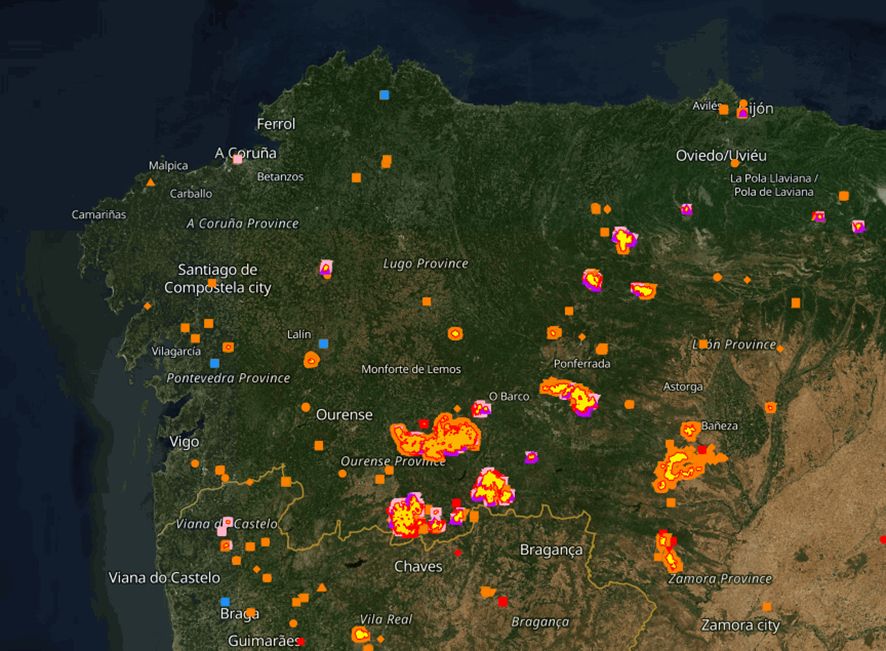
¿Por qué la región entre Zamora, León y Ourense arde tanto?
No, no es para construir aerogeneradores, ni por ninguna de las teorías conspiranoicas que estamos leyendo. La explicación es más compleja… y menos cómoda para quienes buscan respuestas simples. 1/13
15.08.2025 17:24 — 👍 864 🔁 670 💬 55 📌 57

EuroMarine
EuroMarine is a member-based, interdisciplinary, collaborative network of European marine organisations and research institutes.
🚀OYSTER 4th Call for #ECR #Cooperation Projects is now open🌊
💡 On-line Networking & Information Session on September 5th
💰 #Funding for 2 projects up to €7000
⏳ Apply by October 10th
📚 Check Info and documents 👇
11.08.2025 14:26 — 👍 2 🔁 4 💬 0 📌 0

O cartaz da Queimada de Cervo deste ano fíxoo Dani, o fillo de Vizoso. Na base hai dous Vizosos, un vivo e un morto, que beben queimada. O vivo leva o lapis na mao e o morto pícalle con el os collós ao demo. 😍
#Vizoso #OfCourseCeltic
03.08.2025 10:41 — 👍 38 🔁 14 💬 1 📌 3
10.07.2025 04:39 — 👍 5 🔁 3 💬 1 📌 0
Puedes mandarme un DM si tienes dudas :)
16.05.2025 08:18 — 👍 0 🔁 0 💬 0 📌 0
No es mucho pero ayuda... Si no es tu primera carrera o no puedes matricularte en el año completo, la UNED tiene la carrera de magisterio (creo) y te permite matricularte en asignaturas sueltas. Como no es presencial puedes compaginarlo con trabajos. Por si quieres estudiar posibilidades.
16.05.2025 08:10 — 👍 1 🔁 0 💬 1 📌 0
Buenos dias. Si es tu primera carrera y accedes a una universidad publica puedes solicitar la beca del estado. Se conceden segun nivel de ingresos y pagan la matricula mas una cantidad fija al año que te ingresan directamente en la cuenta (hace años eran 3000 o 6000€ dependiendo de tus ingresos).
16.05.2025 08:09 — 👍 1 🔁 0 💬 1 📌 0
The idea of the world being "disenchanted" once science and "rationality" take hold has never sat well with me. You want to tell me that people who lived in a time when demons were considered a legit cause of disease somehow felt more mystical about life? I don't buy it.
06.05.2025 13:25 — 👍 509 🔁 88 💬 1 📌 0
Come with me as I try to build a modular open-source 24-well Plate Reader from scratch. I'll post updates regularly on this thread and then compile it to my open lab notebook later. Let's make some tools!
🛠️🧵
1/n
01.05.2025 04:40 — 👍 101 🔁 22 💬 7 📌 0
El debate es si algo tan crítico como la energía puede ser privado.
30.04.2025 06:32 — 👍 193 🔁 84 💬 11 📌 13
Eu 🥲 que nunca lle miro o prezo o chocolate cando compro
24.03.2025 14:31 — 👍 1 🔁 0 💬 1 📌 0
Reading The Dawn of Everything ruins at least half of popular history books you try to read afterwards. Because if an author starts building their case with a simple, linear narrative of human history…you already know it’s bullshit. What else are they going to be wrong about?
31.01.2025 05:55 — 👍 80 🔁 10 💬 7 📌 1
YouTube video by Ecoinformatica AEET
Seminarios Ecoinf | Nerea Piñeiro - BlueCarbon R package: get carbon stocks and sequestration rates
For those that missed the The BlueCarbon R library workshop, it was recorded and it is available here thanks to the @ecoinf-aeet.bsky.social group of the @eco-aeet.bsky.social
www.youtube.com/watch?v=XCrr...
30.01.2025 09:55 — 👍 4 🔁 2 💬 0 📌 0
This is today!
bsky.app/profile/ecoi...
28.01.2025 09:19 — 👍 1 🔁 0 💬 0 📌 0
On Tuesday 28 January at 16:00 h we will have the seminar ‘BlueCarbon R package: get stocks and sequestration rates estimations directly from raw laboratory data’ by
@npjuncal.bsky.social
We hope to see you all there👇
24.01.2025 10:25 — 👍 5 🔁 7 💬 0 📌 1
Pero se e Moaña xD Dunas incipientes da praia da Xunqueira.
21.01.2025 19:30 — 👍 3 🔁 0 💬 1 📌 0
Pois ten pinta de sistema dunar incipiente
21.01.2025 19:28 — 👍 3 🔁 0 💬 2 📌 0
A Kameron Hurley WWII fantasy novel? Take my money. :)
27.11.2024 16:23 — 👍 0 🔁 1 💬 0 📌 1
Son ás 3:30am e podo dicir que Bluesky xa está traducido ao galego na súa totalidade. Agora esperar a que acepten a tradución.
#Blueskyengalego
19.11.2024 02:32 — 👍 283 🔁 81 💬 23 📌 12
Author of critically acclaimed grimdark epic fantasy, EMPIRES OF DUST, A WOMAN OF THE SWORD, A SWORD OF BRONZE AND ASHES. A SWORD OF GOLD AND RUIN out now.
Dyslxic, dyspraxic, ASD, PhD.
PhD Candidate on marine trophic ecology at Universitat de Barcelona @ub.edu
Board member at OYSTER Network @em-oyster.bsky.social supporting Early Career Scientist #ECS accross Europe
Senior Scientist of Coastal and Marine Ecology Division at GUIDE. Oceanography and Marine biologist.
research software, ecology, public health, open science
Research Fellow at The Kids Research Institute, Australia and University of Western Australia
she/her
Associate Professor @Paris-Saclay University
Interests: ecology, soils, biogeochem, data analysis, reproducible code
she/her
https://tania-maxwell.github.io/
The Journal of Open Source Software is a developer friendly, diamond open access journal for research software packages.
Committed to publishing quality research software with zero article processing charges or subscription fees.
https://joss.theoj.org/
Research Software Engineer (PhD) | 10+ years building open source systems | Developer of R packages (10+ on CRAN) and Shiny apps | Learner & educator | Associate editor & mentor @ rOpenSci
Researcher | Behaviour, movement ecology, & global change | Data editor at Proceedings B
Website: http://www.jackandrewbrand.com
YOU MUST TAKE CARE OF YOURSELF IF YOU WANT TO VANQUISH YOUR ENEMIES. I WILL HELP. (by @nora.zone, icon by Delapouite at https://game-icons.net)
Welcome to OYSTER, the early career network from
@euromarine.bsky.social 🐟🐠
PhD candidate at @icmcsic.bsky.social. Global change, seagrass, nature based solutions and coastal habitat conservation🌿🌊
(she/her)
Mariano Villarreal, administrador web Literatura Fantástica: información y crítica cf, fantasía y terror: http://literfan.cyberdark.net
Autor del ensayo 'Historia de la CF Española' http://bit.ly/3GKzrxl
Bio: https://bit.ly/4hWbM9X
since 2017, advancing open science at LMU University in Munich and beyond.
managing director: Felix Schoenbrodt @nicebread.bsky.social
scientific coordinator: Malika Ihle @malikaihle.bsky.social
student assistant: E. Waterfield @bethwater.bsky.social
🔴 Periodismo crítico para un público exigente
👉¡Hazte socio/a! Súmate a nuestra comunidad: https://publico.es/unete?tpcc=bk_epaut
A podcast in which a guy with “some college” and a day job has long-form conversations about biblical texts. http://patreon.com/ItMeansWhatItMeansPodcast
Soil Science cluster of Wageningen University and Research advancing understanding of interactions between soil properties and processes & the impacts of land use and management on soil. Visit our website: https://www.wur.nl/en/research-results/chair-group
Ecologist working on the conservation and restoration of macroalgal marine forests. Current postdoc at MBA, Plymouth, UK🌱🌊 BEECH, MedRecover and MarineForest groups
Tools for environmental monitoring and bio-logging. Birthplace of #EnvLoggers, #PULSE, #TRIDENT and others!
Postdoctoral Research Associate at Northeastern University, oceanographer, wetland ecologist, biogeochemist, educator, and nature-lover