OpenAlex
⚠️ Open science action on the day: Use OpenAlex (openalex.org) instead of Web of Science! 💪
The CNRS has taken the bold step of unsubscribing from WoS! This means €1.4 million will go back into open science initiatives. 👏👏👏
www.cnrs.fr/fr/actualite...
02.12.2025 06:00 — 👍 6 🔁 1 💬 0 📌 0

Some possible forms of sex-specific plasticity in each infection component and how they may lead to non-intuitive predictions for sex-biases in pathogen transmission. Using a horizontally transmitted pathogen as an example, transmission capacity through each sex depends on the sex-specific differences in host susceptibility, pathogen loads, and death rates. Hypothetically, each component could have a unique form of sex-specific plasticity – susceptibility might be plastic only for males (i.e., sex-specific), equally plastic in both sexes in the same direction (i.e., equivalent), and equally plastic in both sexes but in opposing directions (i.e., divergent). Yet considering overall disease spread would suggest a strong male-bias in transmission in environment 1, but no bias at all in environment 2, and that this shift in the extent of the ‘sicker sex’ (in regard to the sex where pathogen transmission is highest) would be underpinned entirely by plasticity in male transmission only.
🆕 in "Ecology": Who spreads more disease - males or females? At least in water fleas, it depends on temperature
📄The sicker sex is plastic: Thermal plasticity determines sex biases in pathogen transmission
doi.org/10.1002/ecy....
25.11.2025 20:16 — 👍 13 🔁 10 💬 0 📌 0
Foraging Behaviours of Ants
While the collective foraging of ants has been studied extensively, there has been much emphasis on the mechanisms that underlie ant foraging; however, ...
Got some nice work about ant foraging? Can't decide where to send it? We have a special issue just for you!
And, as a bonus, it's in (afaiac*) the best journal in the world @insectessociaux.bsky.social
link.springer.com/collections/...
*As Far As I Am Concerned
21.11.2025 21:33 — 👍 10 🔁 5 💬 0 📌 0
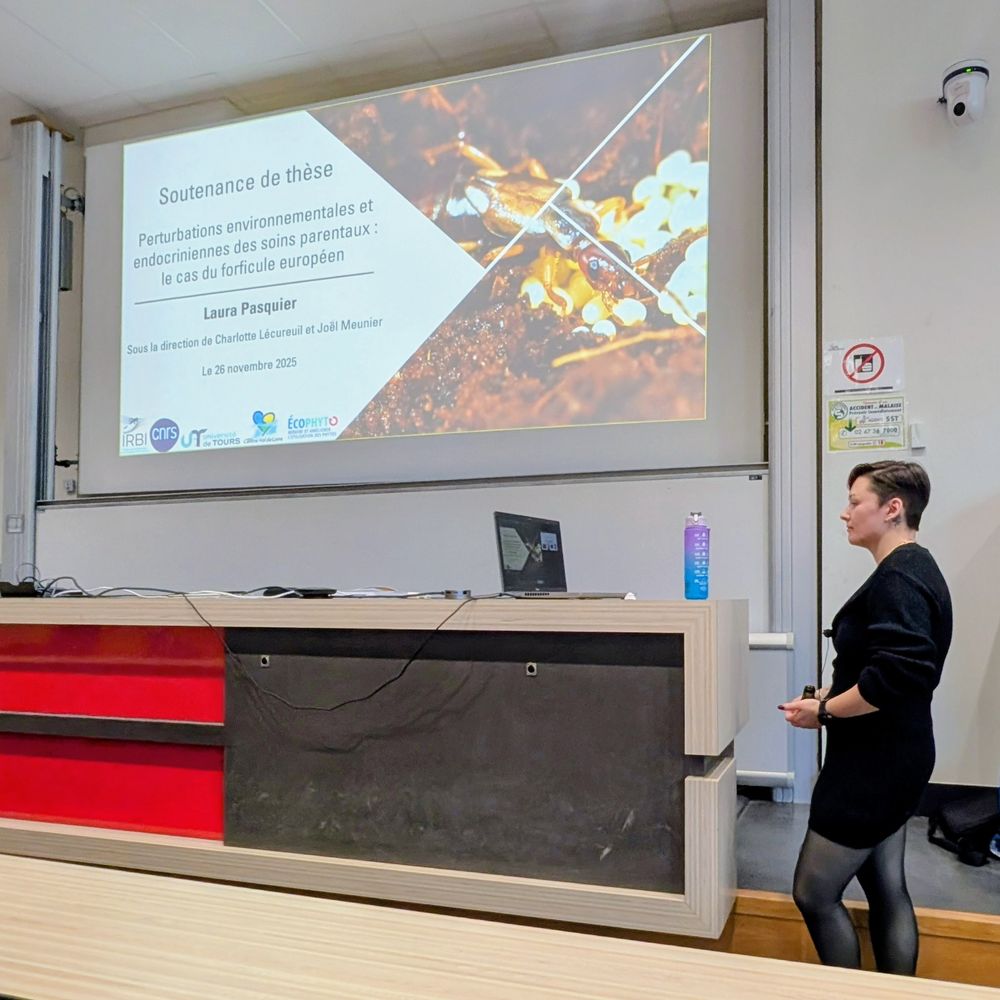
Yesterday, Laura Pasquier successfully defended her PhD thesis, which focused on environmental and endocrine disruptions in parental care, using the European earwig as a case study. After 3 years of hard work, the outcome was fantastic!! Congrats Laura, and all the best for the future!
27.11.2025 08:24 — 👍 1 🔁 0 💬 0 📌 0

Sounds good, doesn't it?
("The predicted demise of scientific publications?" - a special day of discussion organised by the CNRS)
25.11.2025 08:37 — 👍 2 🔁 0 💬 0 📌 0

Harmony in the hive? Think again! 🐝⚔️
Insect societies are famous for cooperation, but beneath the surface lies a brutal conflict over who gets to wear the crown!
Our new review in Biological Reviews explores the evolutionary battleground caused by such caste fate conflict. 🧵
24.11.2025 13:08 — 👍 49 🔁 23 💬 1 📌 0

A macro photo of a mother earwig guarding a cluster of her tiny, pale babies, all of them on damp earth.
#Bugsky 🐙🌿 Who wants another baby earwig update? Everyone? Thought so. The babies are now two days old and slightly darker than when they hatched. Mama is guarding them and will stay on the job until their second molt. Btw, in the earlier post, the newly-hatched babies only had--
20.11.2025 17:45 — 👍 143 🔁 31 💬 4 📌 2

Soutenance de thèse Laura Pasquier
Date(s) - Le 26 novembre 2025 à 14h
Lieu(x)- amphi 030 du bâtiment E1
Perturbations environnementales et endocriniennes des soins parentaux : le cas du forficule européen / Environmental and endocrine disruptions in parental care: the case of the European earwig
14.11.2025 08:14 — 👍 0 🔁 2 💬 0 📌 0

A macro photo of a group of just-hatched baby earwigs along with some still-unhatched eggs. The babies are transparent, except for orange-brown on their compound eyes and their mandibles. Those pigmented structures are visible through the shells of the yet-to-hatch eggs.
--in which you can better see the eyes and mandibles on the new babies, plus see both structures clearly showing through the shells on the still-unhatched eggs. (Btw, mama earwig was close by in a burrow. She didn't want to come out into the light, so I carefully replaced the rock.)
18.11.2025 18:34 — 👍 48 🔁 6 💬 2 📌 0

AI image generated using Google's Gemini.
New paper: "A formal theory of group-level adaptation for obligate eusociality", with Kalyani Twyman (@kztwyman.bsky.social) #OpenAccess
academic.oup.com/jeb/advance-...
#Image #GoogleGemini @jevbio.bsky.social #OA
18.11.2025 10:35 — 👍 27 🔁 8 💬 2 📌 0


This weekend, I was invited by the association A.L.L.E.E. in Toulouse to present earwigs to a broad and curious audience. It was a fantastic opportunity to share our work, highlight why fundamental research matters, and spark new appreciation for these often-misunderstood insects. 😃😃😃
17.11.2025 06:12 — 👍 1 🔁 0 💬 0 📌 0
Amis Toulousains : C'est demain ! Venez nombreuses et nombreux 😄👍🐛
14.11.2025 05:57 — 👍 5 🔁 3 💬 0 📌 0

Je donnerais une conférence grand public sur les perce-oreilles à Toulouse.
Venez découvrir les secrets de ces petits insectes discrets, souvent mal-aimés, mais à la vie sociale fascinante.
📅 Samedi 15 nov. 2025 à 14h.
➡️ Infos & inscription via l’affiche ci-dessous
#Conférence #Insectes #Nature
04.10.2025 09:57 — 👍 5 🔁 1 💬 0 📌 1

Better safe than sorry: leg amputations as a prophylactic wound care behaviour in carpenter ants buff.ly/INPxtKN | #ProcB #Behaviour #Evolution #WoundInfection
27.10.2025 09:02 — 👍 7 🔁 3 💬 0 📌 0

The genetic basis of natural variation in sociability
Abstract. Sociability, defined as individuals’ tendencies to affiliate with conspecifics, is widespread among animals, including species not traditionally
Editor's Choice article in our latest issue:
"The genetic basis of natural variation in sociability " by Arteen Torabi-Marashi, Dania Daanish, Andrew M Scott, Reuven Dukas, & Ian Dworkin.
academic.oup.com/evolut/artic...
@idworkin.bsky.social
20.10.2025 10:36 — 👍 12 🔁 5 💬 0 📌 0

The Adaptive Relationships Framework illustrating how broad socioecological pressures shape the social solutions animals use to meet these challenges, and how these lead to social strategies and emergent structures that help them gain access to those solutions.
Social relationships are powerful predictors of fitness across social animals. But *why*?
In our new @cp-trendsecolevo.bsky.social paper, we outline testable predictions for why relationship quality and quantity adaptively vary across socio-ecological contexts.
tinyurl.com/55dnkeh7
16.10.2025 07:07 — 👍 99 🔁 52 💬 1 📌 3

I'm on my way to Avignon to learn about the earwig research on a species that I know much less about than my favourite, F. auricularia. I'm looking forward to being there, despite the early start and multiple train connections 🚆🚅🚌
16.10.2025 05:29 — 👍 3 🔁 0 💬 0 📌 0
Redirecting
🪳 New paper out – Part II!
Our 2nd study on the hormonal regulation of maternal care in the European earwig is now out!
We show that blocking juvenile hormone synthesis with Precocene reduces egg care in post-oviposition mothers, while JH supplementation has no effect.
doi.org/10.1016/j.yh...
15.10.2025 06:19 — 👍 4 🔁 2 💬 0 📌 0
Je donnerais une conférence grand public sur les perce-oreilles à Toulouse.
Venez découvrir les secrets de ces petits insectes discrets, souvent mal-aimés, mais à la vie sociale fascinante.
📅 Samedi 15 nov. 2025 à 14h.
➡️ Infos & inscription via l’affiche ci-dessous
#Conférence #Insectes #Nature
04.10.2025 09:57 — 👍 5 🔁 1 💬 0 📌 1

I'm on my way back from Roscoff, where I attended a two-day event organised by the CNRS for 'advanced researchers'. What a beautiful location❤️! It's a shame it's so far away — I still have a day of buses and trains ahead of me to reach Tours 😳
01.10.2025 09:32 — 👍 2 🔁 0 💬 0 📌 0
En fait, j'étais initialement l'un des invités, malheureusement je n'étais pas disponible à cette date ;)
23.09.2025 11:40 — 👍 0 🔁 0 💬 1 📌 0

Very happy to see our new study on the evolution of eusociality come out in Evolution Letters! Our study is the first to experimentally manipulate the proportion of females that stay and help to simulate incipient sociality & assess fitness impact of helping. 🧵
23.09.2025 09:18 — 👍 26 🔁 8 💬 1 📌 1
Merci Anne! Je l'ai écouté avec attention :) j'espère que tout ça bien pour toi !
22.09.2025 17:48 — 👍 0 🔁 0 💬 1 📌 0
PCI Webinar-Dorothy Bishop-How negligent publishers subvert quality control in scientific publishing
Yesterday, we had the pleasure of listening to Dorothy Bishop emphasize the responsibility of editors during the 12th PCI Webinar! If you weren't able to join, you can catch her talk and the following Q&A session at this link: youtu.be/0NJ87tYE8_s
19.09.2025 13:34 — 👍 17 🔁 10 💬 0 📌 0
Writer & nature photographer, especially macro photography of arthropods. Desert Tortoise conservation advocate. Fan of California, Montana, the rest of the planet. Photo website: https://www.tomastlephotography.com/
BayCEER, the Bayreuth Center of Ecology and Environmental Research, University of Bayreuth @unibayreuth.bsky.social
https://www.bayceer.uni-bayreuth.de/
4th (and last !) year PhD. Student working on #phthalate impact on #bee health and development at UMons (BE) and ULille (FR) 🐝
PhD student at the University of Würzburg
Study the evolution of social wound care behaviour in ants | MEME alumnus 🇸🇪 🇨🇵 🇩🇪 🇨🇴
Social evolution, behaviour and maths
https://juanjose-lagosoviedo.weebly.com/
Scientist Senckenberg Biodiversity and Climate Research Center, Frankfurt, Germany
evolutionary biology, adaptive genomics, behavior
Senior Lecturer - The Roach Lab @ Ben-Gurion University
Studying the secret lives of cockroaches.
https://www.sofiabouchebti.com/
Studying why and how behavior evolves, from mosquitoes to mole-rats | Postdoc/Leon Levy Scholar @Columbia working with Ishmail Abdus-Saboor | PhD @Princeton with Lindy McBride | 麻布/東大 alum 🇯🇵 | yukihaba.github.io
We found a strong correlation between effort and disappointment.
https://ko-fi.com/minorrevision <- If you are wondering how these comics are made, it is explained here. No need to have a meltdown.
PhD student in ant’s venom alkaloids 🐜🌱
Metabolomic / Molecular Biology / Chemical Ecology
Université de Tours
Research in insect diseases and immunity @inrae-dgimi.bsky.social in Montpellier, France 🐝 🦗 🐛
International & inclusive online platform bringing together researchers in animal behaviour.
🔗Website: animalbehaviour.live
🌲Linktree: https://linktr.ee/animalbehaviourlive
📝Conference: https://ablaoc25.sciencesconf.org/
We study socially transferred materials, metabolic division of labour, and the evolution of cooperation. Mostly ants, sometimes microbes, sometimes vertebrates.
PI = @adriatica.bsky.social, Lab is @camzoology.bsky.social at University of Cambridge.
Scientist, professor, gardener, grandmother.
🇹🇼Taiwan
Research assistant, Academia Sinica
Behavioural ecology | Buring beetle | Social behaviour
Professor of Animal Behaviour. www.SHOALgroup.org
Association promouvant la bande dessinée et organisant, chaque septembre, le festival de BD de Tours
https://linktr.ee/atoursdebulles
(En bandeau : un fragment de l'affiche du festival 2025, oeuvre de Jean Cremers)
Syndicat national de la recherche scientifique
Engagé·es au quotidien pour la recherche publique et tous ses personnels
www.sncs.fr
Behavioral ecologist studying social evolution in comparative studies and long-term field studies in South Africa. Studying the solitary bush Karoo rat and the socially flexible striped mouse. Animal behavior. Succulent Karoo Research Station. CNRS, IPHC.