Thanks Kevin!
13.02.2026 16:44 — 👍 0 🔁 0 💬 0 📌 0
Favourite paper I have read this year. Check it out! Great work @harikalidindi.bsky.social and @fredcrevecoeur.bsky.social!
13.02.2026 12:30 — 👍 8 🔁 1 💬 2 📌 0
awesome paper bridging the gap between RNN and optimal control models of motor control
13.02.2026 13:05 — 👍 15 🔁 4 💬 0 📌 0
Enjoyed a lot doing this work with @fredcrevecoeur.bsky.social throughout! Glad it's finally out 🎉🎉🎉
Here is the accompanying code for implementing:
github.com/neurohari/si...
13.02.2026 16:40 — 👍 4 🔁 1 💬 0 📌 0
Now published in the Journal of Neurophysiology:
journals.physiology.org/doi/full/10....
Get in touch if you think this tool could help in your science! We will be developing improvements and extensions over the next year.
12.12.2025 14:57 — 👍 58 🔁 21 💬 1 📌 0

Image of robots struggling with a social dilemma.
1/ Why does RL struggle with social dilemmas? How can we ensure that AI learns to cooperate rather than compete?
Introducing our new framework: MUPI (Embedded Universal Predictive Intelligence) which provides a theoretical basis for new cooperative solutions in RL.
Preprint🧵👇
(Paper link below.)
03.12.2025 19:19 — 👍 65 🔁 27 💬 5 📌 6
Very interesting work!
03.12.2025 09:12 — 👍 0 🔁 0 💬 0 📌 0

The brain computes by processing information over time through interactions between connectivity and dynamics that are hard to model. Here we infer these interactions from data and find they better predict cognitive performance! www.nature.com/articles/s41... w/ @lindenmp.bsky.social
02.12.2025 23:38 — 👍 35 🔁 12 💬 4 📌 2
Join us for Fall 2026. In our group, you can run studies from human behavior and neuroimaging, to large-scale NHP ephys, and join them up with a robust computational foundation. Bonus: you can help build the reading list.
02.12.2025 13:23 — 👍 37 🔁 29 💬 1 📌 1
European universities leading the way
03.12.2025 08:41 — 👍 0 🔁 0 💬 0 📌 0
Thread of French and Dutch research institutes slowly unsubscribing from web of science (and thence impact factors).
03.12.2025 06:53 — 👍 78 🔁 35 💬 2 📌 6
0/10 Thanks for the interest in our preprint. Some takes say it negates or fully supports the “manifold hypothesis”, neither quite right. Our results show that if you only focus on the manifold capturing most of task-related variance, you could miss important dynamics that actually drive behavior.
02.12.2025 07:48 — 👍 50 🔁 22 💬 1 📌 1

How I contributed to rejecting one of my favorite papers of all time
I believe we should talk about the mistakes we make.
How I contributed to rejecting one of my favorite papers of all times, Yes, I teach it to students daily, and refer to it in lots of papers. Sorry. open.substack.com/pub/kording/...
02.12.2025 01:27 — 👍 119 🔁 28 💬 1 📌 10
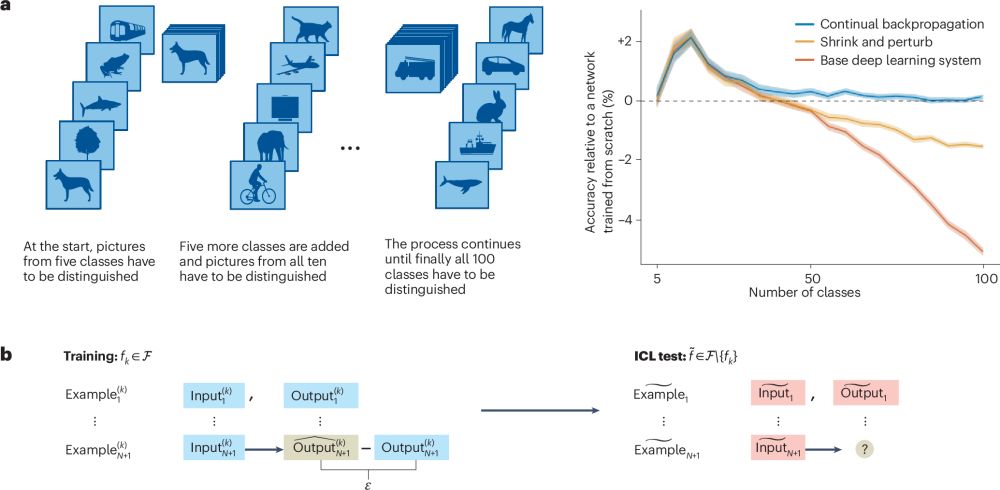
What neuroscience can tell AI about learning in continuously changing environments
Nature Machine Intelligence - Durstewitz et al. explore what artificial intelligence can learn from the brain’s ability to adjust quickly to changing environments. By linking neuroscience...
Unlike current AI systems, animals can quickly and flexibly adapt to changing environments.
This is the topic of our new perspective in Nature MI (rdcu.be/eSeif), where we relate dynamical and plasticity mechanisms in the brain to in-context and continual learning in AI. #NeuroAI
29.11.2025 09:24 — 👍 47 🔁 11 💬 0 📌 1
What's the main factor that prevents us from getting universities and grant committies to pull the plug on these massive profiteering journals and put control back in the hands of researchers ?
27.11.2025 14:53 — 👍 2 🔁 0 💬 1 📌 0

Two posts from Bluesky. The first one shows a figure from a paper published in Nature Scientific Reports full of totally incoherent AI fabricated gibberish words. The other a comment on a recently published paper by eLife discussing the paper and its peer reviews which were published along with the paper.
Nature Sci Rep publishes incoherent AI slop. eLife publishes a paper which the reviewers didn't agree with, making all the comments and responses public with thoughtful commentary. One of these journals got delisted by Web of Science for quality concerns from not doing peer review. Guess which one?
27.11.2025 13:35 — 👍 156 🔁 69 💬 4 📌 8
Characterizing control between interacting subsystems with deep...
Biological function arises through the dynamical interactions of multiple subsystems, including those between brain areas, within gene regulatory networks, and more. A common approach to...
13/ 😀Feel free to reach out to discuss this work, or the application of it to your field of study. Or come swing by our poster at #NeurIPS2025. We’d love to chat!
📄 Paper: openreview.net/forum?id=I82...
💾 Code: github.com/adamjeisen/J...
📍 Poster: Thu 4 Dec 11am - 2pm PST (#2111)
26.11.2025 19:32 — 👍 11 🔁 3 💬 2 📌 0
Very interesting work!
26.11.2025 21:04 — 👍 2 🔁 0 💬 0 📌 0

How do brain areas control each other? 🧠🎛️
✨In our NeurIPS 2025 Spotlight paper, we introduce a data-driven framework to answer this question using deep learning, nonlinear control, and differential geometry.🧵⬇️
26.11.2025 19:32 — 👍 90 🔁 30 💬 1 📌 3
looks very cool!
26.11.2025 15:40 — 👍 0 🔁 0 💬 0 📌 0
I am not even sure it is a hypothesis.
I mean, it is a certainty that neural activity coding for a behavior is not using the full subspace of coding available.
It is interesting how many dimensions are in use.
But these are almost mathematically guaranteed.
Can you state the hypothesis?
26.11.2025 15:17 — 👍 4 🔁 1 💬 0 📌 0
"The inevitability and superfluousness of cell types in spatial cognition". Intuitive cell types are found in random artificial networks using the same selection criteria neuroscientists use with actual data. elifesciences.org/reviewed-pre... 1/2
25.11.2025 19:29 — 👍 45 🔁 15 💬 4 📌 3
It looks like networks stripped to their bare minimum end up emulating multiple observations while being analytically tractable. I'm curious to see how learning in networks interacts with this control process
25.11.2025 16:32 — 👍 0 🔁 0 💬 0 📌 0
This has made me think that it’s just as important to ask what an ideal actor would do without imposing structure, nonlin or data-training on the networks in the first place...this can allow us to interpret empirical observations in a rule based framework (a useful complementary approach!!)
25.11.2025 16:15 — 👍 1 🔁 1 💬 1 📌 0
I like using ANNs for prediction! but one challenge is that we can engineer them in multiple ways to generate similar data. E.g. M1-like patterns emerge from both sensory and autonomous networks with different optimization rules. They depend on training method, and tricky to infer organizing rules
25.11.2025 16:12 — 👍 2 🔁 1 💬 1 📌 0

Motor Cortical Output Integrates Distorted Proprioceptive Feedback
Proprioceptive feedback from muscles is essential for continuous monitoring and precise control of limb movement, yet how such peripheral feedback is integrated into ongoing descending motor cortical ...
In fact, in some recent work, we showed that transiently blocking some proprioceptive feedback *increases* the dimensionality of dynamics along a direction orthogonal to the task manifold, with only *weak* effects on behavioral trajectories.
24.11.2025 01:16 — 👍 15 🔁 4 💬 4 📌 0

Neural dynamics outside task-coding dimensions drive decision trajectories through transient amplification
Most behaviors involve neural dynamics in high-dimensional activity spaces. A common approach is to extract dimensions that capture task-related variability, such as those separating stimuli or choice...
“Our findings challenge the conventional focus on low-dimensional coding subspaces as a sufficient framework for understanding neural computations, demonstrating that dimensions previously considered task-irrelevant and accounting for little variance can have a critical role in driving behavior.”
23.11.2025 13:38 — 👍 144 🔁 41 💬 8 📌 9
MD/PhD student at the University of Pittsburgh-Carnegie Mellon University MSTP. Interested in computational neuroscience and cognition.
Healthcare Data Analyst at UCLA Health specializing in data analysis, reporting, and insight generation to support clinical excellence and organizational strategy. https://www.uclahealth.org/
PI @ the PERL lab, assistant professor @ Haifa University, interested in how Humans smell, breathe, remember and recall their world. 👃🏻📈🧠
theoretical neuroscience phd student at columbia
Staff Reporter at The Transmitter. Science Journalist.
٣٤ ⋅ Doctor ⋅ Specialist Registrar (ST7) in Neurology 🧠 ⋅ PhD candidate @uclqsion.bsky.social — #HD-YAS https://orcid.org/0000-0002-0679-0117
Professor of Information Engineering and Neuroscience, University of Cambridge
Computational Neuroscientist + ML Researcher | Control theory + deep learning to understand the brain | PhD Candidate @ MIT | (he) 🍁
Father, husband, scientist
🇪🇺
European.
Views my own; RT = interest, not endorsement.
Computational neuroscience, neuroML, natural behavior. I charge more for miracles. PI @ pearsonlab.github.io. @dukemedschool.bsky.social.
PhD candidate in computational neuroscience, university of Geneva.
Studying the dynamical properties of neural activity during speech processing.💻🧠
webpage: nosratullah.github.io
The SMMBL at the University of Sydney explores how music affects higher order cognition, as well as ways to support musicians' health. https://www.sydney.edu.au/music/our-research/cross-disciplinary-research/sydney-music-mind-and-body-lab.html
Postdoc @ Donders Institute | Body perception, brain plasticity, sensorimotor augmentation | PhD in Neuroscience from Karolinska Institutet | Co-chair of Halkes Women+ Faculty Network | dominikaradziun.github.io
Cognitive scientist at Stanford. Open science advocate. Symbolic Systems Program director. Bluegrass picker, slow runner, dad. http://langcog.stanford.edu
Cognitive Neuroscience PhD student, studying motor and perceptual learning in body augmentation | Plasticity lab, University of Cambridge | MD, neurology, epilepsy | she/her
Ph.D. Student Mila / McGill. Machine learning and Neuroscience, Memory and Hippocampus