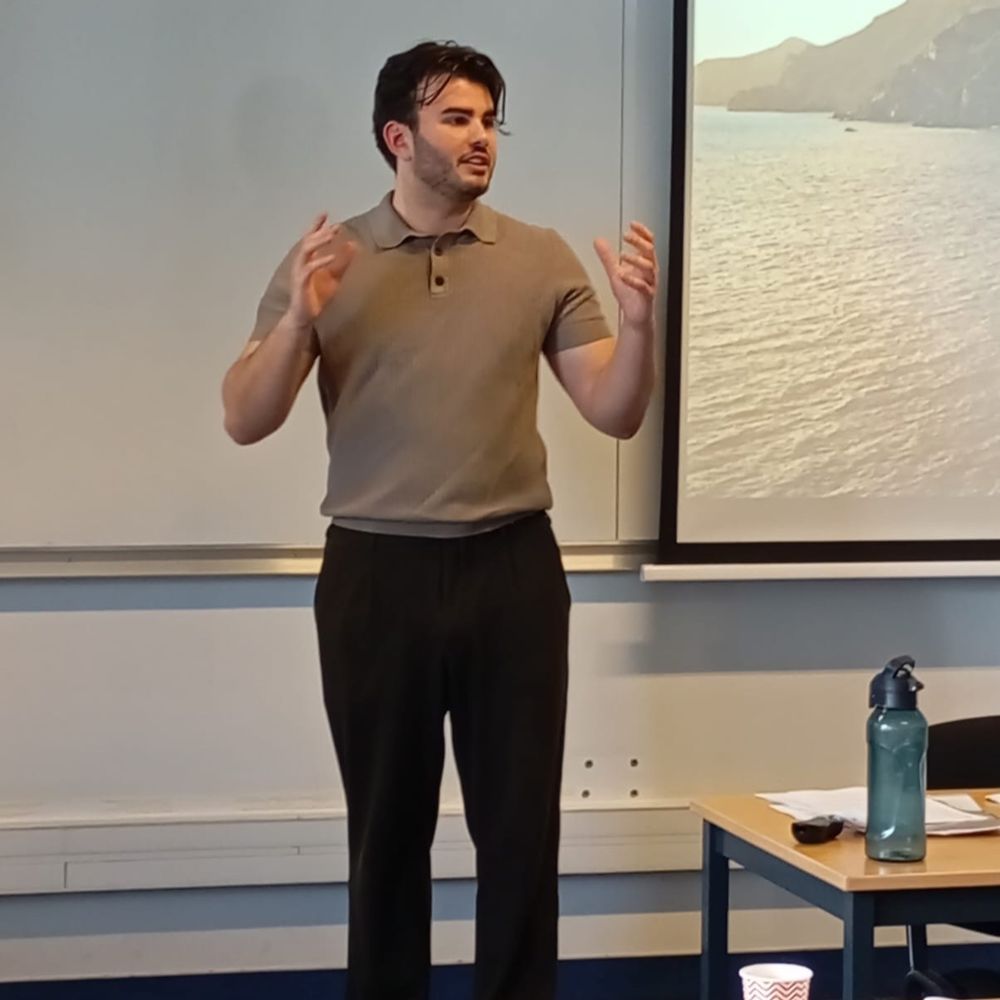
So proud to be part of this amazing team. A lot of projects going on and even more coming in the future, stay tuned! 🌳🔥🛰️
13.05.2025 00:23 — 👍 5 🔁 0 💬 0 📌 0
Analyses de thèse | Académie d'Agriculture de France
Vous souhaitez en apprendre plus sur la vulnérabilité des forêts et zones agricoles face aux incendies ? 🔥🌳
Mais, vous n'avez pas le temps de lire les 250 pages que compose ma thèse ?
Ça tombe bien, l'académie d'Agriculture vient d'en faire une synthèse 👇
Merci à Yves Birot pour son analyse
10.04.2025 16:24 — 👍 3 🔁 0 💬 0 📌 0

Regardons la communauté des followers de @cnrsecologie.bsky.social , qui étudie l'environnement
On distingue 5 communautés
21.03.2025 17:38 — 👍 11 🔁 1 💬 1 📌 2
We need to adapt global models to regional conditions to ensure accurate estimation of the processes that will be transformed by future climate conditions.
13.01.2025 17:19 — 👍 3 🔁 0 💬 1 📌 0
Climate change seems bound to push fires further north, towards temperate forests.
This process should increase the C emissions balance to significant levels (here : 2% of the national balance, 30% of annual sequestration by forests).
13.01.2025 17:19 — 👍 1 🔁 0 💬 1 📌 0
As a result, the total carbon footprint for the 2022 fire season in France amounts to 7.95 million tonnes of CO2 equivalent.
Global models, which did not take into account the underground parts of temperate forests, predicted a balance 2 times lower (4.18 MtCo2e).
13.01.2025 17:19 — 👍 2 🔁 0 💬 1 📌 0

It is estimated that 1.15 million tonnes of CO were emitted by fires in 2022.
For this molecule, underground compartments are becoming the dominant source!
13.01.2025 17:19 — 👍 1 🔁 0 💬 1 📌 0

Our model estimates that 6.15 million tonnes of CO2 were emitted by the fires.
In terms of this molecule, soil and aerial parts account for an equal share.
The Landes region dominates this assessment (large surface area burned, high concentration of C in the soil).
13.01.2025 17:19 — 👍 1 🔁 0 💬 1 📌 0

In total, it is estimated that 4.5 million tonnes (dry mass) will be combusted in 2022, all compartments combined.
Subterranean compartments, in particular soil and lignite, play an important role in this balance.
13.01.2025 17:19 — 👍 1 🔁 0 💬 1 📌 0

We have thus built a new fire emission model, with aerial compartments (trees, shrubs, herbaceous plants, litter) and underground compartments (soil, peat bogs, lignite).
This 10m-resolution model is calibrated with data from the Atmospheric towers.
13.01.2025 17:19 — 👍 2 🔁 0 💬 1 📌 0

We have observed that this type of combustion can be favored by various factors: a high carbon density in the soil, the presence of peat bogs or lignite, low fire propagation speed, high fire intensity, etc.
13.01.2025 17:19 — 👍 2 🔁 0 💬 1 📌 0

Smoldering combustion can occur in various ecosystem compartments (e.g. wood), but such high values are generally associated with combustion in the subterranean soil layers. This corroborates evidence of fumaroles and deep combustion (Landes).
13.01.2025 17:19 — 👍 1 🔁 0 💬 1 📌 0
When a large quantity of carbon monoxide (CO) is released relative to dioxide (CO2), this is considered to be smoldering combustion (absence of O).
Here, we sometimes observe MCEs of 0.75, i.e. a quantity of CO emitted for only 3 of CO2!
13.01.2025 17:19 — 👍 1 🔁 0 💬 1 📌 0

The quantities of CO and CO2 vary from site to site:
In the Mediterranean (OHP), the signal corresponds to normal surface combustion (low CO).
In the Landes (BIS) and Brittany (ROC), very high CO values are obtained at times
*MCE=CO2/(CO2+CO)
13.01.2025 17:19 — 👍 1 🔁 0 💬 1 📌 0

We had to retrace the path of the molecules from the fire, in the atmosphere and thus obtain the points of intersection with the atmospheric towers (including @icos-ri.eu towers)
This work was carried out by colleagues from @universitereims.bsky.social (C.Abdallah, T. Lauvaux & L.Joly)🙏
13.01.2025 17:19 — 👍 3 🔁 1 💬 1 📌 0

In 🔵⚪🔴, we have a nationwide network of atmospheric towers, which measure molecule quantities in real time.
We have taken advantage of the proximity of certain towers (OHP, ROC, BIS) to wildfires to analyze changes in CO2 and CO
13.01.2025 17:19 — 👍 2 🔁 0 💬 1 📌 0
How does this redistribution to the North affect the carbon balance of fires?
What role does soil combustion play in these ecosystems?
Do global models and inventories correctly estimate these emissions?
13.01.2025 17:19 — 👍 1 🔁 0 💬 1 📌 0

While fires affect ecosystems with low biomass in the Mediterranean (garrigue, low forest), this redistribution of occurrence to temperate forests increases the amount of biomass affected 🌳
Total: 2.55 million tonnes of vegetation affected in 2022
13.01.2025 17:19 — 👍 1 🔁 0 💬 1 📌 0

In 2022, the area burnt in France amounts to 42,500 hectares 🔥
Very large fires in the Landes (26,800 ha vs. 494 ha/year over 2006-2021)
Numerous fires in temperate forests (7,800 ha vs. 216 ha/year)
Surface burned within norms in the Mediterranean (7,900 ha)
13.01.2025 17:19 — 👍 1 🔁 0 💬 1 📌 0
🚨NEW SCIENTIFIC STUDY🚨
8 million tonnes of CO2
~ 2% of french greenhouse gas emissions 🔵⚪🔴
~ 30% of the national sequestration capacity of the forest🌳
That's the carbon emissions from fires in 2022! 🔥
⚠️Predominant effect of soil combustion
🧵👇
13.01.2025 17:19 — 👍 8 🔁 4 💬 1 📌 1

The scars of the fires encircling Los Angeles as seen by Sentinel-2 (SWIR) on January 12 🛰🔥
13.01.2025 11:52 — 👍 9 🔁 0 💬 0 📌 0
Forest ecologist, artist. Mostly posting pics of cats and cool trees.
Assistant Professor of Forestry at Paul Smith's College. Interested in ecological forestry, fire ecology, and wildlife ecology. Also a musician, snowboarder, and climber.
Extreme Wildfire Events Data Hub for Improved Decision Making | UCPM-2023-KAPP
Web: https://civil-protection-knowledge-network.europa.eu/projects/ewed
We're a nonprofit helping scientists and subject matter experts communicate with clarity, strategy, and purpose — all in service of people and nature.
Learn more: https://linktr.ee/compassscicomm
Interdisciplinary Approaches on Ecological Justice 🌿🌎
Promoting inter-species, inter-human and inter-generational equality
⬇️Learn about our project!
🔗 https://www.speak4nature.eu
GPGRS
› Earth Observation & Spatial Science
╔═════════════╗
║● GIS G #GIS
║● Photogrammetry P #Photogrammetry
║● Geodesy G #Geodesy
║● Remote Sensing RS #RemoteSensing
╚═════════════╝
M.Sc. Graduate, KNT University
Photogrammetry | Remote Sensing
Remote Sensing → Environmental Monitoring, Forest Ecology, Wildfire
Photogrammetry → Bundle Adjustment, UAV, Canopy Cover
#RemoteSensing #Photogrammetry #UAV #Drone #DeepLearning #GIS
I do social media workshops for scientists (Bluesky, LinkedIn, X, Reddit) and like talking #philosophy and #history when I am off duty! Ex-University Post editor in Copenhagen.
Website: https://mikeyoungacademy.dk/
Linktree: https://linktr.ee/mkeyoung
Former PhD Student @ieesparis.bsky.social studying small population dynamics and environmental changes. Focused on extinction risks and phenotypic plasticity in ectotherms.
Open to work for a postdoc position 🌱
Le Haut conseil pour le climat apporte un éclairage indépendant sur la politique du gouvernement en matière de climat. #NeutralitéCarbone
PhD student in Lausanne. Working on Macroecology - Biogeography - Entomology - Macroevolution
ONG scientifique qui lutte contre la destruction de l’océan et du climat.
🔗 bloomassociation.org
@bloom-eng.bsky.social
ig : @bloom_association
Fondatrice de @bloomassociation.bsky.social, @bloom-eng.bsky.social
🔗 bloomassociation.org
La reconquête politique se fera avec intégrité et courage ou ne se fera pas. On est mal barrés.
Née 330 ppm. 425 auj.
PhD Fellow in Arctic plant diversity 🌿🌼 & pollination networks 🪰🐝, Natural History Museum Denmark, University of Copenhagen🇩🇰. APECS❄️. Erasmus Mundus Master Programme in Evolutionary Biology (🇸🇪🇫🇷🇩🇪🇳🇴). 🇨🇦🏳️🌈 Born @360ppm. Fieldwork in Kalaallit Nunaat Greenland🇬🇱.
Naturalist. Wildlife Photographer.
Founder of Wildlife.net
Share, Inspire, Protect.
Wildlife Community for those who care about species & habitat conservation. Photography, Art, Videos of Birds,Mammals,Reptiles,Plants,insects
https://www.facebook.com/profile.php?id=61578489868735
https://www.tiktok.com/@wildlife.net?_t=ZN-8yV9vhsHk0c&_r=1
Double Degree International Master Program between 🇩🇪 Würzburg & 🇳🇴 Bergen in 🌱Ecology, 🌿Conservation & 🌡️Global Change
https://www.ecology-conservation.de/
| #Fire & #Soil Scientist 🔥 | Researcher at IMIB-CSIC (@imibasturias.bsky.social @csic.es)🔬 | Post-fire soil erosion and carbon dynamics 🛠️ | Mountain lover 🏔️ | Boardgamer 🎲 | https://www.agironagarcia.com/ | https://www.fireprosrt.com/ |