Often we talk about accuracy and speed of inference during ML applications to science. However, an equally important feature is flexibility. This is because real data requires flexibility (changing settings during inference time). Please check out Annalena’s thread for more info!
03.12.2025 18:49 — 👍 3 🔁 1 💬 0 📌 0

Scientific poster with dark background and two black holes illustrated in the center. The paper visualizes gravitational waves, and explains how parameter estimation is performed with DINGO. The standard DINGO model and the DINGO-T1 architectures are illustrated and results are shown. For example, it is possible to reanalyze the same event with different detector configurations with DINGO-T1, illustrated bz a corner plot.
1/ 🌀 New paper alert! We introduce Dingo-T1, a flexible transformer-based deep learning model for gravitational-wave (GW) data analysis. It adapts to different detector & frequency settings, improving inference efficiency and flexibility
🚀 #AI #MachineLearning #Physics #Astronomy #AcademicSky
03.12.2025 17:21 — 👍 37 🔁 11 💬 1 📌 3

Black-hole scattering with numerical relativity: Self-force extraction and post-Minkowskian validation
The asymptotic nature of unbound binary-black-hole encounters provides a clean method for comparing different approaches for modeling the two-body problem in general relativity. In this work, we use n...
How much information can we gain by pushing numerical relativity to its limit by simulating black hole scattering encounters? My latest paper (below) explores these extreme regions of the black-hole scattering parameter space using simulations generated using the Spectral Einstein Code (SpEC).
16.11.2025 11:30 — 👍 7 🔁 4 💬 1 📌 1

Initial sky localization. 90% area 1,200 sq deg.

Initial three-dimensional volume localization. Distance around 96 Mpc.
Oo! Interesting #GravitationalWave candidate #S251112cm potentially from a *subsolar* mass source
If real, the source is probably has chirp mass ~0.1–0.87 solar masses
False alarm rate 1 in 6.2 yr
GraceDB gracedb.ligo.org/superevents/...
GCN gcn.nasa.gov/circulars/42...
Rating 📏🍬
[🧪🔭⚛️]
12.11.2025 18:29 — 👍 90 🔁 22 💬 4 📌 9

Made a poster for a conference!
09.10.2025 20:53 — 👍 3 🔁 1 💬 0 📌 0

A posting on the arXiv preprint server.
Title: Systematic errors in fast relativistic waveforms for Extreme Mass Ratio Inspirals
Authors: Hassan Khalvati, Philip Lynch, Ollie Burke, Lorenzo Speri, Maarten van de Meent, Zachary Nasipak
Abstract: Accurate modeling of Extreme Mass-Ratio Inspirals (EMRIs) is essential for extracting reliable information from future space-based gravitational wave observatories. Fast waveform generation frameworks adopt an offline/online architecture, where expensive relativistic computations (e.g. self-force and black hole perturbation theory) are performed offline, and waveforms are generated rapidly online via interpolation across a multidimensional parameter space. In this work, we investigate potential sources of error that result in systematic bias in these relativistic waveform models, focusing on radiation-reaction fluxes. Two key sources of systematics are identified: (i) the intrinsic inaccuracy of the flux data, for which we focus on the truncation of the multipolar mode sum, and (ii) interpolation errors from transitioning to the online stage. We quantify the impact of mode-sum truncation and analyze interpolation errors by using various grid structures and interpolation schemes. For circular orbits in Kerr spacetime with spins larger than a≥0.9, we find that ℓmax≥30 is required for the necessary accuracy. We also develop an efficient Chebyshev interpolation scheme, achieving the desired accuracy level with significantly fewer grid points compared to spline-based methods. For circular orbits in Kerr spacetimes, we demonstrate via Bayesian studies that interpolating the flux to a maximum global relative error that is equal to the small mass ratio is sufficient for parameter estimation purposes. For 4-year long quasi-circular EMRI signals with SNRs=O(100) and mass-ratios 10^−4−10^−6, a global relative error of 10−6 yields mismatches <10^−3 and negligible parameter estimation biases.
New paper on the arXiv today about systematic errors when modelling the gravitation waveform from extreme mass ratio inspirals and their impact on LISA data science
Huge thanks to my collaborators, especially Hassan Khalvati, for getting this project over the line! 🧪⚛️🔭🧮
arxiv.org/abs/2509.08875
12.09.2025 16:47 — 👍 13 🔁 3 💬 1 📌 0

top panel of figure 13 from the LVK populations paper (linked in post)
Ok, there's a lot of cool stuff in the new @ligo.org collaboration paper (and I'll let the actual LVK members talk about most of it), but one very cool thing from the populations paper (arxiv.org/abs/2508.18083) that jumps out to me is this plot of the effective spin for 30-40 solar mass BHs: 🔭🧪
26.08.2025 13:30 — 👍 14 🔁 2 💬 2 📌 0
Everyone is saying it looks like a phoenix I feel like it looks more like a butterfly or a moth from a top down view
The beak of the phoenix/antenna of the moth is the heaviest one we've seen so far, and by a good bit!
26.08.2025 16:48 — 👍 2 🔁 0 💬 0 📌 0

An interesting talk today at #gramaldi #amaldi16 by Gautam Satishchandran on how black holes cause decoherence of quantum experiments. The research is a thought experiment but also provides estimates on the decoherence time as a function of the distance between the experiment and the black hole.
17.07.2025 19:07 — 👍 1 🔁 0 💬 0 📌 0

My favorite slide of the day from #gramaldi #amaldi16. Isobel Romero-Shaw talks about how we can use spin distributions and eccentricities to differentiate between field triples, isolated binary evolution and dynamical formation. It was a cool artwork as well
17.07.2025 07:11 — 👍 0 🔁 0 💬 0 📌 0

My favorite slide today from Oliver Jennrich at #gramaldi #amaldi16. It shows how rich gravitational waves from extreme mass ratio inspirals are for testing general relativity
15.07.2025 10:09 — 👍 4 🔁 1 💬 0 📌 1
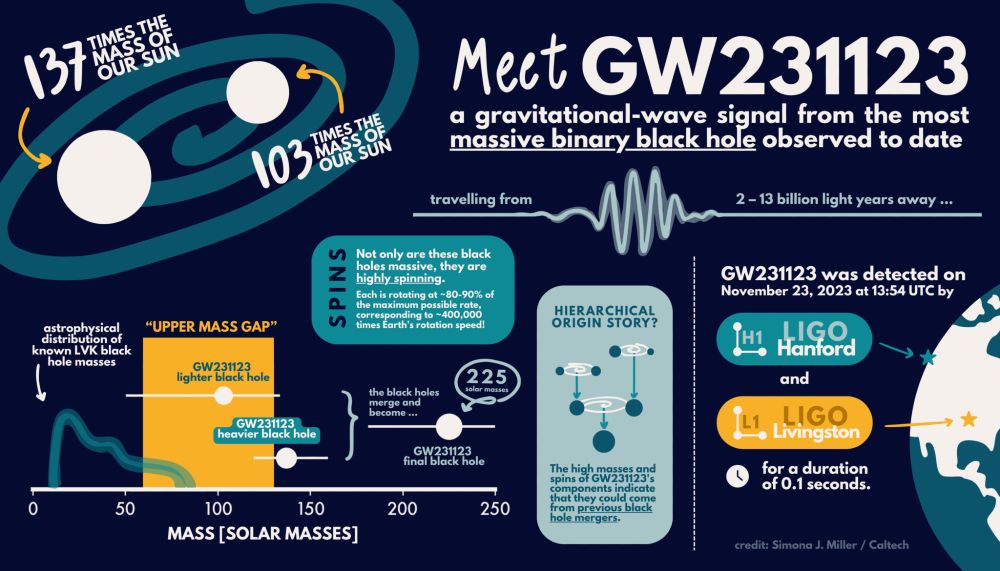
We are excited to announce the discovery of #GW231123, a gravitational-wave signal from the merger of two high-mass black holes to form one about 190–265 times the mass of our Sun
ligo.org/ligo-virgo-k...
#O4IsHere 🔭🧪☄️
14.07.2025 15:22 — 👍 109 🔁 38 💬 2 📌 16

Budget cuts to NSF projects
Trump has decided he wants to kill one of humanity's most sensitive instruments for understanding the universe for... about the cost of... half a fighter jet (or less). Source: www.nasa.gov/wp-content/u...
05.06.2025 09:41 — 👍 1 🔁 0 💬 0 📌 0

Figure 1 from our new catalog paper. We accurately capture precession, memory, eccentricity, and high mass ratio systems. For full details, see the paper.
We are excited to release a major update to our catalog of binary black hole simulations, available at arxiv.org/abs/2505.13378! Such simulations are key to LIGO/Virgo/KAGRA being able to extract science from their gravitational wave detections.
1/13
🧪⚛️🔭
20.05.2025 03:13 — 👍 49 🔁 10 💬 5 📌 4
Amaldi Art Show
For those with an artistic streak, #GR24Amaldi16 will be hosting an art science exhibition.
We welcome submissions inspired by the themes of the meeting (gravity, cosmology, black holes, gravitational waves, astrophysics). Anyone can submit!
uofgravity.github.io/amaldi-art/
🧪🔭🐚
01.05.2025 13:32 — 👍 10 🔁 5 💬 2 📌 0

Poster showing neutron stars and the remnant kilonova. It also shows the posterior distribution of the neutron star parameters.
Wanted to shout out this paper: by @maximiliandax.bsky.social and @stephenrgreen.bsky.social. It allows us to perform parameter inference of binary neutron stars in a second. These binary neutron stars are measured with gravitational waves! Here’s a poster I made for the LVK meeting in Barcelona!
22.03.2025 10:51 — 👍 7 🔁 1 💬 1 📌 1
...so is it time to throw a funeral for LCDM? That depends on who you ask 😂. It's certainly a sign that DESI's DR1 results were not a statistical fluke. Even if LCDM prevails, SOMETHING is weird and that's a great sign that we're learning something new.
20.03.2025 01:05 — 👍 44 🔁 4 💬 2 📌 0
GOAT meets GOAT to create the GOAT of Astro YouTube series
24.02.2025 17:50 — 👍 0 🔁 0 💬 0 📌 0
Wow!
04.02.2025 09:48 — 👍 2 🔁 0 💬 0 📌 0

Scientific poster with the title "Flow Matching for Atmospheric Retrieval of Exoplanets: Where Reliability meets adaptive noise levels". The background is dark with a blue exoplanet in the center and the surface of a yellow star at the bottom.
1/ 🌌 New Paper Alert: How can we decode the atmospheres of exoplanets efficiently and reliably?
The latest work by my amazing collaborator @timothygebhard.bsky.social introduces Flow Matching Posterior Estimation for atmospheric retrieval. 🚀🧵👇
#AI #MachineLearning #Physics #Astronomy #AcademicSky
14.01.2025 17:13 — 👍 40 🔁 8 💬 1 📌 0

A blue pen sketch of queen Victoria’s statue in front of Buckingham palace.
I had the opportunity to answer questions at the Royal Astronomical Society (@royalastrosoc.bsky.social) about GWs+ML. Thanks to all the organizers from Royal Holloway (esp. Ann and Mattia) for inviting me!
I was able to work on this fountain pen sketch of the Victoria statue before the workshop:
12.01.2025 15:53 — 👍 3 🔁 2 💬 0 📌 0
It's times like this when I sometimes regret working in GWs. I love the science we do, but as noted by 2019 Nobel Laureate Michel Mayor: "We can learn much from our discoveries of distant worlds, but, we cannot travel to them". Maybe there's a balance to be found.
11/11
08.01.2025 09:57 — 👍 1 🔁 0 💬 0 📌 0
The other issue you may notice based on the other triggers is that the FAR is quite high, which was addressed in some of the more recent project developments in which I was not so involved. It's a great group of people working there though.
10/11
08.01.2025 09:57 — 👍 1 🔁 0 💬 1 📌 0
We unfortunately caught this fire right around the time it started, ideally we would want to catch it hours or days earlier thereby preventing it. In some cases, this happens, but depending on the cause of the fire this isn't always possible.
9/11
08.01.2025 09:57 — 👍 2 🔁 0 💬 1 📌 0
However, if there is a fire, (true - expected) will be very different (almost like the fire is a hole in your continuous temperature/infrared field which is OOD for the NN).
8/11
08.01.2025 09:57 — 👍 1 🔁 0 💬 1 📌 0
If there are no fires, the (true - expected) infrared value of the central pixel should be ~0. This is because temperature is a continuous field. I.e. the central pixel should come from a predictable way based on the surrounding pixels. The NN is learning the method to predict the field.
7/11
08.01.2025 09:57 — 👍 1 🔁 0 💬 1 📌 0
The way the code works at inference is by taking infrared images every 5 minutes of California using the NOAA GOES-16 satellite. It then feeds a temporal and spatial cube of pixels into a neural net whose goal is to predict the infrared reading of the central pixel.
6/11
08.01.2025 09:57 — 👍 1 🔁 0 💬 1 📌 0
High Energy Physics/Machine Learning/Data Science Prof @tum.de www.lukasheinrich.com
A Ph.D. student at AEI Hannover; PyCBC developer; LISA member
https://inspirehep.net/authors/1831981
PhD at the University of Glasgow, illustrator, astrobiter
they/them 🏳️⚧️
one time i dressed up as a higgs boson to a party and really thats all you need to know
scolloms.github.io
Waitress turned Congresswoman for the Bronx and Queens. Grassroots elected, small-dollar supported. A better world is possible.
ocasiocortez.com
Official account of the LIGO Scientific Collaboration. We detect gravitational waves!
Email: questions@ligo.org
Get ready for a new era in astronomy and astrophysics with Rubin Observatory!
Para español siga a Instagram: http://instagram.com/rubin_observatory
PhD student at the University of Rhode Island studying ML applications for gravitational wave parameter estimation
Astronomer here! I’m a Hungarian-American radio astronomer, alias /r/Andromeda321 on Reddit. Assistant professor at the University of Oregon
Ph.D. atmospheric scientist🌎, nuclear engineer☢, 📰 #antarctica
South Pole Station 🐧 http://amzn.to/2klpv3b 🐧
🎨 merging art + astrophysics
✨ space-inspired paintings
🔭 planetary science PhD
🪶 bird nerd, gamer, cloud watcher
⬇️ email list, shop, & contact
https://stellerarts.com
Astrophysicist. Currently working on my second PhD on gravitational waves from black holes, at the Gravity Exploration Institute, Cardiff University.
They/any 🏳️🌈
Gravitational-wave astronomer. Author, physicist, philosopher. Revealer of truths, exposer of lies. Exemplar of humanity. Also rather modest. https://fictionalaether.substack.com/
A research institute in the School of Physics and Astronomy at Cardiff University, focused on detecting gravitational waves and understanding their sources.
Astrophysicist @monashastro.bsky.social | Previously @ Northwestern & UMN | తెలుగు | Gravitational waves | @LIGO | LISA
Decarbonization now ✊🏽
All opinions my own and do not represent past or present employers.
orcid : https://orcid.org/0000-0001-7852-7484
ISFJ,Blackfoot,Scottish, Washington, PNW,
Backpacker,Salsa Dancer,Traveler,LIGO, Gravitational Waves
https://linktr.ee/corey_m_gray