's Avatar

@timsearchinger.bsky.social

132 Followers  |  5 Following  |  1 Posts  |  Joined: 19.11.2024  |  1.2928

Latest posts by timsearchinger.bsky.social on Bluesky


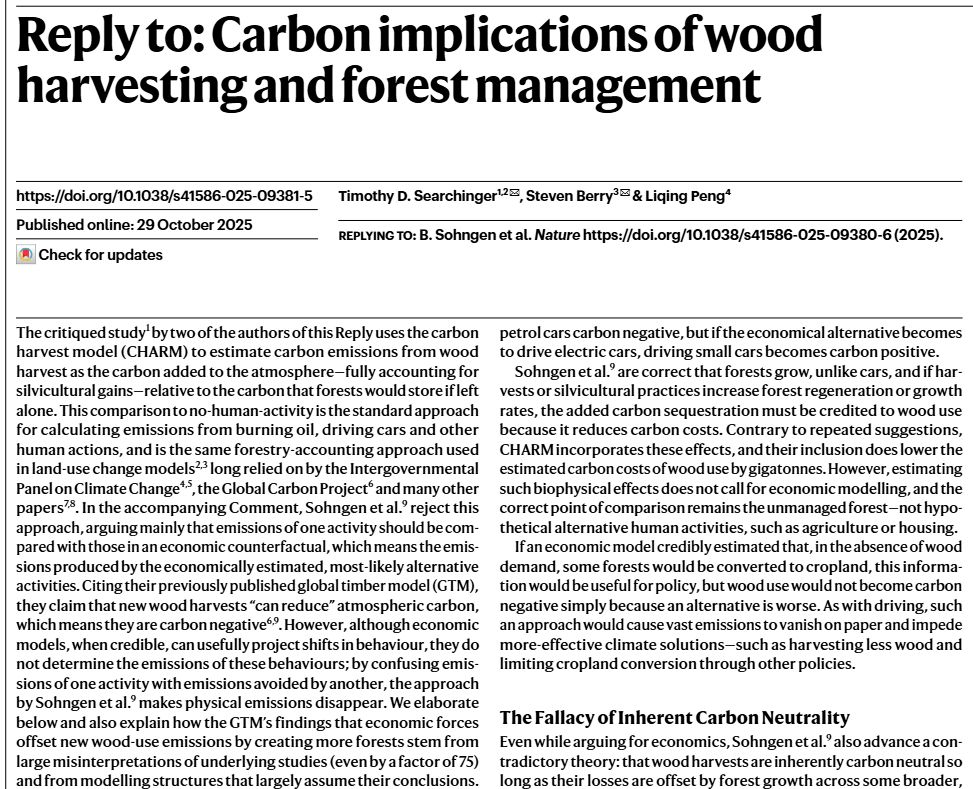
Reply to: Carbon implications of wood harvesting and forest management

Timothy D. Searchinger, Steven Berry, Liqing Peng

The critiqued study by two of the authors of this Reply uses the carbon harvest model (CHARM) to estimate carbon emissions from wood harvest as the carbon added to the atmosphere—fully accounting for silvicultural gains—relative to the carbon that forests would store if left alone. This comparison to no-human-activity is the standard approach for calculating emissions from burning oil, driving cars and other human actions, and is the same forestry-accounting approach used in land-use change models long relied on by the Intergovernmental Panel on Climate Change, the Global Carbon Project and many other papers. In the accompanying Comment, Sohngen et al. reject this approach, arguing mainly that emissions of one activity should be compared with those in an economic counterfactual, which means the emissions produced by the economically estimated, most-likely alternative activities. Citing their previously published global timber model (GTM), they claim that new wood harvests “can reduce” atmospheric carbon, which means they are carbon negative. However, although economic models, when credible, can usefully project shifts in behaviour, they do not determine the emissions of these behaviours; by confusing emissions of one activity with emissions avoided by another, the approach by Sohngen et al. makes physical emissions disappear. We elaborate below and also explain how the GTM’s findings that economic forces offset new wood-use emissions by creating more forests stem from large misinterpretations of underlying studies (even by a factor of 75) and from modelling structures that largely assume their conclusions.

Reply to: Carbon implications of wood harvesting and forest management Timothy D. Searchinger, Steven Berry, Liqing Peng The critiqued study by two of the authors of this Reply uses the carbon harvest model (CHARM) to estimate carbon emissions from wood harvest as the carbon added to the atmosphere—fully accounting for silvicultural gains—relative to the carbon that forests would store if left alone. This comparison to no-human-activity is the standard approach for calculating emissions from burning oil, driving cars and other human actions, and is the same forestry-accounting approach used in land-use change models long relied on by the Intergovernmental Panel on Climate Change, the Global Carbon Project and many other papers. In the accompanying Comment, Sohngen et al. reject this approach, arguing mainly that emissions of one activity should be compared with those in an economic counterfactual, which means the emissions produced by the economically estimated, most-likely alternative activities. Citing their previously published global timber model (GTM), they claim that new wood harvests “can reduce” atmospheric carbon, which means they are carbon negative. However, although economic models, when credible, can usefully project shifts in behaviour, they do not determine the emissions of these behaviours; by confusing emissions of one activity with emissions avoided by another, the approach by Sohngen et al. makes physical emissions disappear. We elaborate below and also explain how the GTM’s findings that economic forces offset new wood-use emissions by creating more forests stem from large misinterpretations of underlying studies (even by a factor of 75) and from modelling structures that largely assume their conclusions.

Does burning more wood lead to more forests & help the climate? In a new Nature paper, WRI & Yale researchers show such claims rely on flawed accounting and models, and misinterpret underlying studies.

Read the papers: rdcu.be/eNkXX

RSVP to a webinar 10/31, 9:30 ET: hub.wri.org/events/2025/...
30.10.2025 20:48 — 👍 32    🔁 12    💬 2    📌 4
Post image

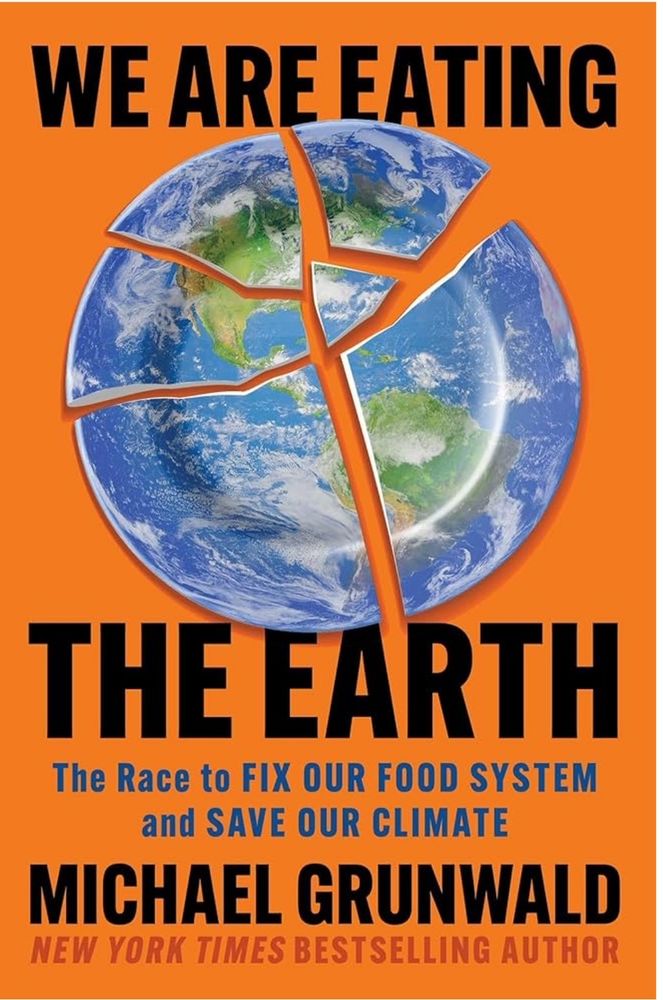
Join WRI for a webinar with best-selling author Michael Grunwald on July 1st, the day Simon & Shuster is releasing his new book - We Are Eating the Earth. Register here: www.wri.org/events/2025/...

12.06.2025 23:01 — 👍 17    🔁 5    💬 1    📌 0
Major New Book - "We Are Eating the Earth" - A Conversation with Author Michael Grunwald Humanity has cleared a land mass the size of Asia plus Europe to grow food, and our food system generates a third of our carbon emissions. By 2050, we’re going to need a lot more calories to fill near...

Hey I’m doing a webinar about food, ag, and the future of the planet with @worldresources.bsky.social on July 1, publication day for WE ARE EATING THE EARTH. We’ll talk beef, biofuels, cool technologies and depressing politics. You can register here: www.wri.org/events/2025/...

12.06.2025 13:07 — 👍 35    🔁 11    💬 1    📌 1
Preview
Opinion | The Climate Solution That’s Horrible for the Climate (Published 2023) Corn ethanol and soy biodiesel accelerate food inflation and global hunger, but they’re also a disaster for the climate and the environment.

Oh, and here's another essay I once wrote in the NYT about how we could save forests by ditching ethanol. So on Sunday, if you find yourself wondering why I didn't write about how we need to stop using valuable land to grow grain for our fuel tanks, well, I did.
www.nytimes.com/2023/06/06/o...

12.12.2024 14:27 — 👍 31    🔁 9    💬 1    📌 2
Preview
Opinion | No One Wants to Say ‘Put Down That Burger,’ but We Really Should (Published 2022) If current eating and farming trends continue, the world will clear at least one and a quarter Indias’ worth of land by 2050.

Hey, I just wanted to post this essay I once wrote in the NYT about how we need to eat less beef to save forests. No reason. Although this Sunday, if you read something else by me and wonder why this idiot didn't write about how we need to eat less beef, well, I did.

www.nytimes.com/2022/12/15/o...

12.12.2024 14:18 — 👍 58    🔁 14    💬 4    📌 2
Preview
Opinion | We’re Going to Have to Learn to Love Factory Farms (Gift Article) Every farm, even the scenic ones with red barns and rolling hills, is a kind of environmental crime scene, an echo of whatever wilderness it once replaced.

Some jerk wrote an essay in the NYT claiming industrial agriculture is actually good for forests and the climate. That jerk is me! Here’s a free link: www.nytimes.com/2024/12/13/o...

13.12.2024 13:51 — 👍 126    🔁 50    💬 43    📌 25

@timsearchinger is following 5 prominent accounts