Find out more:
Preprint: www.biorxiv.org/content/10.1...
Code: github.com/davidfischerlab/kai
Blog: ai4biomedicine.org/agenticai

@davidsebfischer.bsky.social
I develop mechanistic machine learning tools for single-cell and spatial omics data to understand the regulatory patterns underlying human disease dynamics. ai4biomedicine.org
Find out more:
Preprint: www.biorxiv.org/content/10.1...
Code: github.com/davidfischerlab/kai
Blog: ai4biomedicine.org/agenticai
kai is an assistant for single-cell biology optimized for human-agent collaboration. Like AI assistants in other domains, kai enhances human efficiency while maintaining accountability – a key advantage over fully autonomous systems in science.
26.11.2025 12:55 — 👍 4 🔁 0 💬 1 📌 0
kai benchmarking heatmap
We compared kai with one-shot analysis generation by LLMs by scoring the generated Jupyter notebooks based on various criteria. kai consistently outperforms one-shot analysis generation.
26.11.2025 12:55 — 👍 0 🔁 0 💬 1 📌 0We tested kai on complex scenarios in single-cell biology. kai consistently completed analyses and reasoned (LLM reasoning + analysis execution) for longer than 20 minutes.
26.11.2025 12:55 — 👍 1 🔁 0 💬 1 📌 0The output of kai’s reasoning process is this Jupyter notebook: a transparent documentation of all analyses performed and decisions made. Human scientists can inspect, modify, and give feedback on each step of the analysis.
26.11.2025 12:55 — 👍 0 🔁 0 💬 1 📌 0
A an example chat interaction between kai and the user.
kai interacts with human scientists through a chat interface in VS Code and directly edits and executes Jupyter notebooks. This design enables kai to autonomously perform analyses while maintaining full accountability.
26.11.2025 12:55 — 👍 0 🔁 0 💬 1 📌 0
kai architecture
This motivated us to build kai: an agentic AI that uses Jupyter notebooks – the same interface that humans use to collaborate.
26.11.2025 12:55 — 👍 0 🔁 0 💬 1 📌 0We started by asking: how do humans build trust with each other? In collaborations, they document their reasoning in computational notebooks, e.g. Jupyter notebooks.
26.11.2025 12:55 — 👍 0 🔁 0 💬 1 📌 0For example, how can I verify the product of 20 minutes of autonomous work by an agent without blindly hoping that it didn’t hallucinate at a key decision point at minute 5?
26.11.2025 12:55 — 👍 0 🔁 0 💬 1 📌 0In cell biology, agentic AI systems need to reason over text, code, and analysis results. How do we ensure accountability in this complex multimodal setting to inspire trust in the predictions made by agents?
26.11.2025 12:55 — 👍 0 🔁 0 💬 1 📌 0Agentic AI systems are becoming available for use in science – but can we trust them?
26.11.2025 12:55 — 👍 2 🔁 1 💬 1 📌 0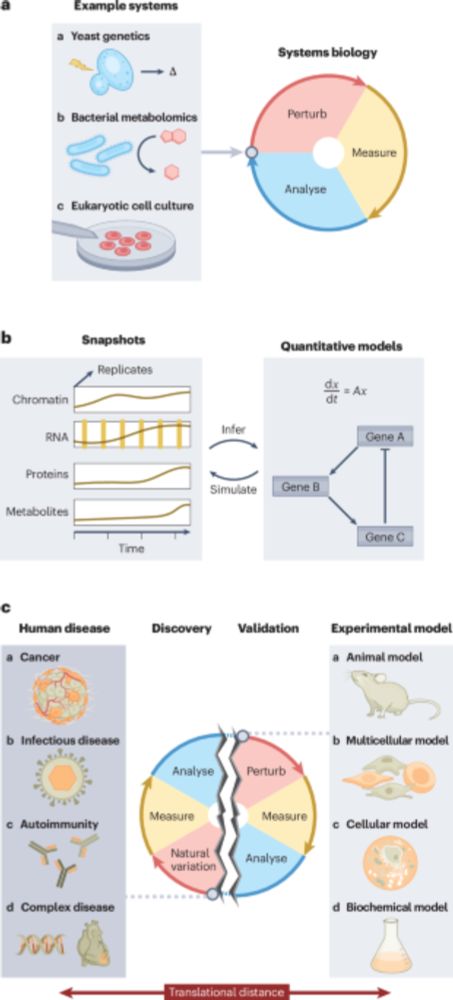
Our featured article: Adapting systems biology to address the complexity of human disease in the single-cell era go.nature.com/3XBo6Vh #Review by @davidsebfischer.bsky.social, Martin A. Villanueva, Peter S. Winter & @shaleklab.bsky.social @broadinstitute.org @mit.edu @ragoninstitute.bsky.social
18.07.2025 08:03 — 👍 2 🔁 1 💬 0 📌 0A major KI initiative to recruit new assistant professors with outstanding proposals in all areas of medicine, biomedicine and public health. We offer an amazing research environment, great colleagues and generous startup packages. Check it out and get working on your applications! (repost please!)
25.06.2025 10:08 — 👍 115 🔁 109 💬 2 📌 3Check out this drone footage of our institute!
06.05.2025 12:25 — 👍 1 🔁 0 💬 0 📌 0Cool positions for AI x biology in Belgium!
02.05.2025 19:18 — 👍 4 🔁 2 💬 0 📌 0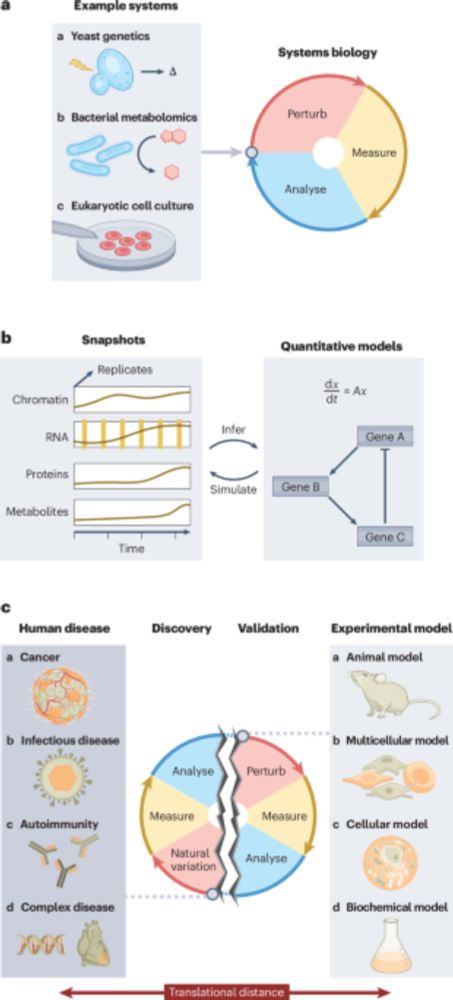
This review is a product of a great team effort together with Martin Villanueva, Peter Winter and Alex Shalek! www.nature.com/articles/s41... & rdcu.be/ecTna
13.03.2025 04:07 — 👍 1 🔁 0 💬 0 📌 0In summary, we outline how systems biology is being adapted to the multiscale dynamics of human health and disease in omics-driven as what is effectively a two-loop cycle over discovery and validation.
13.03.2025 04:07 — 👍 0 🔁 0 💬 1 📌 0We review strategies that can manage this distance and dissect how it relates to understanding cellular systems at specific spatiotemporal scales - be it the cellular scale often considered in the context of single-cell-resolved experiments, or the tissue niche scale captured with spatial omics.
13.03.2025 04:07 — 👍 0 🔁 0 💬 1 📌 0Both are needed to build quantitative models are faithful to human biology and validated through perturbation experiments. However, the usage of two distinct systems incurs a "translational distance" that complicates systems biology approaches that utilize information from the two.
13.03.2025 03:57 — 👍 0 🔁 0 💬 1 📌 0In this review, we discuss how one can rationalize what information about a multiscale cellular system is actually captured by on omics study. We leverage that insight to describe how one can translate between discovery efforts in human tissues and validation efforts in experimental model systems.
13.03.2025 03:56 — 👍 0 🔁 0 💬 1 📌 0However, the dynamics of human tissues in disease settings is multiscale - not only does that impact quantitative models, it also reflects in experimental design and the resources of publicly available data that we have access to. This obstructs attempts at building such quantitative models.
13.03.2025 03:55 — 👍 0 🔁 0 💬 1 📌 0Currently, there's a lot of interest in quantitative models that would help us understand and predict features of the complex cellular systems that underlie human health and disease - think about virtual cells, for example. On can trace some of these ideas back to the early days of systems biology.
13.03.2025 03:53 — 👍 14 🔁 6 💬 1 📌 0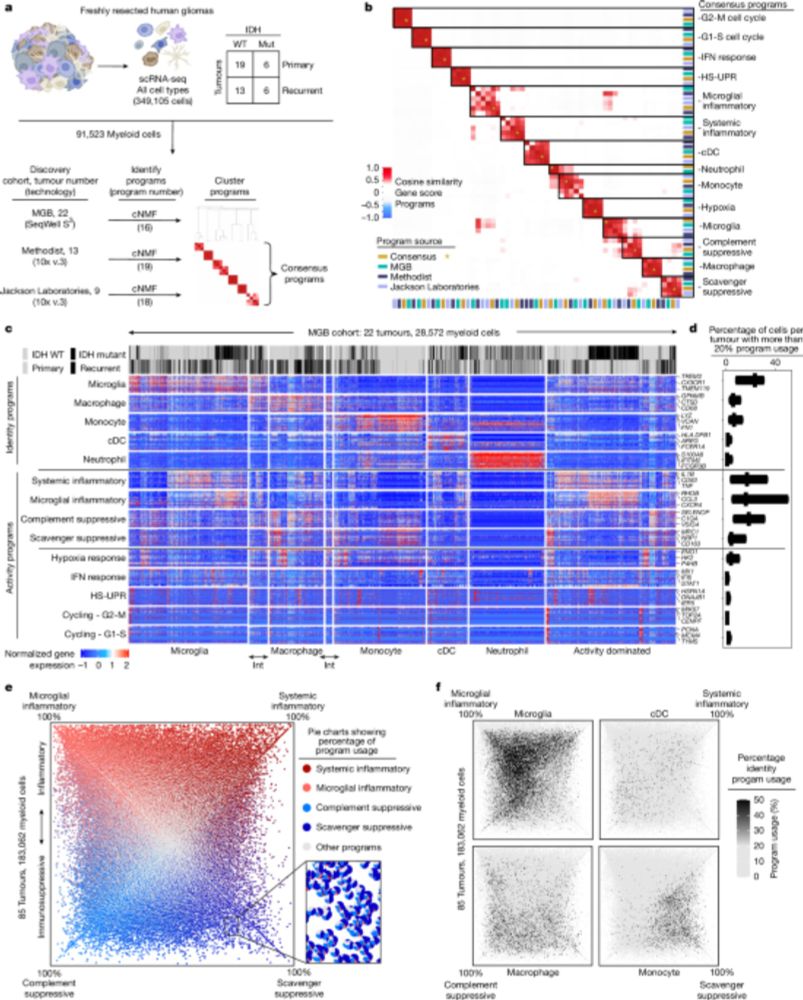
Proud to share our @nature.com paper, co-led by Chadi El Farran & Charles Couturier under mentorship of Brad Bernstein where we develop a new framework to understand immunomodulatory myeloid cells in #glioma & lay a foundation to develop more effective immunotherapies. www.nature.com/articles/s41...
27.02.2025 04:04 — 👍 29 🔁 9 💬 4 📌 2Read about self-supervision in models of scRNA-seq data in this deep dive!
07.01.2025 10:28 — 👍 6 🔁 0 💬 0 📌 0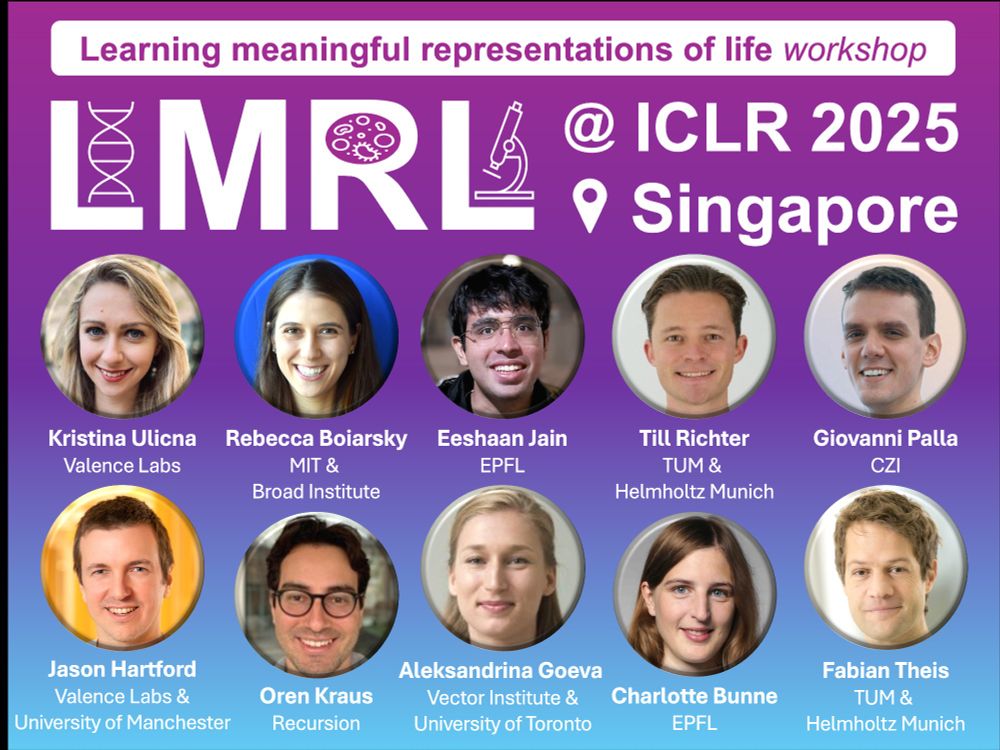
Exciting news! 🚀 The Learning Meaningful Representations of Life ( #LMRL 🌟) workshop is returning at #ICLR2025! 🎉
On 27th / 28th April 2025 in Singapore 🇸🇬, this popular event returns with a fresh organizing team 👇 & bold new ideas 🧠 to explore bridging AI & life sciences 🧬
Our ChromBPNet preprint out!
www.biorxiv.org/content/10.1...
Huge congrats to Anusri! This was quite a slog (for both of us) but we r very proud of this one! It is a long read but worth it IMHO. Methods r in the supp. materials. Bluetorial coming soon below 1/
What cellular & multicellular changes underpin aging of ovaries? We used spatial transcriptomics to study this process in mice, capturing dynamic changes in cells, follicles, and tissue across the estrous cycle. Read about the age-related changes in these dynamics we discovered!
19.12.2024 09:04 — 👍 9 🔁 1 💬 0 📌 0
I could not be more thrilled to announce the Nature Methods @naturemethods.bsky.social Method of the Year is Spatial Proteomics! Please see our editorial as a roadmap to the fantastic content in this special issue! www.nature.com/articles/s41...
06.12.2024 20:52 — 👍 613 🔁 170 💬 3 📌 18You are already in this one @jasmineplummer.bsky.social!
27.11.2024 04:09 — 👍 0 🔁 0 💬 0 📌 0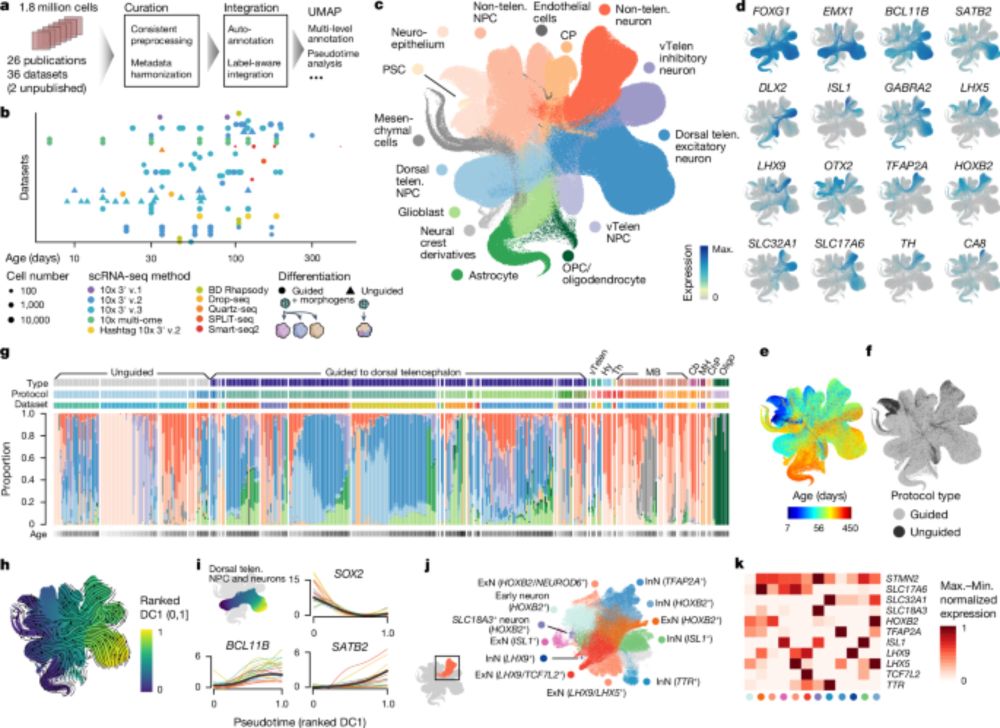
Super excited to share our Human Neural Organoid Atlas, now out in Nature! Led by @zhisonghe.bsky.social @josch1.bsky.social, and myself, this resource was created from 36 scRNA-seq datasets—totalling over 1.7 million cells! 🔬✨
www.nature.com/articles/s41...
Find out how it can serve you ⏬
🧵1/8