The front cover of the textbook "Optics f2f: from Fourier to Fresnel". Authors C. S. Adams, and Ifan G. Hughes. Published by Oxford University Press.
All the material for the Fourier Optics course this term is from set text #opticsf2f co-authored with
@durhamqlm.bsky.social colleague @etotheipiequals.bsky.social
global.oup.com/academic/pro...
Part of the PHYS3721 Modern Atomic and Optical Physics 3 module taught at Durham Physics.
07.02.2026 19:24 —
👍 1
🔁 0
💬 0
📌 0

A 4f Fourier transform setup. In the plane z=-2f we see the letter K; in the plane z=-f there is a lens; in the plane z=0 we see the Fourier transform of the letter, and a diffraction grating has been added; in the plane z=f there is a lens; in the plane z=2f we see periodic copies of the letter K inverted.
If we use a diffraction grating as a filter in the Fourier plane, we realise a replicator! A periodic array of copies of the object is seen in the image.
07.02.2026 19:24 —
👍 2
🔁 0
💬 1
📌 0

An image with an aperture in the form of the letter K in the plane z=-2f. There is a lens in the plane z=-f. We see the Fourier transform in the plane z=0. (Fourier analysis). There is a lens in the plane z=f. An inverted image of K is seen in the plane z =2f (Fourier synthesis).
In this week’s Fourier Optics course we shall be looking at spatial filtering – how a pair of lenses performs a Fourier analysis and subsequently Fourier synthesis in the 4f set up. The importance of the f to f set up with a single lens is emphasised.
🧪 #physics ⚛️ #optics 💡 #iTeachPhysics 🎢
07.02.2026 19:24 —
👍 17
🔁 4
💬 2
📌 1

Opening slide of my presentation on Quantum Error Correction at Durham Uninversity. Slide features a picture of the Durham student union and Kingsgate bridge, famously designed by legendary North Eastern arcitect Ove Arup and considered to be one of the world's finest examples of brutalist architecture.

A slide from my presentation comparing surface codes to QLDPC codes. Background: surface codes are a leading approach to QEC, favoured for their local connectivity and straightforward ability to scale to arbitrary distance. However, from a coding theory perspective, they are far from optimal codes, owing to the fact that only a single logical qubit is encoded per patch. In practice, it is estimated that ~1000 qubits will be required per logical qubit in a surface code architecture, making them much less efficient than classical LDPC codes (of the type used in 5G and WiFi) where encoding ratios can be as low as 2-to-1. Quantum LDPC are modelled on classical codes, and it is has been shown (through simulation) that they code achieve encoding densities as low as 50-to-1 (some 20x improvement than surface codes). The tradeoff is that QLDPC codes are much less structured than surface codes, requiring long-range interactions between qubits. The QLDPC Tanner graph shown on the slide depicts a naive layout that I usefully refer to as the "spaghetti connectivity".

Language is redundant by design. The town of Llanfairpwllgwyngyllgogerychwyrndrobwllllantysiliogogogoch in Anglesey Wales is probably the best error corrected placename in the world!
Great day back in Durham visiting @durhamqlm.bsky.social to give a seminar on QEC and our recent work at Quantum Software Lab. Also fun to discuss the fault-tolerance of the Welsh towname Llanfairpwllgwyngyllgogerychwyrndrobwllllantysiliogogogoch w/ @ifanghughes.bsky.social @tobifranzen.bsky.social
04.02.2026 15:55 —
👍 15
🔁 4
💬 1
📌 0
Thanks for an excellent talk!
Crystal-clear explanations of difficult concepts;
fault-tolerance of Welsh place names;
cloned sheep.
What's not to like?
04.02.2026 16:37 —
👍 1
🔁 0
💬 0
📌 0
Yes. The others are slightly trickier.
02.02.2026 14:23 —
👍 0
🔁 0
💬 0
📌 0

Darlun o rhan o gyfrifiadur cwantwm. Yn gysylltiedig ag erthygl "Y 'pendraphendod' all newid ein byd", gan Ifan G. Hughes.
Am image of a part of a quantum computer. There is an accompanying article in Welsh by Ifan G. Hughes.
Oes gennych diddordeb i ddarllen am gyfrifiaduron cwantwm, a sut fydd eu heffaith ar eich bywyd bob dydd yn ddofn?
Mae gen i erthygl "Y ‘pendraphendod’ all newid ein byd" yn y rhifyn cyfredol o Barn.
barn.cymru/en_gb/y-pend...
01.02.2026 16:37 —
👍 1
🔁 0
💬 0
📌 0

The front cover of the textbook "Optics f2f: from Fourier to Fresnel". Authors C. S. Adams, and Ifan G. Hughes. Published by Oxford University Press.
All the material for the Fourier Optics course this term is from set text #opticsf2f co-authored with
@durhamqlm.bsky.social colleague @etotheipiequals.bsky.social
global.oup.com/academic/pro...
Part of the PHYS3721 Modern Atomic and Optical Physics 3 module taught at Durham Physics.
01.02.2026 12:14 —
👍 4
🔁 0
💬 0
📌 0
6.3. 2D FT of arrays: Exercise — Optics f2f Code Book
The code for generating the quiz (and many other images from the Fourier Optics course) were developed by @etotheipiequals.bsky.social and can be found here:
opticsf2f.github.io/Opticsf2f_Co...
01.02.2026 12:14 —
👍 6
🔁 1
💬 1
📌 0

A four by six array of images. Images in the top row are labelled A, B, ... F. Images in the second row are labelled G, H, ... L. In the top two rows each image is of a collection of simple shapes, such as three identical circles displaced uniformly horizontally. The lower two rows are Fourier intensity diffraction patterns. The images in row three are labelled 1, 2, ... 6, and in row four 7, 8, ...12.
In this week’s Fourier Optics course we shall be looking at diffraction from 2D apertures, with arrays of identical structures.
A quiz to test your understanding of the array theorem. Can you match the apertures to their Fraunhofer diffraction patterns?
🧪 #physics ⚛️ #optics 💡 #iTeachPhysics 🎢
01.02.2026 12:14 —
👍 26
🔁 5
💬 4
📌 2

The front cover of the textbook "Optics f2f: from Fourier to Fresnel". Authors C. S. Adams, and Ifan G. Hughes. Published by Oxford University Press.
All the material for the Fourier Optics course this term is from set text #opticsf2f co-authored with @durhamqlm.bsky.social colleague
@etotheipiequals.bsky.social
global.oup.com/academic/pro...
Part of the PHYS3721 Modern Atomic and Optical Physics 3 module taught at Durham Physics.
25.01.2026 12:10 —
👍 2
🔁 0
💬 0
📌 0
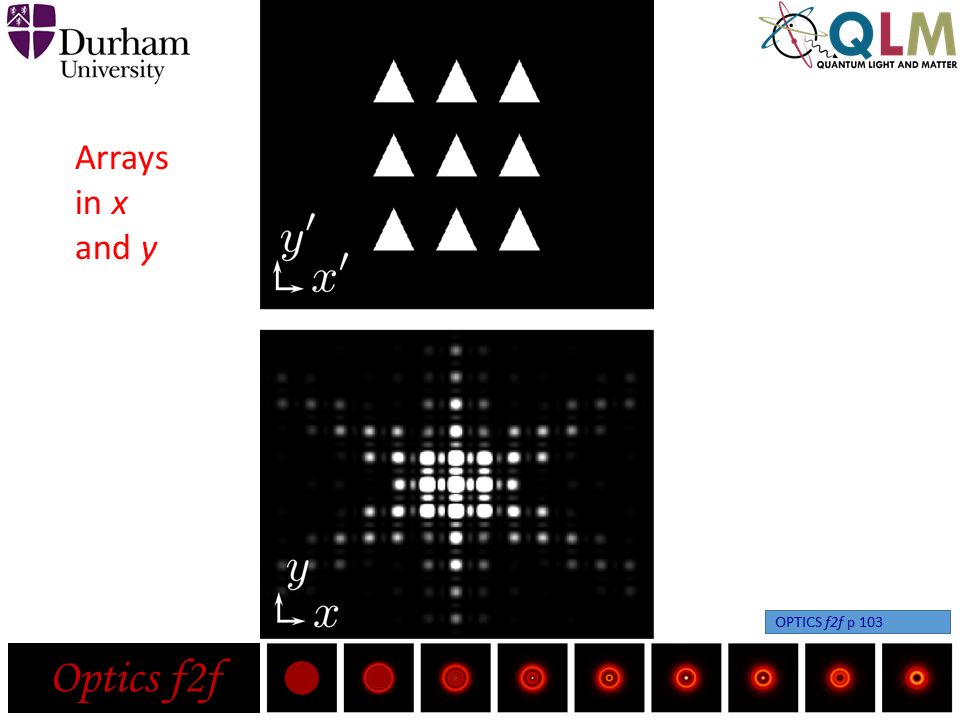
A three by three regular array of triangles is seen in the upper image. In the lower image the corresponding intensity diffraction pattern is seen. There is an envelope from the triangular shape, and the characteristic fringe pattern associated with three copies ("big-little-big-little) is seen along both axes.
For regular arrays the Fourier technique allows the diffraction pattern to be sketched easily.
25.01.2026 12:10 —
👍 1
🔁 0
💬 1
📌 0
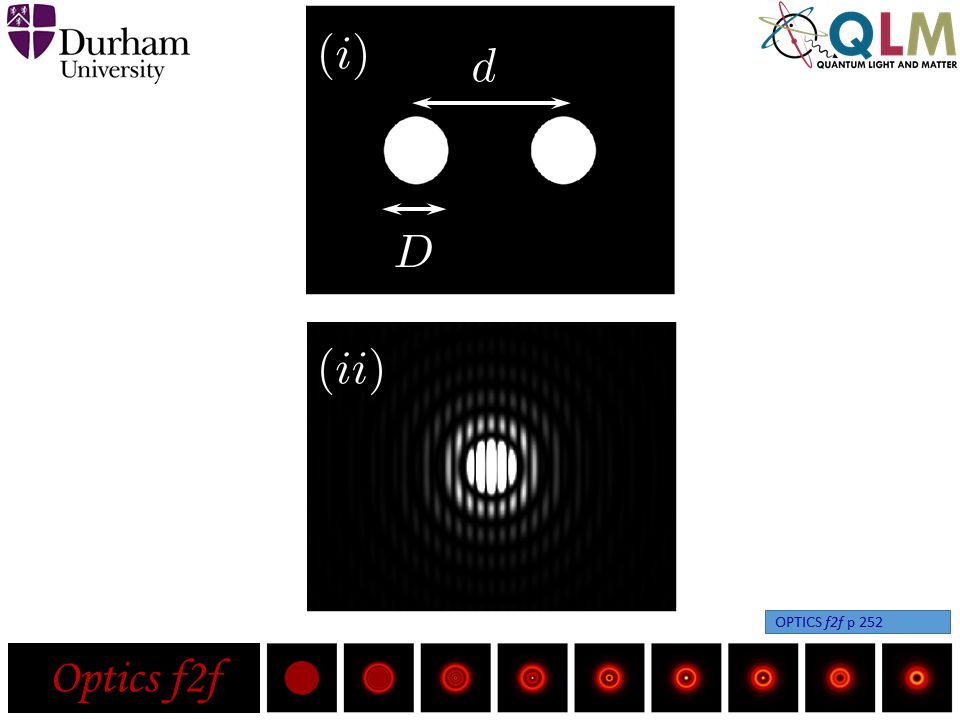
Two images. The upper shoes to identical circles of diameter D separated horizontally by d. The lower shows the corresponding intensity diffraction pattern; an Airy disk modulated with cosine-squared fringes.
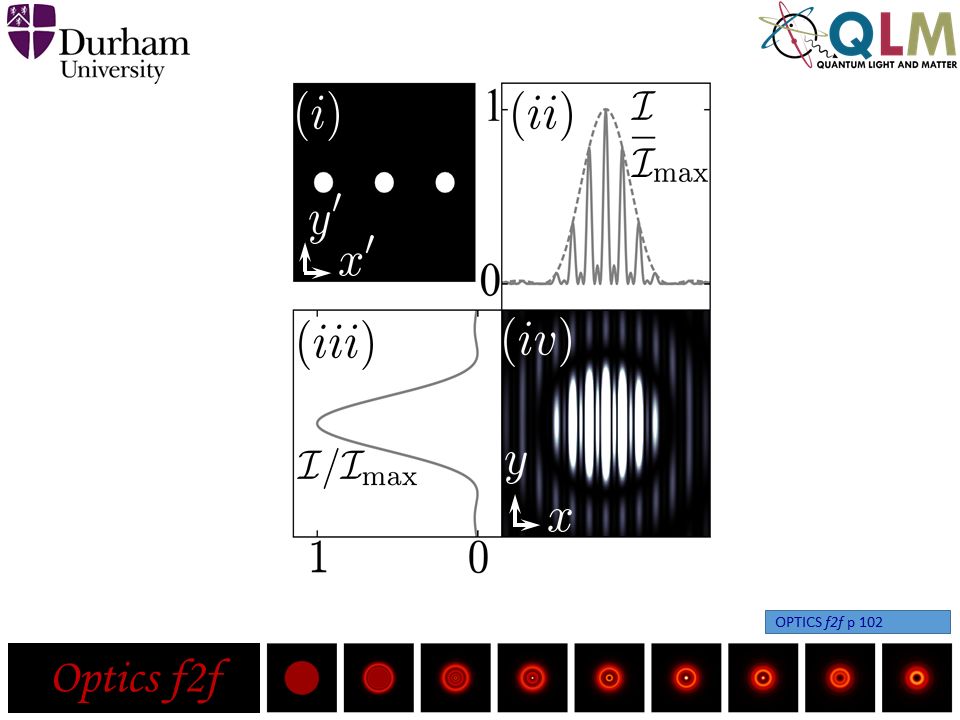
A two by two array of images. The top left shows three identical circles separated equally along the horizontal axis. The bottom right panel shows the corresponding intensity diffraction pattern: an Airy patter modulated with the characteristic pattern for three identical objects, "big-little-big-little" fringes. The other two panels show slices of the diffraction pattern along the horizontal and vertical (no fringes) axes.
In this week’s Fourier Optics course we shall be looking at diffraction from 2D apertures.
Fourier techniques provide an elegant way of calculating the patters for regular arrays
🧪 #physics ⚛️ #optics 💡 #iTeachPhysics 🎢
25.01.2026 12:10 —
👍 13
🔁 2
💬 1
📌 0

The @durhamphysics.bsky.social now has an account here to tell you about the latest Physics research news @durham.ac.uk
19.01.2026 16:02 —
👍 5
🔁 3
💬 0
📌 0

5 graduates in red robes and black flat hats stand in front of Durham cathedral during evening time, with colleagues from QLM Durham.
Heartfelt congratulations to our newest Drs from the Quantum Light and Matter section at Durham, pictured here in front of the cathedral. We wish you all the best with your next steps, and we'll be seeing some of you around the department as new PDRAs!
21.01.2026 11:14 —
👍 8
🔁 3
💬 0
📌 0
Good to hear that!
The codes are in a new location, I'll dig out the link.
19.01.2026 09:12 —
👍 1
🔁 0
💬 0
📌 0

The front cover of the textbook "Optics f2f: from Fourier to Fresnel". Authors Charles S. Adams, and Ifan G. Hughes. Published by Oxford University Press.
All the material for the Fourier Optics course this term is from set text #opticsf2f co-authored with colleague @etotheipiequals.bsky.social
global.oup.com/academic/pro...
Part of the PHYS3721 Modern Atomic and Optical Physics 3 module taught at Durham Physics.
18.01.2026 12:34 —
👍 4
🔁 0
💬 1
📌 0
You can make movies showing the evolution of the diffracted field as done by @jacopobertolotti.com in this #PhysicsFactlet
bsky.app/profile/jaco...
18.01.2026 12:34 —
👍 6
🔁 0
💬 1
📌 0

A slide with mathematical formulae. Starting with the hedgehog equation, and performing a binomial expansion of the components of the wave vector, the Fresnel diffraction integral is derived.
As a further bonus, we can also obtain familiar analytic results in certain approximations. In the paraxial regime the hedgehog equation can be re-written with a different propagator, yielding the Fresnel diffraction integral.
18.01.2026 12:34 —
👍 2
🔁 0
💬 1
📌 0

Am image of a diffracted light field. The initial distribution on the left is narrow; as the field propagates to the right the diffracted field spreads out and exhibits a fringe pattern.
This allows us to calculate the field at any plane downstream for an arbitrary initial distribution. And as there are very efficient algorithms for efficient evaluation of the Fourier transform, this technique is highly compatible with modern computers.
18.01.2026 12:34 —
👍 1
🔁 0
💬 1
📌 0

An image depicting a mathematical transformation. The initial field is Fourier transformed; then a propagation phase is added; the resulting angular spectrum is inverse Fourier transformed to yield the diffracted field. An equation known as the hedgehog equation is depicted.
Now the really clever part. What is the field downstream? “All” we have to do is sum the plane waves in our decomposition, encapsulated in the hedgehog equation:
(i) Take Fourier transform
(ii) Multiply by propagation phase
(iii) Diffracted field is inverse Fourier transform.
So elegant!
18.01.2026 12:34 —
👍 2
🔁 0
💬 1
📌 0

Two mathematical definitions: those of the Fourier transform of a two dimensional function; and that of the inverse Fourier transform.
In this week’s Fourier Optics course we shall be looking at diffraction.
The central idea is:
decompose an arbitrary light distribution in one plane into a sum of plane waves with Fourier transform to solve the Helmholtz equation for light propagation.
🧪 #physics ⚛️ #optics 💡 #iTeachPhysics 🎢
18.01.2026 12:34 —
👍 20
🔁 3
💬 2
📌 1
The front cover of the textbook "Optics f2f: from Fourier to Fresnel". Authors Charles S. Adams, and Ifan G. Hughes. Published by Oxford University Press.
All the material for the Fourier Optics course this term is from set text #opticsf2f co-authored with colleague @etotheipiequals.bsky.social
global.oup.com/academic/pro... Part of the PHYS3721 Modern Atomic and Optical Physics 3 module taught at Durham Physics.
11.01.2026 12:38 —
👍 4
🔁 1
💬 0
📌 0

A high-pass filtered image of Fourier. On a presentation slide labelled Fourier Optics. There is a banner of Fresnel circular diffraction images from the book Optics f2f.

A collection of slides highlighting the Nobel prize in physics in 2018 and 2023.

A photo entitled The Rochester Lecture 2025. With Dr R M Potvliege, Prof. Anne L'Huillier, Prof. Paula Chadwick and Prof. Ifan Hughes.
Looking forward to teach the Fourier Optics course this term.
We shall apply Fourier techniques to optical phenomena including recent physics Nobel Prizes.
We had the honour of hosting 2023 Nobel Laureate Prof. Anne L'Huillier in Durham last year.
🧪
#physics ⚛️
#optics 💡
#iTeachPhysics 🎢
11.01.2026 12:38 —
👍 14
🔁 0
💬 1
📌 0

ifanghughes.bsky.social's Bluesky Wrapped 2025
Check out ifanghughes.bsky.social's year on Bluesky!
This year on Bluesky I wrote 53 posts and 64 replies. I received 669 likes, whereas 49 was from my most popular post, and apparently I love saying "optics" and 💡!
www.madebyolof.com/bluesky-wrap...
31.12.2025 23:39 —
👍 8
🔁 0
💬 0
📌 0
An easier question to answer today.
12.12.2025 09:05 —
👍 6
🔁 0
💬 1
📌 0

A 2 by 2 array of images. They depict the four Stokes parameters for potassium vapour as a function of frequency in the vicinity of the D1 resonance. For a natural abundance potassium vapour cell of length 25 mm containing 60 Torr of neon buffer gas. The applied magnetic field is 1160 G, with the vapour cell stem temperature, increasing from 75∘C to 135∘C , in 15∘C increments.

Theoretical ElecSus calculations of the on-resonance (i.e.
= 0 GHz) normalised Stokes parameter magnitude for (a) S0, (b) S1, (c) S2 and (d) S3 for a vapour cell stem temperature range between 75–135∘C and magnetic fields, in Faraday geometry, of 750 G, 1000 G, and 1200 G for three neon buffer gas filling pressures of 0 Torr, 60 Torr, and 100 Torr .

Experimental and theoretical Stokes parameters of the potassium D1 line as a function of linear detuning
in a 25 mm natural abundance potassium vapour cell with 60 Torr of neon buffer gas, when filled at room temperature and atmospheric pressure, subject to a magnetic field of (1160 ± 4) G. The solid lines represent the experimental data, while the dashed lines represent the ElecSus theoretical fit to the data. The Stokes parameters shown are (a) S0, (b) S1, (c) S2 and (d) S3 for five vapour cell stem temperatures
of 93 ∘C, 103 ∘C, 110 ∘C, 118 ∘C, and 129 ∘C . The vapour cell body temperature was maintained at 20 ∘C above the stem temperature. The residuals, shown below each main subplot, for
= 93 ∘C are shown as a demonstration of excellent agreement between experimental data and the ElecSus model.
Hot off the press!
Experimental and theoretical characterisation of Stokes polarimetry of the K D1 line with neon buffer gas broadening
doi.org/10.1088/1361...
via @ioppublishing.bsky.social
Performed with colleagues at
@durhamqlm.bsky.social
Atoms, lasers, and magnets!
🧪 #physics ⚛️ #optics 💡
03.12.2025 15:46 —
👍 12
🔁 2
💬 0
📌 0

I hope someone draws this wonderful story about Tom Stoppard's Arcadia and the power of the arts to help us see things differently, to the attention of our Education Secretary. Do read it, it will lift your spirits.
02.12.2025 10:58 —
👍 10952
🔁 3211
💬 210
📌 256
RIP. Some of his science-inspired works were brilliant.
29.11.2025 18:43 —
👍 1
🔁 0
💬 0
📌 0