This is a showcase of Julia across several industry verticals from engineering, life sciences and beyond. Speakers will outline case studies at their respective organizations and comment on the advantages and disadvantages of using Julia in their roles, or across teams or business units.
The Julia community stands to benefit from increased adoption across the industry. This series of talks outline the strengths and weaknesses of Julia in the context of different industries, in addition to case studies and comments on using Julia in a production environment. Additionally, the group may touch upon using Julia in domains with regulatory constraints.
Ranjan Anantharaman and Avik Sengupta will host a minisymposium on "Julia in Industry" at JuliaCon 2026!
Find out more at pretalx.com/juliacon-202... and submit your talks until February 28th at juliacon.org/2026/cfp/
#julialang
11.02.2026 10:41 — 👍 4 🔁 4 💬 0 📌 0
This is a showcase of Julia across several industry verticals from engineering, life sciences and beyond. Speakers will outline case studies at their respective organizations and comment on the advantages and disadvantages of using Julia in their roles, or across teams or business units.
The Julia community stands to benefit from increased adoption across the industry. This series of talks outline the strengths and weaknesses of Julia in the context of different industries, in addition to case studies and comments on using Julia in a production environment. Additionally, the group may touch upon using Julia in domains with regulatory constraints.
Ranjan Anantharaman and Avik Sengupta will host a minisymposium on "Julia in Industry" at JuliaCon 2026!
Find out more at pretalx.com/juliacon-202... and submit your talks until February 28th at juliacon.org/2026/cfp/
#julialang
11.02.2026 10:41 — 👍 4 🔁 4 💬 0 📌 0

Julia is an increasingly established language for Earth and climate science due to interactivity, productivity, performance and a growing software stack for high-performance computing, big data analysis and visualisation. It empowers developers to build performant Earth-System model components in a composable way, thus allowing users to easily become developers themselves and fostering collaborative work. In this minisymposium speakers will present software projects used for and in Earth system science.
@milank.bsky.social, Brian Groenke, Lazaro Alonso, and Jan Swierczek-Jereczek are hosting a minisymposium on "Earth system science in Julia" at JuliaCon 2026! Learn more at pretalx.com/juliacon-202... and submit your proposal until February 28th at juliacon.org/2026/cfp
#julialang
09.02.2026 15:15 — 👍 6 🔁 2 💬 0 📌 1
Are you a life scientist? Do you use code in your work? Then this conference is for you! Come find out why julia should power your next project
And don't forget to check out the Health-sciences and Pharma-focused minisymposia too! 🧪
bsky.app/profile/thec...
06.02.2026 13:41 — 👍 6 🔁 2 💬 0 📌 0

Computing has a rich history in biological discovery, and the needs of biologists are continuing to drive algorithm development in multiple domains. Close alignment between developers and deep biological domain expertise is crucial in this field and a programming language such as Julia provides an ideal platform for such tight collaborations that require a range of access points to the software. Julia provides interactive and notebook-based interfaces commonly used by experimentalists whilst also giving algorithm developers the opportunity create more complex workflows and structures, and optimize performance as needed.
In this minisymposium, we aim to highlight ways in which computational biologists* are using Julia to advance our understanding of living systems, in academia and industry, while also contributing to the package ecosystem and core language on multiple fronts.
"Computational biology" is a broad tent. Topics presented include algorithms for text matching and search (bioinformatics), modeling and machine learning (systems biology and quantiative pharmacology),statistics and data science (experimental analysis, epidemiology), and imaging and geospatial statistics (microscopy), among others.
@kevinbonham.com, Rasmus Henningsson, Elisabeth Rösch, and Jakob Nybo Andersen are running a minisymposium on "Julia for Biology" at JuliaCon 2026!
Find out more at pretalx.com/juliacon-202... and submit your talk to juliacon.org/2026/cfp
#julialang #biology
06.02.2026 09:47 — 👍 10 🔁 6 💬 0 📌 1

In the last few years, the state of geospatial tooling in Julia has significantly improved. We now have first-in-class libraries with native algorithms that are the fastest that exist in the world. Today, Julia has capabilities to some degree or another over the full geospatial stack: file I/O, raster and vector data processing, visualization, and analytics.
This minisymposium is meant for discussion of software projects in earth observation, geostatistics, geometry, or anything else geospatial/GIS related - with emphasis on how they can empower users to do interesting things!
Anshul Singhvi, Maarten Pronk, and Felix Cremer will host a minisymposium on "Geospatial and GIS" at JuliaCon Global 2026!
Find out more at pretalx.com/juliacon-202... and submit your talks to juliacon.org/2026/cfp
#julialang #gis #geospatial
05.02.2026 12:15 — 👍 4 🔁 2 💬 0 📌 0

JuliaCon 2026
JuliaCon 2026, Mainz
Ah, darn! It's supposed to be juliacon.org/2026/cfp
05.02.2026 12:10 — 👍 1 🔁 0 💬 0 📌 0

Engineering is the cornerstone of our society, driving technological innovation and addressing complex engineering challenges across disciplines. The rapid advancement of computational tools has become essential for pushing the boundaries of engineering research and practice. Among them, Julia is emerging as a preferred solution, owing to its user-friendly syntax, high-performance capabilities, and ever-growing package ecosystem. Julia is transforming the way engineers approach modeling and analysis across diverse engineering disciplines.
The Engineering with Julia minisymposium aims to bring together researchers, industry professionals, and educators to showcase Julia's contributions to engineering. We will explore its transformative potential for enhancing infrastructure, advancing reliability, and promoting sustainability in the context of modern engineering solutions. Additionally, we also aim to provide a platform for open discussion on the computational tools that engineers rely on in today’s research, practice, and education.
JuliaCon 2026 will host a minisymposium on "Engineering with Julia" by Cris Moen, Damir Akchurin, and Cole Miller. Find out more at pretalx.com/juliacon-202... and submit your proposal at juliacon/2026/cfp
#julialang #engineering
04.02.2026 13:17 — 👍 10 🔁 4 💬 1 📌 0

Partial differential equations describe the evolution of physical systems in space and time. Realistic models involve the nonlinear coupling of different physical fields, and require their self-consistent solution. Numerical simulation methods involve various space and time discretization approaches which almost certainly lead to sparse nonlinear and linear systems to be solved.
Julia enables efficient composition of partial differential equations (PDEs) solvers through its multiple dispatch, while also offering access to parallel computing and hardware accelerators such as GPUs. The mini-symposium shall discuss various tools and approaches available in Julia which are relevant for PDEs like sparsity handling, automatic differentiation, mesh generation, linear and nonlinear system solvers, parallelization, pre- and post-processing, and visualization. It shall highlight applications from various fields of science and engineering. At the same time, issues like interoperability between different package ecosystems and missing functionality shall be discussed. An open panel will specifically discuss infrastructure needs, identify gaps, and coordinate development efforts to advance the ecosystem.
@juliacon.org will host a minisymposium on "Julia for Partial Differential Equations and its Applications" hosted by Marco Artiano, Arpit Babbar, Dennis Ogiermann and Jürgen Fuhrmann. Find out more at pretalx.com/juliacon-202... and submit your proposal through juliacon.org/2026/cfp
#julialang #pde
03.02.2026 09:21 — 👍 9 🔁 3 💬 0 📌 1
Partial differential equations describe the evolution of physical systems in space and time. Realistic models involve the nonlinear coupling of different physical fields, and require their self-consistent solution. Numerical simulation methods involve various space and time discretization approaches which almost certainly lead to sparse nonlinear and linear systems to be solved.
Julia enables efficient composition of partial differential equations (PDEs) solvers through its multiple dispatch, while also offering access to parallel computing and hardware accelerators such as GPUs. The mini-symposium shall discuss various tools and approaches available in Julia which are relevant for PDEs like sparsity handling, automatic differentiation, mesh generation, linear and nonlinear system solvers, parallelization, pre- and post-processing, and visualization. It shall highlight applications from various fields of science and engineering. At the same time, issues like interoperability between different package ecosystems and missing functionality shall be discussed. An open panel will specifically discuss infrastructure needs, identify gaps, and coordinate development efforts to advance the ecosystem.
@juliacon.org will host a minisymposium on "Julia for Partial Differential Equations and its Applications" hosted by Marco Artiano, Arpit Babbar, Dennis Ogiermann and Jürgen Fuhrmann. Find out more at pretalx.com/juliacon-202... and submit your proposal through juliacon.org/2026/cfp
#julialang #pde
03.02.2026 09:21 — 👍 9 🔁 3 💬 0 📌 1

The adoption of differentiable modeling and simulation has gained significant traction in computational science and engineering (CSE) workflows, driving advancements in optimization, sensitivity analysis, uncertainty quantification, model discovery, and more. This minisymposium brings together scientists, researchers, practitioners, students, and software developers who are either utilizing or developing differentiable computational models. We also welcome those seeking inspiration to integrate these methodologies into their own work. Our goal is to provide a platform for knowledge exchange and learning from each other's experiences—highlighting both success stories and challenges encountered along the way.
We invite contributions that share experiences in developing differentiable computational models—including specific challenges faced, innovative solutions found—and applications of these models across various domains. Attendees can look forward to learning from notable contributors within the Julia community who will present innovative use cases while fostering collaboration among participants. Through networking opportunities and shared insights, we aim to inspire both seasoned users and newcomers by demonstrating how differentiable modelling can enhance model-based CSE workflows!
Alan Correa and Sarah Williamsom will host a minisymposium on "Differentiable Computational Models and their Applications" at JuliaCon 2026. Find out more at pretalx.com/juliacon-202... and submit your talk at juliacon.org/2026/cfp
#julialang #automaticdifferentiation
02.02.2026 10:06 — 👍 7 🔁 2 💬 0 📌 1

Approximate computing techniques within numerical linear algebra algorithms are raising major interests in the context of exascale-era supercomputers and problems. By approximating all or certain strategic parts of the computation, approximate computing methods can substantially reduce the time, memory, and energy consumption of scientific computing algorithms. In this context, Julia has offered a fantastic playground for the development of approximate computing techniques, such as mixed precision algorithms, randomization and sketching, or low-rank approximations.
This minisymposium features talks from researchers and practitioners describing their use of Julia for studying the numerical behavior or leveraging the computational benefits of approximate computing techniques.
JuliaCon Global 2026 will host a minisymposium on "Approximate Computing in Numerical Linear Algebra" by Jonas Schulze, Nicolas Venkovic, Andreas Varga and Mantas Mikaitis find out more on pretalx.com/juliacon-202... and submit your talks at juliacon.org/2026/cfp
#julialang #numerics
30.01.2026 19:42 — 👍 6 🔁 2 💬 0 📌 0

We have a new round of project updates to kick off the new year! Check out the updates on the NumFOCUS blog at hubs.la/Q040Wf_l0. This month features updates from:
pandas
ITK
geopandas
@julialang.org
@cupy.bsky.social
@ropensci.org
@projectpythia.bsky.social
@optuna.bsky.social
Taskflow
29.01.2026 17:25 — 👍 3 🔁 1 💬 0 📌 0

The computational humanities and social sciences (CHSS) increasingly rely on large, text-rich datasets – from digital corpora and learner corpora to discourse-annotated datasets and historical archives – yet researchers often struggle with the limitations of existing tools for large-scale data processing, modeling, and reproducibility. This minisymposium introduces Julia as a powerful, expressive, and high-performance solution for CHSS research. We showcase how Julia’s strengths (speed, a solid type system, first-class multiple dispatch, and seamless interoperability with Python and R) enable both rapid experimentation and production-grade analysis. Through case studies ranging from corpus statistics and collocation networks to mixed-effects modeling of experimental data and large-scale language data pipelines, we highlight existing Julia packages and other emerging ones such as TextAssociations.jl and demonstrate how Julia can substantially expand what researchers in the humanities and social sciences can achieve. The minisymposium aims to build bridges between Julia developers and CHSS scholars while fostering a new community of users working with rich textual, linguistic, and sociocultural data.
@juliacon.org will host a minisymposia on "Bringing Julia to the Computational Humanities and Social Sciences" by @alextantos.bsky.social, Julia Müller and Axel Bohmann.
Find out more at pretalx.com/juliacon-202... and submit your proposal to juliacon.org/2026/cfp
#julialang #digitalhumanities
29.01.2026 14:51 — 👍 10 🔁 3 💬 0 📌 0

Scientific machine learning (SciML) methods are techniques which incorporate machine learning with mechanistic modeling. The purpose of this minisymposium is to share improved methods and applications of SciML to showcase the ever advancing ecosystem in Julia.
Examples of topics fit for this minisymposium include:
New algorithms and software for physics-informed neural networks
Tips, tricks, and techniques for improving convergence of universal differential equations
Applications of fitting universal differential equations on real data and verification
Methods which use neural networks with classical solvers in new ways
Advancements in automatic differentiation for SciML applications
Methods which use learning to accelerate numerical simulations (surrogates, metamodels, emulators, reduced order methods (ROMs))
Advancements in compiler and optimization techniques to improve learning in SciML scenarios.
@juliacon.org 2026 will have a minisymposium on "Methods and Applications of Scientific Machine Learning (SciML)" hosted by @chrisrackauckas.bsky.social find out more on pretalx.com/juliacon-202... and submit your proposal through juliacon.org/2026/cfp/
#julialang #sciml
28.01.2026 09:49 — 👍 8 🔁 4 💬 0 📌 0

JuliaCon 2026 Health Mini-Symposium
If you are using Julia for health, medicine, or biomedical research, consider submitting an abstract to the 🩺 Health Mini-Symposium at JuliaCon 2026 (10–15 August 2026, Mainz, Germany). Abstract J...
Join JuliaHealth @juliacon.bsky.social 2026 in Mainz, Germany this summer! 🌍
Submit your #julialang poster & talk proposals by Feb 28! We would love to see you there! 🤗
See @cncastillo.bsky.social announcement's for topics & details! 🤓
Post or DM if you have ❓'s!
#opensource #academicsky 🧪 🛟 📊🩺
22.01.2026 01:13 — 👍 8 🔁 4 💬 0 📌 0

The Computational Physics Minisymposium highlights numerical methods, algorithms, and software implementations—including testing and benchmarking—for modeling and simulation across a broad range of theoretical and computational physics subfields. It serves as a “trading port” for computational methods that connect diverse areas of physics.
This year’s minisymposium will feature a special session spotlighting the JuliaQCD and JuliaFewBody ecosystems.
@juliacon.org 2026 will have a minisymposium on "Computational Physics" hosted by Shuhei Ono, Martin Mikkelsen, Ray Yang, Yuki Nagai, and Akio Tomiya find out more on pretalx.com/juliacon-202... and submit your talks through the Call for Proposals juliacon.org/2026/cfp/ until Feb 28th!
27.01.2026 10:34 — 👍 8 🔁 4 💬 0 📌 0
The Computational Physics Minisymposium highlights numerical methods, algorithms, and software implementations—including testing and benchmarking—for modeling and simulation across a broad range of theoretical and computational physics subfields. It serves as a “trading port” for computational methods that connect diverse areas of physics.
This year’s minisymposium will feature a special session spotlighting the JuliaQCD and JuliaFewBody ecosystems.
@juliacon.org 2026 will have a minisymposium on "Computational Physics" hosted by Shuhei Ono, Martin Mikkelsen, Ray Yang, Yuki Nagai, and Akio Tomiya find out more on pretalx.com/juliacon-202... and submit your talks through the Call for Proposals juliacon.org/2026/cfp/ until Feb 28th!
27.01.2026 10:34 — 👍 8 🔁 4 💬 0 📌 0

If you are working with #JuliaLang in health, medicine, or biomedical research, consider submitting an abstract to the 🩺 Health Mini-Symposium at JuliaCon 2026 (10–15 August 2026, Mainz, Germany). @thecedarprince.bsky.social
16.01.2026 18:13 — 👍 8 🔁 6 💬 0 📌 0

The JuliaGPU community has been a strong presence at JuliaCon for many years, and continues to be a strong foundation of Julia's overall computing ecosystem. In 2026, we propose to organize a minisymposium specifically focused on the usage and programming of GPUs (and other accelerators) in Julia. There is some overlap with an HPC minisymposium, however we intend to focus our track on very GPU-specific content or low-level details that make JuliaGPU tick. Additionally, material relating to non-GPU devices (such as TPUs, APUs, IPUs, etc.) are very welcome!
#JuliaCon 2026 will have a minisymposium on "Julia, GPUs, and Accelerators" hosted by Julian Samaroo, Tim Besard, and @vchuravy.dev find out more on pretalx.com/juliacon-202... and submit your talks through the Call for Proposals juliacon.org/2026/cfp/ until Feb 28th!
#julia #gpu #cuda #opencl #rocm
25.01.2026 14:40 — 👍 10 🔁 4 💬 0 📌 0
The JuliaGPU community has been a strong presence at JuliaCon for many years, and continues to be a strong foundation of Julia's overall computing ecosystem. In 2026, we propose to organize a minisymposium specifically focused on the usage and programming of GPUs (and other accelerators) in Julia. There is some overlap with an HPC minisymposium, however we intend to focus our track on very GPU-specific content or low-level details that make JuliaGPU tick. Additionally, material relating to non-GPU devices (such as TPUs, APUs, IPUs, etc.) are very welcome!
#JuliaCon 2026 will have a minisymposium on "Julia, GPUs, and Accelerators" hosted by Julian Samaroo, Tim Besard, and @vchuravy.dev find out more on pretalx.com/juliacon-202... and submit your talks through the Call for Proposals juliacon.org/2026/cfp/ until Feb 28th!
#julia #gpu #cuda #opencl #rocm
25.01.2026 14:40 — 👍 10 🔁 4 💬 0 📌 0

JuliaCon Global 2026
Call for Proposals is Open!
Submission Deadline: February 28, 2026
Johannes Gutenberg University
Mainz, Germany
The #JuliaCon Global 2026 call for proposals is open! We have a host of exciting minisymposia and we look forward to your talks!
Find more information on juliacon.org/2026/cfp/ and submit your proposal until February 28th at pretalx.com/juliacon-202...
#julia @julialang.org
23.01.2026 21:37 — 👍 20 🔁 12 💬 0 📌 0
The European open-source community is growing, and it's only the beginning! See you all in Paris 🥐
01.10.2025 10:18 — 👍 12 🔁 2 💬 0 📌 0

An advertisement for PumasAI: "by scientists, for science"
Another day, another sponsor for JuliaCon Local in Paris! #PumasAI brings together technology and science to enable more efficient and seamless drug development workflows. Explore at pumas.ai, or come to their talk next Thursday and see where #JuliaLang comes into play!
26.09.2025 12:20 — 👍 4 🔁 1 💬 0 📌 0

An advertisement for the software company CodeGlass: "bringing clarity to Julia's runtime"
Meet our second Platinum sponsor for the Paris event!
CodeGlass helps software teams look inside their running #JuliaLang applications, with profiler and time-travel analysis tools. Wanna trace performance and memory back to the lines of code that really matter? Check them out 👀
24.09.2025 09:29 — 👍 6 🔁 1 💬 0 📌 0
YouTube video by The Julia Programming Language
JuliaHub Sponsor Talk | Viral B. Shah | JuliaCon Global 2025
JuliaHub has sponsored every single JuliaCon since 2014, and this year is no different! Check out their JuliaCon Global 2025 Pittsburgh Sponsor Talk, and look out for them at JuliaCon Local Paris in a few weeks!
youtu.be/zCUQfE-MGgM
23.09.2025 18:09 — 👍 2 🔁 1 💬 0 📌 0

A poster advertising cutting-edge satellite solutions by Eutelsat
#JuliaCon Local Paris is powered by sponsors across the world... and by some right next door! The French company Eutelsat is a global leader in satellite communications, delivering connectivity and broadcast services worldwide. Bet you didn't know they were using Julia!
18.09.2025 11:22 — 👍 3 🔁 0 💬 0 📌 1

Logos of JuliaCon Local Paris 2025 and Temple Capital
#JuliaCon Local Paris 2025 could not happen without the generosity of our sponsors. Our first platinum sponsor is Temple Capital, an algorithmic trading firm which makes extensive use of #JuliaLang for their quantitative research. Check out their plenary on October 2nd!
17.09.2025 13:06 — 👍 2 🔁 0 💬 0 📌 1
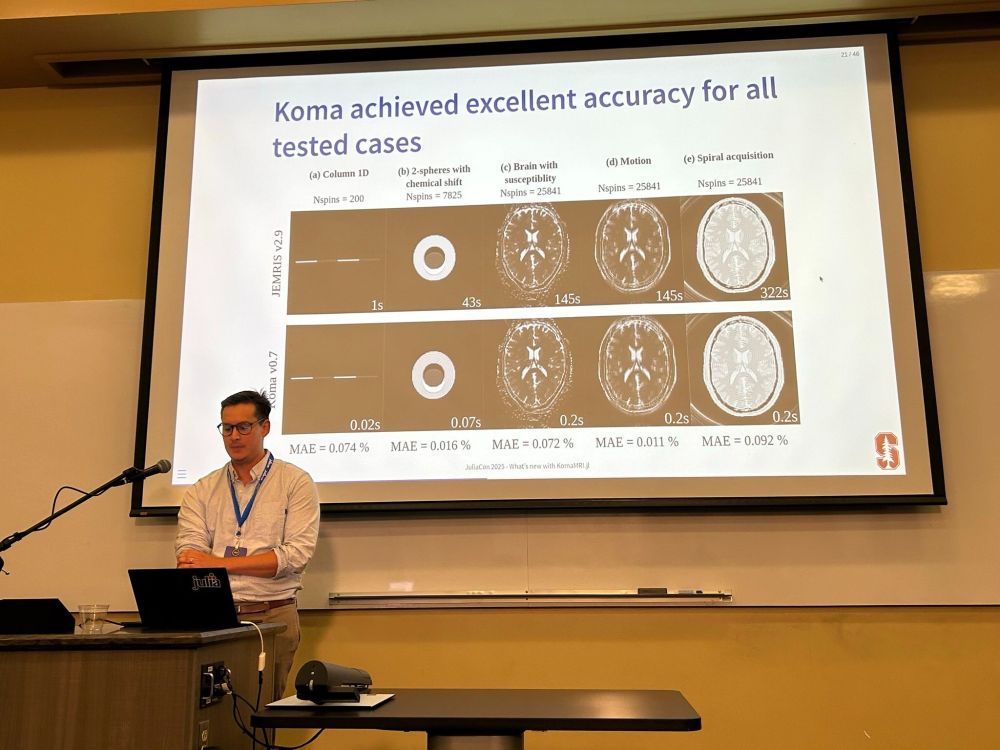
JuliaHealth Mini-Symposium featuring Carlos Castillo Passi on his "What's New with KomaMRI.jl?" talk
24.07.2025 18:55 — 👍 6 🔁 1 💬 0 📌 2
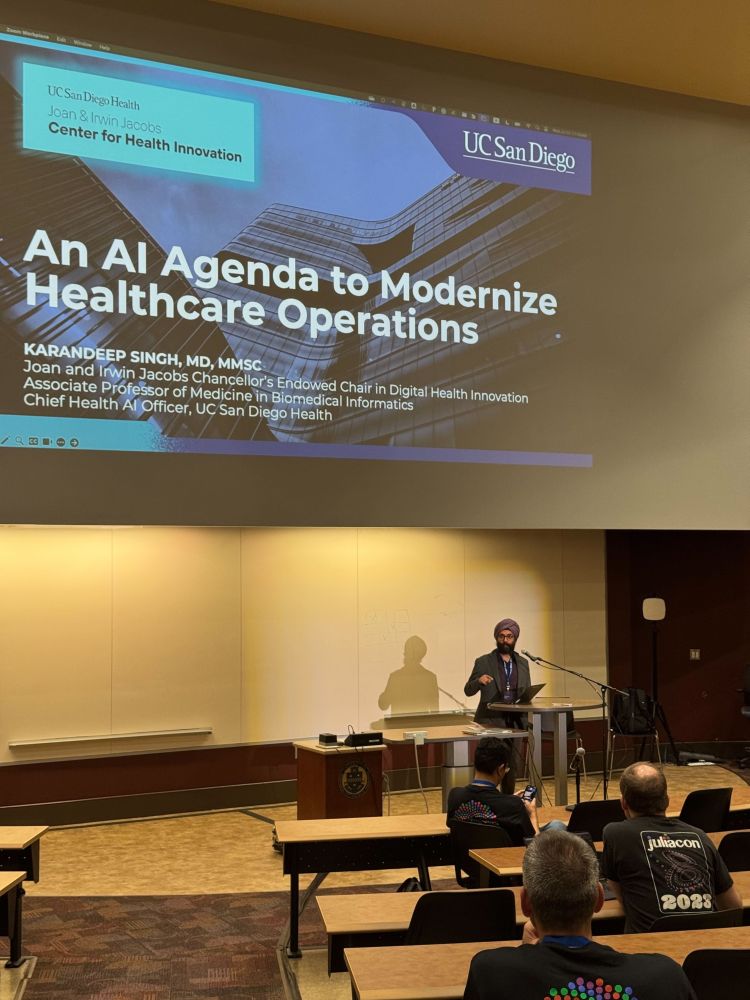
Dr. Karandeep Singh with An AI Agenda to Modernize Healthcare Operations.
A compelling case for rethinking healthcare ops using simulation and generative AI.
24.07.2025 13:47 — 👍 1 🔁 0 💬 0 📌 1