Did you miss Dr. Catharine Krebs’ recent webinar about #AnimalMethodsBias? The recording is now online!
If you’ve been looking for a comprehensive overview of our work from the last four (‼️) years, this is it!
#PeerReview #Bias #PhDChat 🧪
@ertrunnell.bsky.social
neuroscientist 🧠 | Director @ https://www.scienceadvancement.org/ | Moving U.S. biomedical research toward humans & away from other animals | she/her/hers
Did you miss Dr. Catharine Krebs’ recent webinar about #AnimalMethodsBias? The recording is now online!
If you’ve been looking for a comprehensive overview of our work from the last four (‼️) years, this is it!
#PeerReview #Bias #PhDChat 🧪

New publication from MIMETAS 🧠 A scalable 3D human BBB model under gravity-driven, unidirectional flow. Built with self-assembling triculture microvasculature, it combines physiological relevance with higher-throughput capability for BBB research and drug discovery.
🔗 www.mimetas.com/news/mimetas...
Useful new data from @faunalytics.bsky.social's @andreapolanco.bsky.social 👇
19.02.2026 02:58 — 👍 2 🔁 1 💬 0 📌 0
Delegates in discussion at a scientific meeting.
To support delivery of the UK Government’s alternatives strategy, we are working with @innovateuk.bsky.social on a Contracts for Innovation competition, with £2M available for non-animal approaches in pharmacokinetic prediction and cardiovascular safety.
Learn more: nc3rs.org.uk/news/working...
Dr. Donya Mand and I worked with @amandaelyse.bsky.social on the scientific aspects of the article. So great to see it out for everyone to read!
Check it out in @umaryland.edu's Journal of Health Care Law & Policy:
digitalcommons.law.umaryland.edu/jhclp_online...
#PsychedelicSciSky 🧪

New law review article by @amandaelyse.bsky.social of @seattleulaw.bsky.social on why it makes absolutely no sense to use animals for preclinical #psychedelic research.
🐭🍄
🥼 It's already done in humans!
✅ Long history of safety
⚖️ Harm w/o scientific benefit
🧍 Policy shifts toward #NAMs
YES! 👏 👏
Another excellent take by @mbolotnikova.bsky.social for @vox.com
Just because animal use has *been* a part of the process does not prove it *needed to be*
A broken clock is right twice a day...

For the first time in almost 180 years, the #AAASmtg plenary was given by graduate students! Long overdue 👏
So inspired by these young scientists in the @snapcoalition.bsky.social! Check them out: snapcoalition.org
Moderated by @holdenthorp.bsky.social
#AAAS2026 @aaas.org

Graphic announcing a presentation at the AAAS Annual Meeting, Science @ Scale. Along with a photo of Gabby Vidaurre, PhD is the following text: "Science without animals: a scalable policy vision for the public good. Gabby Vidaurre, Ph.D., Feb 14, 2026. 2:30 - 3:30. Expo Stage."
📣 Attending #AAASmtg? Make sure to add this talk by SAO's Gabby Vidaurre, PhD to your Saturday schedule.
As global & U.S. initiatives accelerate toward #NAMs, Dr. Vidaurre will unpack the scientific & policy landscape driving this shift & what still needs to be pushed forward.
@aaas.org #AAAS2026
Yup 👎
13.02.2026 01:58 — 👍 1 🔁 0 💬 0 📌 0


At #AAASmtg in Phoenix! Excited to connect & re-connect with my #SciPol peers.
So much happened in 2025 for those of us working to modernize biomedical research away from animal use. Go hear Gabby Vidaurre, PhD talk about it on Sat at the Expo Stage during the 2:30-3:30 postdoc talks!
@aaas.org
Hope to run into you here, @elisabethbik.bsky.social !
13.02.2026 00:39 — 👍 1 🔁 0 💬 0 📌 0
And check out @renzocee.bsky.social's new book, The Hidden Lives of Lab Animals: A Vet’s Vision for a More Human Future, by @ucpress.bsky.social:
www.ucpress.edu/books/the-hi...

Read @renzocee.bsky.social's full article in @nautil.us:
nautil.us/how-animal-s...
#animalwelfare 🧪 #VetSky #VetMed
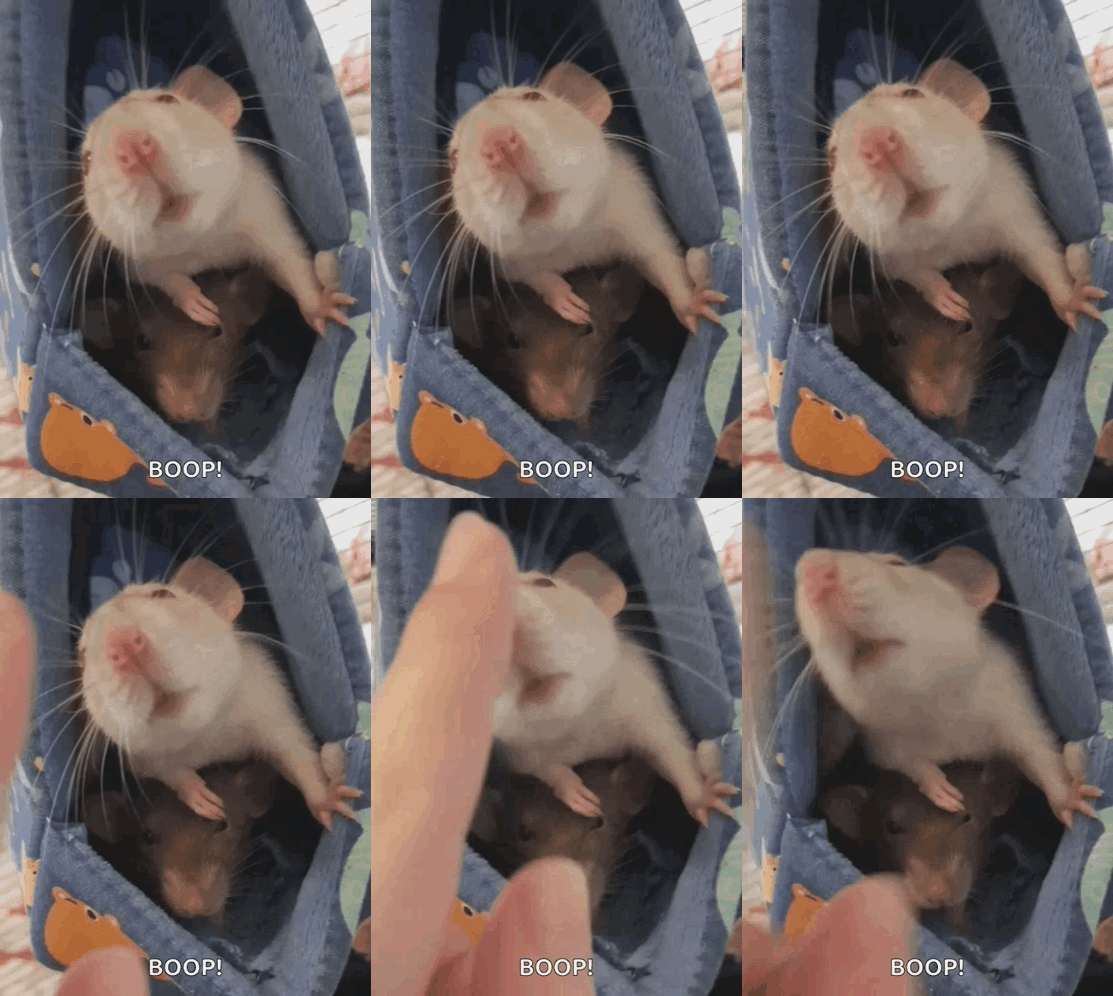
How Animal Suffering Can Ruin Lab Experiments
Interesting perspective from @renzocee.bsky.social on his 3 greatest revelations while writing his new book, The Hidden Lives of Lab Animals.
1⃣ Rats have feelings
2⃣ Suffering messes up experiments
3⃣ Science can improve the lives of animals
🔗👇

#Xenotransplantation is presented as a solution to the global organ shortage, despite ongoing scientific, ethical, & regulatory concerns.
This new issue from @lynncornell.bsky.social explores these questions from diverse perspectives.
Check out some highlights:
www.linkedin.com/pulse/februa...

ICYMI 🧪 For @snexplores.bsky.social, Avery Hurt broke down how AI, organs-on-a-chip, and other human-based models are delivering better research at lower cost and in less time.
Feat. experts from @jhucaat.bsky.social, @harvardmed.bsky.social, & NIH.
www.snexplores.org/article/rese...
#NAMs

In Jan, SAO submitted a response on NSF’s 2026–2030 Strategic Plan, which asked for input on ensuring “American excellence and national security through investments in transformative research and innovation.”
Read our full response: www.scienceadvancement.org/wp-content/u...
#NSF #SciPol 🧪
BREAKING 🚨 The motion to allow OHSU to negotiate with NIH toward transitioning the primate center to a sanctuary has just PASSED by unanimous vote from OHSU's board.
Thank you for taking action!

How does SAO define #NAMs?
Find out in this blog by Gabby Vidaurre, PhD: www.scienceadvancement.org/reflections/...
Collaboration works a lot better when we’re all speaking the same language. 🤝 ✨
#biomedicalresearch #sciencecommunication #scicomm

Screenshot from the linked page, showing the paper "Lost in NAMs-lation: A review of animal-free science definitions" by Donna S. Macmillan, Phi Holcomb, and Kristie M. Sullivan. Published as a Benchmarks article in the journal ALTEX.
It’s giving… NAM‑biguity 🧪
#NonAnimalMethods?
#NewApproachMethodologies?
In this timely new paper, Donna Macmillan, Phi Holcomb, and Kristie Sullivan (ICCS & IIVS) take on the great vocabulary swirl of animal‑free science and call for some much-needed clarity.
www.altex.org/index.php/al...

A tan, brown, and crimson graphic with icons representing stacked papers and bullseyes with dollar figure targets. The title reads: “NAMs-Relevant Highlighted Topics” and includes a list of six research area topics. “Find more at: grants.nih.gov/funding/find-a-fit-for-your-research/highlighted-topics.”
U.S. researchers: Don't forget to check NIH's Highlighted Topics page when considering your next grant application! grants.nih.gov/funding/find...
Recent topics of interest to #NAMs researchers are listed in the graphic.
#NIH #NIHfunding 🧪

Read in @natcomms.nature.com :
www.nature.com/articles/s41...
This 3D human skin tissue model recapitulates the structure of skin, how HSV infects it, & how existing drugs work.
The #NCATS, @uwiscrm.bsky.social, @uwdeptmedicine.bsky.social, @uwdgh.bsky.social, & @fredhutch.org team screened 738 potential compounds & identified 23 potential antivirals.

A graphic with a quote and modified figure from the linked Nature Communications paper, “Limitations of acyclovir and identification of potent HSV antivirals using 3D bioprinted human skin equivalents” (doi: 10.1038/s41467-025-64245-w). It features Figure 2A, a schematic illustrating the following: “Dermis equivalents were 3D printed onto the apical side of transwell inserts...Keratinocytes were pipetted onto the apical surface of the dermis. In the submerged model, the tissues were infected at the apical surface. In the ALI model, tissues were brought to ALI and then infected at the basolateral surface.” Also a quote from a NCATS article published on January 27, 2026: “This collaborative research showed that the bioprinted 3-D skin tissue model closely replicates the structure and layered organization of human skin and that HSV infects these cells the same way it infects people.”
There is currently no cure for #HSV, and patients can develop resistance to the drug used to manage symptoms.
But thanks to NCATS' 3D Tissue Bioprinting Program, scientists now have the best model yet for testing new treatments.
ncats.nih.gov/news-events/...
#3Dprinting #bioprinting #virosky 🧪

HonorHealth and the University of Arizona developed a 3-D human tumor chip that better reflects cancer biology and therapeutic evaluation than animal tests. medicalxpress.com/news/2026-01...
06.02.2026 12:59 — 👍 1 🔁 1 💬 0 📌 0
🚨 OHSU's Board of Directors is deciding whether to shut down its primate lab—urge them to vote YES and transition the facility into a sanctuary for thousands of monkeys.
Send your letter by noon PT on Friday, 2/6 to make it count: actionnetwork.org/letters/shut...

📢 ACTION NEEDED TODAY!
Please submit comments to ohsuboard@ohsu.edu with the subject line "For public comment." Ask OHSU’s Board to approve the resolution & permit negotiations with NIH for the proposed phase-out and sanctuary plan.
#AnimalRights #AnimalWelfare
This: bsky.app/profile/opb....
05.02.2026 02:55 — 👍 0 🔁 0 💬 1 📌 0THIS is how it's done! 👏
This is NIH putting its money where its mouth is:
➡️ April '25: Sets agency-wide priority to support NAMs & reduce animal use
➡️ Sept '25: Allows grant funds to be used for animal retirement & rehoming
➡️ 2026: Takes decisive action to see where the transition can be made