TikTok’s screentime management tools were subject to A/B testing which found that the actual impact on minors’ overall use was “about 10 minutes on weekdays and 15 minutes on weekends.” (13/13)
12.02.2026 16:26 — 👍 0 🔁 0 💬 1 📌 0
Adoption rates reported by TikTok, finding that from January 2024 to January 2025 the adoption rate for screentime breaks were approximately 1.5% of users, and sleep reminders between 0.7 and 1.8% of users. (12/13)
12.02.2026 16:26 — 👍 0 🔁 0 💬 1 📌 0
One internal TikTok document suggesting that “minors do not have executive function to [voluntarily] control their screen time.” (11/13)
12.02.2026 16:26 — 👍 0 🔁 0 💬 1 📌 0
3. Platforms know the mitigations they employ to reduce these harms don’t work: (10/13)
12.02.2026 16:26 — 👍 0 🔁 0 💬 1 📌 0
TikTok’s Minor Safety Strategy Paper references studies that suggest 6 or more hours a day spent on TikTok heightens depression risk. (9/13)
12.02.2026 16:26 — 👍 0 🔁 0 💬 1 📌 0
TikTok staff discussed external research finding that “minors who spend more than three hours a day on social media double their risk of ‘poor mental health outcomes, including symptoms of depression and anxiety.’ (8/13)
12.02.2026 16:26 — 👍 1 🔁 0 💬 1 📌 0
2. Platforms know that this addictive design has problematic associations: (7/13)
12.02.2026 16:26 — 👍 0 🔁 0 💬 1 📌 0
Internal documents state that the platform can “get people into flow – the psychological state of extreme engagement, loss of sense of time and even loss of self” including through “the variability of rewards (which is what makes the app so addictive).” (6/13)
12.02.2026 16:26 — 👍 0 🔁 0 💬 1 📌 0
TikTok's own records describe how it uses “powerful coercive design tactics” to extend use. (5/13)
12.02.2026 16:26 — 👍 0 🔁 0 💬 1 📌 0
TikTok’s Digital Wellbeing Product strategy describes compulsive usage as “rampant” on the platform. (4/13)
12.02.2026 16:26 — 👍 0 🔁 0 💬 1 📌 0
I'll give TikTok as an example for this thread, but the report also looks at Meta. Here's what we know:
1. Platforms know their designs are addictive: (3/13)
12.02.2026 16:26 — 👍 0 🔁 0 💬 1 📌 0
The report leverages two sources of data - 1) DSA mandated risk assessments, written by the platforms, and 2) internal platform documents that have emerged from US litigation against platforms. (2/13)
12.02.2026 16:26 — 👍 0 🔁 0 💬 1 📌 0
This new report from @knightgtown.bsky.social @pfchap.bsky.social @matt-steinberg.bsky.social shows the substantial gap between platform risk assessments and their actual approaches to mitigating risk. (1/13)
12.02.2026 16:26 — 👍 2 🔁 1 💬 1 📌 0
Lots of people talking about age assurance these days, but little about how it actually works - what core tradeoffs are built into the technology, in terms of baseline accuracy, circumvention resistance, availability, and privacy. The new KGI report digs into these weedy issues, check it out!
29.01.2026 17:52 — 👍 1 🔁 1 💬 0 📌 0

Registration for the Digital Competition Conference 2026 is now open to the public!📍Feb 5-6, 2026 | Washington, DC in person + livestream
DCC is where cutting-edge research meets policy on antitrust & digital competition. 🎟️ Secure your free ticket here: kgi.georgetown.edu/events/digit...
15.01.2026 17:43 — 👍 1 🔁 1 💬 0 📌 0

🚨Why does access to public platform data matter? Join our webinar "Better Access: Data for the Common Good" (Jan 28, 2026, 11am-12pm ET) for a discussion on the Better Access framework, current regulatory shifts in the EU, UK + US, and what changes 2026 might hold. kgi.georgetown.edu/events/bette...
13.01.2026 19:17 — 👍 2 🔁 3 💬 0 📌 0
Ranked Choice Voting Singers
Please click the link to complete this form.
Love this practice ranked choice voting ballot from DC board of elections, ranking your favorite singers. (Even better would be if it validated at the end whether you did it right or not.)
vr.dcboe.org/253434754272...
13.01.2026 18:45 — 👍 0 🔁 0 💬 0 📌 0
Please share with all the awesome applicants you know!
08.01.2026 19:30 — 👍 1 🔁 1 💬 0 📌 0
We recently concluded a special article series, “Seeing the Digital Sphere: The Case for Public Platform Data,” in collaboration with the Knight-Georgetown Institute, in which experts explored why access to public platform data is critical. Here’s a snapshot: (1/9)
17.11.2025 18:15 — 👍 14 🔁 11 💬 1 📌 0

Why Commercial Tools Can Scrape Social Media But Researchers Can't | TechPolicy.Press
Brandon Silverman explains how researchers face barriers to social media data under the DSA, while corporations can buy full access.
Despite new EU transparency laws, researchers are still blocked from vital social media data, while corporations buy the same information freely, argues Brandon Silverman. The result: a two-tier system that shields platforms from scrutiny and weakens democratic oversight.
11.11.2025 14:31 — 👍 49 🔁 23 💬 2 📌 5

Why Platform Data is Essential to Public Health Efforts in Tobacco Control | TechPolicy.Press
Social media platforms are a key avenue for tobacco control research, but as George Pearson argues data access barriers hinder efforts to monitor impacts.
Think platform data from social media only matters for election or disinformation research? Think again. George Pearson, a researcher at the Truth Initiative, shows it’s vital for public health—revealing how tobacco companies can target youth, dodge regulations, and influence policy.
10.11.2025 13:40 — 👍 5 🔁 2 💬 0 📌 0

📣Announcing our new series with @techpolicypress.bsky.social "Seeing the Digital Sphere: The Case for Public Platform Data". Should we be able to understand the risks kids face online? How businesses target consumers? How politicians communicate? These qs depend on access to public platform data. 👇
07.11.2025 14:52 — 👍 4 🔁 2 💬 1 📌 0

There is More Online Election Discourse than Ever, But Researchers See Less | TechPolicy.Press
Josephine Lukito and Kaitlyn Dowling explore why public social media data is vital for transparent elections and accountability in the digital campaign era.
Another in our series, Seeing the Digital Sphere: The Case for Public Platform Data. This week’s elections show how central social media has become to campaigns with politicians on nearly every platform. But as Josephine Lukito and Kaitlyn Dowling explain, access to this data is shrinking.
07.11.2025 14:01 — 👍 0 🔁 1 💬 0 📌 0
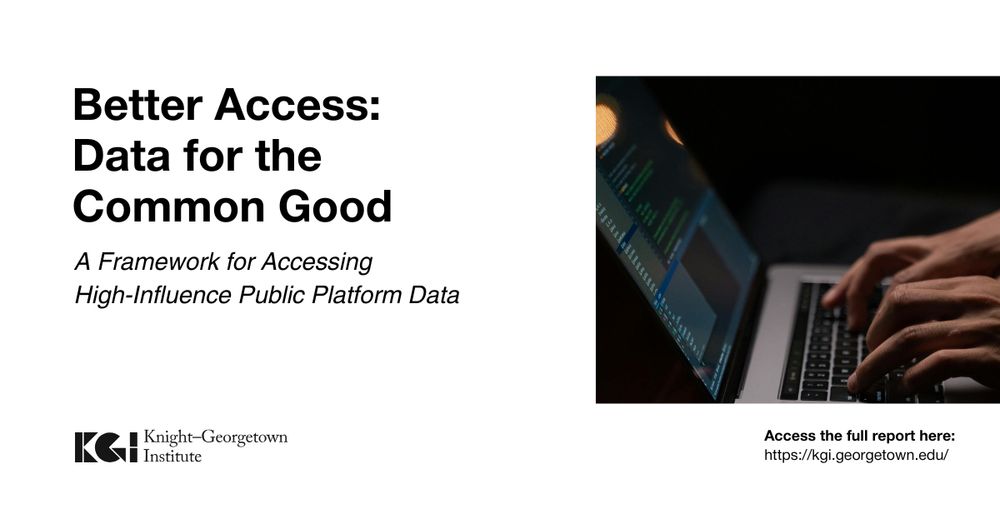
📣 Online platforms shape what we know, how we connect, and who gets heard, yet researcher access to public platform data is shrinking, while platforms monetize this data. Our new report "Better Access" offers a framework for accessing this critical data: kgi.georgetown.edu/research-and...
06.11.2025 14:58 — 👍 6 🔁 7 💬 0 📌 2

Online platforms shape what we know, how we connect & who gets heard. In partnership with KGI, we are launching a new series, Seeing the Digital Sphere: The Case for Public Platform Data. The series starts today, with an essay from Leticia Bode & Peter Chapman.
www.techpolicy.press/seeing-the-d...
06.11.2025 14:30 — 👍 10 🔁 3 💬 1 📌 0
Come work with us! We are a fun and scrappy team. :)
20.10.2025 20:35 — 👍 2 🔁 0 💬 0 📌 0

It must be weird to be a kid in DC ("free lemonade until the government shutdown is over!") . 😂
14.10.2025 21:52 — 👍 3 🔁 0 💬 0 📌 0

How common are “survey professionals” - people who take dozens of online surveys for pay - across online panels, and do they harm data quality?
Our paper, FirstView at @politicalanalysis.bsky.social, tackles this question using browsing data from three U.S. samples (Facebook, YouGov, and Lucid):
07.10.2025 18:49 — 👍 136 🔁 54 💬 4 📌 6
Tech Policy at Georgetown | fellow at New America's Open Technology Institute
Technology & Human Rights Fellow @harvardkennedy.bsky.social | Senior Advisor @ict4peace.bsky.social | Non-Res. Fellow, AI Security Initiative @berkeleyischool.bsky.social | Studying gender, cybersecurity, and digital peacebuilding
We are the non-profit host of RECAP, CourtListener, and the Big Cases bots. We use technology and advocacy to make the legal sector better.
https://free.law | https://free.law/recap/ | https://courtlistener.com | https://bots.law
i write at @theverge.com. Portland, OR.
Senior Editor, Tech & Policy, The Verge
Real-time updates on the latest cases in tech. Curated by The Verge. Hosted by @free.law.
Also at @techcases@mastodon.social and @techcases_bot
https://bots.law/little-cases/tech-cases-bot/
Professor of Data Science and Public Policy | Director @ Hertie School Data Science Lab | Elections, Public Opinion, Data
Astrophysicist turned advocate; guiding the globe to a safer, stronger Internet (ht APF). Distinguished Technologist @internetsociety.bsky.social https://josephhall.org/ (former CDT, NYU, Princeton CITP, Berkekey iSchool/Astro)
Dad/husband. Public servant. Broadband and digital inclusion leader. Advocate for ethics in AI. Basement rockstar. Opinions are my own.
Digitalisation & Society | Digital Policy | Recommender Systems | Freedom of Speech | 🗣️: 🇬🇧 / 🇩🇪 | https://linktr.ee/al.hohlfeld
Psychologist. Founder of Well-Being Laboratory. Studies happiness, purpose, curiosity, courage, resilience, anxiety, flexibility, etc.
Author x 3 books.
More: toddkashdan.com & toddkashdan.substack.com
Founder and ED @ Digital Democracy Institute of the Americas (DDIA) — DDIA.org
We work across disciplines—the humanities, social sciences, computer, and data sciences—to research and create critical and creative responses to our data-filled world.
Led by Dr. Wendy Hui Kyong Chun, Simon Fraser University
🌐 digitaldemocracies.org
data & implementation at the Oversight Board | formerly academics + researchers at CrowdTangle / Meta | fellow at the Integrity Institute and Atlantic Council’s DFRLab | advisor at Connect Humanity, a fund for digital equity
Assistant Professor of Computer Science @JohnsHopkins,
CS Postdoc @Stanford,
PHD @EPFL,
Computational Social Science, NLP, AI & Society
https://kristinagligoric.com/
Building more civic futures through daily small actions. Carrboro, NC.
Interests:📚🗳️🐶🍝🏔️
http://kpete.rs
https://civicfutures.substack.com
Associate Director of Research, DemocracyFund
Research Director for Voter Study Group
Previously at PRRI, Center for American Progress, Editorial Committee PS: Political Science & Politics
Polisci PhD
Personal website: rgriffin.crd.co
Political Communication is an international journal publishing theory-driven empirical research at the intersection of politics and communication.
https://www.tandfonline.com/journals/upcp20
she/her
Going on the job market in fall 2025
PhD candidate @nunetsi.bsky.social
website: https://asmithh.github.io/
NSF GRFP Awardee, narcoleptic, whale fan, and powerlifter