We’re often asked: Why are Chinese EVs so cheap? Comparing costs between Western and Chinese automakers in China shows that subsidies matter, but they’re only part of the story:
19.02.2026 19:01 — 👍 26 🔁 4 💬 0 📌 6
@marcin.website.bsky.social
marcin.website
We’re often asked: Why are Chinese EVs so cheap? Comparing costs between Western and Chinese automakers in China shows that subsidies matter, but they’re only part of the story:
19.02.2026 19:01 — 👍 26 🔁 4 💬 0 📌 6

Solar and batteries are cheap enough that most people can get most of their electricity from them, and save money. This equation gets better and better over time as their costs decline.
All details in a new blog post: nworbmot.org/blog/solar-b...
Now that more details are known about the three #V2G propositions (🇩🇪 BMW/E.ON, 🇫🇷 Mobilize/Renault/Mobility House, 🇬🇧 Octopus) currently available or announced in Europe, it is time to compare them.
All three aim to enable the average user to drive for free with an annual mileage of 11,000–14,000 km

New paper argues that we should not harm economic growth with climate policies because this growth helps with both adaptation and mitigation.
osf.io/preprints/so...
It leaves me agreeing and exasperated at the same time because...
the best climate policies ALSO HELP economic growth. Let me explain

If you do any cost analysis or economics for energy then stop assuming 8% is your discount rate!
Getting specific data on costs of capital was a nightmare, until now:
www.nature.com/articles/s41...

Since everyone is busy "resetting", here is a more focused plea: let's manage our sustainable biomass better.
People get nervous around biomass (it's complicated!) but high costs for green hydrogen and direct air capture mean we need to take a closer look.
Blog: nworbmot.org/blog/biomass...
We spent two months talking with RC alums and thinking deeply about how LLMs are changing programming and learning.
Here’s what we learned, and how we're currently thinking about AI at RC: t.co/ddFj486ch8
Great overview of industrial electrification: challenges + current policy + opportunities for improvement
Tiny critique: I would have liked more discussion on reaching cost parity in the long-term through learning, flexibility, finance, onsite solar, and optimal control. Maybe that's coming soon?
I'm trying to learn more about climate policy. One of the books that I read is Simon Sharpe's "Five times faster". It's pretty high-level, but more insightful than most books of its kind. This report, that he cowrote, contains many of the book's insights. It's systems thinking applied to climate.
06.06.2025 00:31 — 👍 13 🔁 2 💬 0 📌 0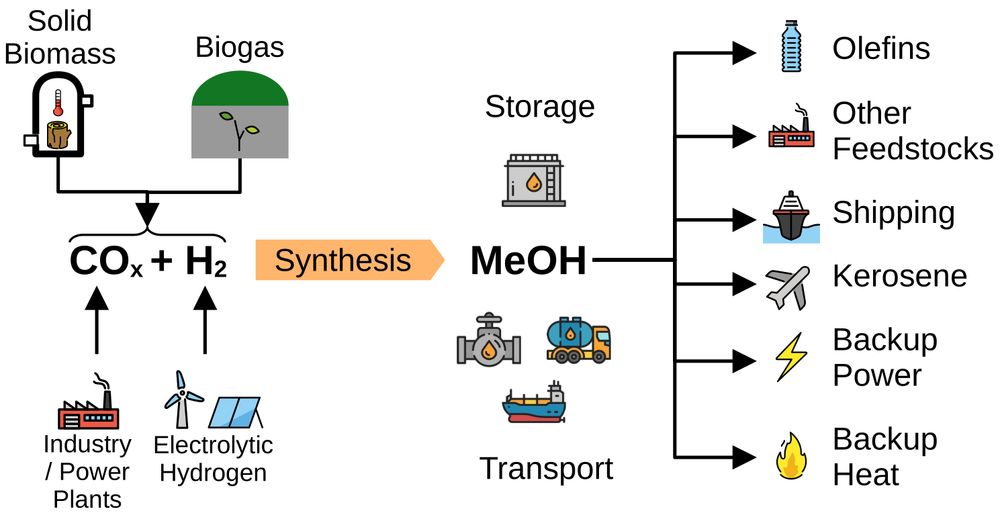
As the hydrogen bubble deflates, what are the alternatives? We present a "minimal methanol economy": using methanol as a gap-filler for the few sectors electrification can't reach.
New working paper together with Philipp Glaum, @fneum.bsky.social, @millinger.bsky.social:
arxiv.org/abs/2505.09277