Project CETI •-- Home
CETI is a nonprofit organization applying advanced machine learning and state-of-the-art robotics to listen to and translate the communication of sperm whales.
In the meantime, @poetz.bsky.social will talk at CRAB satellite (sites.google.com/view/crab202...) about recent work by Project CETI (www.projectceti.org) on understanding social dynamics during a sperm whale calf birth.
01.09.2025 11:20 — 👍 5 🔁 1 💬 2 📌 0
Lots of NPL at @ConfCompSys 2025. Thread below!
01.09.2025 11:20 — 👍 9 🔁 5 💬 1 📌 1
CRAB2025
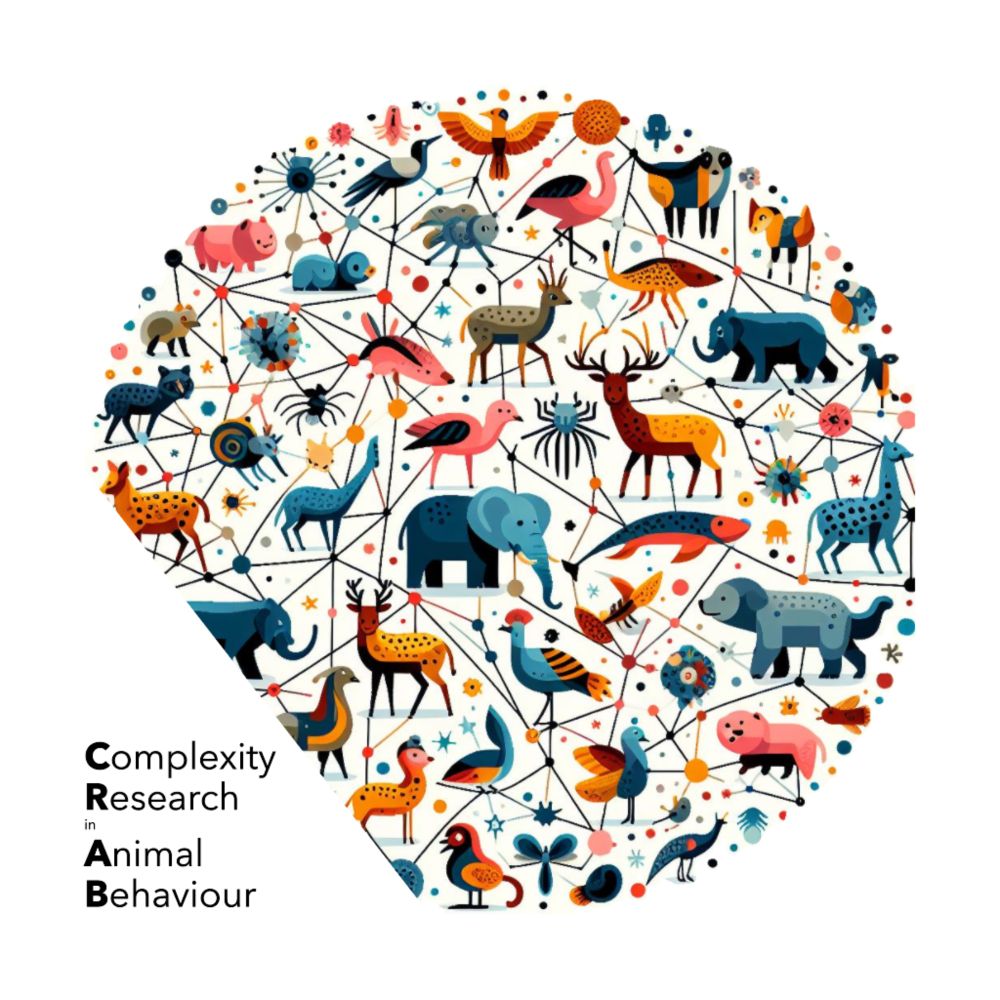
Complexity Research in Animal Behaviour
Satellite @ CCS 2025 - Siena, 3 September 2025
Animal groups can be considered as complex systems of interacting entities (the individuals). The collective beha...
The #CRAB2025 🦀 programme is out!
Join us in Siena on Sept 3 at #CCS25 for the 2nd edition of the Complexity Research in Animal Behaviour satellite 🐜🐦🦋🐳🐙🐝
🧑🏫 Invited talks by S. Melillo & P. Bartashevich
Full programme: sites.google.com/view/crab202...
@jbbrask.bsky.social @saraneven.bsky.social
23.07.2025 09:59 — 👍 17 🔁 6 💬 0 📌 0

Info. Theory in Comp. Neuroscience Workshop (CNS*2024)
Overview, list of speakers, and schedule
Program posted for our Workshop on Methods of Information Theory in Computational Neuroscience at CNS*2025 Florence next week -- kgatica.github.io/CNS2025-Info... -- chaired by @marilyngatica.bsky.social
30.06.2025 23:16 — 👍 6 🔁 3 💬 0 📌 1
Huge thanks to my amazing co-authors:
@h-merritt.bsky.social, @andreasantoro.bsky.social, @grabuffo.bsky.social, Demian Battaglia, Francesco Vaccarino, Manish Saggar, @brovelli.bsky.social, @lordgrilo.bsky.social
30.06.2025 14:54 — 👍 4 🔁 1 💬 0 📌 0
This balance between redundancy and synergy, woven into each person’s unique topological scaffold, may offer a new lens on individual variability, and a powerful pathway for identifying cognitive or clinical biomarkers. 9/n
30.06.2025 14:51 — 👍 2 🔁 1 💬 1 📌 0

Third: most intriguingly, we found that the scaffold's structure dictates its information flow. The borders of loops handle redundant information, while the connections spanning these loops exhibit high synergy. It's a beautiful metaphor: integration happens within the voids. 8/n
30.06.2025 14:51 — 👍 2 🔁 1 💬 2 📌 0


Second, while FC fingerprints often draw from features confined to particular brain networks, scaffolds gain their power from inter-network connections. In other words, identity seems to live in how different large-scale brain systems interact 7/n
30.06.2025 14:51 — 👍 2 🔁 1 💬 1 📌 0

First, scaffold-based fingerprints achieved near-perfect identification accuracy (~100%), outperforming FC-based methods (~90%). Even more 🤯, they remained robust across different preprocessing strategies, brain atlases, and dramatically shortened scan times. 6/n
30.06.2025 14:50 — 👍 2 🔁 1 💬 1 📌 0

a basketball court with the word awesome on the bottom right
ALT: a basketball court with the word awesome on the bottom right
We tested this approach on resting-state fMRI data from 100 unrelated individuals in the Human Connectome Project. The results were striking. 5/n
30.06.2025 14:49 — 👍 2 🔁 1 💬 1 📌 0

To better capture this richer structure, we use homological scaffolds. Picture incrementally building a brain network by adding connections in order of strength. As we do this, loops begin to form. The scaffold is made of all edges that participate in these mesoscale loops 4/n
30.06.2025 14:47 — 👍 2 🔁 1 💬 1 📌 0
Traditional approaches to brain fingerprinting typically rely on Functional Connectivity (FC), which measures pairwise correlations between brain regions. But brains don’t just operate in pairs—networks of regions interact in complex, higher-order ways that FC often misses. 3/n
30.06.2025 14:45 — 👍 2 🔁 1 💬 1 📌 0

We show that the topological structure of brain connectivity—, homological scaffolds—offers a powerful and highly robust way to identify individuals based on their functional brain organization. 2/n
30.06.2025 14:45 — 👍 3 🔁 1 💬 1 📌 0
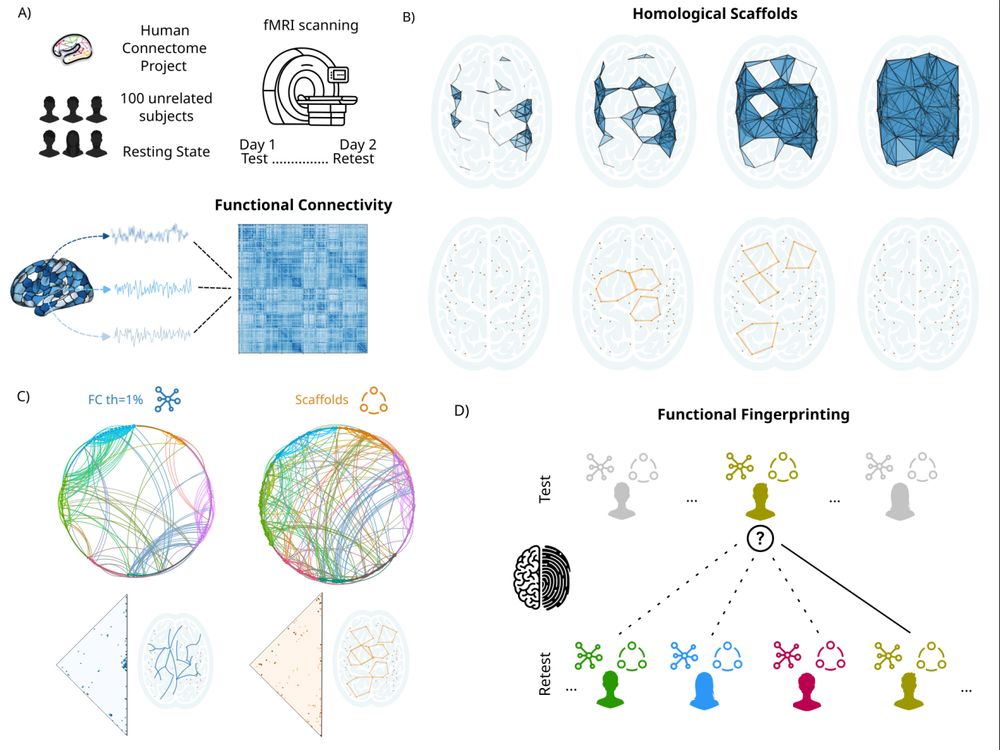
Thrilled to finally share a huge piece of my PhD project!
Our paper “The Topological Architecture of Brain Identity” is now out on bioRxiv: biorxiv.org/content/10.1... 🧵 1/n
30.06.2025 14:45 — 👍 15 🔁 7 💬 1 📌 0
Systems neuroengineering to model and interface brain networks
@institutducerveau.bsky.social, @fondation-inria.bsky.social, @cnrs.fr, @inserm.fr, @sorbonne-universite.fr, @ap-hp.bsky.social
Institute for Advanced Studies @uni-konstanz.de.bsky.social. Lighthouse project in the Excellence Strategy since 2007, fostering early independence with an international, intergenerational, intra-university, interdisciplinary angle. uni.kn/zukunftskolleg
Professor of Animal Behaviour @ University of Bristol | cetacean communication and cognition group | loves dogs | PI @ Shark Bay Dolphin Research | she/her 🏳️🌈
Networking the complexity community since 1999.
Official news channel of the @cssociety.bsky.social
Edited by @cgershen.bsky.social
We are a collective of animal behaviour researchers organising microgrants and mentorship for undergraduate & graduate students in animal behaviour
Research Group for Multilayer Modeling and Analysis of Complex Systems: from cells to societies. Led by manlius.bsky.social at Dept. of Physics & Astronomy "Galileo Galilei", University of Padua
Neuroscientist @ CNRS & Aix-Marseille University, France | SCGB TTI fellow | ERC StG 2024 | fannycazettes.com
Jobs, PhD’s, postdocs, internships, and volunteer opportunities for ECRs in animal behavior and adjacent fields. Run and created by @juliammachado.bsky.social
Journal of Animal Ecology publishes the best #AnimalEcology research that develops, tests and advances broad ecological principles. A @britishecologicalsociety.org journal.
behavioral ecologist, studying the evolution of social relationships - postdoc @PrimEvo lab @MPI-EVA | team MacaqueNet & @ABCmicrogrants | she/her
linkree: https://linktr.ee/delphinedemoor
Shark scientist 🦈 & behavioural ecologist | Animal Social Networks
Junior Professor at University of Montpellier @umontpellier.bsky.social | Lab MARBEC
Website: www.johannmourier.com
Prof Language Evolution FBA FRSE MAE. Head of Dept, Linguistics & English Language, Uni Edinburgh. With my students & collaborators I do science & art. he/him. simonkirby.net
Exciting stuff on complexity, theoretical biology, artificial intelligence, linguistics, neuroscience and their intersections.
#complexitycat
complexitycat.org
Complex systems, network science, data/AI, empirical system modelling, ecological networks, constellation line figures. Faculty, University of Twente, NL [ https://doina.net ]
Doing research on biology, patterns, and collective phenomena
Researching human adaptation to global changes in climate, environment, and technology
The Complexity Science Group led by Professor Karoline Wiesner at the Institute for Physics and Astronomy at the University Potsdam.
Karoline Wiesner: https://www.karowiesner.org
University Website: https://www.uni-potsdam.de/de/complexity-science/
Prof of Complexity Science and Physics University of Potsdam | head of @complexityup.bsky.social | Ext faculty @csh.ac.at Complexity Science Hub Vienna