Several craters are visible on a tan surface. The largest crater, on the right, has internal markings that make it look like a winking face with a smile. Please see the explanation for more detailed information.
🔭 Galle: Happy Face Crater on Mars
Image Credit: NASA, MGS, MSSS
apod.nasa.gov/apod/ap26020...
01.02.2026 08:00 — 👍 215 🔁 53 💬 4 📌 5

Close-up astrophotography of the Wizard Nebula (NGC 7380) showing intricate dark dust pillars, soft blue and golden emission clouds, and a rich star field in the background.
NGC 7380, Wizard Nebula
app.astrobin.com/i/d6pwe0
#Astrophotography
10.01.2026 08:28 — 👍 20 🔁 6 💬 0 📌 0

Ionized hydrogen nebula in the Cygnus region: swirling gas and dust forming subtle light-and-shadow shapes, with a dense field of fine stars scattered across the entire frame.
This is a quick test on NGC 7000, with only the Hα filter. 8x300’’ taken with N.I.N.A. and processed with Pixinsight.
#astrophotography
04.12.2025 21:58 — 👍 10 🔁 2 💬 0 📌 0

An example of violence on a cosmic scale, enormous elliptical galaxy NGC 1316 lies about 75 million light-years away toward Fornax, the southern constellation of the Furnace. Investigating the startling sight, astronomers suspect the giant galaxy of colliding with smaller neighbor NGC 1317 seen just right of the large galaxy's center, producing far flung star streams in loops and shells. Light from their close encounter would have reached Earth some 100 million years ago. In the sharp telescopic image, the central regions of NGC 1316 and NGC 1317 appear separated by over 100,000 light-years.Complex dust lanes visible within also indicate that NGC 1316 is itself the result of a merger of galaxies in the distant past. Found on the outskirts of the Fornax galaxy cluster, NGC 1316 is known as Fornax A. One of the visually brightest of the Fornax cluster galaxies it is one of the strongest and largest celestial radio sources with radio emission extending well beyond this one degree wide field-of-view.
🔭 Galaxies in the Furnace
Image Credit & Copyright: Simone Curzi and the ShaRA Team
apod.nasa.gov/apod/ap25120...
04.12.2025 08:00 — 👍 146 🔁 45 💬 1 📌 2
Vous assistez, quasiment en direct à la formation d'un cratère sur la Lune, avec un impact filmé ce matin !
16.11.2025 15:26 — 👍 799 🔁 176 💬 24 📌 20

I’m making progress on my latest project. This is the Soul Nebula. This is currently a 4 panel mosaic and is cropped to make it as much of a rectangular FOV as possible. #astrophotography
15.11.2025 15:11 — 👍 35 🔁 3 💬 1 📌 0

Andromeda Galaxy (M31) appears as a large, bright spiral galaxy surrounded by countless stars. Its bright core is situated in the center, with soft dust lanes spiraling outward in the dark night sky.
A quick photography of Andromeda Galaxy, M31, during my transition tests from Asiair to N.I.N.A. (30 minutes for each L, R, G, B filter ; processed with Pixinsight).
#astrophotography
12.11.2025 15:08 — 👍 34 🔁 10 💬 0 📌 0

Sure, Halloween is an astronomy holiday. But astronomers always enjoy scanning the heavens for spook-tacular galaxies, stars, and nebulae. This favorite is item number 43 from the Beverly Lynds' 1962 Catalogue of Dark Nebulae, fondly known as the Cosmic Bat nebula. While its visage looks alarmingly like a scary flying mammal, Lynds Dark Nebula 43 is over 12 light-years across. Glowing with eerie light, stars are forming within the dusty interstellar molecular cloud that is dense enough to appear in silhouette against a luminous background of Milky Way stars. Watch out. This Cosmic Bat nebula is a mere 400 light-years distant toward the serpent-bearing constellation Ophiucus.
🔭 Lynds Dark Nebula 43
Image Credit & Copyright: Team Ciel Austral
star.ucl.ac.uk/~apod/apod/a...
30.10.2025 08:00 — 👍 185 🔁 49 💬 3 📌 7
This is a nebula, which is the result of the ejection of gas and dust from a star at the late stage of its evolution.
25.10.2025 09:04 — 👍 2 🔁 0 💬 0 📌 0

Astrophotography image of the Dumbbell Nebula (M27), a bright planetary nebula in the constellation Vulpecula, surrounded by a rich field of stars.
This is one of my first astrophotographies, retreated with tools from 2025. M27, taken in 2022 with a 150/750 Newton and a Nikon D7100 (processed on Pixinsight).
#astrophotography
25.10.2025 08:10 — 👍 21 🔁 3 💬 1 📌 0

A starfield is shown that has a multi-filament nebula flowing across it horizontally. The most prominent colors are red and blue. Please see the explanation for more detailed information.
🔭 NGC 6960: The Witch's Broom Nebula
Image Credit & Copyright: Brian Meyers
apod.nasa.gov/apod/ap25100...
01.10.2025 08:00 — 👍 221 🔁 72 💬 1 📌 1

Schéma illustrant la contraction des longueurs pour différentes vitesses (v nulle, v = 86.6% de c, v = 99.5% de c, et v tend vers c)
Le saviez-vous ?
Plus vous approchez de la vitesse de la lumière, plus la distance entre vous et votre destination RÉTRÉCIT, ce qui permet en théorie, sans briser aucune loi de la physique, d'atteindre n'importe quel point de l'Univers en un temps raisonnable (si vous allez assez vite)
#thread
⬇️⬇️⬇️
27.09.2025 08:38 — 👍 271 🔁 105 💬 15 📌 16
Il est très rare d'avoir 2 comètes visibles dans le ciel... et encore plus rare de pouvoir les capturer toutes les deux en un seul cliché :
22.09.2025 18:36 — 👍 174 🔁 35 💬 4 📌 0
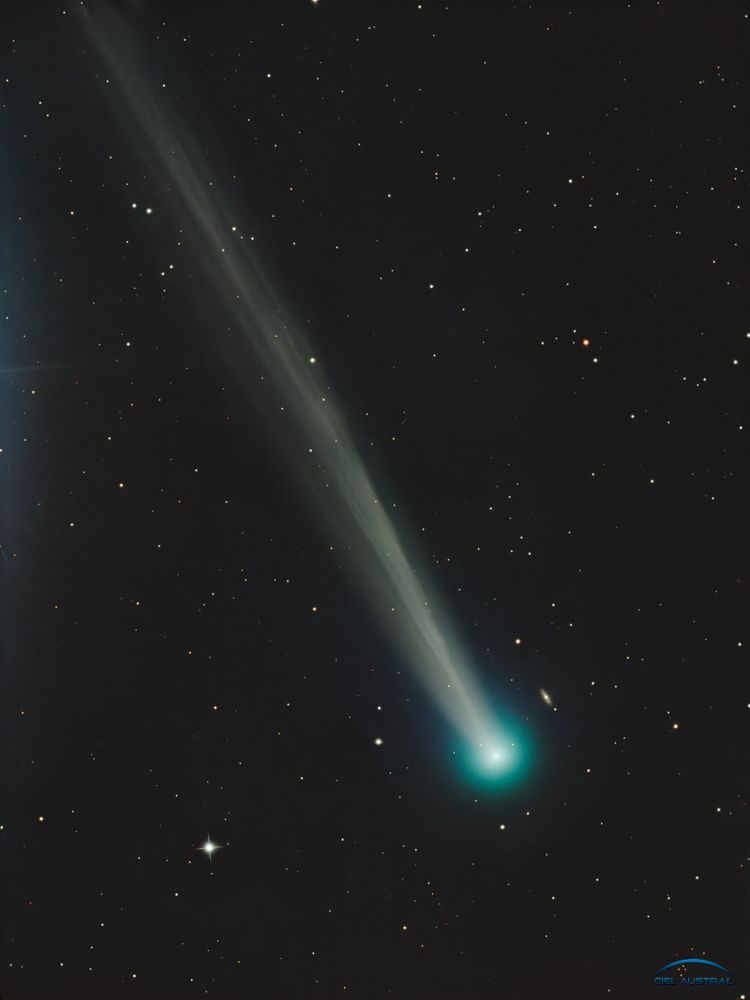
A new visitor from the outer Solar System, comet C/2025 R2 (SWAN) also known as SWAN25B was only discovered late last week, on September 11. That's just day before the comet reached perihelion, its closest approach to the Sun. First spotted by Vladimir Bezugly in images from the SWAN instrument on the sun-staring SOHO spacecraft, the comet was surprisingly bright but understandably difficult to see against the Sun's glare. Still close to the Sun on the sky, the greenish coma and tail of C/2025 R2 (SWAN) are captured in this telescopic snapshot from September 17. Spica, alpha star of the constellation Virgo, shines just beyond the upper left edge of the frame while the comet is about 6.5 light-minutes from planet Earth. Near the western horizon after sunset and slightly easier to see in binoculars from the southern hemisphere, this comet SWAN will pass near Zubenelgenubi, alpha star of Libra, on October 2. C/2025 R2 (SWAN) is scheduled to make its closest approach to our fair planet around October 20.
🔭 Comet C/2025 R2 (SWAN)
Image Credit & Copyright: Team Ciel Austral
apod.nasa.gov/apod/ap25091...
18.09.2025 08:00 — 👍 197 🔁 50 💬 1 📌 0

Ajout de 80 nouveaux sub's sur cette cible. Un total de 7h de poses 🔭. Beaucoup de nouveaux détails. J'adore cette nébuleuse.
Nébuleuse de la bulle / NGC7635
#Celestron C8 Edge HD / Réducteur 0.7 ASI533MC Pro / Mount iOptron CEM40 #Astrophography #Astronomy
03.09.2025 06:24 — 👍 27 🔁 4 💬 0 📌 1
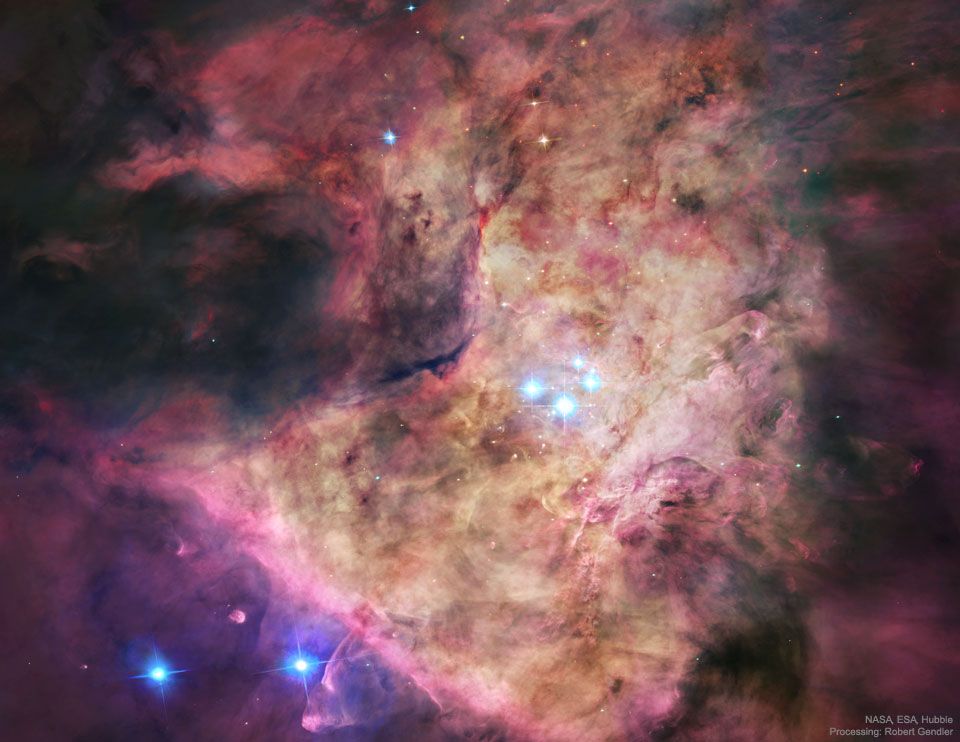
A bright nebula occupies the center of the frame. The nebula is complex but roughly tan in the center and red around the edges. In the center are four bright blue stars. Please see the explanation for more detailed information.
🔭 Trapezium: In the Heart of Orion
Image Credit: Data: Hubble Legacy Archive, Processing: Robert Gendler
apod.nasa.gov/apod/ap25081...
13.08.2025 08:00 — 👍 152 🔁 48 💬 1 📌 1
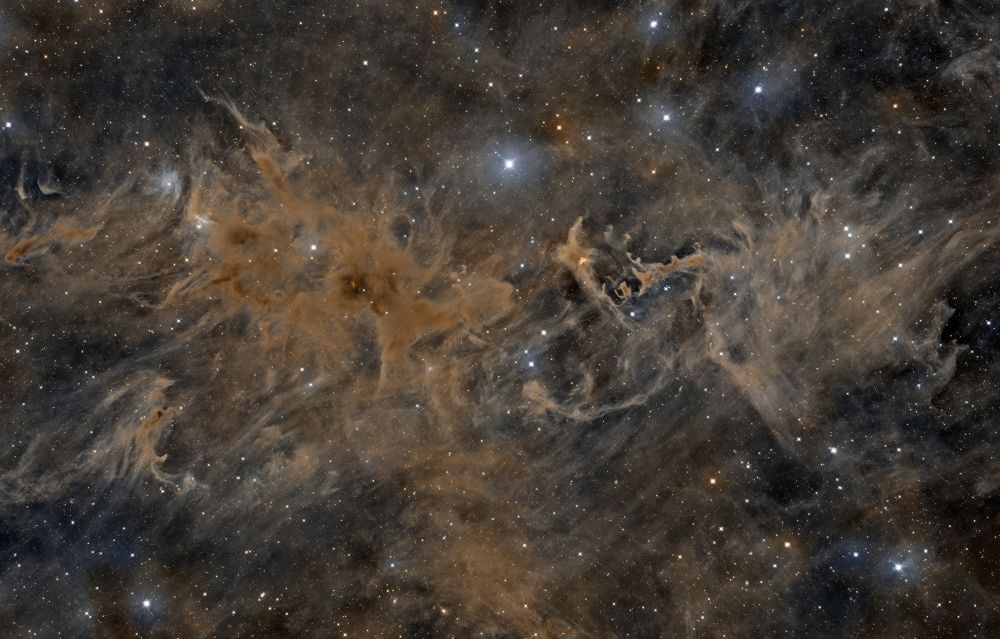
Lots of brown/grey molecular space dust in a field of stars
Molecular dust flying about 600 light-years away. This image is about 3.5x2.5 degrees, which means the moon would fit inside the field of view 35 times. Taken with my Takahashi Epsilon in SW New Mexico and processed in my astro-den in Virginia. #astrophotography #photography
02.08.2025 19:20 — 👍 96 🔁 15 💬 1 📌 1

The Cygnus Wall in NGC 7000 about 2.500 light years away. Starless with 8" Newton & 2600 mono. ~20 hours of exposure. #astrophotography
13.07.2025 19:49 — 👍 43 🔁 3 💬 0 📌 1

📢 J’adresse une lettre ouverte au préfet du Bas-Rhin.
Deux enfants scolarisés à Strasbourg ont été emmenés à Paris pour être expulsés. L’un a été menotté. Leur mère est déjà en Géorgie.
Cette violence d’État est inacceptable.
👉 Les droits de l’enfant doivent primer.
06.05.2025 14:55 — 👍 27 🔁 19 💬 1 📌 0
Thank you !
01.05.2025 20:07 — 👍 1 🔁 0 💬 0 📌 0

#astrophotography
01.05.2025 19:20 — 👍 18 🔁 2 💬 1 📌 0

Waxing gibbous moon, tonight
#astrophotography
10.04.2025 22:40 — 👍 70 🔁 12 💬 0 📌 0

The Moon
Tonight
#astrophotography
04.04.2025 22:24 — 👍 47 🔁 7 💬 1 📌 0

Les premières images d’Euclid dévoilées au Planétarium
Ce mercredi 20 mars, la mission Euclid de l’Agence spatiale européenne a publié son premier lot de données captées par le télescope spatial du même nom. A cette occasion, l’Observatoire astronomique d...
La mission Euclid de l’Agence spatiale européenne a publié son premier lot de données captées par le télescope spatial du même nom.
Ce 19 mars, l'@obsstrasbourg.bsky.social a accueilli des membres de l'équipe française du Consortium scientifique Euclid pour une projection commentée.
@esa.int
21.03.2025 08:12 — 👍 16 🔁 9 💬 0 📌 0
Thanks !
12.03.2025 22:05 — 👍 1 🔁 0 💬 0 📌 0

NGC 2237, Rosette Nebula
#astrophotography
app.astrobin.com/i/y0e199
12.03.2025 21:20 — 👍 99 🔁 6 💬 1 📌 0
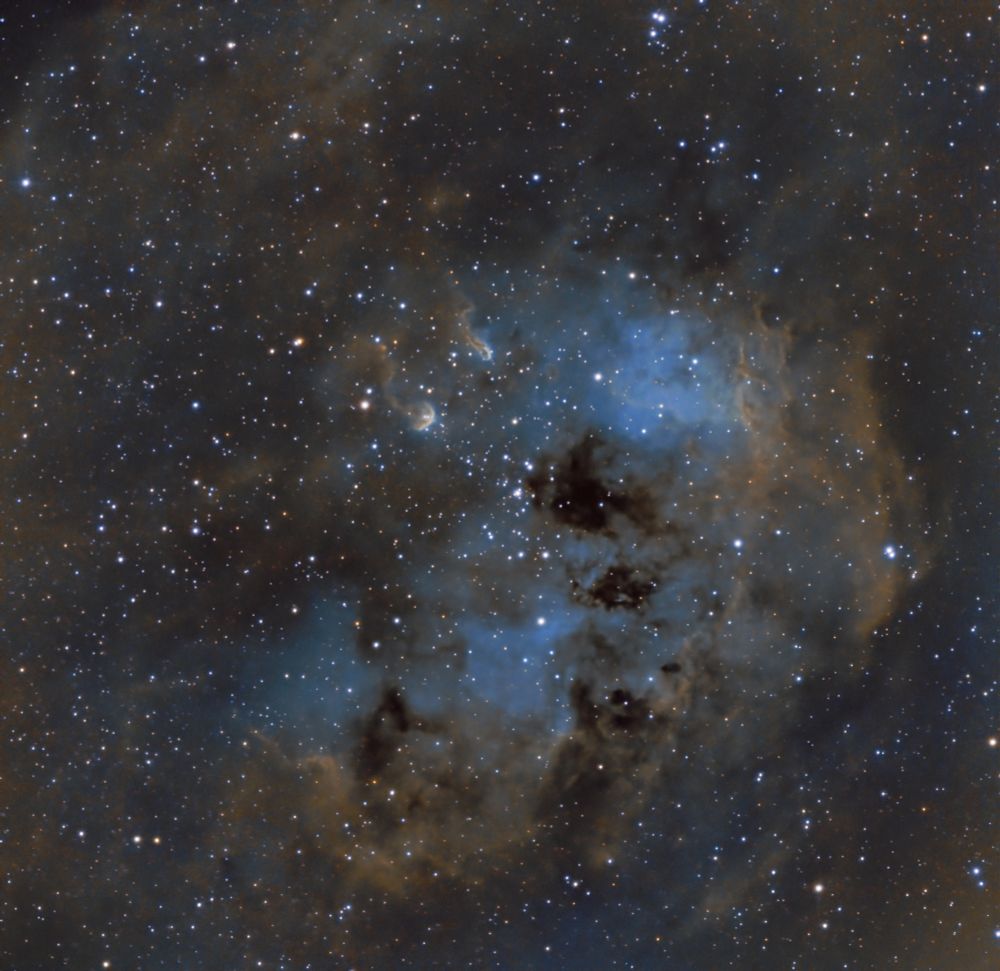
IC 410, the Tadpoles Nebula.
More on www.astrobin.com/czmq74/0/
#astrophotography
20.01.2025 22:52 — 👍 46 🔁 7 💬 0 📌 0
Thanks :-)
11.01.2025 15:01 — 👍 1 🔁 0 💬 0 📌 0
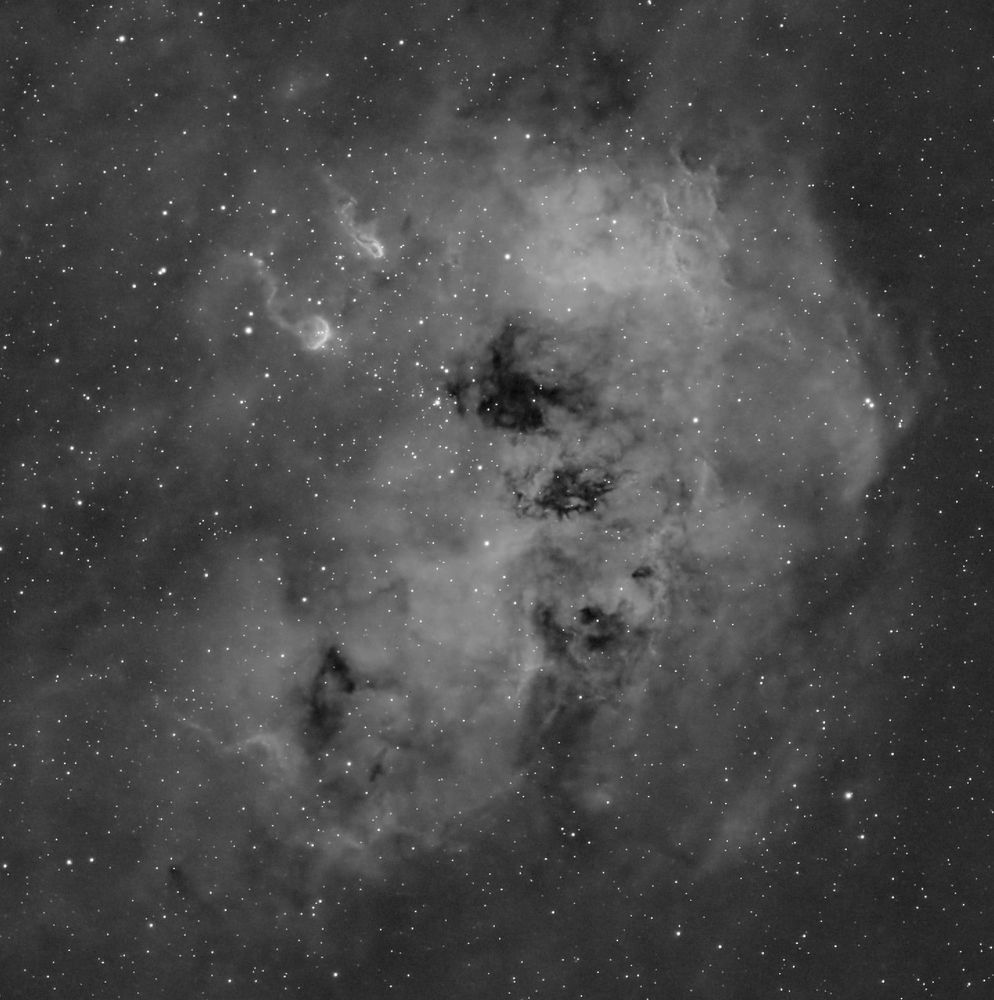
[work in progress] IC 410, Tadpole Nebula (Ha filter)
11.01.2025 09:33 — 👍 5 🔁 0 💬 1 📌 0
La Société astronomique de France est une association fondée par Camille Flammarion en 1887.
Ouverte à tous, son but est de diffuser les sciences de l’Univers et faire participer les amateurs à leurs progrès.
https://saf-astronomie.fr/ - lastronomie.fr
Amateur astronomer based in Essen, Germany
I'm Naz! An astrophotographer from of Boston. I post astrophotos as well as videos which I create to spread the good word about space.
shop.naztronomy.com/product/astronomy-calendar-by-naztronomy-2026
naztronomy.com
youtube.com/Naztronomy
Des chemins de traverse...
Amateur astronomer, sci-fi lover, STEM, art lover.
More women in science.
Working on my PhD
#transrightsarehumanrights
#loveistheanswer
#BLM
#landback
Writer. Revenant. Wrote THE SAINT OF BRIGHT DOORS (2023, Nebula, Ignyte, Crawford, and Locus awards) & RAKESFALL (2024, Le Guin Prize and Otherwise award.) Colombo/New York. https://vajra.me
Ursula K. Le Guin (1929-2018) was a celebrated author of novels, children’s books, poetry and essays. This account is managed by her estate.
https://www.ursulakleguin.com/
Maire de Strasbourg et présidente déléguée de l'Eurométropole, engagée pour la #justicesociale, le #climat et l' #Europe 🌱🚲🇪🇺
📱👉🏼 https://linktr.ee/jeannebarseghian
Journaliste 📺 France 3 Grand Est et BFM Alsace - Made in Ijba - StrasbourgMonAmour 🥨
Astronomer at the Strasbourg Observatory & CDS, working on super-massive black holes in the relics of galaxy nuclei. Can be found running otherwise.
📚 PhD student in Astrophysics
📍Strasbourg (France)
Profile picture credits: E. D.
Les propositions les plus insolites de la chaîne éditoriale.
En l'absence de réelle politique écologique, nous prenons les commandes #Écologie #Énergie #Environnement Compte parodique
Site perso: http://marcello.robert.free.fr
Actusf.com vous donne tous les jours des infos sur la science fiction, la fantasy, le fantastique...
Découvrez aussi sur Deezer ou Spotify le podcast Actusf !
Coopalim, ou comment faire ses courses autrement à Strasbourg ! Venez nous rejoindre dans ce projet : manger mieux à un prix juste pour le producteur et le consommateur
Plus de 60 organisations unies pour une société écologique, sociale et démocratique.
Médecin Urgentiste - 1er adjoint à la maire de Strasbourg - Vice-président de l’Eurométropole de Strasbourg - Finances, budget et RH
Compte officiel de la Ville et de l'Eurométropole de Strasbourg.
Laboratoire d'Instrumentation et de Recherche en Astrophysique de l'Observatoire de Paris - PSL.
Thèmes de recherche : Physique solaire, Planétologie, Exoplanètes, Galaxies, Physique stellaire, Plasma, Haute Résolution Angulaire
Physicien climatologue, Directeur de Recherche du CNRS au LMD/ENS/IPSL
Auteur principal du 6e et 7e rapport du #GIEC @IPCC_CH, Groupe 1: "Les bases physiques du Climat"
Co-fondateur des Trains du Climat
Climate Scientist @CNRS, IPCC AR6 and AR7 lead author