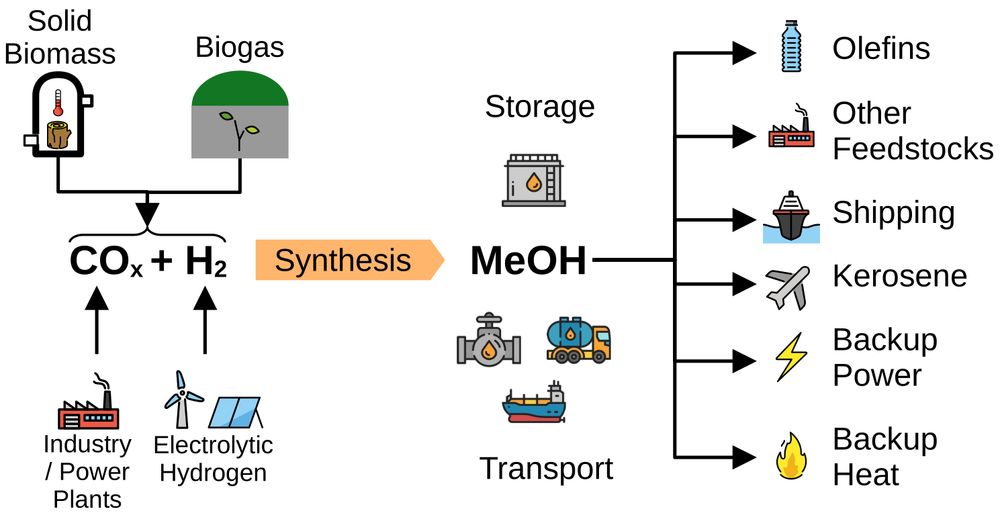
As the hydrogen bubble deflates, what are the alternatives? We present a "minimal methanol economy": using methanol as a gap-filler for the few sectors electrification can't reach.
New working paper together with Philipp Glaum, @fneum.bsky.social, @millinger.bsky.social:
arxiv.org/abs/2505.09277
19.05.2025 15:23 — 👍 56 🔁 18 💬 2 📌 8
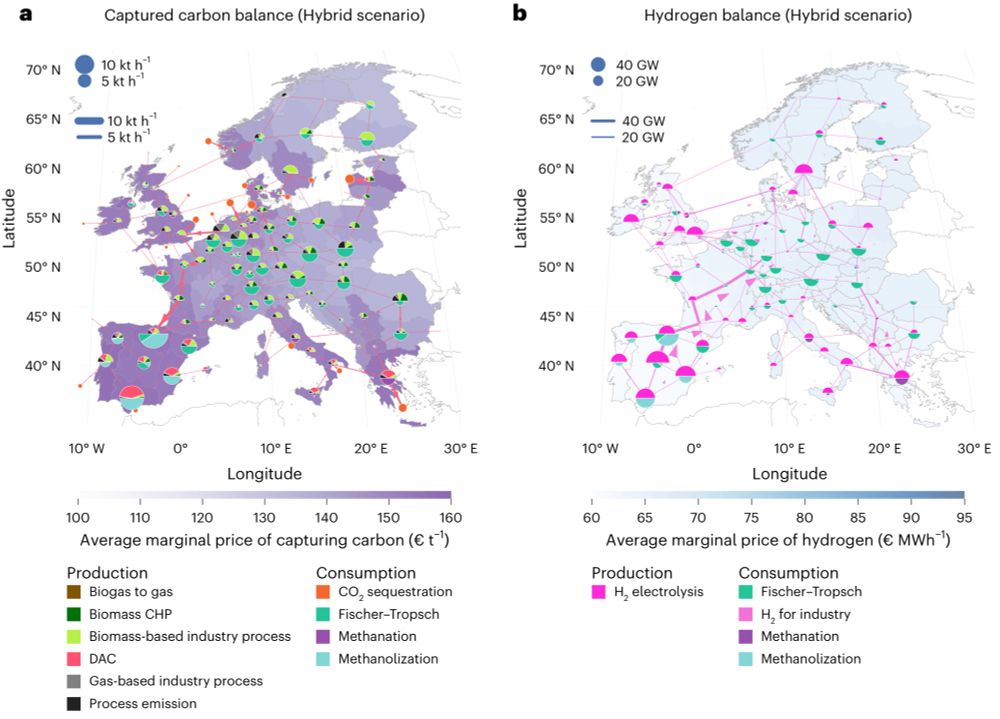
✈️🚢🧪For Europe's green fuels for aviation, shipping, and chemicals: Should we pipeline H₂ to industrial CO₂ capture sites, or CO₂ to regions with better renewable resources for H₂ production?
📖 See our new study in @natureenergy.bsky.social on future carbon management: www.nature.com/articles/s41...
11.04.2025 09:27 — 👍 25 🔁 12 💬 3 📌 3
Thanks Felix, yes I agree with you, going forward. I'll take a look at the studies you posted!
We include spatial detail for biomass on the country level. Hope you enjoy the read, and happy to discuss!
25.01.2025 22:33 — 👍 0 🔁 0 💬 0 📌 0
Policy Brief ¦ Biomass exclusion must be weighed against benefits of carbon supply in European energy system. @millinger.bsky.social
25.01.2025 13:30 — 👍 3 🔁 1 💬 0 📌 0
Thank you Marta! I'm happy to discuss it.
Have a nice weekend!
24.01.2025 15:50 — 👍 1 🔁 0 💬 0 📌 0
That is great! I haven't seen an IAM study with e-fuels/CCU yet though, are they out yet?
24.01.2025 09:29 — 👍 0 🔁 0 💬 1 📌 0
Thanks for sharing our study Adrian!
24.01.2025 06:28 — 👍 2 🔁 0 💬 0 📌 0
Renewable carbon can also be sequestered for negative emissions.
Among the challenges: key technologies such as BECCUS and DACCUS have yet to take off, and not all biomass is sustainably sourced today. But I don't see how it would take off without subsidies in waiting for a reliable carbon market.
23.01.2025 22:49 — 👍 1 🔁 0 💬 1 📌 0
Thank you Roger, hope you enjoy the read!
23.01.2025 22:32 — 👍 1 🔁 0 💬 1 📌 0
Thank you Jonas!
23.01.2025 22:28 — 👍 0 🔁 0 💬 0 📌 0
We used the state-of-the-art open-source European energy systems model PyPSA-Eur to analyse near-optimal solution spaces. Co-authors: Fredrik Hedenus, Elisabeth Zeyen @lisaze.bsky.social, Fabian Neumann @fneum.bsky.social, Lina Reichenberg and Göran Berndes.
23.01.2025 13:44 — 👍 3 🔁 0 💬 0 📌 0
➡️ Policy support for sustainable biomass use alongside emerging technologies reduces energy system costs and the risk of missing emissions targets.
23.01.2025 13:43 — 👍 2 🔁 0 💬 0 📌 0
We used the state-of-the-art open-source European energy systems model PyPSA-Eur to analyse near-optimal solution spaces. Co-authors: Fredrik Hedenus, Elisabeth Zeyen @lisaze.bsky.social, Fabian Neumann @fneum.bsky.social, Lina Reichenberg and Göran Berndes.
23.01.2025 13:42 — 👍 1 🔁 0 💬 0 📌 0
🔹 Bioenergy with carbon capture is more cost-competitive than DAC under a wide range of assumptions. This may inhibit DAC deployment unless it is targeted by policy.
23.01.2025 13:40 — 👍 3 🔁 0 💬 0 📌 0
🔹 Policies limiting biomass (residue) use likely need to be accompanied by strong policies to support a greater deployment of clean electricity, electrolytic hydrogen and direct air capture to achieve emissions targets.
23.01.2025 13:40 — 👍 2 🔁 0 💬 0 📌 0
🔹 Excluding biomass increases energy system costs by ~20% under a net-negative emissions target, like excluding wind power or electrolytic hydrogen.
23.01.2025 13:40 — 👍 2 🔁 0 💬 0 📌 0
Highlights:
🔹 The main value of biomass is to provide renewable carbon, rather than bioenergy. It is less central what biomass is used for if carbon is captured for reuse or sequestration.
23.01.2025 13:39 — 👍 3 🔁 0 💬 1 📌 0
 23.01.2025 13:38 — 👍 1 🔁 0 💬 0 📌 0
🚨 New Article and Policy Brief in Nature Energy 🚨
📄We examine the value of biomass in the European energy system and its interplay with other technologies under stringent emissions scenarios.
🔗 Article: doi.org/10.1038/s415...
🔗 Policy Brief: doi.org/10.1038/s415...
@natureenergy.bsky.social
23.01.2025 13:38 — 👍 31 🔁 12 💬 10 📌 3
Environmental economist | land use🚜🌱 / soils🪱 / biodiversity🪲 | behaviour & policy | social–ecological modelling | ast prof at @ufz.de & @unihalle.bsky.social | tea addict🫖 | jazz afficionado🎷 | born at 352 ppm | posts in 🇩🇪 🇬🇧 🇵🇱
https://bartoszbartk.com
Fossilfritt Sverige är ett regeringsinitiativ för att göra Sverige till ett av världens första fossilfria välfärdsländer
Research Software Engineer @ PyPSA
When I was born ('57) 2,8B people and 315 ppm CO2.Nowdays 7B and 415 ppm. Green economy roots are there.
Professor at Stanford Doerr, Advisor to Watershed. Steer Global Carbon Project, Co-lead Carbon Monitor, Contributing Author to IPCC, Tech Council of SBTi. https://sustainablesolutions.stanford.edu
Climate scientist, professor of Physics of the Oceans in Potsdam. Opinions my own.
Group Leader 'Renewable Energies' @UFZ
energy system modeller | head of department at Jülich Systems Analysis (FZJ-ICE-2) https://www.fz-juelich.de/en/ice/ice-2/research-1/integrated-scenarios
Advisor for scientific studies at VNG AG
Previously: TU Dresden
Topics: energy system analysis; hydrogen
Views are my own!
energ system modelling @ TU Berlin
decarbonising heavy industries
one (excel sheet) at a time
Dr. Sonia Yeh, Professor of Transport and Energy Systems at Chalmers University of Technology, Sweden, specializes in energy economics, sustainable transportation, and system modeling.
Visiting postdoc in mobility data science at Technical University of Denmark | postdoc at Chalmers University of Technology. #UrbanBigData & #Transportation | yuan-liao.com
Once a PhD in Physical Resource Theory. Now a Postdoc. Undisciplined engineer into sustainability transformations, critical systems practice and social learning
PhD student at Imperial College London researching demand response technologies. Always trying to find the cheapest way to decarbonise.
Global Climate Lead Scientist @WWF
IPCC Lead author AR7 and AR6
Working at the intersection of climate, biodiversity & sustainable development.
Research: Ecosystems, Food, CDR, Energy
Pinay, mom, sunshine hunter, LOL-er
Nature Energy is a peer-reviewed research journal that publishes the latest advances in the energy field, from the generation, storage, and distribution of energy to the societal impact of energy technologies and policies.
www.nature.com/nenergy