Whoops, apparently, a transparent background does not work. Here is our model schematics
07.04.2025 15:02 — 👍 4 🔁 0 💬 0 📌 0
@ninelk.bsky.social
Computational neuroscientist interested in movement and prediction
Whoops, apparently, a transparent background does not work. Here is our model schematics
07.04.2025 15:02 — 👍 4 🔁 0 💬 0 📌 0
Our study provides new insights into the neural code for feedback-driven motor control, showing that movement corrections can be encoded in small, yet behaviorally-relevant neural variability.
Check it out: www.biorxiv.org/content/10.1... #biorxiv

Finally, our model’s sequence-to-sequence behavior decoder allowed us to explore the temporal relationships between neural latent factors and behavior. The movement corrections generated latents that lag behind behavior by 90ms, suggesting a feedback-driven motor control strategy.
07.04.2025 14:54 — 👍 4 🔁 0 💬 1 📌 0
Comparing models on a force-field perturbation dataset, we found that model dynamics captures the movement plan (like LFADS), while behavior supervision captures transient corrections (like CEBRA). The best results are achieved with the combination of both.
07.04.2025 14:54 — 👍 2 🔁 0 💬 1 📌 0
We immediately achieved excellent results on Neural Latents Benchmark (neurallatents.github.io), outperforming both unsupervised as well as (semi-)supervised models on hand velocity reconstruction
07.04.2025 14:54 — 👍 3 🔁 0 💬 1 📌 0
We added behavior supervision in our Behavior Aligned Neural Dynamics (BAND) model to ensure that the neural code for movement correction is included in the latent variables, since movement corrections cause a substantial change in behavioral output.
07.04.2025 14:54 — 👍 2 🔁 0 💬 2 📌 0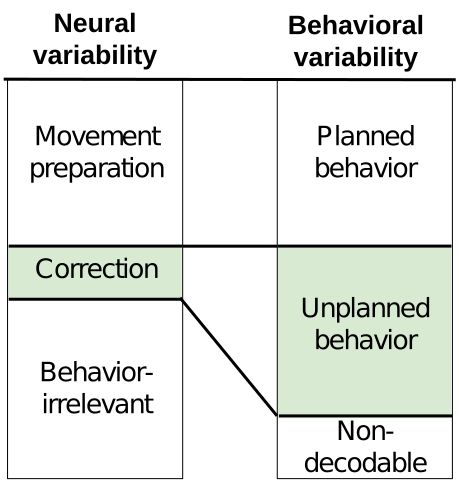
We hypothesize that, unlike movement plans, corrections to a perturbation only transiently deviate from planned trajectories. As a result, these corrections would be reflected in relatively few spikes (i.e. account for a small neural variability).
07.04.2025 14:54 — 👍 2 🔁 0 💬 1 📌 0
In data from [Perich et al. 2018], we found that monkeys showed hand velocity oscillations during center-out reaches in a force-field. These oscillations were decodable from M1 (not PMd), but unsupervised models like LFADS struggled to capture them in the latent space.
07.04.2025 14:54 — 👍 4 🔁 0 💬 1 📌 0Preparatory activity is a central source of neural and behavioral variability in motor areas. This is a baseline assumption for a computation through dynamics framework, which informs the current most powerful models in the field.
07.04.2025 14:54 — 👍 3 🔁 0 💬 1 📌 0
Excited to share our new pre-print on bioRxiv, in which we reveal that feedback-driven motor corrections are encoded in small, previously missed neural signals.
07.04.2025 14:54 — 👍 26 🔁 16 💬 1 📌 1