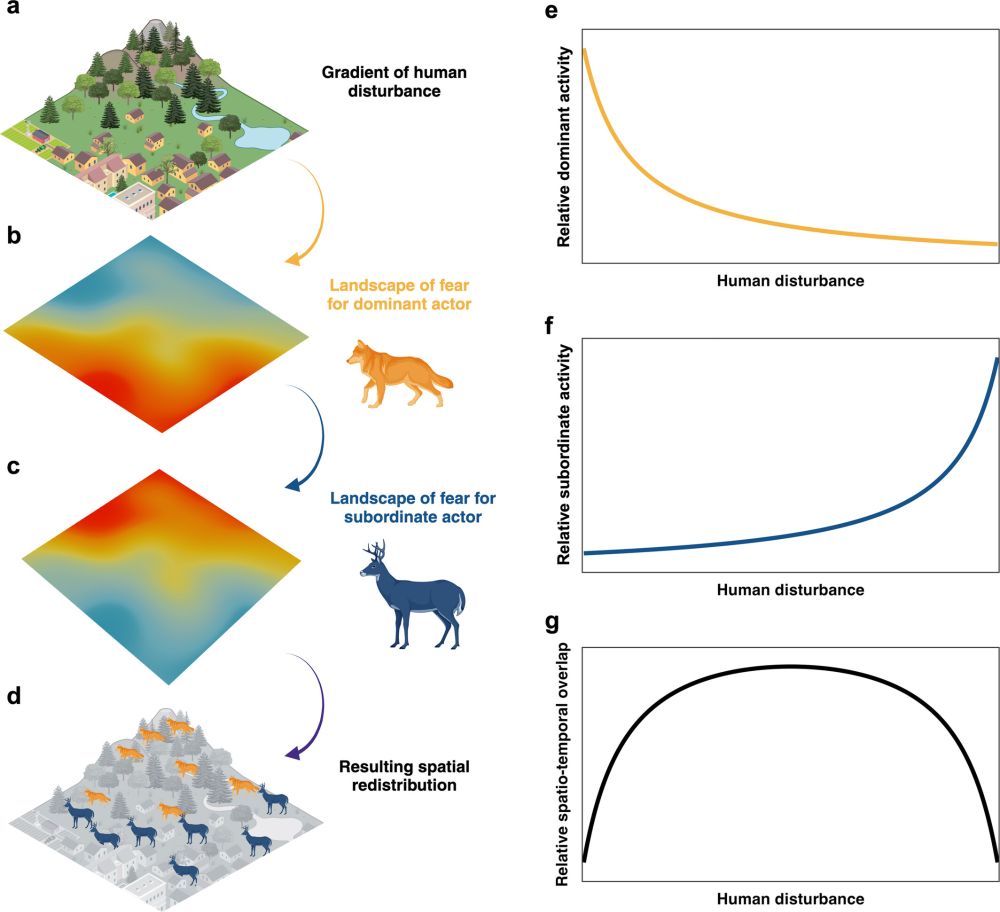
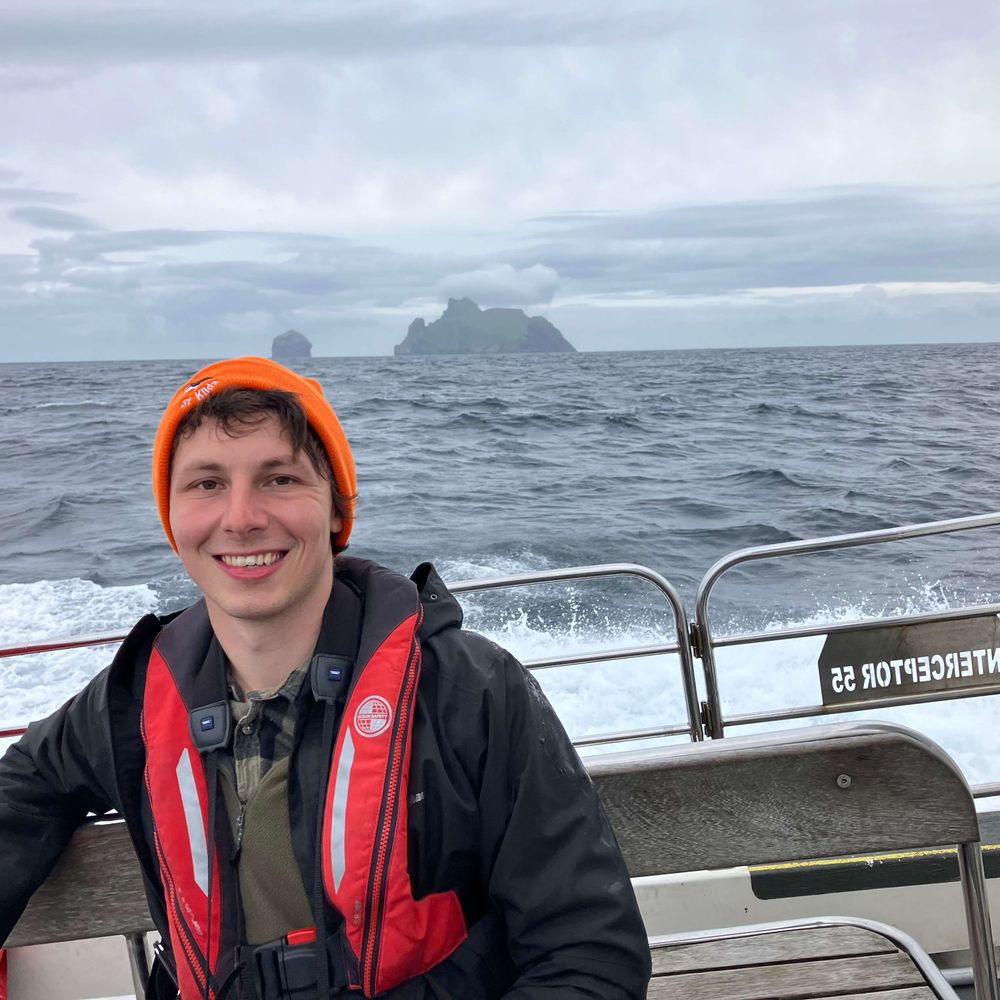
🌿 An honor to present at UC Berkeley's Wildlife Seminar where I talked about the use of AI + species distribution models to study agriculture's impacts on wildlife and One Health.
Thanks @ornithoale.bsky.social for hosting me!
#Wildlife #Tapirs #OneHealth #AIinConservation #UCBerkeley
17.10.2025 23:18 — 👍 9 🔁 1 💬 0 📌 0
Overall, a super fun experience and so lucky to work with my amazing collaborators: @ornithoale.bsky.social who inspired a lot of this work as well as @katherinelauck.bsky.social and Julian Tattoni who TAed the class and helped create this course-based research experience :)
09.10.2025 19:57 — 👍 4 🔁 1 💬 0 📌 0

Finally, larger, more attractive species were consistently more likely to be marketed.
This is despite prior work arguing that an emphasis on novel birds translates into dedicated birdwatchers preferring dull species.
Dedicated birdwatchers may value beauty in birds, just like everyone else.
09.10.2025 19:57 — 👍 1 🔁 2 💬 1 📌 0

Second, we were surprised that regularly observed species were more likely to be mentioned in trip itineraries.
Maybe tour operators are balancing novelty with the risk of disappointing clients when they inevitably fail to encounter rare species?
09.10.2025 19:57 — 👍 1 🔁 2 💬 1 📌 0

Ok, so what did we find?
First, tour operators recognized that birdwatchers value novelty above all else. Range-restricted species were ten times more likely to appear in trip itineraries than cosmopolitan species.
09.10.2025 19:57 — 👍 2 🔁 2 💬 1 📌 0


The most unique part: this was a multi-year class project! So fun to have undergrads help us collect the data, form their own questions, present posters, and then, eventually, have it turn into a published product!
(photos are example student posters)
09.10.2025 19:57 — 👍 1 🔁 1 💬 1 📌 0
Validate User
Stoked to share our new paper, just out in @amornith.bsky.social, that explores the traits that predict which species that appear in Costa Rican bird itineraries!
(open access link below, thread to follow)
academic.oup.com/condor/advan...
09.10.2025 19:48 — 👍 9 🔁 1 💬 1 📌 1
New paper out today led by Prof. @dskarp.bsky.social
Marketing birds: The traits birdwatching tourism companies highlight in Costa Rican tour itineraries
10.10.2025 00:30 — 👍 4 🔁 2 💬 0 📌 0

a man in a suit is crying in the rain .
ALT: a man in a suit is crying in the rain .
the worst part of every manuscript for an ornithologist,
yes, worse than tough reviewers
worse even than outright rejection
when they typeset the paper and all the species names are lower case
04.09.2025 17:43 — 👍 12 🔁 2 💬 0 📌 0
Happy to share our research on traditional farming landscapes in northwest Himalaya is out in Science Advances! Thanks to my advisor Tulja & all the wonderful collaborators- Ale @ornithoale.bsky.social, Katie @kasolari.bsky.social, Akshata, Kullu, Rinchen, Lamaji. 1/7 www.science.org/doi/10.1126/...
19.08.2025 20:59 — 👍 16 🔁 5 💬 1 📌 0
Check out our newest study published in Science Advances last Friday ❤️
19.08.2025 17:21 — 👍 1 🔁 1 💬 0 📌 0

Wednesday, August 13, 2025, 10:30 AM – 11:30 AM EDT
Preparing for a Career at a Research Station
Career Central Room 1 (Exhibit Hall)
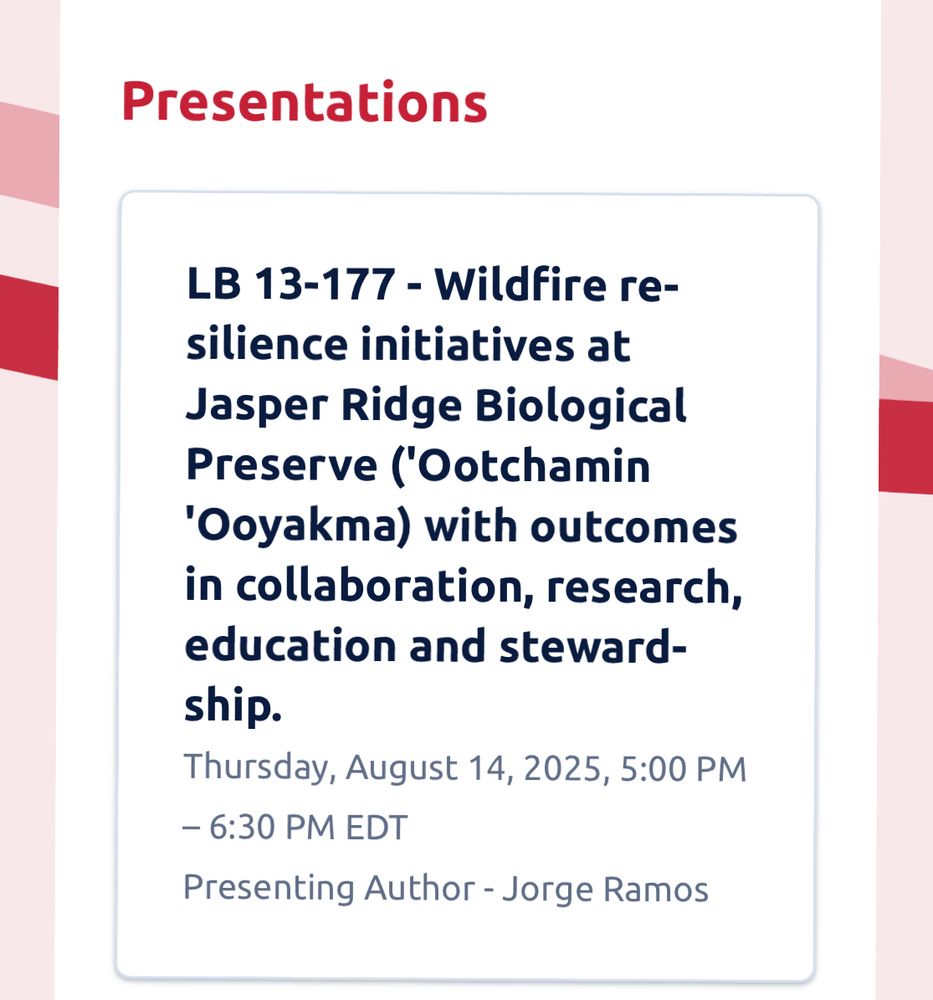
Presentations
LB 13-177 - Wildfire resilience initiatives at Jasper Ridge Biological Preserve ('Ootchamin 'Ooyakma) with outcomes in collaboration, research, education and stewardship.
Thursday, August 14, 2025, 5:00 PM – 6:30 PM EDT
Presenting Author - Jorge Ramos
See you at #ESA2025 next week!Find me at the ESA SEEDS events, Wed, 10:30 AM Panel on Careers at a Research Station with OBFS friends; and Thu, 5 PM Poster LB 13-177 on Wildfire resilience initiatives at Jasper Ridge Biological Preserve ('Ootchamin 'Ooyakma)!
08.08.2025 14:26 — 👍 12 🔁 4 💬 0 📌 1
Junior, Assistant, or Associate Specialist – Xue Lab
University of California, Irvine is hiring. Apply now!
The Xue lab at UC Irvine is looking for a staff scientist to support our work investigating how microbes interact and evolve in the gut microbiome! Open to a wide range of previous experience levels, see ad for more.
recruit.ap.uci.edu/JPF09601
17.07.2025 20:32 — 👍 116 🔁 112 💬 0 📌 3

A nine panel overview of native insects on native plants from our yard. Starting in the upper left, Agapostemon (a native bee) on echinacea, a young grasshopper, a Mydas fly swamp milkweed, a woolcarder bee with just its butt showing out of an obedient plant flower, two mating milkweed bugs (strikingly yellow and red) on milkweed, a hoverfly on a cherry blossom, another hoverfly on queen of the prairie flowerbuds, a monarch butterfly on blazing star, and a great black wasp on mountain mint.
Of course the main purpose of a yard is to attract bugs, and the best way to attract bugs is with native plants, so that’s mostly what we do. Here’s a sampling—descriptions in alt text. 🐝🦋🐛🐜🪰🪲🐞 (Remaining grass lets us play games and lets doggies chase balls, but is slowly going to clover)
07.07.2025 17:18 — 👍 119 🔁 24 💬 7 📌 1
It was a pleasure to work with my amazing interdisciplinary team of coauthors: @ornithoale.bsky.social, Maya Xu, @flamingmuffinz.bsky.social, Mei Li Palmeri, Meggie Callahan, Nicole Ardoin, and Gretchen Daily
14.05.2025 05:00 — 👍 1 🔁 1 💬 1 📌 0

This underscores the importance of urban community gardens - not only do they provide habitat for biodiversity and opportunities to access nature, but also many other benefits: social connections, education, and food sovereignty. Let’s work to protect and advocate for urban community gardens!
14.05.2025 04:58 — 👍 1 🔁 1 💬 1 📌 0

Regardless, these results are exciting - they suggest that community gardens have the potential to provide access to nature across an income gradient! People in both high and low income neighborhoods in San Francisco can have positive interactions with birds in gardens.
14.05.2025 04:58 — 👍 0 🔁 1 💬 1 📌 0
Why might this be? It could be because birds are highly mobile organisms, the nature of San Francisco (compact, lots of greenspace, heterogenous), regional effects (luxury effect is stronger in tropical and arid environments), or community gardens themselves.
14.05.2025 04:57 — 👍 1 🔁 1 💬 1 📌 0

For example, we expected lower income neighborhoods to have less canopy cover and therefore less avian species richness, but instead found all three of these variables were unrelated!
14.05.2025 04:57 — 👍 0 🔁 1 💬 1 📌 0
Instead, we found that avian species richness and abundance were predicted by local and landscape-scale environmental factors, very few of which were correlated with income.
14.05.2025 04:57 — 👍 0 🔁 1 💬 1 📌 0
Surprisingly, given past studies on the luxury effect that show higher biodiversity in higher income neighborhoods, we found no relationships between any of these metrics and garden income!
14.05.2025 04:57 — 👍 0 🔁 1 💬 1 📌 0
For each garden, we compared three bird metrics with garden income: species richness, abundance, and a species access metric, a metric for our 10 focal species that was higher where there were more individuals from species people noticed and cared about.
14.05.2025 04:56 — 👍 0 🔁 1 💬 1 📌 0

We dug into why attitudes differed. While less-popular species had mostly aesthetic disservices, popular species had both ecological and aesthetic services. This suggests that providing education about species’ ecological roles could be an important conservation tool!
14.05.2025 04:55 — 👍 0 🔁 1 💬 1 📌 0

However, we also wanted to understand how much gardeners noticed each species. When we weighted sentiment scores by recognition, the scores of less-charismatic species like the Black Phoebe dropped.
14.05.2025 04:55 — 👍 0 🔁 1 💬 1 📌 0

Using these results, we were able to assign each species a “sentiment score” and rank them in terms of positive sentiment. Most species had more positive than negative words associated with them, while corvids were the exception.
14.05.2025 04:54 — 👍 0 🔁 1 💬 1 📌 0
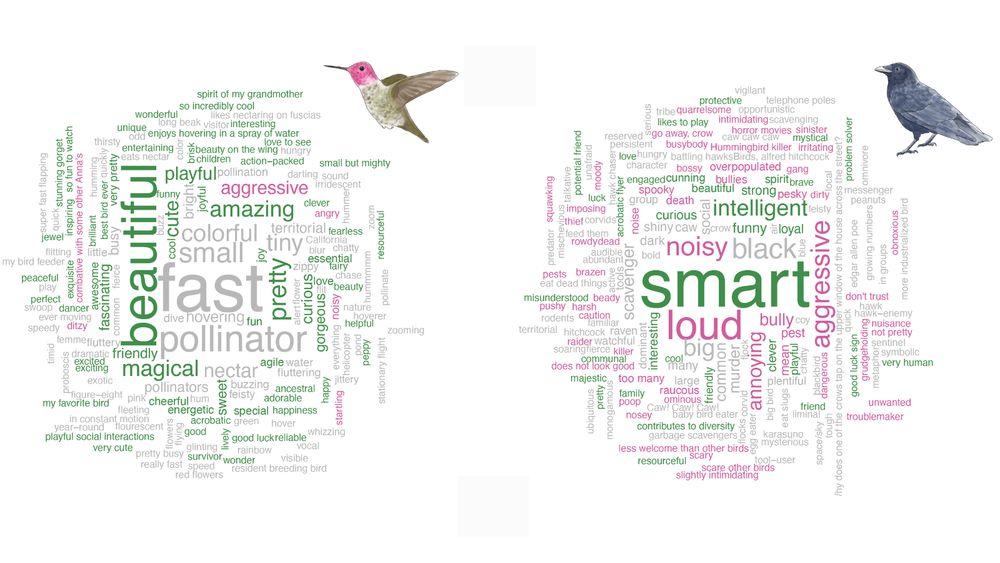
For each species, we performed a sentiment analysis, classifying words into positive, negative and neutral. While species like the Anna’s Hummingbird had primarily positive associations, others like the American Crow, were more controversial.
14.05.2025 04:54 — 👍 0 🔁 1 💬 1 📌 0
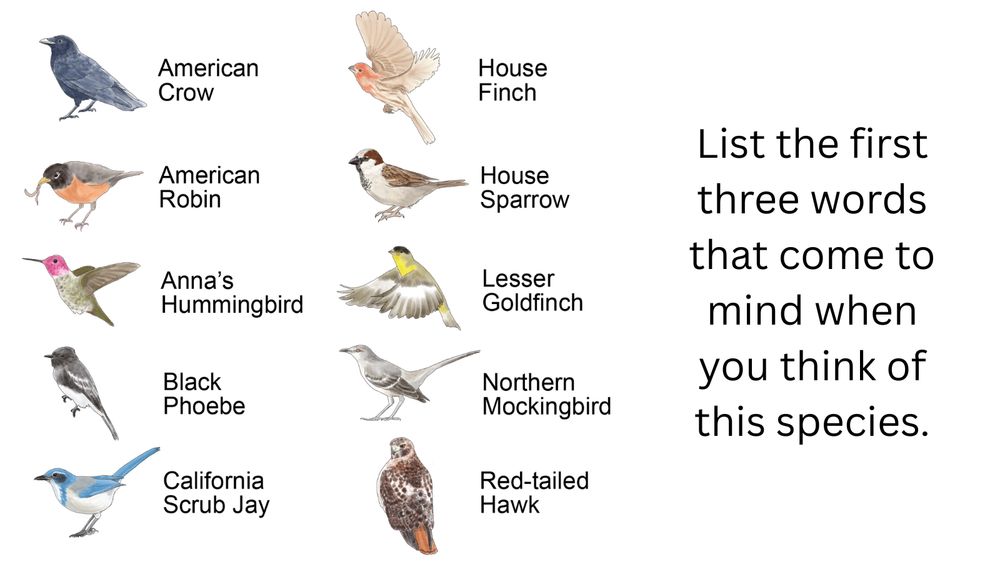
We also examined gardener attitudes towards 10 common garden species, chosen to capture a range of traits, through a word association task.
14.05.2025 04:53 — 👍 0 🔁 1 💬 1 📌 0
Postdoc, Natural Capital Project @Stanford | Chair, IUCN SSC Tapir Specialist Group | Fulbrighter | Passionate about improving agricultural systems to protect ecosystems and biodiversity. #Wildlife #Tapirs #HealthyEcosystems #LatinaInSTEM 🇨🇴
PhD Student | NSF GRF | Safford Vegetation and Fire Ecology Lab | Graduate Group in Ecology | U.C. Davis | Research on the nexus of avian ecology, fire ecology, and ecological forest management 🪺🌲🔥
HMEI Postdoc, Princeton university.
PhD '24 Stanford university.
Interested in population dynamics, theoretical ecology, and traditional farming landscapes.
Part-time bird writer for hire, part-time school garden educator. Author of Flight Paths: How a Passionate and Quirky Group of Pioneering Scientists Solved the Mystery of Bird Migration. She/her. https://linktr.ee/r_heisman
Biologist • Mom • PhD candidate @Stanford • Small Business Owner • Colombiana 🇨🇴 • She/Her/Ella/Mija • #LatinaInSTEM
Mayor-Elect of New York City
Professor passionate about student success & team science #firstgen #Brassica enthusiast walking Dogs of the Plant World
#Agriculture #Food #HigherEd #EduSky #Agsky #SciComm & more
#Soil #Crop #Science ; opinions mine
Conservation social science postdoc at Virginia Tech, former PhD in ecology at Stanford
Interdisciplinary conservation scientist studying human/wildlife relationships, birds, urban ecosystems, access to nature.
Field biologist - Academic Programs Coordinator at Alliance for a Sustainable Amazon, Peru
An open access @natureportfolio.bsky.social journal publishing high quality primary research, reviews, and commentary in Earth, environmental, and planetary science.
nature.com/commsenv/
UBC Zoology PhD Student l Gaynor Lab l Studying the ecology of carnivore reintroductions in Gorongosa National Park, Mozambique | he/him
Prof at #UCDavis
Work: evolution, ecology, function & phylogenomics of host-microbiome systems; #openscience;
Other: #birds; baseball; T1D
Lab phylogenomics.me
Pics jonathaneisen.smugmug.com
Links linktr.ee/jonathaneisen
TED go.ted.com/6WPm
Climate, extinction, and biodiversity scientist researching Earth’s past for a better future. Writing and podcasting for the planet. Chaotic good professor. Forever DM. Working to be a good ancestor. She/her. @makeaplanetpod.bsky.social
I am a professor of tropical ecology at the University of York. I have a passion for Mountain ecosystems and cultures across the Global South, particularly in Kenya and Tanzania where I work with many Universities, NGOs and Government organisations.
Biogeographer 🌏 mostly working on evolution of island organisms 🏝️(and mostly birds 🦉).
@leverhulme.ac.uk Early Career Fellow at @unibirmingham.bsky.social.
Professor at Univ of Washington @uwsafs.bsky.social I run models and synthesize data, love R graphics, and do research on the status of marine fisheries, fishing quotas, and blue whales @bluewhalenews.bsky.social
Cutting-edge research, news, commentary, and visuals from the Science family of journals. https://www.science.org
Ecologist, Professor at the University of Michigan, Executive Editor at Journal of Animal Ecology, and once claimed to be a former professional wrestler.
Wildlife Disease Ecology and Conservation, Author, Dad, Princeton Professor, External Faculty Santa Fe Institute and STRI. Photographer, cook, & nerd who works in Serengeti, Yellowstone, California, NJ, and collects guitars and books. Rewilding his yard!
Phylogenomics, Biogeography, bees. Postdoctoral researcher at USP, Brazil.