CRESSENT Schematic
Worried your ssDNA virus genomes aren't getting enough love? Now they can, thanks to CRESSENT, a new software package from Ricardo Pavan, @sullivan-lab.bsky.social, and I! 🧬💻🧪
Out now: doi.org/10.1099/mgen...

@karatasmustafa.bsky.social
PhD student and #FWO fellow at Laboratory of Metagenomics, Rega Institute, KU Leuven, Belgium. Working on environmental surveillance of viruses using #metagenomics #viralmetagenomics
CRESSENT Schematic
Worried your ssDNA virus genomes aren't getting enough love? Now they can, thanks to CRESSENT, a new software package from Ricardo Pavan, @sullivan-lab.bsky.social, and I! 🧬💻🧪
Out now: doi.org/10.1099/mgen...

🚨 New paper in Eurosurveillance - @karatasmustafa.bsky.social
We used shotgun metagenomics on indoor air in a Belgian daycare to track respiratory, enteric & skin viruses.
👉 40/42 samples contained human viruses—even when kids seemed healthy!
📄 Read here: pubmed.ncbi.nlm.nih.gov/41000028/

Figure 3. (A–N) Sequencing coverage plots of genetic sequences of viruses detected in indoor air samples of a daycare and phylogenetic analyses of sequences of (O) two human bocaviruses and (P) one RSV identified in some samples, Belgium, January–December 2022
New paper out!
We sampled indoor air for a year in a Belgian daycare and used shotgun metagenomics to track viruses. We recovered many viral genomes of interest.
What would you sample next?
Read at @eurosurveillance.org
@emmanuel-microb.bsky.social, @jellematthijnssens.bsky.social
-->
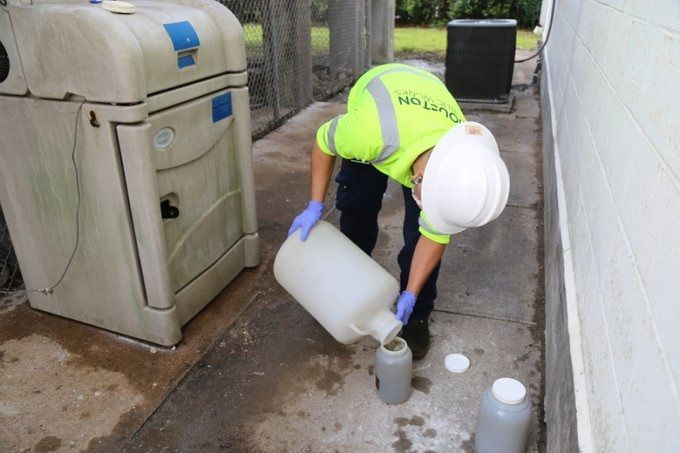
An innovative outbreak detection program that tracks viruses in #wastewater identified the #measles virus in #Houston in early January 2025, before cases were reported. #TailorLabs #saracregeen @miketisza.bsky.social @bcmhouston.bsky.social #TEPHITexas #RiceU @apha.org www.bcm.edu/news/measles...
13.05.2025 15:46 — 👍 4 🔁 3 💬 0 📌 0
Another example of how wastewater sequencing is going to positively impact Public Health. TEPHI's Outbreak Detection program shows once more the sensitivity and specificity of agnostic sequencing .... ajph.aphapublications.org/doi/abs/10.2...
09.05.2025 00:12 — 👍 2 🔁 2 💬 0 📌 0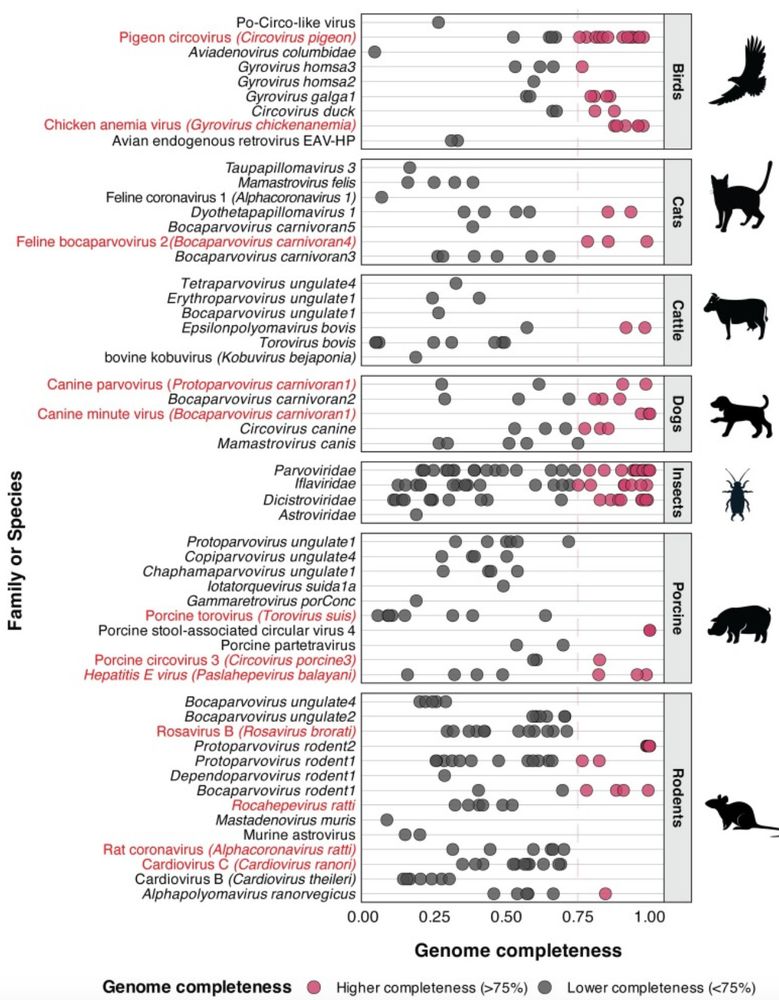
Check out our latest paper on how #wastewater can be used to track animal and #zoonotic #viruses in urban settings!
pubmed.ncbi.nlm.nih.gov/40318358/
Great work by @karatasmustafa.bsky.social in collaboration with @marcvanranst.bsky.social @wollants.bsky.social @stevenvangucht.bsky.social
and what we found is probably just the beginning. There’s a whole world of viruses out there in the sewers!
You can check out all the details here, at Environment International:
doi.org/10.1016/j.en...
@jellematthijnssens.bsky.social
@wollants.bsky.social @vanranstmarc.bsky.social
that animal viruses are part of the urban environment too. And just like us, they leave their mark in the wastewater!
In our latest study, we used a hybrid-capture metagenomics approach on wastewater to detect not only human viruses but also a wide range of animal viruses —

🎉🎉 Happy to share our new paper! 🎉🎉
Have you ever wondered about the animal viruses living right alongside us in our cities?
Between our pets at home, rats in the sewers, pigeons on the streets, insects everywhere, and even farm animals nearby, it’s no surprise +++

Clinical translation of microbiome research www.nature.com/articles/s41... #microbiome
20.04.2025 16:10 — 👍 8 🔁 2 💬 0 📌 0To answer their study question on the influence of the COVID-19 pandemic on rotavirus infections in Belgium, @karatasmustafa.bsky.social et al. used data collected 10 years before, 2 years during, and 2 years after the pandemic
#IDsky #EpiSky 🦠
👇🏽
• A new equine-like G3P[8] rotavirus variant has become dominant, especially post-pandemic. While vaccines prevent severe disease, they may be less effective against this genotype.
• Continuous genomic surveillance is crucial!
Feel free to read more in our article!
@jellematthijnssens.bsky.social
• COVID-19 measures reduced rotavirus circulation, but easing restrictions led to a resurgence, especially among children between 2 and 5 years old.
• Seasonality was disrupted and was linked to measures.
• We may be overlooking rotavirus cases in older populations due to testing practices.
📢 Excited to share the first paper of my PhD: 14 years of rotavirus epidemiology in Belgium!
Read the full story on Eurosurveillance: @eurosurveillance.org
👉 www.eurosurveillance.org/content/10.2...
#Rotavirus #Virology #PublicHealth #Epidemiology #EpiSky #IDsky
Key messages -->

🚨 New paper alert! 🚨 How did the #COVID_19 pandemic impact #rotavirus epidemiology in Belgium? Read all about it in our latest paper in @Eurosurveillanc:
eurosurveillance.org/content/10.2...
@karatasmustafa.bsky.social @vanranstmarc.bsky.social @wollants.bsky.social
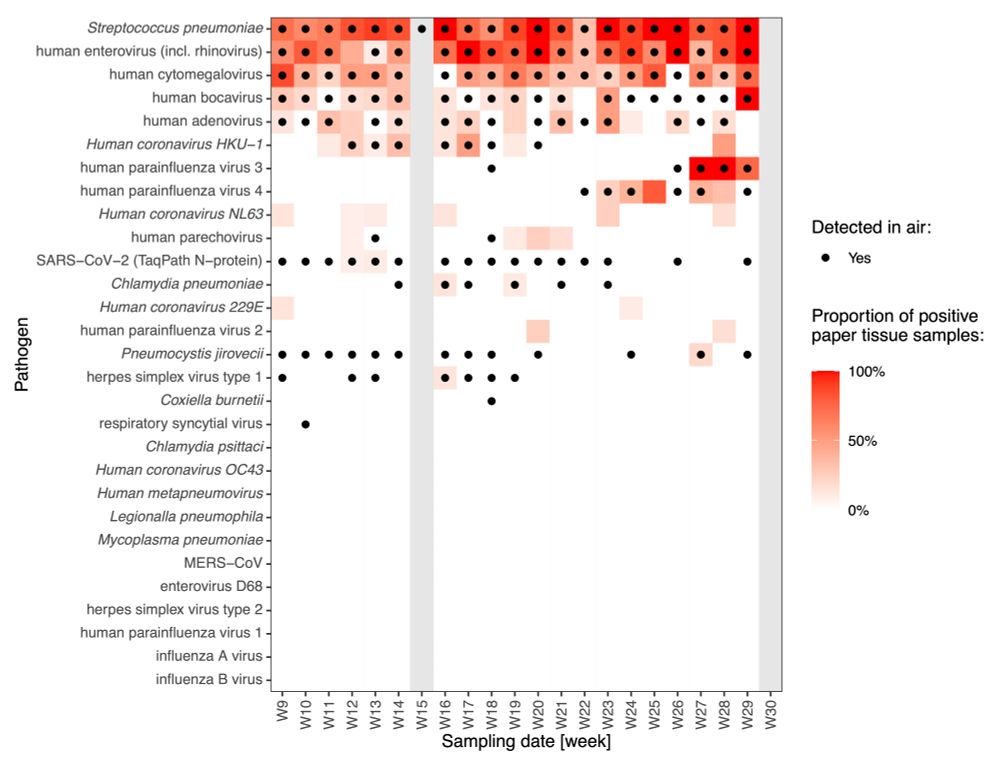
Heatmap chart showing the detection of various pathogens over different sampling weeks (W9 to W30). Pathogens are listed on the y-axis, including viruses and bacteria such as Streptococcus pneumoniae, human coronaviruses, influenza viruses, and others. The x-axis represents the sampling weeks. Black dots indicate detection of the pathogen in the air. The colour gradient, ranging from white to dark red, represents the proportion of positive paper tissue samples, with darker shades indicating higher proportions. This alt text was generated by ChatGPT.
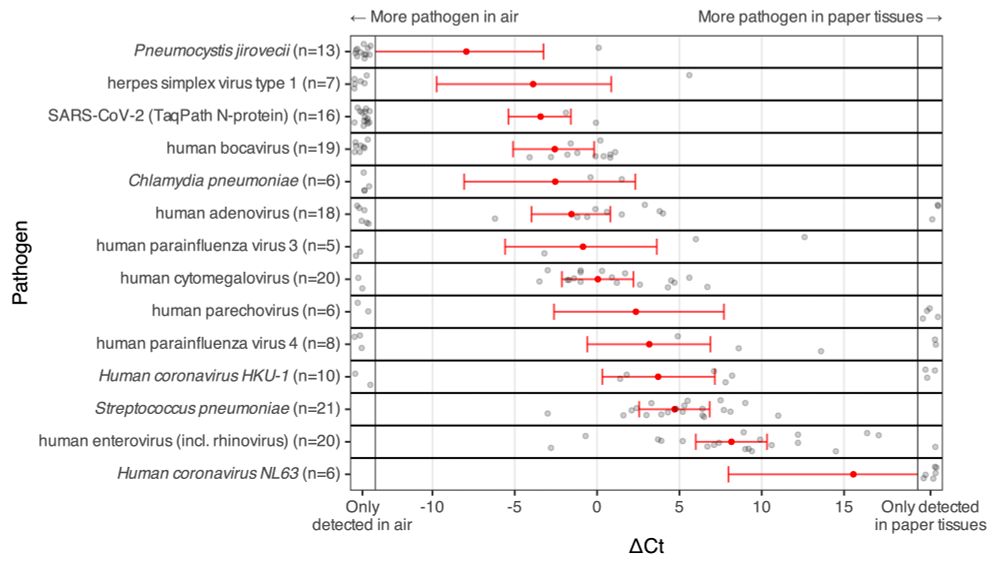
A chart showing the relative detection of pathogens in air versus paper tissues, with pathogens listed on the y-axis (e.g., Pneumocystis jirovecii, herpes simplex virus type 1, SARS-CoV-2). The x-axis represents ∆Ct values, where negative values indicate higher detection in air and positive values indicate higher detection in paper tissues. Red dots represent the mean ∆Ct for each pathogen, and horizontal red error bars represent the 95% confidence intervals. Individual grey dots indicate data points for each sample. Pathogens are arranged by their relative prevalence in air and paper tissues. This alt text was generated by ChatGPT.
New study: analysing indoor air to detect outbreaks.
“… Air sampling could provide sensitive, responsive #epidemiology indicators for surveillance of respiratory pathogens…”
See thread for details and previous air sampling work with @emmanuel-microb.bsky.social…
#IDEpi #IDsky #PedsID #KULeuven 🛟

New #kuleuven study: indoor air sampling to monitor respiratory infections in childcare settings. 🧒🏽🏫 Key findings: 🔬 Sensitive pathogen detection 🌬️ Correlation with CO2 & infection rates 📈 Early outbreak warnings
👇 www.thelancet.com/journals/ebi...
#PublicHealth #Epidemiology #RespiratoryInfections

2️⃣ Metagenomics can find unexpected viruses in air. Also viruses associated with skin infections or gastroenteritis.
More in this preprint with the Rega Institute’s Viral Metagenomics Lab:
@karatasmustafa.bsky.social , @jellematthijnssens.bsky.social
www.medrxiv.org/content/10.1...
🦠Human-associated viruses were detected in 95% of samples (pathogenic and non-pathogenic!)
📈Results correlated with epidemiological patterns
🧬Genome reconstructions allowed discrimination of viral subtypes
Thanks to my supervisors
@jellematthijnssens.bsky.social & Emmanuel André
#metagenomics
Happy to share my first post here!
Feel free to look at our preprint, which is currently under review (with constructive and encouraging comments from reviewers!).
We performed viral metagenomics to track viruses in the indoor air of a daycare center:
Our findings... (see the next post!)-->