#DHL and #AnPost seem to have lost my workstation. Sent it from Munich to Ireland. AnPost says they are returning it because label had an issue. DHL thinks it’s still in Germany. If it’s returned to Germany I can’t get it shipped back because I don’t live in Germany anymore.
04.07.2025 12:18 — 👍 1 🔁 0 💬 0 📌 0
We cannot change our past, but we can look critically at our present and work to shape a better future.
24.06.2025 18:55 — 👍 7 🔁 3 💬 0 📌 0
I think we have the mathematical tools to argue for the efficacy and outcomes of interventions in these situations, and the people conducting the experiments are well-equipped to use them.
The demand should be for rigorous analysis, not “you must use this approach”. We are not in primary school.
23.06.2025 22:10 — 👍 0 🔁 0 💬 1 📌 0
Have we some “explanation” or “reasoning” as to how instabilities are caused?
Could you explain how info is propagated across layers in your approach vs densenet in some more details over the conversation?
How do your approaches scale when we need to do RL on say LLMs?
2/2 (for now) Thanks again!
23.06.2025 22:04 — 👍 0 🔁 0 💬 0 📌 0
Beautiful work, thank you for the overview!
I haven’t done RL work in half a decade — I thought delayed updates with exp moving average of target networks helped deal with these instabilities. I assume it’s not enough given your paper.
1/N
23.06.2025 22:04 — 👍 0 🔁 0 💬 1 📌 0
If this is indeed it, then we have good reasons to be optimistic, no?
23.06.2025 16:02 — 👍 0 🔁 0 💬 0 📌 0
Maybe I am just seeing things, but it looks like we are past the upper inflection point of the sigmoid.
Do we have sims of different scenarios?
23.06.2025 16:01 — 👍 0 🔁 0 💬 1 📌 0
Don’t worry, scientists thought of that as well. There is a whole science of communicating with future people that don’t speak our language.
From hostile architecture, to death symbols.
23.06.2025 13:34 — 👍 0 🔁 0 💬 1 📌 0
The very active isotopes of fast-breeder-reactor waste decay over 300 years and need containment.
The very inactive isotopes take thousands of years and are indistinguishable from background radiation. They pose a problem only when ingested or inhaled.
23.06.2025 13:32 — 👍 0 🔁 0 💬 2 📌 0
So personally, if the choice was living close to a nuclear reactor or storage facility vs living next to a battery factory or a solar factory, I’d take my chances with the former.
23.06.2025 13:01 — 👍 0 🔁 0 💬 1 📌 0
Your risk of developing cancer is hundreds of times higher tanning in the sun on a high UV day than living close to a containment facility.
23.06.2025 12:58 — 👍 0 🔁 0 💬 1 📌 0
For fast breeder reactors, the half-life of the more active isotopes is 300 years, then it gaps to thousands of years for the longer dated ones.
The longer dated isotopes are so inactive they might as well be background radiation. In fact, for them to do damage they need to be ingested or inhaled.
23.06.2025 12:58 — 👍 0 🔁 0 💬 2 📌 0
So the important thing to know is that longer lived isotopes are less dangerous than shorter dated isotopes. Inversely proportional actually [1].
[1] en.wikipedia.org/wiki/Technet...
23.06.2025 12:58 — 👍 0 🔁 0 💬 1 📌 0
The US does not recycle nuclear waste or use breeder reactors.
23.06.2025 12:42 — 👍 0 🔁 0 💬 0 📌 0
It also implies not being dogmatic about particular solutions or fear mongering about things we don’t actually understand and shoving our head in the ground like ostriches.
It is in our best interest to think in 5 years, in 10, in 20, and in 50.
23.06.2025 12:40 — 👍 1 🔁 0 💬 0 📌 0
That implies reducing waste, improving efficiency, reducing reliance on complex chains, funding sciences, math, physics, material science, chemistry, biochemistry, biology, computational sciences and so on.
7/8
23.06.2025 12:40 — 👍 1 🔁 0 💬 1 📌 0
But because the constant supply chain issues reverberated across markets, resulted in difficult to predict outcomes, and threatened stability.
It follows then that the right thing to do to protect our society is reduce the fragility of the system.
6/8
23.06.2025 12:40 — 👍 1 🔁 0 💬 1 📌 0
As much as I hate to say this, the cynic in me believes that we did not make the decision to go off oil not because of climate change leading animals to extinction and threatening ordinary population.
5/N
23.06.2025 12:40 — 👍 1 🔁 0 💬 1 📌 0
It is integral to identify all the ways that said supply chains can go wrong, and ameliorate the situation. The oil crises are exemplars of this.
4/N
23.06.2025 12:40 — 👍 1 🔁 0 💬 1 📌 0
of modern society.
It follows that any country that aims to think in decades about its own sovereignty should seek to minimize the effects of disruption on its supply chains.
Betting it all on any one particular technology is naive if not outright stupid, and when evaluating solutions, 3/N
23.06.2025 12:40 — 👍 1 🔁 0 💬 1 📌 0
Just as we don’t know the future in sciences we don’t know the future in terms of geopolitics.
Covid, the Russian invasion of Ukraine, the aggression of CCP towards Taiwan, the Israeli and US war on Iran, the US’ unnecessary and myopic tarrifs exposed the fragility of the complex supply chains 2/N
23.06.2025 12:40 — 👍 1 🔁 0 💬 1 📌 0
When we as the broader society fund sciences, we don’t put all our eggs in one basket. We fund as wide as we can, with some areas a little more or less.
We don’t know what the future holds, and thus we try to explore as much as possible.
The responsible approach is to plan in decades. 1/N
23.06.2025 12:40 — 👍 1 🔁 0 💬 1 📌 0
Nothing you have said around here is of substance.
Just assertions that can be dismissed with the same effort you spent writing them, and a “gotcha” that lost you any and all credibility.
23.06.2025 12:13 — 👍 1 🔁 0 💬 1 📌 0
Of course your argument is also a whole lot of bullshit because you are not arguing in good faith here.
We seal the uranium and all fission products in lead contains that can withstand collisions with cars and don’t allow radiation to leak out.
23.06.2025 12:12 — 👍 0 🔁 0 💬 2 📌 0
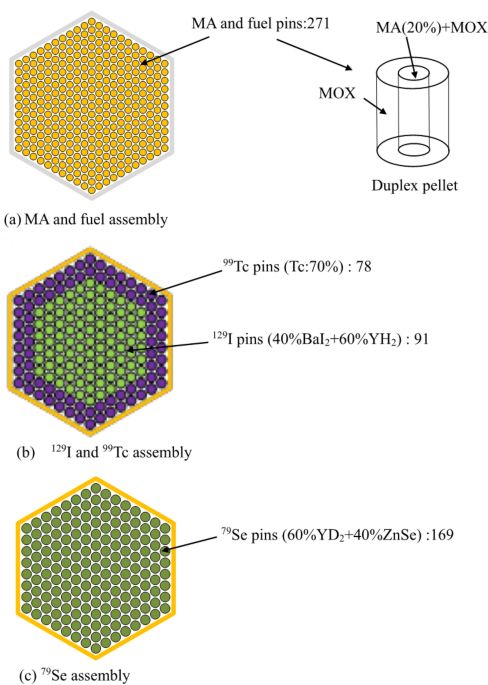
Concept of a fast breeder reactor to transmute MAs and LLFPs - Scientific Reports
Scientific Reports - Concept of a fast breeder reactor to transmute MAs and LLFPs
After breeder reactor processing, the waste is primarily fission products that decay to safe levels in 300-500 years, leaving only seven very long-lived isotopes (200,000+ year half-lives) at very low activity levels.
www.nature.com/articles/s41...
23.06.2025 12:10 — 👍 0 🔁 0 💬 1 📌 0
Nuclear is a far more stable and predictable source too. Contrast this with the issues that arise in dealing with over and under production, potential cascades due to lots of smaller power plants, limits or failures of energy storage, and all your “simplicity” arguments go out the window.
23.06.2025 12:06 — 👍 1 🔁 0 💬 2 📌 0
Standard nuclear reactors are already a solved problem and we don’t need to care about complex supply chains or weather systems or integration of lots of moving pieces, nor do we care about batteries.
23.06.2025 12:03 — 👍 1 🔁 0 💬 2 📌 0
Lmao.
23.06.2025 12:01 — 👍 0 🔁 0 💬 0 📌 0
I am not even opposed to solar and renewables, I just find it fascinating how lay people got convinced that nuclear is not safe when we have all the data and numbers, when the tech pushes forward even without all the funding given to renewables, and that they are without their own sets of problems.
23.06.2025 09:25 — 👍 1 🔁 0 💬 1 📌 0
bsky.app/profile/quee...
23.06.2025 09:13 — 👍 0 🔁 0 💬 1 📌 0
Leftist web guy. Big public infrastructure fan. The other one on Burn These Books.
#1 John Tory Hater.
He/him mostly.
youtube.com/@burnthesebooks
Father, author, developer, maker. Sometimes called "an inflammatory enigma". #stl #ansible #k8s #raspberrypi #mac #crohns www.jeffgeerling.com
Whispering from the Void.
ESRB: TEEN
Choose a better internet where privacy is the default. Start protecting your personal information online with Proton Mail, Proton VPN, Proton Drive, Proton Pass, Proton Wallet, and Lumo: https://proton.me/
18+ 🧁 full snack developer
I run @booksky.club, the Tolkien feed, the Cooking feed, the BoobSky feed, the ButtSky feed etc 🫡
🌶 of.com/clarabellewoods/c50
🎁 throne.com/clarabellewoods
☕️ https://ko-fi.com/clarabelle
We're increasing the cost of lies that undermine democracy ☀️
Read our analysis: https://americansunlight.substack.com/
Join our Patreon: https://www.patreon.com/americansunlightproject
Support our work: https://www.americansunlight.org/donate
Grateful. 🚫maga. Follower of truth. Builder of things. #Runner #Resister There is still hope!
Follow me for Coding, Computers, and Backend stuff.
Community at Pulumi
Host of CoRecursive
Give me feedback: https://admonymous.co/adamgordonbell
Serverless enthusiast. DuckDB afficionado. AWS Community Builder.
Building @sql-workbench.com @ownstats.com @learningduckdb.com
Blog: https://tobilg.com
AWS Serverless Hero, Cloud & AI consultant, and founder @getampt.com. I build, blog, speak, and publish OffByNone.io.
AWS Serverless Hero & Principal Engineer @ PostNL
@__steele on the bird site. Lefty, in every sense of the word. AWS Hero, I mostly post about cloudy things and silly projects I’ve worked on. I also post photos of my dog. He/him.
sugarbaby cosplaying as a tech consultant • mean eastern european with unrealistically high expectations and unreasonable quality standards
🏳️🌈he/him🏳️🌈
AWS Hero
Staff Eng @ Datadog
Streaming at: twitch.tv/aj_stuyvenberg
Videos at: youtube.com/@astuyve
I write about serverless minutia at aaronstuyvenberg.com/
Principal Developer Advocate | Former AWS Serverless Hero | Engaged to the wonderful @arcticf0xx.com | Opinions are my own | gunnargrosch.com | Sweden + Bay Area
Principal Meme Engineer.
Support Ukraine & Trans lives NOW, when it matters the most.