🚀 We’re hiring - Join our lab 🚀
🔍 Hiring: PhD (75% TV-L) & Postdoc (100% TV-L)
🧠 fMRI, VR, EEG, modelling
We combine a range of cognitive neuroscience methods to study flexible behaviour.
📅 Start: Feb 2026 or later | ⏳ Apply by Nov 3!
More details:
tinyurl.com/ms3a9ajt
#CognitiveNeuroscience
27.10.2025 11:57 —
👍 53
🔁 44
💬 1
📌 2
Enhancing memory using cross-species closed-loop Targeted Memory Reactivation | mrcbndu
** We have up to TWO funded PhD positions available in our lab!! Apply below to find new ways to enhance memory👇 Pls retweet **
Deadline: 2nd December
1. Cross-species closed-loopTMR: tinyurl.com/bddu4tp6
2. TUS and TMR in humans:
tinyurl.com/jjws5ctj
Happy to chat to interested applicants.
06.10.2025 11:51 —
👍 48
🔁 46
💬 1
📌 1
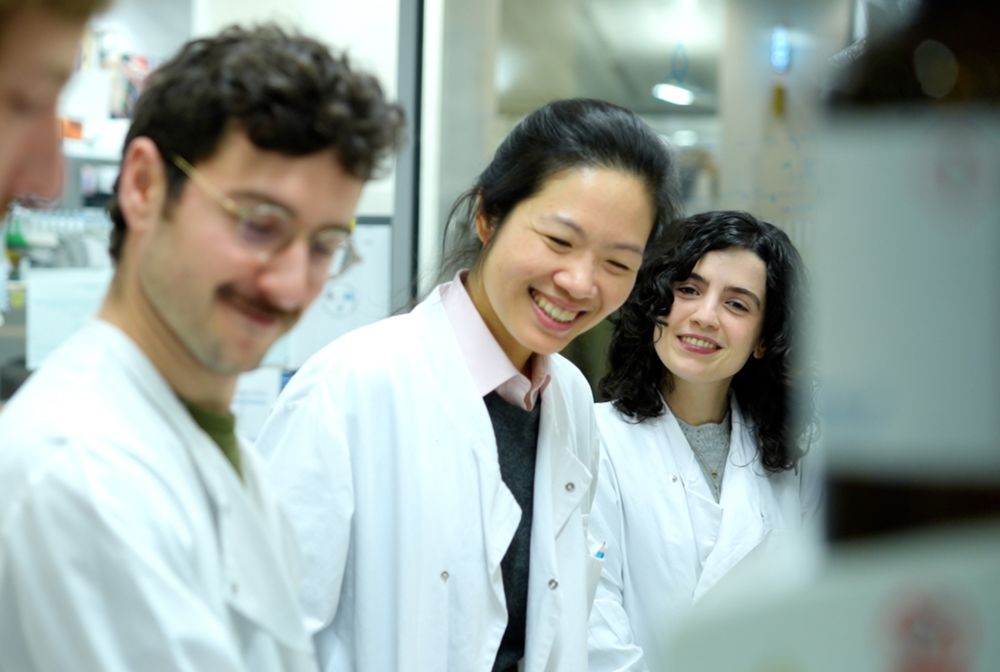
Early career group leaders
We appoint researchers from across biology and biomedicine to set up their first groups at the Crick.
The @crick.ac.uk is recruiting Early Career Group Leaders
- Lab set-up, research costs, salaries for up to 5 researchers
- Support for up to 12 years
- Access to our core facilities
- Competitive salary
- Fantastic colleagues
- All areas of biology
Deadline 27 Nov
www.crick.ac.uk/careers-stud...
10.10.2025 08:20 —
👍 155
🔁 154
💬 2
📌 3

A core function of cortex is predicting what happens next given the world's state.
This recent paper from Oxford shows how cortical layers may use a delay trick to learn to predict.
A simple illustration can explain the idea.
A🧵with my toy model and notes:
#neuroskyence #compneuro #NeuroAI
09.10.2025 08:03 —
👍 32
🔁 10
💬 1
📌 6

📣 New preprint from the Braga Lab! 📣
The ventral visual stream for reading converges on the transmodal language network
Congrats to Dr. Joe Salvo for this epic set of results
Big Q: What brain systems support the translation of writing to concepts and meaning?
Thread 🧵 ⬇️
07.10.2025 21:51 —
👍 59
🔁 17
💬 2
📌 1

New paper in Imaging Neuroscience by Jingyuan E. Chen, Jonathan R. Polimeni, et al:
Differentiating BOLD and non-BOLD signals in fMRI time series using cross-cortical depth delay patterns
doi.org/10.1162/IMAG...
04.10.2025 20:07 —
👍 19
🔁 4
💬 0
📌 0
We’re looking for a postdoc to join our Max Planck group in Germany some time in 2026. If you have computational and/or neuroimaging expertise, and are interested in questions intersecting perception and cognition, please reach out! I’ll also be happy to chat at the #Bernsteinconference this week.
29.09.2025 17:15 —
👍 63
🔁 54
💬 1
📌 1

Our new paper is out now in Neuron! 🎉 With @vaibhavtripathi.bsky.social @maxwellelliott.bsky.social Joanna Ladopoulou, Wendy Sun, Mark Eldaief, and Randy Buckner
Paper link: www.sciencedirect.com/science/arti...
26.09.2025 15:24 —
👍 57
🔁 26
💬 2
📌 2
Very excited for this year Bernstein! @bernsteinneuro.bsky.social
We'll bring a bunch of new work, here's a thread with the summaries.
Please check them out if you are interested in (low rank) RNN and distributed computations.
26.09.2025 16:56 —
👍 19
🔁 5
💬 1
📌 0
I’m super excited to finally put my recent work with @behrenstimb.bsky.social on bioRxiv, where we develop a new mechanistic theory of how PFC structures adaptive behaviour using attractor dynamics in space and time!
www.biorxiv.org/content/10.1...
24.09.2025 09:52 —
👍 219
🔁 86
💬 9
📌 9

There is going to be an exiting workshop on advanced fMRI end of October in Erice, Sicily (Italy).
The agenda looks just at great as the location.
ismrbf.marbilab.eu/events/7-xiv...
12.09.2025 17:36 —
👍 7
🔁 4
💬 0
📌 0
Wohooo congrats!
04.09.2025 10:59 —
👍 1
🔁 0
💬 0
📌 0
We recently also replicated this FPN fractionation in densely- sampled subjects at 7T and found this FPN subnetwork to strongly couple with the dorsolateral DMN subnetwork.
04.09.2025 08:07 —
👍 1
🔁 0
💬 0
📌 0
It’s an FPN subnetwork: at rest, it couples more strongly with the rest of the FPN than with the DMN. During some tasks it shifts toward the DMN, but for cognitive control it ramps up connectivity with the FPN. Good reference: doi.org/10.1073/pnas...
04.09.2025 07:57 —
👍 2
🔁 0
💬 1
📌 0
Amazing, thanks so much! Will reach out via email!
04.09.2025 06:23 —
👍 1
🔁 0
💬 0
📌 0
I am planning to do the same in my lab - would love to hear more how you decided to design such a session!
04.09.2025 05:42 —
👍 2
🔁 0
💬 1
📌 0
Replicability isn’t just a VASO issue — it’s a challenge across the (laminar) fMRI field. However, I argue that low SNR makes VASO especially hard: tricky to detect signal and even harder to replicate. I’m not pushing GE-BOLD for laminar fMRI, but “just use VASO” oversimplifies the current problems.
02.09.2025 14:54 —
👍 0
🔁 0
💬 0
📌 0
Compared to laminar MVPA in GE-BOLD, these are not many studies :) I know your work (RSA in Kenshu paper), Polina's preprint + Daniel's preprint (where it becomes evident that decoding with VASO is hard and in his case looks similar to GE-BOLD on the group level). Is Insub Kim's work published yet?
02.09.2025 14:47 —
👍 0
🔁 0
💬 1
📌 0
If replication isn’t possible due to physiology/attention, we’d be giving up on replicability as a field. Did you engage with our paper and the original? Attention is measured via task performance, and the original study showed very large effects in individuals, so replication is a fair expectation.
02.09.2025 10:27 —
👍 0
🔁 0
💬 1
📌 0
does someone good at coding & analysis want to work remotely w/ us in the coming few months (before end of 2025), as a paid consultant? project will be on neurofeedback (fMRI, ECoG, calcium imaging). we'll work towards developing the experiments & analysis pipelines together. if so pls DM me ur CV🧠📈
01.09.2025 13:06 —
👍 42
🔁 37
💬 4
📌 0
I haven't seen that many papers yet using MVPA in VASO. With respect to our replication study, main thing is the ROI selection I would say and not segmentation issues as we did a lot of control analyses including manual segmentation.
01.09.2025 15:24 —
👍 0
🔁 0
💬 2
📌 0
We haven’t managed to get reliable decoding with VASO yet, even for simple contrasts. My sense is that most of the field will continue to rely on GE-BOLD for MVPA, which is exactly why we thought our paper might be useful!
01.09.2025 11:36 —
👍 4
🔁 1
💬 4
📌 0
Run don’t walk to the #Neuro4Pros summer school if it happens again and you’re an early career prof
Thanks again for the absolute best time ⭐️ @gunnarblohm.bsky.social @kordinglab.bsky.social @yaelniv.bsky.social @meganakpeters.bsky.social @patrickmineault.bsky.social, and Hannah Bayer
30.08.2025 12:37 —
👍 22
🔁 6
💬 1
📌 0
For the laminauts. @layerfmri.bsky.social
30.08.2025 11:06 —
👍 16
🔁 7
💬 2
📌 0
What started as a journal club on layer decoding turned into a project thanks to @karolisdegutis.bsky.social. Our preprint challenges a widespread assumption in the field: MVPA is not immune to vascular confounds in laminar GE-BOLD decoding, as shown using a mechanistic laminar response model.
30.08.2025 14:58 —
👍 12
🔁 3
💬 0
📌 0