Organised by @sila-demirors.bsky.social @hadoose.bsky.social @kiragk.bsky.social @hannahsender.bsky.social @callumny.bsky.social, Edward Shepherd, Chris Foye, Laure Casanova Enault & Michael Goldman
27.10.2025 12:46 — 👍 0 🔁 1 💬 1 📌 0
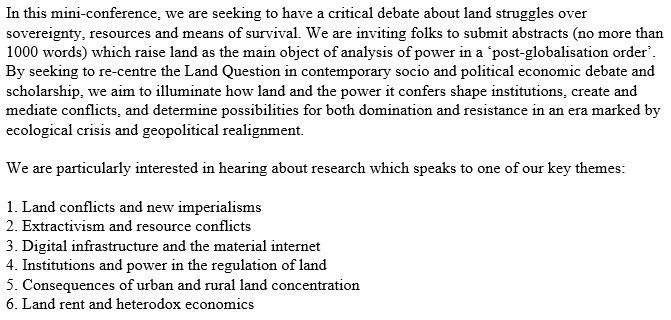
In this mini-conference, we are seeking to have a critical debate about land struggles over sovereignty, resources and means of survival. We are inviting folks to submit abstracts (no more than 1000 words) which raise land as the main object of analysis of power in a ‘post-globalisation order’. By seeking to re-centre the Land Question in contemporary socio and political economic debate and scholarship, we aim to illuminate how land and the power it confers shape institutions, create and mediate conflicts, and determine possibilities for both domination and resistance in an era marked by ecological crisis and geopolitical realignment.
We are particularly interested in hearing about research which speaks to one of our key themes:
1. Land conflicts and new imperialisms
2. Extractivism and resource conflicts
3. Digital infrastructure and the material internet
4. Institutions and power in the regulation of land
5. Consequences of urban and rural land concentration
6. Land rent and heterodox economics
Dear Colleagues,
On behalf my co-organisers, I am writing to invite abstract submissions for the ‘Re-centring land conflicts in the post-globalisation order’ mini-conference (MC11) as part of the SASE 2026 Conference in Bordeaux (1-3 July).
sase.org/events/2026-...
Deadline: December 16th
27.10.2025 12:46 — 👍 11 🔁 10 💬 1 📌 0
Implications?
Risks of a slippery slope leading to publicly funded private windfalls with unclear benefits, and climate action becoming narrowed to the most profitable, not necessarily most effective, solutions.
14.10.2025 12:54 — 👍 3 🔁 0 💬 1 📌 0
• This drives “assetization cascades”: more corporate welfare spending → more profit → more actors → more asset infrastructure → repeat
14.10.2025 12:54 — 👍 2 🔁 0 💬 1 📌 0
• I show how the private sector plays a key role in leading and shaping climate change mitigation initiatives such as voluntary carbon markets by, together public entities, co-creating infrastructure for new natural captial assets and corporate welfare programmes - weakly conditioned public funding
14.10.2025 12:54 — 👍 1 🔁 0 💬 1 📌 0
🚨New Article Out! “The Scottish Road to Net Zero: Corporate Welfare and Assetization Cascades”
The article focuses on the evolution of the land-based natural capital market in Scotland in light of the country's net zero efforts.
14.10.2025 12:54 — 👍 24 🔁 9 💬 1 📌 0

Max Planck Summer School for Women in Political Economy
To all female scholars, working in the broad field of political economy: Apply for the Max Planck Summer School for women in political economy! Two years ago we had a blast!
www.mpifg.de/1343511/2025....
21.03.2025 11:03 — 👍 23 🔁 19 💬 0 📌 1
Congrats!!
19.03.2025 15:08 — 👍 1 🔁 0 💬 0 📌 0
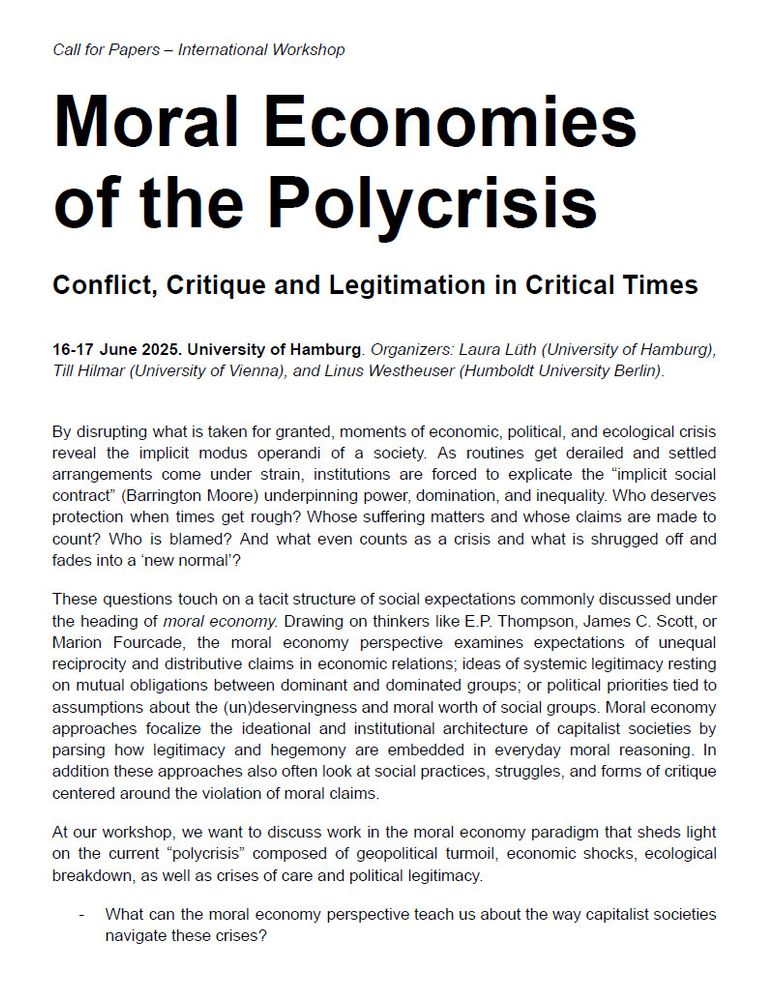
Moral Economies of the Polycrisis
Conflict, Critique and Legitimation in Critical Times
International Workshop. 16-17 June 2025. University of Hamburg. Organizers: Laura Lüth (University of Hamburg), Till Hilmar (University of Vienna), and Linus Westheuser (Humboldt University Berlin).
By disrupting what is taken for granted, moments of economic, political, and ecological crisis reveal the implicit modus operandi of a society. As routines get derailed and settled arrangements come under strain, institutions are forced to explicate the “implicit social contract” (Barrington Moore) underpinning power, domination, and inequality. Who deserves protection when times get rough? Whose suffering matters and whose claims are made to count? Who is blamed? And what even counts as a crisis and what is shrugged off and fades into a ‘new normal’?
These questions touch on a tacit structure of social expectations commonly discussed under the heading of moral economy. Drawing on thinkers like E.P. Thompson, James C. Scott, or Marion Fourcade, the moral economy perspective examines expectations of unequal reciprocity and distributive claims in economic relations; ideas of systemic legitimacy resting on mutual obligations between dominant and dominated groups; or political priorities tied to assumptions about the (un)deservingness and moral worth of social groups. Moral economy approaches focalize the ideational and institutional architecture of capitalist societies by parsing how legitimacy and hegemony are embedded in everyday moral reasoning. In addition these approaches also often look at social practices, struggles, and forms of critique centered around the violation of moral claims.
At our workshop, we want to discuss work in the moral economy paradigm that sheds light on the current “polycrisis” composed of geopolitical turmoil, economic shocks, ecological breakdown, as well as crises of care and political legitimacy.
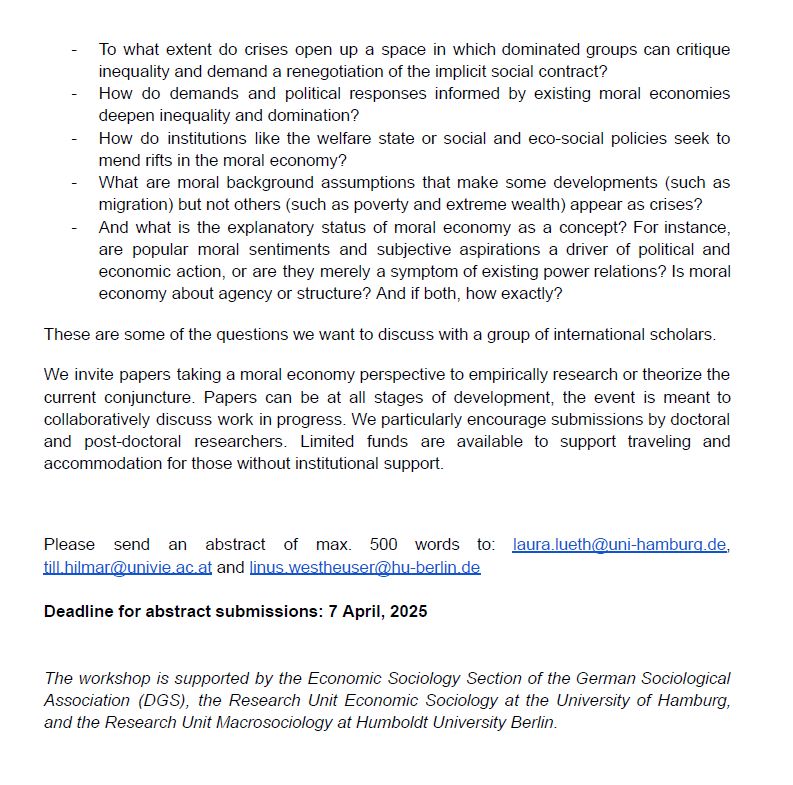
What can the moral economy perspective teach us about the way capitalist societies navigate these crises?
To what extent do crises open up a space in which dominated groups can critique inequality and demand a renegotiation of the implicit social contract?
How do demands and political responses informed by existing moral economies deepen inequality and domination?
How do institutions like the welfare state or social and eco-social policies seek to mend rifts in the moral economy?
What are moral background assumptions that make some developments (such as migration) but not others (such as poverty and extreme wealth) appear as crises?
And what is the explanatory status of moral economy as a concept? For instance, are popular moral sentiments and subjective aspirations a driver of political and economic action, or are they merely a symptom of existing power relations? Is moral economy about agency or structure? And if both, how exactly?
These are some of the questions we want to discuss with a group of international scholars.
We invite papers taking a moral economy perspective to empirically research or theorize the current conjuncture. Papers can be at all stages of development, the event is meant to collaboratively discuss work in progress. We especially welcome submissions from doctoral and post-doctoral researchers. Limited funds are available to assist with travel and accommodation for those lacking institutional support.
Please send an abstract of max. 500 words to: laura.lueth@uni-hamburg.de, till.hilmar@univie.ac.at and linus.westheuser@hu-berlin.de
Deadline for abstract submissions: 7 April, 2025
The workshop is supported by the Economic Sociology Section of the German Sociological Association (DGS), the Research Unit Economic Sociology at the University of Hamburg, and the Research Unit Macrosociology at Humboldt University Berlin.
📢 CALL FOR PAPERS 📢
"Moral Economies of the Polycrisis. Conflict, Critique, and Legitimation in Critical Times"
Workshop, June 16-17
University of Hamburg
Deadline for abstracts: 07/04
Supported by the Economic Sociology section of @dgsoziologie.bsky.social
linuswestheuser.com/cfp-moral-ec...
17.03.2025 16:35 — 👍 95 🔁 45 💬 1 📌 5
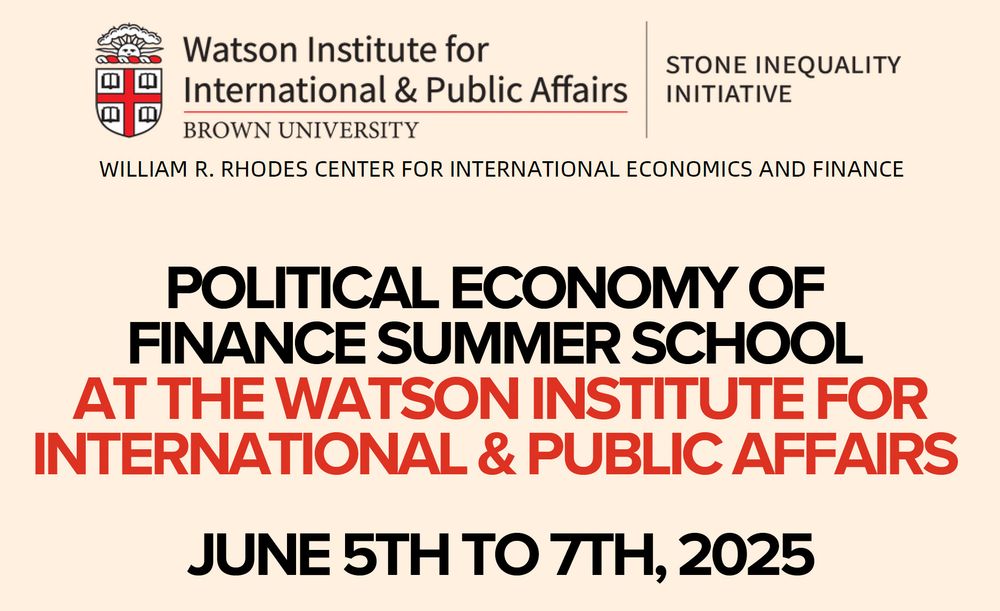
POLITICAL ECONOMY OF
FINANCE SUMMER SCHOOL
AT THE WATSON INSTITUTE FOR
INTERNATIONAL & PUBLIC AFFAIRS
FORMAT
June 5th to 7th
Open to PhD candidates and early career scholars
Travel and accommodation covered for all participants
JUNE 5TH TO 7TH, 2025
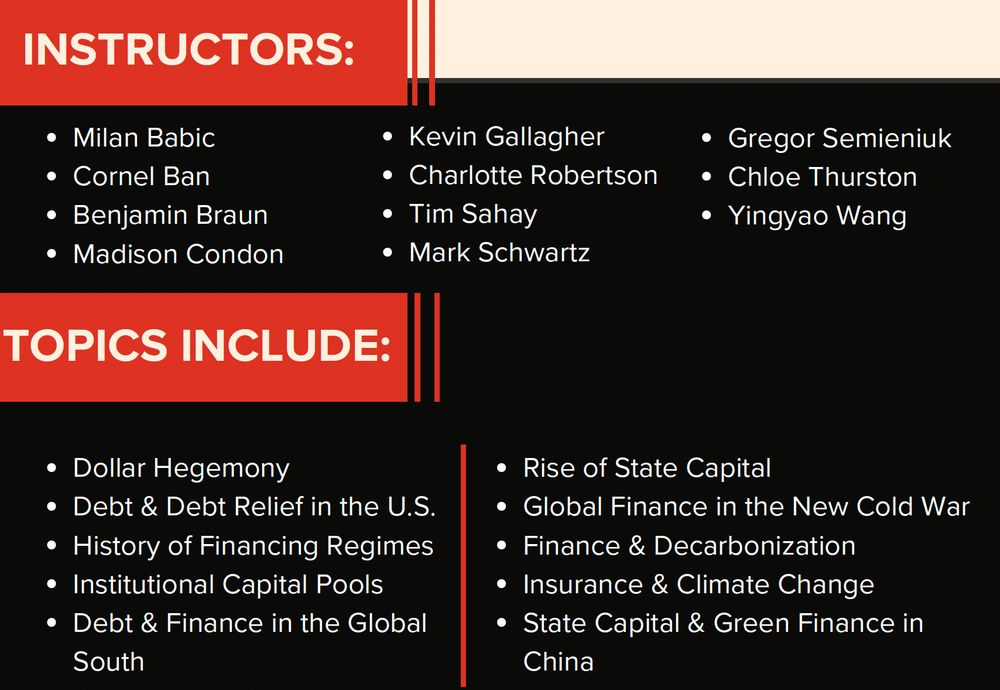
INSTRUCTORS:
Milan Babic
Cornel Ban
Benjamin Braun
Madison Condon
Kevin Gallagher
Charlotte Robertson
Tim Sahay
Mark Schwartz
Gregor Semieniuk
Chloe Thurston
Yingyao Wang
TOPICS INCLUDE:
Dollar Hegemony
Debt & Debt Relief in the U.S.
History of Financing Regimes
Institutional Capital Pools
Debt & Finance in the Global South
Rise of State Capital
Global Finance in the New Cold War
Finance & Decarbonization
Insurance & Climate Change
State Capital & Green Finance in China
🚨📣 We are so back:
ℙ𝕠𝕝𝕚𝕥𝕚𝕔𝕒𝕝 𝕖𝕔𝕠𝕟𝕠𝕞𝕪 𝕠𝕗 𝕗𝕚𝕟𝕒𝕟𝕔𝕖 𝕤𝕦𝕞𝕞𝕖𝕣 𝕤𝕔𝕙𝕠𝕠𝕝 𝟚.𝟘
- 3 days @ Watson Institute, Providence
- PhD candidates (2nd year+), post-docs & assistant profs
- All expenses covered (🙏 sponsors)
- A-team of instructors 🙏💪
- Mark Blyth 😎
Apply by 𝐌𝐚𝐫𝐜𝐡 𝟏. Link below. Please share!
22.01.2025 13:42 — 👍 117 🔁 72 💬 4 📌 8
Feminist | STS scholar | welfare and penal surveillance | digital welfare state
Marie Skłodowska-Curie postdoctoral resesarcher @ Oslo Metropolitan University
Board member Dutch Journal for Gender Studies
She/her
Politische Ökonomie | Computational Social Sciences
Researching on property, land, housing, real estate
Postdoctoral Fellow | LSE | European Institute
https://kira-gartzou-katsouyanni.github.io
art & architectural historian / visual, material & religious culture
geographer researching the politics of land in england
https://geog.ubc.ca/profile/isabella-pojuner/
remembering the birth of private property with the museumofenclosure.org
and mapping trespass instagram.com/domesplaybook
Collaborative research centre "Structural Change of Property" (SFB 294: Strukturwandel des Eigentums) @uni-jena.de and @unierfurt.bsky.social. Funded by the @dfg.de. Posts by @leni.bsky.social.
PhD fellow at Roskilde University, Denmark
studying politics, expertise & law in climate finance.
International climate politics: negotiations, diplomacy, and finance.
Senior Fellow at the Hertie School.
https://hertie-school.org/en/research/faculty-and-researchers/profile/person/feist
Researcher @gesis.org | EU solidarity, EP Elections & political attitudes | Interested in feminist literature #FirstGen
Journalist | @fragdenstaat.de | Arbeit, Umwelt, Ernährung | www.thepickers.de | Threema: V4Z9DPJ5 | Signal: joseuf.03
Sociologist. Post-Doctoral Researcher @mpifg.bsky.social. Labour, culture & elites. Ethnographer of butlers.
Researcher in political sociology at LSE. Interested in history & political economy of socialist parties and labour movements, economic policy ideas including socialisation of investment & economic democracy.
Researcher at Common Wealth & post-doctoral fellow at LSE Sociology. Ajax fan. She/her.
ECPR is an independent, scholarly association with a mission to advance political science ▪ https://ecpr.eu/ ▪ https://podcasters.spotify.com/pod/show/ecpr/ ▪ @ecprtheloop.bsky.social
PhD Candidate @Harvard Gov. Political Economist researching on the politics of opportunity. Credit Access, Education, and Labor Market policy in US, Germany, and Japan + affects on global financial stability. On the market.
https://www.danieltroberts.com/
Expert analysis of political data and global government developments from European Consortium for Political Research (ECPR). Listen to the latest election commentary on our podcast: http://bit.ly/3s4kgYj
Research Fellow, University of Oxford
Theology, philosophy, ethics, politics, environmental humanities
Associate Director @LSRIOxford
Anglican Priest
https://www.theology.ox.ac.uk/people/revd-dr-timothy-howles
Alle Beiträge auf daslamm.ch
Unterstützt unabhängigen Journalismus: daslamm.ch/spenden
Newsletter: daslamm.ch/newsletter
Telegramkanal: t.me/daslamm