My accessible email is my name as seen above this post, at Gmail.
07.12.2025 20:09 — 👍 1 🔁 0 💬 0 📌 0

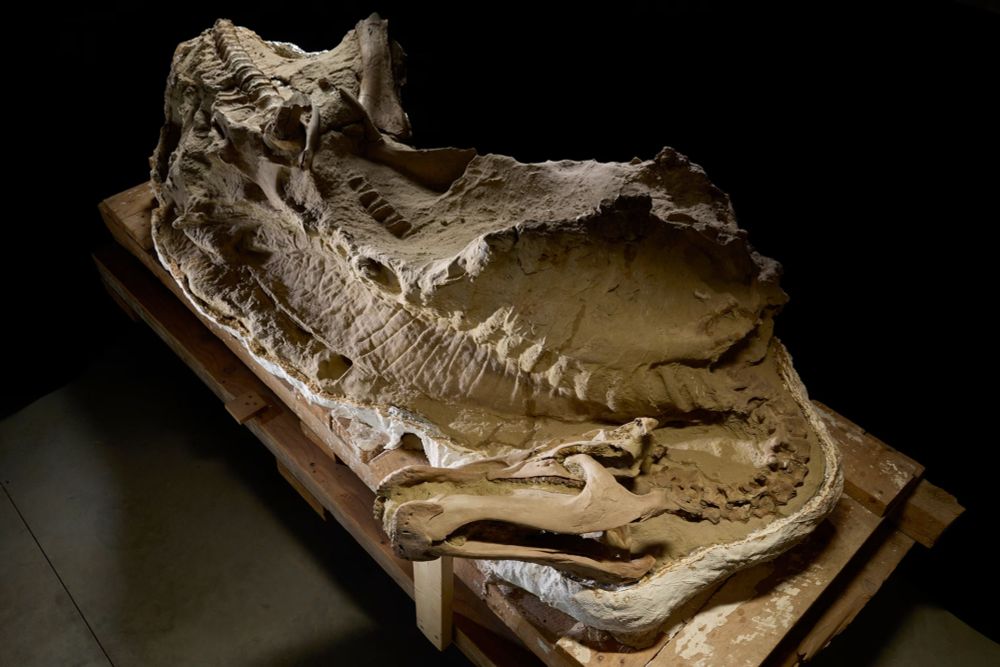
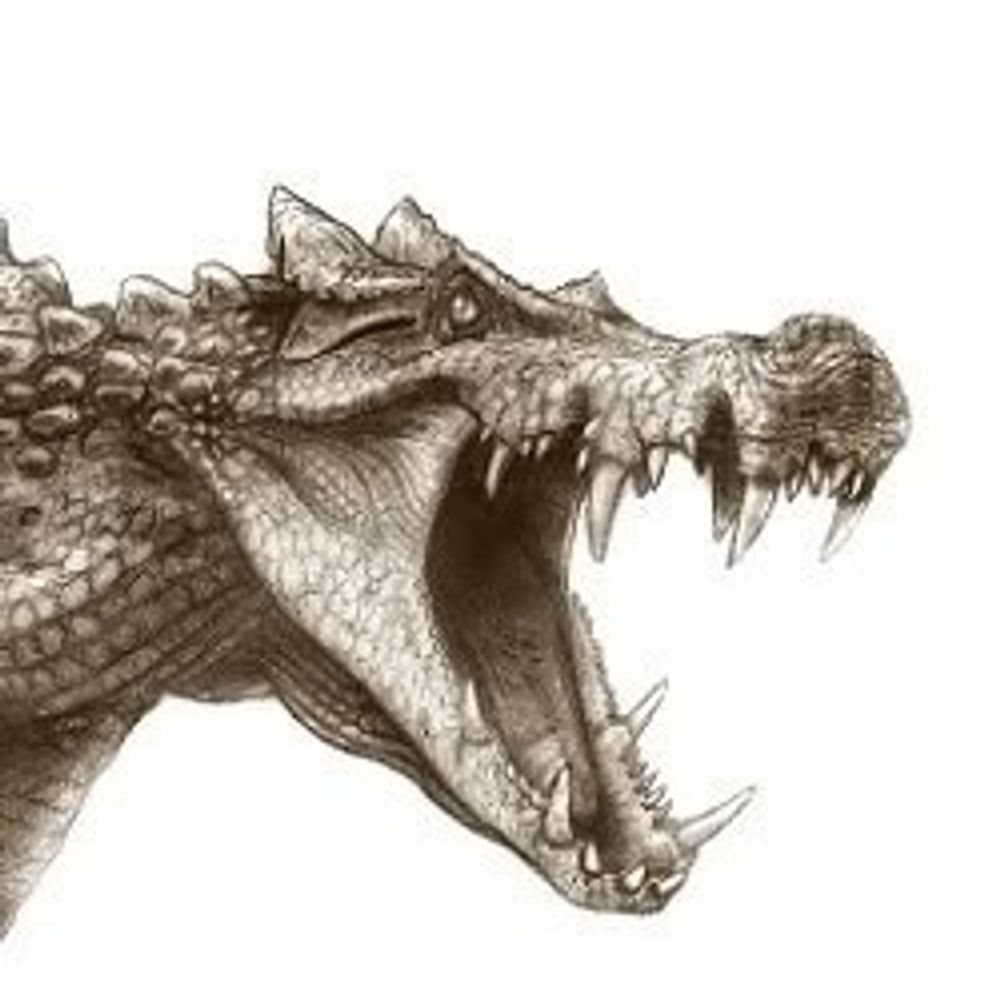
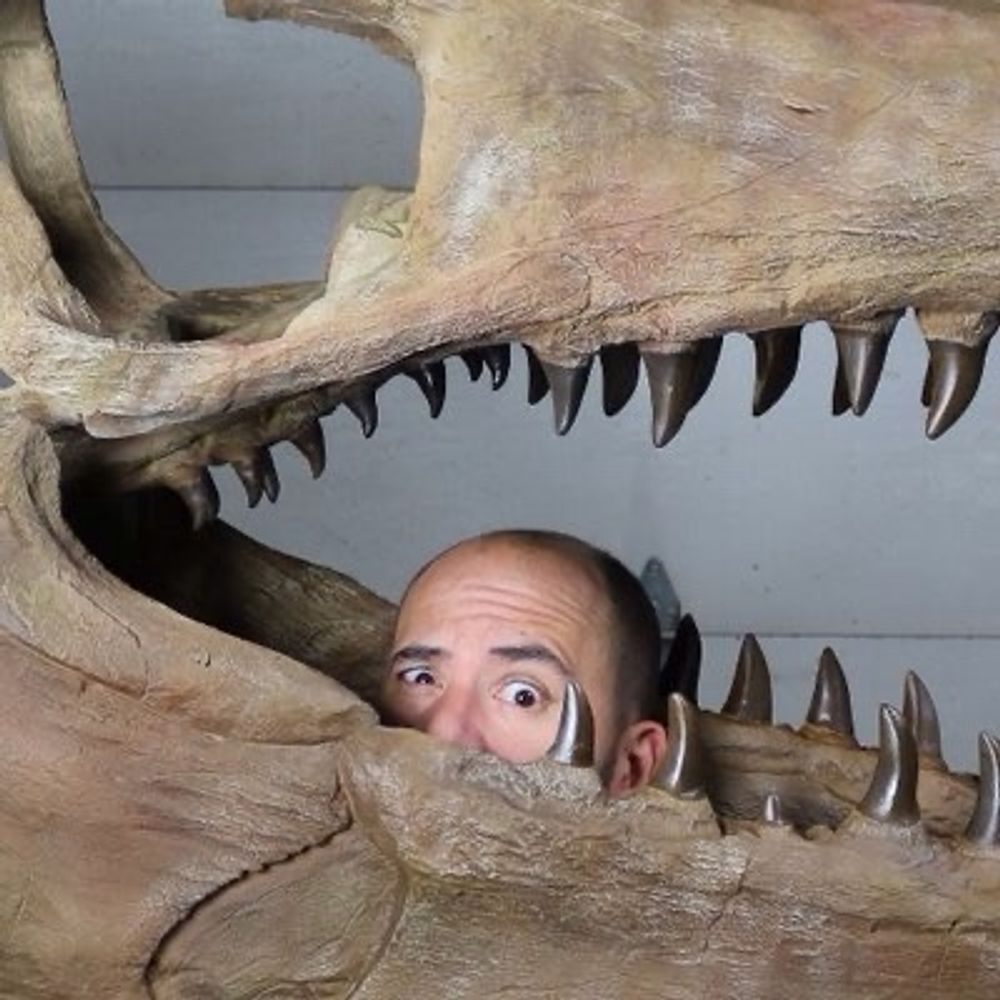
- Nanotyrannus lancensis -
07.12.2025 08:59 — 👍 107 🔁 30 💬 4 📌 0
I love the smile.
07.12.2025 09:23 — 👍 0 🔁 0 💬 0 📌 0
I'm not sure I would do much a good job mentoring, but you're welcome to share with me here, if you message me personally. I'll try to offer what I can, but I can't really critique the art.
07.12.2025 09:20 — 👍 3 🔁 0 💬 1 📌 0

A Tyrannosaurus rex looks upon
the viewer inquisitive
A bright green eye fixates
as we gaze back.
Its garb in wooded brown
and trimmed in milky cream, a thickened face of armored gold,
lined in sky's blue.
What colors does it have
seem hardly to matter to it.
Perhaps it doesn't see us
as either threat or food.
We are mere denizens in its eye.
Now, I'm not saying this is how I'd do it, but prompted by nothing other than my own curiosity, a sketch of #Tyrannosaurus for Saturday.
#SciArt and #SciComm
07.12.2025 02:08 — 👍 7 🔁 1 💬 0 📌 0
Draw for yourself, and speculate. It's actually been a bit freeing to think that I can draw whatever I want, to nudge along the fantastical side of the axis a bit.
06.12.2025 18:57 — 👍 2 🔁 0 💬 1 📌 0
One of the reasons I don't relly post the progress of my own paleoart that often, and for this subject I have plenty or at least sketches, is that I don't want progress and "thinking about" pieces to come off as authortitative, as if I have a right to decide.
I tend to the opposite, rather!
06.12.2025 18:56 — 👍 2 🔁 0 💬 1 📌 0
Butt.
06.12.2025 18:42 — 👍 1 🔁 0 💬 1 📌 0
I'm not actually prompting anyone to do *anything*. More like ... have this conversation?
But I get the exhaustion of a constant and piecemeal change over time. But I look at it as us having these rows over minutiae, while reminding myself it's actually about scientific process, curiosity, art.
06.12.2025 18:42 — 👍 2 🔁 0 💬 1 📌 0
The vascular grooves do cross the rim of the AOF in Jane, however, without a tapering off. The "rim" might just be something of a functional support for the skull, rather than an occlusion of the dermal structure.
06.12.2025 02:34 — 👍 3 🔁 0 💬 1 📌 0
The vascular grooves are there on all tyrant maxillae, but not overlapping the AOF. Albertosaurus/Gorgosaurus have something a "rim" to the AOF that is smooth, and the maxilla isn't as intricately textured. More glabular, "hummocky."
06.12.2025 02:30 — 👍 3 🔁 0 💬 1 📌 0
Caveat lector:
I have made a number of reconstructions of my own, all without following my own advice, hardly to present them as natural depictions or qualitatively authoritative. Most of THAT effort goes into "guides" like these infographics.
The coward in me balks any further.
06.12.2025 02:07 — 👍 4 🔁 0 💬 1 📌 0
I don't come to this interpretation lightly; this is me trying to follow the science, while still trying to draw my leather-faced, RJ Palmer-designed Tyrannosaurus that more clearly mirrors modern "living animal" depictions. But the truth is, tyrants, like ceratopsians, were likely "horn-faced."
06.12.2025 02:04 — 👍 4 🔁 0 💬 1 📌 0
The maxillary features imply something radical:
Like edentulous pterosaurs and ceratopsids, in which a network of grooves reaches the AOF or parietal fossa then taper off, it's likely they support a cornified sheet which surpasses the bone margin, leaving no other trace behind.
06.12.2025 02:02 — 👍 5 🔁 0 💬 2 📌 0
These identifications were based on a broad interpretation and certain assumptions built from a lack of direct examination. They're aslo very, VERY macro. Microstructure will present better details.
"Light vascular skin" is glabular, being fatty and thick, without muscle attachment.
06.12.2025 01:57 — 👍 5 🔁 0 💬 1 📌 0

ANOTHER infographic, this time breaking down AMNH 5027 facial bone structures into their base patterns, and thus the osteological correlates that are inferred from these textures.
1: Oral epithelium
2: Light, vascular skin
3: Squamous dermis
4: Muscular attachment
5: Cartilaginous attachment
6: Pneumatic vasculature
7: Lightly cornified skin
8: Highly cornified skin
9: Cornified sheets
Some years ago, spurred by discussions back on Facebook, I made this infographic based on the same image I used at the top of this thread (from Osborn 1912, improperly citing the person who uploaded the image to Wikipedia, but thanks for doing that).
There's issues with this, including terms.
06.12.2025 01:55 — 👍 6 🔁 0 💬 1 📌 0
These ridges aren't "hummocks" but extensively grooved, and the pattern and arrange of those those grooves suggest something that has been recently proposed for ceratopsians, but long assumed for pachycephalosaurid domes: that the facial skeleton was covered by large keratinized sheets. Horny-faces.
06.12.2025 01:46 — 👍 5 🔁 0 💬 1 📌 0
As for what those features might represent, Witton (personally and in print) referred to them as "hummocks," llikening the ridges between pits to the rounded, lumpy surface of squamate skulls to theorize that they were covered by large, singular (vaguely turtle-like) scales.
06.12.2025 01:44 — 👍 5 🔁 0 💬 1 📌 0
Longrich and Saitta (2024) used the lack of pits to distinguish BMNP 2002.4.1 (Jane, now holotype of Nanotyrannus lethaeus) from T. rex. That's now notable these structures are.
www.mdpi.com/2813-6284/2/...
06.12.2025 01:41 — 👍 6 🔁 0 💬 1 📌 0
I digress.
AMNH 5027 isn't the only Tyrannosaurus maxilla to have these features, either the grooves, which are present on every skull I've seen, but the large pits. FMNH PR 2081 (Sue) has them; CM 9380 has them.
06.12.2025 01:38 — 👍 5 🔁 0 💬 1 📌 0
We're allowed to play the creator of our own worlds, and to directly walk away from models of inference. We should simply be clear when we do so. The less grounded our art becomes, the more fantastical it gets. Be honest with that.
06.12.2025 01:34 — 👍 6 🔁 0 💬 1 📌 0
It's a model, built on inference, developed from living animals and the variety of facial structures they develop, from the Gila monster's cranial armor "shield," croc faces, birds' beaks, rhino horns, musk ox head butting, claws, antlers, etc.
But there's some unknowns, and that's ... fine?
06.12.2025 01:31 — 👍 5 🔁 0 💬 1 📌 0
The paper and follow-up studies looking at how dermis, bone, and other integumental structures interact has been more or less lauded and poorly received by the paleoart community for reasons I can only guess at:
That it seems to "tie one's hands" when it comes to creative depictions.
06.12.2025 01:29 — 👍 5 🔁 0 💬 1 📌 0
That paper is freely available from OUM (Witmer Lab) here:
people.ohio.edu/witmerl/Down...
This is based on Tobin Hieronymous's PhD work, studying why and how horns, beaks, scales, etc., do or do not leave traces on bone. It's also the basis of various issues of contention, built on "inferrence."
06.12.2025 01:26 — 👍 5 🔁 0 💬 1 📌 0
This skull presents the details of the surface vascularity and ridges that Mark Witton some time ago referred to as "hummocky," a phrase used to describe the dermal skull roof of squamates by Hieronymous et al. when working out facial anatomy of rhino noses and bird's beaks, applied to ceratopsids.
06.12.2025 01:25 — 👍 5 🔁 0 💬 1 📌 0

File:Tyrannosaurus rex AMNH 5027 skull.png - Wikimedia Commons
This skull is more of less complete and relatively undistorted, and has been the basis for depictions of the animal since Obsorn described in 1912, making it the most famous dinosaur in the world.
commons.wikimedia.org/wiki/File:Ty...
06.12.2025 01:21 — 👍 5 🔁 0 💬 1 📌 0

Infographic explanation
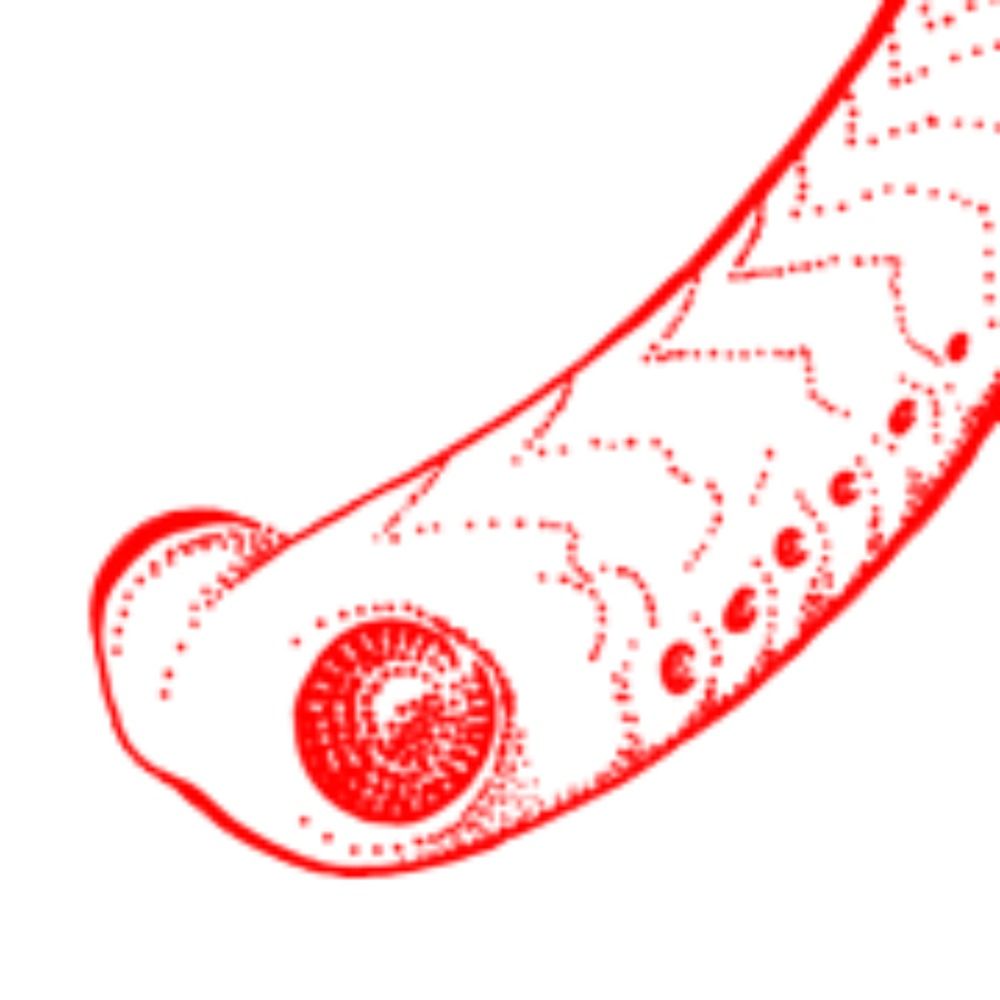
The same image across the top is a crop of the maxilla and nasal of Tyrannosaurus rex (AMNH 5027), the first being a crop from Osborn 1912 (plate, digitally made available by the AMNH). It's separated into A, B, C, with the latter two faded and overlain with tracings and sketches, describing fine vascular features (in B) and large "pits" (in C).
Below it, is the inset text:
"Tyrannosaurus rex AMNH 5027 (maxilla). Osteological correlates to a dense, keratinized facial dermis inferred from low and high-relief structures (large "pits") and extensive vascular grooves surrounding antorbital fossa."
Image sup-parts D includes a key for E-H, describing layers of bone and integument (dermis, scales, cornified structures), described various hues of red, orange, and yellow.
From bottom up, bone in black, deep dermis in orange (where Sharpey's fibres are most common), yellow in the middle for the meso and epidermis, red for the cornified epidermis, and dark red for scales, which sometimes have bony cores in crocodilians and lizards.
Bottom right are E-H, showing various thicknesses and bone "texture" related to relief of structures.
E: glabular, labile, or squamous skin. This is shown with a thick dermis and vague correlation between bone and scale placement.
F: ridged and corrugated bone is related to a thicker, sometimes cornified (keratinized) epidermis.
G: canaliculate or grooves bone texture is associated with more extensive cornified dermis, related to increased vascularization and reduced meso and deep dermis depth.
H: high-relief corrugated with secondary grooves, depicted strongly ridged bone with grooves incised into them, an exagerration of G.
#FossilFriday and #SciArt
The maxilla of various Tyrannosaurus specimens (perhaps or not "rex") have several peculiar, and possibly diagnostic, surface features relating to their integument (skin, horn, whatnot).
We begin with, and perhaps best with, AMNH 5027, the "archetypal" T. rex skull.
06.12.2025 01:20 — 👍 25 🔁 6 💬 2 📌 0
I get that. Based on my reading, it's not something that's going to be discernible at the macro level. One of the models suggested that squamate skulls have an undulating, lumpy surface underlying scales, which have a dense, keratinized skin. So that's a clue, but it's not perfect.
01.12.2025 19:33 — 👍 2 🔁 0 💬 0 📌 0
I think it's healthy to be skeptical, so I've been very low-key in some places on this. Obviously, I'm "pro-ost.corr." when it comes to reconstruction, but given there are unknowns still, some flexibility with actual reconstruction (I was pushing fleshy structures pachy domes!), we have room.
01.12.2025 19:12 — 👍 2 🔁 0 💬 1 📌 0
- professional 3d artist by day - paleoartist by night - science enthusiast -
- pet pigeon owner - autism spectrum -
🇧🇷 Listens to lofi and draws long-gone beings • he/him
🖼️ All my art on #artbyjulio
🔗: linktr.ee/julio.lacerda
scientific illustrator dabbling in paleontological research: pterosaurs, dinosaurs, other fossil reptiles, zoological nomenclature. she/her
Links: https://www.skyemcdavid.com/links
I am America’s Best Christian™. But you knew that. You can find exclusive content here: https://www.patreon.com/c/MrsBettyBowers
TITHE: https://www.paypal.com/donate/?hosted_button_id=Q6REDKBBVUJLU
Artist, crocodile enthusiast, wikipedia editor
tags: #SciArt
Glutton for paleontology fieldwork punishment. Discovering new ancient sea life all over Western Kansas. Curator. Also home to random rescue Golden Retriever pics and the occasional dinosaur.
Paleontologist specializing in birds (especially penguins) and dabbling in choristoderes + sauropods. Curator at the Bruce Museum. All opinions are my own.
Cosmologist, pilot, author, connoisseur of cosmic catastrophes. TEDFellow, CIFAR Azrieli Global Scholar. Domain verified through my personal astrokatie.com website. She/her. Dr.
Personal account; not speaking for employer or anyone else.
Paleontologist that specializes in Diplodocus skin. Currently working at Edelman Fossil Museum
She/her. I'm a Canadian freelance illustrator.
☛ SOCIALS: linktr.ee/smalyon
☛ PRINTS: inprnt.com/gallery/serenamalyon
Chicago-based paleoartist. He/him. Email for commissions/inquiries at liam_elward@yahoo.com
Natee Himmapaan (Puttapipat). Illustrator.
Art, literature, history, natural history, food, handwriting.
Depression, anxiety, & all that jazz.
Fatigued and extremely bitter about social media.
Non-binary (they/them). 🏳️🌈
https://linktr.ee/himmapaan
Dad, husband, paleoartist.
Lab manager for Paul Sereno at University of Chicago Fossil Lab
Writer for Love in the Time of Chasmosaurs - Creator of the speculative evolution project "A New Age of Reptiles" - Natural History and Palaeontology Pop Culture - 27 - (she/her) -
Dinosaurs, 3D digitizing, ADHD, rants on politics
Languages: 🇩🇪🏴
🐎🐎🐎-Content: @isisvomfalkenwald.bsky.social
Dreigiau o Gymru. Aka Andy Frazer. Illustrator of dragons and dinosaurs. All books available in my Etsy shop. Please DM for commission enquiries. He/him. European/Welsh. No AI. www.andyfrazer.com
Freelance artist who paints on everything including trading cards. Closed for alter commissions. For other inquiries: eaklug@gmail.com
Official Bluesky account of LoadingReadyRun. We make silly things on the internet.
Arizona artist, smartass, shark enthusiast, animal lover, & amateur photographer specializing in animals but occasionally distracted by other subjects.
⬇️ Shop Art
www.sarcasticshark.com
Artist: Magic the Gathering, gallery work, commissions, and paint splashes resembling tipsy critters, among other Things.
Occasional wearer of shoes.
linktr.ee/omarrayyan