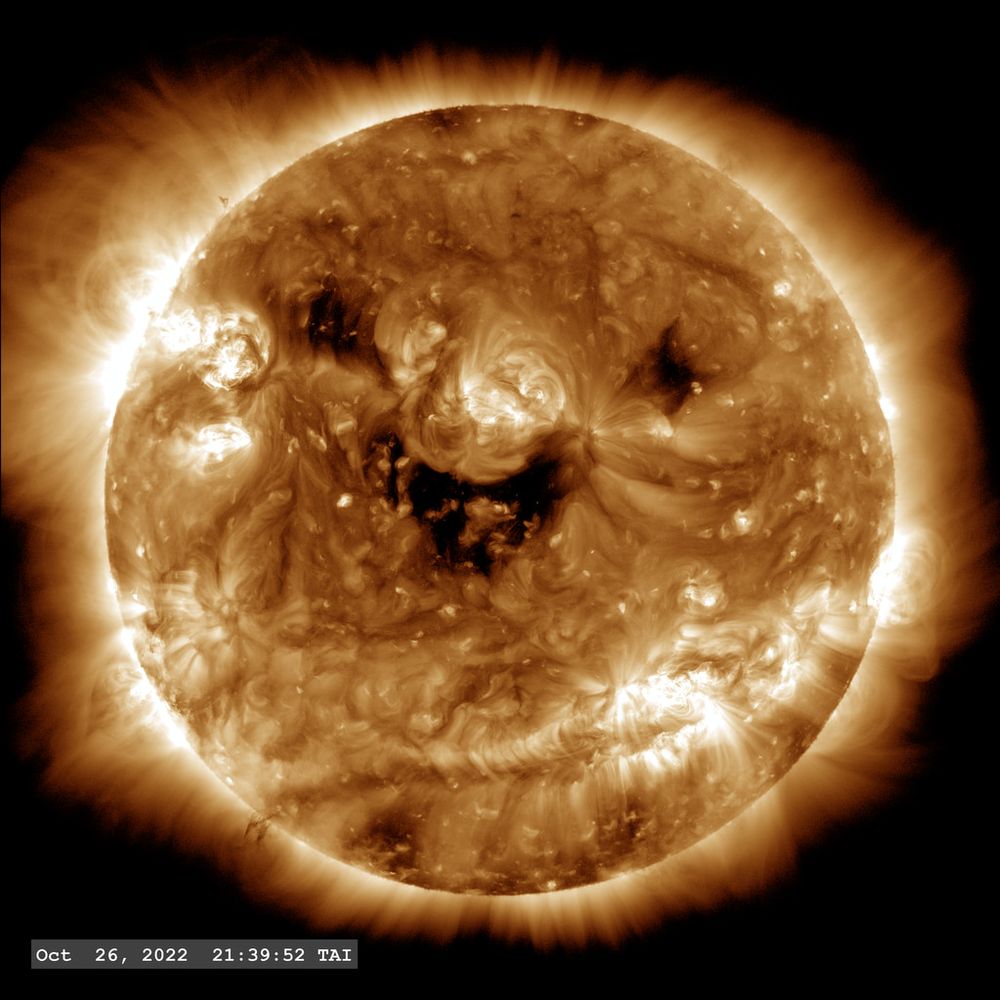
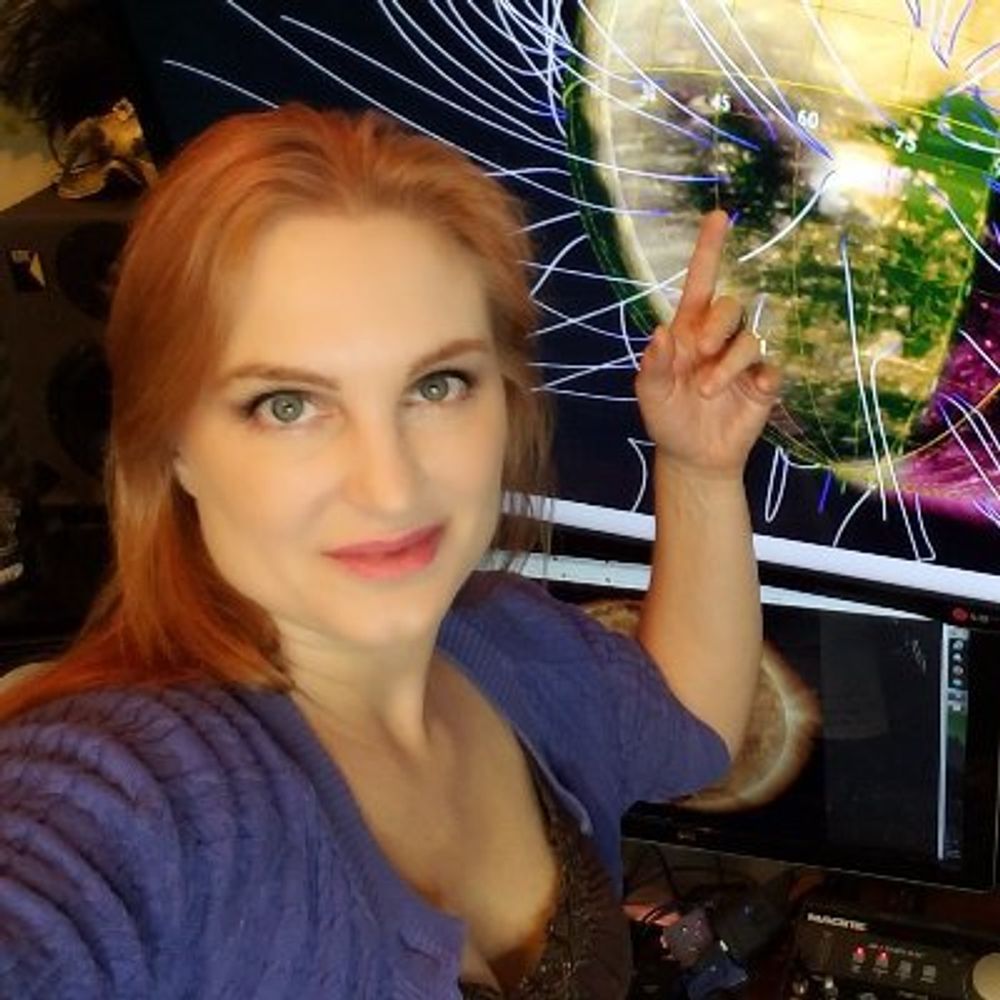
Introducing spherical harmonics to analyze the dominant spatial scales of the magnetic field in each run allowed Caroline to quantify the structure and draw concrete, compelling correlations. This work is part of Caroline's PhD thesis work; more of her fascinating is coming soon!
30.01.2026 21:16 — 👍 1 🔁 0 💬 0 📌 0

The team also showed that a highly structured surface magnetic field meant that more heat was injected into the corona overall. This is related to the total unsigned flux, as well as changes in flux-tube expansion that attenuates the waves that reflect within coronal loops.
30.01.2026 21:16 — 👍 0 🔁 0 💬 1 📌 0

By using a range of resolutions for the input magnetic field, the team found that fine-scale structure in the photosphere led to much more structured heating and connectivity in the middle corona (a region where many physical transitions occur, critical for solar wind formation).
30.01.2026 21:16 — 👍 0 🔁 0 💬 1 📌 0

In @caroline-evans, Cooper Downs, and Don Schmit's new #ApJ paper, a series of simulations at increasing resolution uncover the correlation between magnetic complexity and coronal heating. The MAS model acted as a lab to probe difficult-to-observe scales.
buff.ly/ls2p29Z
30.01.2026 21:16 — 👍 0 🔁 0 💬 1 📌 0
Pete and Michal found the #risk varies by a factor of >100 from the strongest to the weakest solar cycles observed over the past ~80 years.
Punchline: If the strength of the cycle can be #forecast with accuracy, this variability can be predicted.
21.01.2026 20:24 — 👍 0 🔁 0 💬 0 📌 0

🚨📄 New paper alert! 📄🚨
In their new paper published in Space Weather, PSI's Pete Riley and Michal Ben-Nun find that the chances of an extreme #spaceweather event depends strongly on the strength of the #solar cycle.
What does this mean? Read on below!
agupubs.onlinelibrary.wiley.com/doi/full/10....
21.01.2026 20:24 — 👍 1 🔁 0 💬 1 📌 0

Using #MPI to run from 1-1000s of CPU cores, it can also run on 1+ #NVIDIA/#Intel #GPUs for fast local calculations.
GitHub repository examples help you get started.
For easy PFSS+CS solutions try running our SWiG pkg that uses POT3D.
Information on SWiG coming soon - stay tuned!
14.01.2026 21:42 — 👍 0 🔁 0 💬 0 📌 0

Need to calculate potential field solutions of the solar corona, really fast, for grids up to billions of cells (doi.org/10.3847/1538...), or on nonlinear grids (to refine the #solution in ROIs)?
Check out PSI's POT3D code at github.com/predsci/pot3d!
#github #modeling #computing
14.01.2026 21:42 — 👍 0 🔁 0 💬 1 📌 0
James Turtle's poster "Melding Vector and Line-of-Sight Magnetogram Data for Assimilation into Surface Flux Transport Models" examines PSI's data-driven methods for combining HMI Line-Of-Sight (LOS) and vector products using our #python package MagMap (buff.ly/dK2ktYE).
07.01.2026 21:05 — 👍 0 🔁 0 💬 0 📌 0
Slava Titov's poster "A New Approach for Extrapolating Photospheric Vector Magnetic Data to the Chromospheric Level" applies his recent breakthrough in decomposing magnetic fields into their components to derive chromospheric magnetic fields: buff.ly/VahwYDA
07.01.2026 21:05 — 👍 0 🔁 0 💬 1 📌 0
Erika Palmerio's talk "Global MHD Modelling to Support the Next Generation of White-Light Imagers" highlighted the utility of supplementing white-light imagers old and new with analogous forward-modeled imagery created using 3D MHD simulations: buff.ly/sLx13p1
07.01.2026 21:05 — 👍 0 🔁 0 💬 1 📌 0

Ryder Davidson's poster "MHDweb: An Interactive Visualization Toolkit" showcases PSI's #data #visualization suite whose web-based interface analyzes our Coronal and Heliospheric MAS model solutions and compares the results with in-situ #spacecraft data: buff.ly/2or5UXJ
07.01.2026 21:05 — 👍 0 🔁 0 💬 1 📌 0

Emily Mason's talk "Statistical Study of Long-Lived Active Regions" details a newly-identified pool of active regions that last for several solar rotations, and which produce roughly 4-7 times more significant flares than their counterparts: buff.ly/99S2e51
07.01.2026 21:05 — 👍 0 🔁 0 💬 1 📌 0
Pete's invited talk, "Quantifying Uncertainty in Solar Wind and CME Forecasts: Recent Progress & Future Directions" reviews the current state of solar wind modeling, covers recent efforts in addressing uncertainty, and introduced the PSI model sunRunner3d: buff.ly/q5IK39S
07.01.2026 21:05 — 👍 0 🔁 0 💬 1 📌 0
Pete Riley's talk "Using #WISPR measurements and global #MHD models to better understand the evolution of the solar corona," analyzes WISPR data from 2018--2025 and applies statistical and #ML techniques to quantify #CME kinematics and streamer morphology: buff.ly/C4UQNGr
07.01.2026 21:05 — 👍 1 🔁 0 💬 1 📌 0

Jon Linker's talk "Dynamics of the Time-Dependent Solar Corona and Inner Heliosphere" reviews our ground-breaking near-real-time, data-driven eclipse simulation and compares its results with steady-state MHD and PFSS models using the same boundary data: buff.ly/99S2e51
07.01.2026 21:05 — 👍 1 🔁 0 💬 1 📌 0

Cooper Downs' poster, "The Unique Prospects of High-Latitude Observations:A Modeling Perspective" illustrates the ways in which remote-sensing and in situ instruments far from the ecliptic can improve our theoretical understanding of the Sun-Earth system. buff.ly/z8Ve24Q
07.01.2026 21:05 — 👍 0 🔁 0 💬 1 📌 0
Did you miss #AGU25, or perhaps just didn't make it to every session? You can still catch up with our presentations through AGU's recordings, and summaries here. Scroll through the thread to see what we covered!
#science #heliophysics #solar #stem
07.01.2026 21:05 — 👍 0 🔁 0 💬 1 📌 0
We're excited to announce that we're back to posting on X, and launching our new presence on BlueSky! 🚀
Even though we've been quiet on social media, we've been hard at work on the science front. Looking forward to sharing updates about our projects and breakthroughs on a regular basis. #StayTuned
28.12.2025 17:09 — 👍 1 🔁 0 💬 0 📌 0
studying the sun | university of colorado boulder | davidson college | she/ella
Space Weather Analyst @British Antarctic Survey 🌍🛰🌌
Initial account set-up, not posting yet.
Daily 24-hr forecasts of global geomagnetic activity from @britgeosurvey.bsky.social
(Mon - Fri only). More info on our forecast levels at https://t.ly/RBOS
Congressional Staffer | #UW Alum #GoDawgs | #Mariners & #Kraken fan | #Space & #Weather nerd #wawx | Girl & husk(ies) mom | Posts are mine, etc.
Dog-mom x 2, Scientist, part-time Artist, #WIASN, Women Professor, Heliophysicist, #FRAS, Sunspot Solar Observatory, #AGU, #AAS, #IAU, #LGBTQ+ , Solar Physics, Space-Weather, SunSpaceArts, NSF FDSS, NSF SHINE, #NEBP #NASA #MOSAIC #NMSU
PhD, MSc, BEng. Solar Physicist, flare observations and modeling. Dabbles in Space Weather & related stuff. Professor at Mackenzie University (Brazil). Average guitar player. https://orcid.org/0000-0002-4819-1884
All rockets are not created equal. ULA is the nation’s most experienced, reliable and accurate launch service provider delivering unmatched value, a tireless drive to improve, and commitment to the extraordinary.
Official account for Rocket Lab, the end-to-end space company. We build rockets and spacecraft that open access to space to improve life on Earth.
Established in 1989, SpaceNews is the most trusted and comprehensive source of news and analysis of the companies, agencies, technologies and trends shaping the global space industry.
Reporter, ProPublica. The space industry, business & politics, and other things. Signal: HeatherVogell.55
Freelance writer, editor, columnist & consultant. Formerly at Scientific American, Washington Post, National Geographic, Slate, Smithsonian & Science. Past president of National Association of Science Writers. Birder.
Staff writer on science, tech, and health at The Atlantic covering AI. Signal @matteowong.52
Planetary scientist, freelance science writer and space artist, queer, ADHD, mom. Turns out it’s hard to be all those things at once. Shop at elakdawalla.Etsy.com
Writer. Featured in Rolling Stone, WIRED, Zeteo and elsewhere. I write about politics, tech and society.
Subscribe to my newsletter: madness.ghost.io
Freelance science journalist. Bylines in National Geographic, The New York Times, and elsewhere. Former staff writer and union boss at The Atlantic.
www.marinakoren.com / Signal: @marinakoren.08
The Community of European Solar Radio Astronomers (CESRA) is an organization of scientists to stimulate research of the Sun by means of radio waves.
https://www.astro.gla.ac.uk/users/eduard/cesra/
solar physicist, early career research scientist, heliophysics community manager, STEM policy advocate, outreach coordinator, education enthusiast, avid mentor AND mentee, neurospicy woman in STEM, activist, humanist
Space Weather Physicist. Forecasting aurora, GPS, HF radio & radiation issues during solar storms. On TV: HISTORY, Weather Channel, PopSci, NASA TV, Arte TV, Crave TV, MIT Technology Review and more.
A legacy of discovery. A future of innovation.
Four spacecraft, one instrument … imaging almost nothing at all.
PUNCH is a polarizing wide-field imager, distributed across four
orbiting spacecraft, to track space weather (and solar wind) across
the heliosphere. (Non-NASA account for the mission team).